
Top Platforms for Publishing Gastroenterology Research in India: A Practical Guide for Clinicians and Researchers (2026)
A practical guide for Indian gastroenterologists on the top journals and platforms to publish GI research - ranked by impact, indexing, and reach.



You've completed a prospective study on H. pylori eradication failure rates in a tertiary care centre in India. The data is clean, the conclusions are solid, and now you face the question most clinicians skip thinking about until it's too late: where do I publish this? The wrong choice can cost your paper a year in review limbo, bury it behind a paywall your colleagues can't access, or worse - land it in a journal no one reads. This guide cuts through that confusion.
Publishing gastroenterology research in India has changed significantly over the past decade. The UGC-CARE list, PubMed indexing requirements, and Scopus rankings have collectively raised the bar - and rightly so. But the landscape remains uneven. Predatory journals targeting Indian authors have multiplied. Meanwhile, genuinely high-quality regional platforms are underutilised because researchers default to chasing Western journals without considering fit, turnaround time, or audience alignment.
For gastroenterology research publication platforms India now offers, the decision is no longer binary between "Indian journal" and "international journal." It is about matching your study design, reach goals, and impact aspirations to the right platform from the start.
Indian Journals With PubMed Indexing and Real Clinical Reach
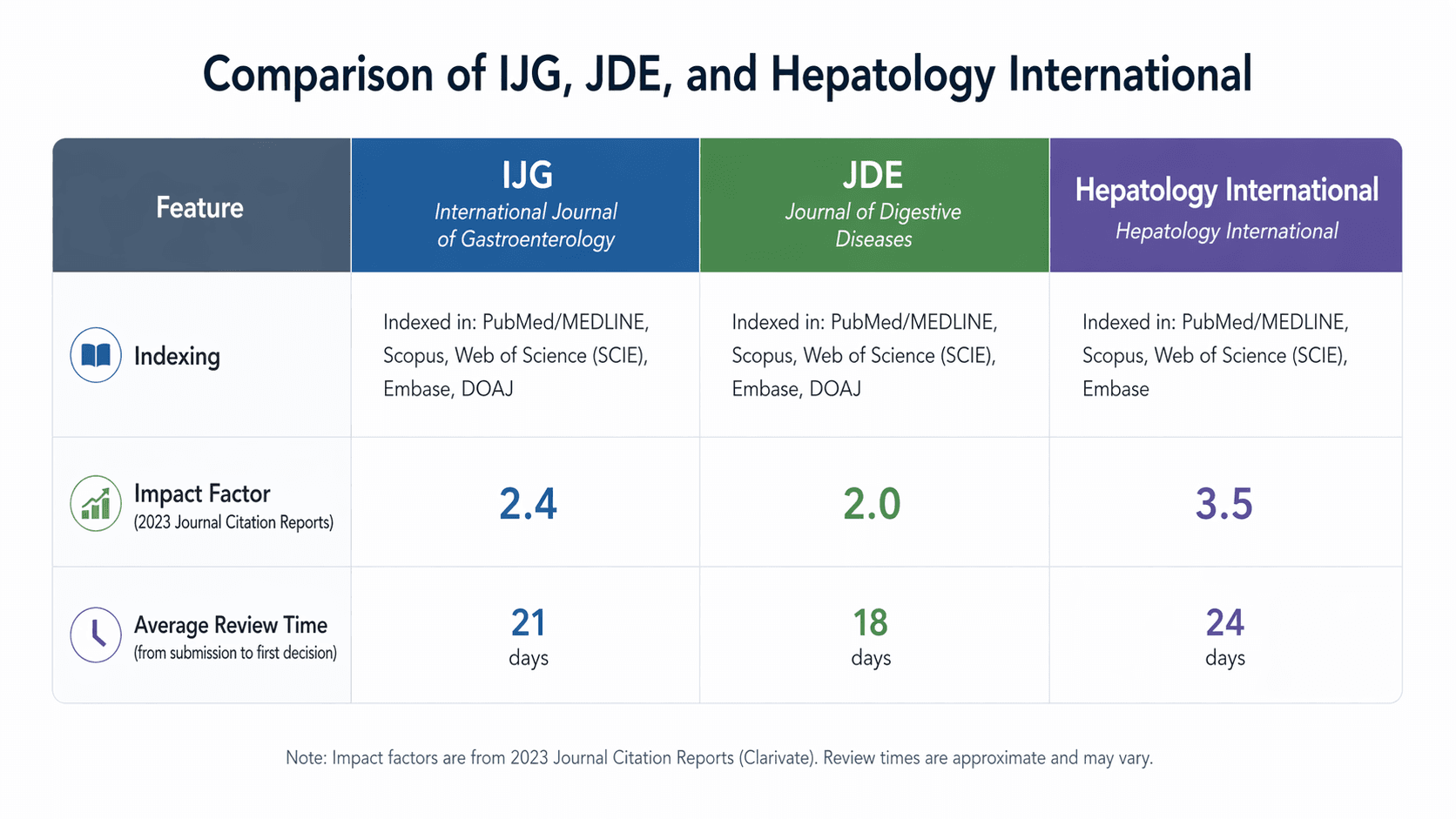
The Indian Journal of Gastroenterology (IJG) remains the flagship. Published by Springer on behalf of the Indian Society of Gastroenterology, it is PubMed-indexed, Scopus-listed, and has a reasonable impact factor for a regional specialty journal. Turnaround from submission to first decision averages 6–8 weeks. It accepts original research, case series, review articles, and correspondence - making it a viable home for everything from large multicentre RCTs to well-documented single-centre case series that carry genuine clinical learning.
The Journal of Digestive Endoscopy (JDE), the official publication of the Society of Gastrointestinal Endoscopy of India (SGEI), is the right home for procedure-focused work - novel endoscopic techniques, case reports of rare endoscopic findings, or outcomes data from Indian endoscopy units. Per current SGEI guidance, the journal prioritises submissions that reflect real-world procedural practice in resource-varied settings - which is a category where Indian data is globally underrepresented and therefore genuinely valued.
For hepatology-heavy work, Hepatology International (APASL's official journal, PubMed-indexed) and the Indian Journal of Hepatology are both relevant. Indian data on NAFLD, viral hepatitis, and ACLF is actively sought at the international level - particularly for Asia-Pacific disease burden characterisation.
Clinical Scenario: When the Journal Choice Changes the Outcome
A junior faculty gastroenterologist at a government medical college in Bhopal completed a retrospective audit of 230 patients with acute-on-chronic liver failure - comparing outcomes in those managed with standard of care versus those enrolled in early MARS therapy. The data was rigorous. The conclusion was clinically meaningful for resource-limited settings.
He submitted to a high-impact Western hepatology journal. It was desk-rejected in three weeks - not because the research was poor, but because the journal's editorial board prioritised RCTs and didn't see the global generalisability. He resubmitted to Hepatology International with a revised framing that centred the Asia-Pacific disease burden angle. It was accepted after one revision. The paper has since been cited 18 times and referenced in an APASL guideline update. Platform fit, not just paper quality, determined whether this work reached the clinicians who needed it.
Open Access Platforms and International Journals Worth Targeting for Indian GI Research
Open access has changed the calculus for Indian researchers. Cureus (a peer-reviewed open access platform indexed in PubMed and Scopus) has emerged as a fast-turnaround option for case reports and observational studies - particularly useful for residents building their first publication record. It charges an APC (Article Processing Charge), but it is transparent, peer-reviewed, and indexed. That distinction matters.
For higher-powered original research, BMC Gastroenterology and Frontiers in Gastroenterology both offer open access publishing with reasonable APCs and genuine PubMed/MEDLINE indexing. The advantage for Indian researchers is global visibility without the paywall - important when your target audience includes practitioners in lower-resource settings across South Asia who cannot access subscription-based journals.
PLOS ONE deserves mention for methodologically sound studies where the novelty is more incremental than landmark. Its review criteria centre on scientific rigour, not novelty of findings - which is actually a better fit for well-executed regional epidemiological work than journals demanding paradigm-shifting conclusions.
One frequently underused route: congress proceedings and supplementary issues. The annual ISGCON (Indian Society of Gastroenterology Conference) and ENDOCON publish abstracts and selected papers in IJG supplements. These carry indexing and provide a route to publication for preliminary or pilot data that is not yet ready for full journal submission but is clinically worth sharing.
A Frequently Overlooked Point: UGC-CARE Listing vs. Actual Indexing
Many Indian gastroenterologists - particularly those in academic positions - conflate UGC-CARE listing with scientific credibility. The UGC-CARE list was designed to curb predatory publishing in India's academic promotion system, but it is not a quality filter in the same sense as PubMed or Scopus indexing. A journal can be UGC-CARE listed and still have questionable peer review. Conversely, several genuinely high-quality international journals are not on the UGC-CARE list because they haven't applied. If you are publishing for academic promotion under Indian university rules, check UGC-CARE. If you are publishing to influence clinical practice or build a research portfolio that travels internationally, PubMed and Scopus indexing are what matter. Never sacrifice one for the other without knowing exactly what you're trading.
Bottom Line for Clinical Practice
For original GI research with an Indian or Asia-Pacific angle: Target the Indian Journal of Gastroenterology first - it is indexed, has editorial familiarity with Indian clinical contexts, and reaches the right readership.
For endoscopy-focused work: Journal of Digestive Endoscopy (SGEI) is the most appropriate first choice; it actively needs Indian procedural data.
For hepatology research, especially NAFLD, viral hepatitis, or ACLF: Frame your submission around Asia-Pacific disease burden and consider Hepatology International or Journal of Clinical and Experimental Hepatology.
For residents and fellows building a first publication record: Cureus and BMC Gastroenterology offer indexed open access with manageable turnaround and transparent peer review.
Always verify PubMed/Scopus indexing independently - do not rely on a journal's own claim on its homepage. Check NLM's PubMed journal database directly.
The next time you're sitting on a completed dataset and asking yourself where it belongs, walk GastroAGI through your study design, sample size, and clinical question - it will help you reason through platform fit, framing strategy, and what your abstract needs to say to survive desk review.

We are pioneers in clinical intelligence, dedicated to helping gastroenterologists harness the power of artificial intelligence to drive precision, efficiency, and patient growth.