
Cold vs Hot EMR for Large Colorectal Polyps: Safety, Recurrence and Patient Selection
Cold versus hot EMR for large colorectal polyps: pooled RCT data reveal a safety–recurrence trade-off and how lesion size and histology shape decisions.


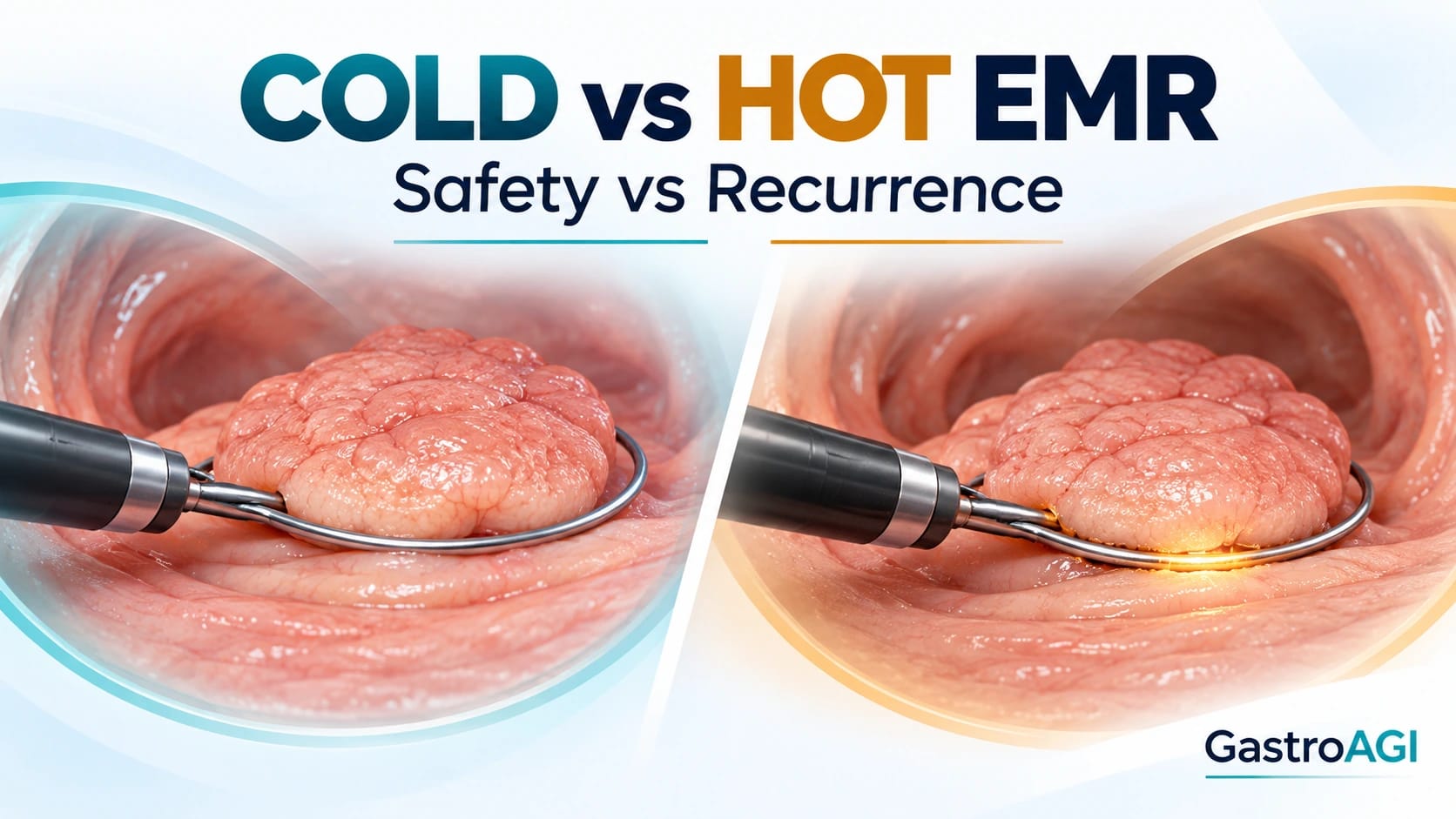
The choice that looks safer in the procedure room
A 35-mm nonpedunculated colorectal lesion appears suitable for endoscopic resection, with no features suspicious for invasive malignancy. The endoscopist must decide between cold and hot endoscopic mucosal resection (EMR).
Cold EMR offers an attractive proposition: remove the lesion without electrocautery, potentially reducing deep mural injury, perforation and delayed bleeding. Hot EMR, however, may achieve more durable eradication through a combination of tissue resection and thermal effects.
The dilemma becomes more complicated when the patient has significant comorbidity or receives antithrombotic medication. Should the immediate safety advantage of cold EMR outweigh the possibility of leaving residual neoplastic tissue?
An individual-patient-data meta-analysis published in Gut in September 2026 provides one of the most informative comparisons yet.
Pooling four randomized controlled trials involving 1,509 large colorectal polyps, the investigators demonstrated a clear trade-off: cold EMR reduced major adverse events but was associated with more than twice the rate of residual or recurrent neoplasia at early surveillance.
The findings shift attention from the safety of an individual procedure toward the durability of the entire treatment strategy.
Four randomized trials provide a clearer view of patient and lesion selection
The investigators combined individual-level data from four randomized trials conducted across 50 centres in Germany, Australia, Spain, the United States and Canada.
The analysis included 1,509 nonpedunculated colorectal polyps measuring at least 20 mm in 1,423 patients. The mean patient age was 66.1 years, and the mean lesion diameter was 31.3 mm.
A total of 762 polyps were allocated to cold EMR and 747 to hot EMR. Approximately 85% of lesions were located in the right colon.
The investigators assessed two main outcomes:
Major adverse events: Deep mural injury or perforation and/or delayed bleeding, evaluated within 14–30 days of resection.
Residual or recurrent adenoma/neoplasia: Histologically confirmed neoplastic tissue identified at the first surveillance endoscopy, generally performed 4–6 months after resection.
Follow-up endoscopic data were available for 1,315 polyps, representing 87.3% of the included lesions.
The individual-patient-data approach offered an important advantage over conventional study-level meta-analysis. It allowed investigators to examine whether lesion size, histology, morphology or location modified the comparative outcomes of the two techniques.
However, this was a post hoc pooled analysis rather than a newly randomized trial designed specifically to test each subgroup. Its strongest conclusions concern the overall safety and recurrence trade-off; subgroup observations require more cautious interpretation.
Cold EMR delivers a substantial immediate safety advantage
The most reassuring finding for cold EMR was the reduction in major procedure-related adverse events.
Major adverse events occurred in 1.7% of lesions treated with cold EMR, compared with 5.9% with hot EMR, demonstrating a substantial short-term safety advantage for the cold technique.
Clinically significant postendoscopic bleeding was also less frequent after cold EMR (1.7% vs 3.5%). Notably, no deep mural injury or perforation events were reported in the cold EMR group, whereas these complications occurred in 2.6% of hot EMR cases.
Together, these findings indicate that cold EMR offers a more favourable immediate safety profile, particularly regarding bleeding and deep mural injury.
The absolute difference in major adverse events was 4.2 percentage points in favour of cold EMR. The reported odds ratio was 0.26, with a statistically significant difference.
Importantly, cold resection remained independently associated with fewer major adverse events after adjustment for measured patient and procedural characteristics.
These findings are clinically meaningful. Delayed bleeding may require readmission, repeat endoscopy or other intervention, while deep mural injury and perforation can cause substantial morbidity.
Avoiding electrocautery plausibly contributes to the safety advantage by limiting thermal tissue damage, although this mechanism was not independently established by the pooled analysis.
The observation of no deep mural injury or perforation events in the cold EMR group is encouraging, but it should not be interpreted as proof that the technique eliminates these risks.
For patients with substantial procedural risk, the immediate safety benefit may be particularly attractive. Yet the first procedure represents only one part of the patient's treatment journey.
The surveillance scar tells a different story
At the first follow-up endoscopy, the balance changed substantially.
Residual or recurrent adenoma/neoplasia was detected in 26.5% of lesions treated with cold EMR, compared with 12.8% after hot EMR.
That represents an absolute difference of 13.7 percentage points and an adjusted odds ratio of 2.61.
In practical terms, the pooled data indicate that approximately one in four cold EMR lesions with available follow-up had residual or recurrent neoplasia at the initial surveillance examination.
This outcome deserves careful interpretation.
The endpoint combined residual and recurrent neoplastic tissue. It did not establish that each case represented a new biological recurrence after complete initial eradication. Nor did it measure subsequent colorectal cancer incidence.
Nevertheless, residual neoplasia is not simply a statistical inconvenience.
A positive surveillance scar may require another endoscopic intervention, additional histological assessment and continued surveillance. Fibrosis or scarring from the original resection can also complicate subsequent treatment.
The study did not establish how many additional procedures patients ultimately required or whether the increased early recurrence rate translated into worse long-term clinical outcomes.
Therefore, the observed recurrence disadvantage cannot automatically be converted into a measured long-term complication burden.
But it raises an essential question: should procedural safety be judged by the first resection alone, or by the complete course required to eradicate the lesion?
Lesion diameter changes the safety–efficacy calculation
One of the most clinically useful findings was the relationship between lesion size and recurrence.
The likelihood of residual or recurrent neoplasia at first surveillance increased with lesion diameter, particularly following cold EMR.
For smaller lesions measuring 20–29 mm, residual or recurrent neoplasia was identified in 16.9% after cold EMR, compared with 11.7% after hot EMR.
The difference became more pronounced in lesions measuring 30–39 mm, with recurrence rates of 27.4% for cold EMR versus 10.3% for hot EMR.
Among the largest lesions, measuring 40 mm or greater, residual or recurrent neoplasia occurred in 46.3% following cold EMR, compared with 19.1% following hot EMR.
These findings highlight an increasingly important durability disadvantage for cold EMR as lesion size increases.
Values represent residual or recurrent neoplasia at the first surveillance examination.
The recurrence difference became more pronounced with increasing diameter.
Among 20–29 mm lesions, the absolute difference was 5.2 percentage points. For lesions measuring 30–39 mm, it increased to 17.1 percentage points. In lesions at least 40 mm, the difference reached 27.2 percentage points.
Lesion diameter was the only examined subgroup characteristic that significantly modified the treatment effect on recurrence.
This makes size particularly relevant during pre-resection planning.
The authors proposed several explanations for the decreasing efficacy of cold EMR as lesions become larger. Cold resection may create smaller tissue fragments, require more individual snare passes and increase opportunities for incomplete mucosal excision. Capillary bleeding may also impair visualization, while the absence of cautery at the margin may leave microscopic residual tissue.
These mechanisms are plausible interpretations, not separately proven causal explanations in the pooled analysis.
The investigators suggested restricting consideration of cold EMR to selected lesions no larger than approximately 4 cm. However, this should not be mistaken for a prospectively validated diameter threshold.
The data instead support a more general principle: the larger the lesion, the more consequential the recurrence disadvantage may become.
Histology matters: Serrated lesions are not equivalent to adenomas
Polyp histology adds another important layer to technique selection.
The differences between cold and hot EMR varied across histological groups.
The difference in residual or recurrent neoplasia between cold and hot EMR also varied according to polyp histology.
Among sessile serrated lesions (SSLs), residual or recurrent neoplasia was observed in 15.0% following cold EMR, compared with 8.1% following hot EMR.
For conventional adenomas with low-grade dysplasia, the corresponding rates were 27.5% after cold EMR versus 12.9% after hot EMR, indicating a more pronounced difference.
The highest recurrence rates were observed in adenomas with high-grade dysplasia, where residual or recurrent neoplasia occurred in 40.8% following cold EMR, compared with 18.0% following hot EMR.
These findings suggest that the recurrence disadvantage associated with cold EMR is particularly relevant for conventional adenomas, especially those containing high-grade dysplasia.
For sessile serrated lesions (SSLs), the difference did not reach conventional statistical significance (p=0.053).
This does not demonstrate equivalence.
The SSL findings varied between studies, with one trial showing a particularly large difference in favour of hot EMR. Another trial excluded SSLs entirely. Consequently, uncertainty remains about the optimal technique for individual large serrated lesions.
Nevertheless, the authors considered cold EMR potentially appropriate for selected SSLs measuring approximately 2–4 cm, particularly in light of their generally favourable safety profile and previous nonrandomized evidence discussed in the paper.
The findings were less reassuring for conventional adenomas.
Even among adenomas with low-grade dysplasia, residual or recurrent neoplasia occurred in 27.5% after cold EMR compared with 12.9% after hot EMR.
For adenomas containing high-grade dysplasia, the corresponding rates were 40.8% and 18.0%.
The absolute recurrence gap in the high-grade dysplasia group was therefore 22.8 percentage points.
The investigators considered current evidence inadequate to support cold EMR for advanced adenomas.
This conclusion is especially relevant when evaluating large lesions in which durable eradication is a major treatment priority. It does not mean that hot EMR is automatically the correct technique for every advanced lesion, particularly when there is suspicion of invasive malignancy.
Importantly, lesions suspicious for malignancy were generally excluded from the randomized trials. The findings should not be extrapolated to the management of suspected invasive colorectal cancer.
Patients at increased bleeding risk present a more complex decision
The results become especially interesting when applied to patients receiving anticoagulant or antiplatelet treatment, or those with significant systemic illness.
Approximately 26% of participants were receiving antithrombotic medication.
Across the pooled population, clinically significant postendoscopic bleeding occurred in 6.0% of patients receiving antiplatelet or anticoagulant therapy, compared with 2.0% among those not receiving these medications.
American Society of Anesthesiologists (ASA) class III status was also independently associated with major adverse events.
These observations identify clinical circumstances in which minimizing immediate complications may carry particular importance.
The investigators suggested that cold EMR could be considered for selected patients with multimorbidity or those receiving antithrombotic therapy.
However, this should not be interpreted as evidence that cold EMR is universally preferable or sufficiently safe in these populations.
The pooled analysis did not establish a validated treatment-selection algorithm based on anticoagulant use, ASA class or other patient characteristics.
For a frail patient, avoiding a serious complication from the initial procedure may be a major priority. Conversely, a strategy associated with more frequent retreatment may create its own difficulties.
The appropriate decision remains individualized, incorporating lesion characteristics, patient risk, available expertise and the consequences of possible repeat intervention.
Could technical modifications improve cold EMR durability?
An important unresolved question is whether the recurrence disadvantage is intrinsic to cold resection or partly related to the techniques used alongside it.
In multivariable analysis, thermal margin ablation was the only procedural factor independently associated with reduced residual or recurrent neoplasia.
The reported adjusted odds ratio was 0.35.
This association is encouraging, but it does not establish that adding thermal margin ablation to cold EMR reliably eliminates the recurrence gap.
The four randomized trials differed in technical protocols, including margin treatment and prophylactic clip closure.
Clip closure was used in approximately 47.8% of hot EMR cases compared with 13.6% of cold EMR cases. Such differences complicate attribution of every observed outcome solely to the choice between cold and hot snaring.
The source also discusses base ablation as a possible approach, while noting that adding thermal treatment could theoretically reduce some of the safety benefit associated with cold resection.
These questions require prospective evaluation.
A technique combining the lower immediate injury risk of cold resection with more durable eradication would be attractive. But its benefits, procedural burden and safety would need to be demonstrated rather than assumed.
Future studies should evaluate standardized techniques, longer surveillance periods, repeated-treatment requirements and cumulative patient outcomes.
The current evidence cannot establish whether a modified cold EMR strategy would outperform optimized hot EMR.
Translating the evidence into everyday endoscopy decisions
The clinical implication is not to abandon cold resection, nor to adopt it indiscriminately for every large colorectal polyp.
Instead, the findings favour deliberate selection.
For selected benign sessile serrated lesions, particularly in patients in whom thermal injury or bleeding is a major concern, cold EMR remains a reasonable technique to consider within the boundaries of available evidence.
For large conventional adenomas, particularly those with high-grade dysplasia or increasing diameter, the higher residual or recurrent neoplasia rate deserves substantial weight.
Before choosing a technique, clinicians should consider whether the lesion has features suspicious for invasive malignancy, assess its diameter and morphology, account for the anticipated histology and evaluate patient-specific procedural risks.
The results should also encourage greater attention to completeness of resection, adjunctive techniques and the quality of scar assessment.
Patients should understand that a lower immediate complication rate does not necessarily mean a lower chance of requiring further treatment.
The study does not provide a basis for inventing new surveillance intervals or replacing existing guideline pathways. It provides evidence to inform technique selection and shared decision-making.
Most importantly, operators should avoid treating the absence of an immediate complication as the sole definition of technical success.

GastroAGI perspective: Judge EMR by safety and durable eradication
This patient-level meta-analysis offers a strong and clinically relevant signal: cold EMR is associated with fewer major short-term adverse events, but considerably more residual or recurrent neoplasia after resection of large colorectal polyps.
The evidence is particularly persuasive for conventional adenomas, with the recurrence disadvantage increasing as lesion diameter rises.
Cold EMR may retain a valuable role in carefully selected benign lesions and patients with higher procedural risk. Yet the findings do not justify routine expansion of cold EMR to large or advanced adenomas.
The practical message for endoscopists is that safer initial resection and more durable lesion eradication are different outcomes—and both matter.
The next important question is whether standardized adjunctive strategies can improve cold EMR durability without sacrificing its immediate safety advantage, and whether those gains translate into fewer procedures and better long-term outcomes.
For now, the strongest approach is selective, lesion-specific decision-making rather than a technique-wide preference.
Reference/Source
Steinbrück I, et al. Patient-level predictors of safety and recurrence after cold versus hot snare resection of large, non-pedunculated colorectal polyps: an individual patient data meta-analysis of four randomised-controlled trials. Gut. Published online 15 September 2026.
DOI: https://doi.org/10.1136/gutjnl-2026-339233
Primary article: https://gut.bmj.com/content/early/2026/09/15/gutjnl-2026-339233
Additional approved source: GI & Hepatology News, 15 October 2026. In pooled trials, cold snare EMR cut adverse events but doubled recurrence.
References

We are pioneers in clinical intelligence, dedicated to helping gastroenterologists harness the power of artificial intelligence to drive precision, efficiency, and patient growth.