
First-Line Infliximab in Pediatric Crohn’s Disease: What the 5-Year TISKids Follow-Up Means
A 5-year TISKids follow-up examines whether first-line infliximab delivers durable benefit in pediatric Crohn’s disease.


Introduction
The question of when to start biologic therapy in pediatric Crohn’s disease remains one of the most important clinical decisions in pediatric IBD care.
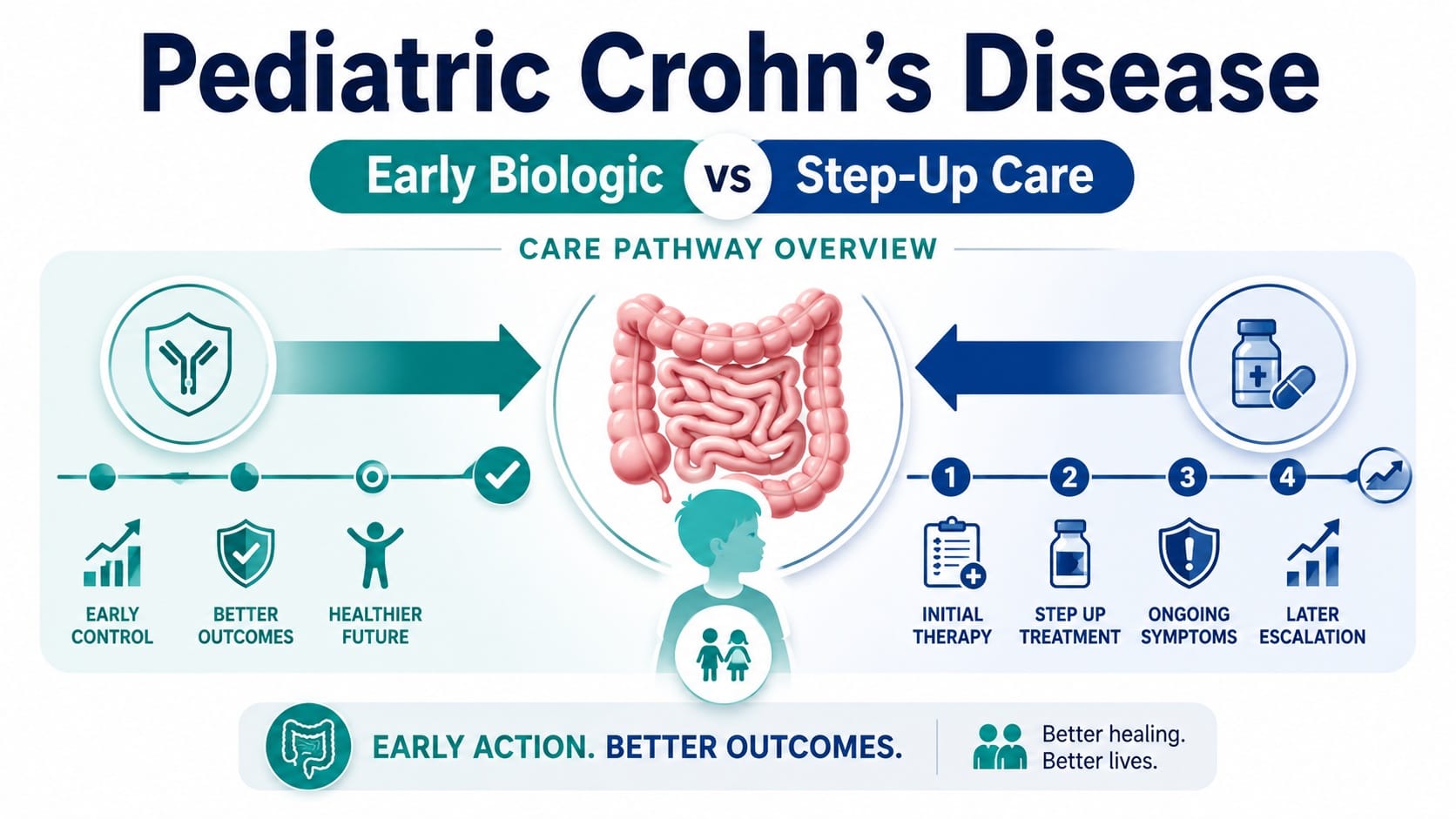
For years, many children with Crohn’s disease were treated with a conventional step-up approach: nutritional therapy or corticosteroids for induction, followed by immunomodulators, with biologics introduced later if disease activity persisted or recurred. But this strategy has increasingly been challenged by the concept of early intensive therapy, especially in children with moderate-to-severe disease or high-risk features.
A new 5-year follow-up from the TISKids trial, published in Clinical Gastroenterology and Hepatology, revisits this debate by comparing first-line infliximab with conventional therapy in pediatric Crohn’s disease. The study is titled “Randomized trial comparing 5-year follow-up of first-line infliximab to conventional therapy in paediatric Crohn’s disease.” It assessed whether the early advantage of first-line infliximab translates into sustained long-term disease control.
Why this update matters
Pediatric Crohn’s disease is not simply adult Crohn’s disease in a smaller body. Children face unique risks: impaired growth, delayed puberty, nutritional compromise, school disruption, cumulative steroid exposure, and long-term bowel damage.
The major clinical question is whether early biologic therapy can alter the disease trajectory, not just induce short-term remission.
The earlier TISKids trial had already shown that first-line infliximab was superior to conventional treatment for short-term clinical and endoscopic remission in newly diagnosed children with moderate-to-severe Crohn’s disease.
The 5-year follow-up is therefore important because it asks a more difficult question: does early infliximab produce durable benefit over years, or do most children ultimately require additional Crohn’s-related therapy regardless of the initial strategy?
What the study found
The 5-year follow-up evaluated children originally randomized in the TISKids study to either first-line infliximab or conventional therapy.
The reported primary outcome was sustained clinical remission at 5 years without additional Crohn’s disease-related therapy. According to the available abstracted data, sustained clinical remission without additional therapy occurred in 3 of 48 patients, or 6%, in the first-line infliximab group, compared with 1 of 46 patients, or 2%, in the conventional therapy group.
The key conclusion is clinically sobering: after 5 years of follow-up, almost all patients required additional Crohn’s disease-related treatment.
That does not mean first-line infliximab is ineffective. Rather, it suggests that an early induction advantage may not necessarily translate into long-term remission without further treatment modification, escalation, or maintenance strategy changes.
This distinction matters. In pediatric Crohn’s disease, the goal is not only to achieve remission quickly, but also to maintain steroid-free, growth-preserving, complication-preventing disease control over many years.
Clinical interpretation
The TISKids 5-year data should be interpreted carefully.
First, the result does not negate the value of early infliximab. The earlier randomized trial supported the short-term effectiveness of first-line infliximab in achieving clinical and endoscopic remission compared with conventional therapy.
Second, the 5-year follow-up highlights that pediatric Crohn’s disease often requires ongoing, adaptive management. A single early biologic induction strategy may not be enough to maintain long-term remission without additional therapy.
Third, the study supports a realistic conversation with families. Early biologic therapy may improve early control, but it should not be framed as a one-time disease-modifying intervention that reliably prevents the need for future treatment changes.
Fourth, the findings reinforce the importance of treat-to-target care. In children, symptoms alone are not enough. Ongoing assessment of growth, inflammatory markers, drug levels when appropriate, endoscopic or imaging healing, nutrition, and quality of life remains essential.
Practical implications for gastroenterologists
For pediatric gastroenterologists and IBD-focused clinicians, this follow-up provides several practical takeaways.
First, early infliximab remains a serious option in newly diagnosed moderate-to-severe pediatric Crohn’s disease, particularly when rapid disease control is needed or when high-risk features are present.
Second, clinicians should avoid presenting early infliximab as a guaranteed long-term solution. Families should understand that Crohn’s disease is chronic, and many children will need treatment optimization, additional therapy, or strategy changes over time.
Third, long-term maintenance planning matters. The clinical question is not only whether infliximab should be used early, but how therapy should be monitored, optimized, continued, combined, de-escalated, or switched over time.
Fourth, the study underscores the need for individualized risk stratification. Not every child with Crohn’s disease has the same disease behavior, inflammatory burden, growth risk, or likelihood of complicated disease. Early biologic therapy may be most appropriate in selected patients, rather than applied uniformly to all.
Finally, this follow-up should encourage clinicians to track meaningful long-term outcomes beyond short-term remission: growth, steroid avoidance, hospitalization, surgery, fistulizing or stricturing complications, mucosal healing, treatment persistence, safety, and patient-reported quality of life.
Limitations and caution
This is an important randomized trial follow-up, but the available headline results should not be overinterpreted.
The primary 5-year endpoint was stringent: sustained clinical remission without additional Crohn’s disease-related therapy. That is a high bar in pediatric Crohn’s disease, especially over five years.
A low rate of remission without additional therapy does not necessarily mean poor disease control overall. Some children may still have achieved good outcomes after treatment optimization, escalation, or switching. The full article should be reviewed for secondary outcomes, safety data, growth outcomes, endoscopic outcomes, surgery, hospitalization, and treatment exposure patterns.
The trial also reflects a specific treatment strategy and patient population. Real-world pediatric IBD care may differ because of biologic optimization, proactive therapeutic drug monitoring, biosimilar use, evolving targets, newer biologics, small molecules, and local practice patterns.
The safest interpretation is that first-line infliximab may offer early benefit, but long-term pediatric Crohn’s management still requires ongoing monitoring and flexible treatment adjustment.
GastroAGI takeaway
The 5-year TISKids follow-up adds an important reality check to the early biologic therapy discussion in pediatric Crohn’s disease.
First-line infliximab has demonstrated early advantages in clinical and endoscopic remission, but the 5-year follow-up suggests that sustained remission without additional Crohn’s-related therapy is uncommon.
For clinicians, the message is not “early infliximab fails.” The better message is: early biologic therapy may improve early control, but it must be embedded within a long-term treat-to-target strategy.
For families, this means hope with realism. Early therapy can be powerful, but pediatric Crohn’s disease often requires years of careful monitoring, shared decisions, and treatment adaptation.
Reference / Source
Vuijk SA, Jongsma MME, and colleagues. Randomized trial comparing 5-year follow-up of first-line infliximab to conventional therapy in paediatric Crohn’s disease. Clinical Gastroenterology and Hepatology. Article in press / available online 2026.
Key Points
The TISKids 5-year follow-up compared first-line infliximab with conventional therapy in pediatric Crohn’s disease.
The earlier TISKids trial showed better short-term clinical and endoscopic remission with first-line infliximab.
At 5 years, sustained clinical remission without additional Crohn’s-related therapy was uncommon in both groups.
Reported rates were 6% with first-line infliximab versus 2% with conventional therapy.
The findings suggest that early infliximab may provide early benefit, but most children still need ongoing therapy adjustment over time.
This supports treat-to-target pediatric IBD care rather than a one-time “top-down” intervention.
The update is clinically meaningful, but individual treatment decisions should remain risk-stratified and specialist-led.
Explore GastroAGI
If you are a gastroenterologist, trainee, researcher, or medical educator navigating journals, guidelines, conferences, and clinical questions every day, GastroAGI is built for you.
GastroAGI brings GI-focused intelligence into one structured platform — helping users learn, reason, and communicate with more clarity across Student, Clinician, and Patient modes.
Explore how specialized AI can support modern gastroenterology workflows.
Visit GastroAGI: https://gastroagi.com

We are pioneers in clinical intelligence, dedicated to helping gastroenterologists harness the power of artificial intelligence to drive precision, efficiency, and patient growth.