
Left Lateral vs Supine Positioning for EUS-Guided Portal Pressure Measurement: Does Position Matter?
A new GIE study suggests left lateral EUS-PPG gives PPG values consistent with supine positioning and may reduce coughing events.


Introduction
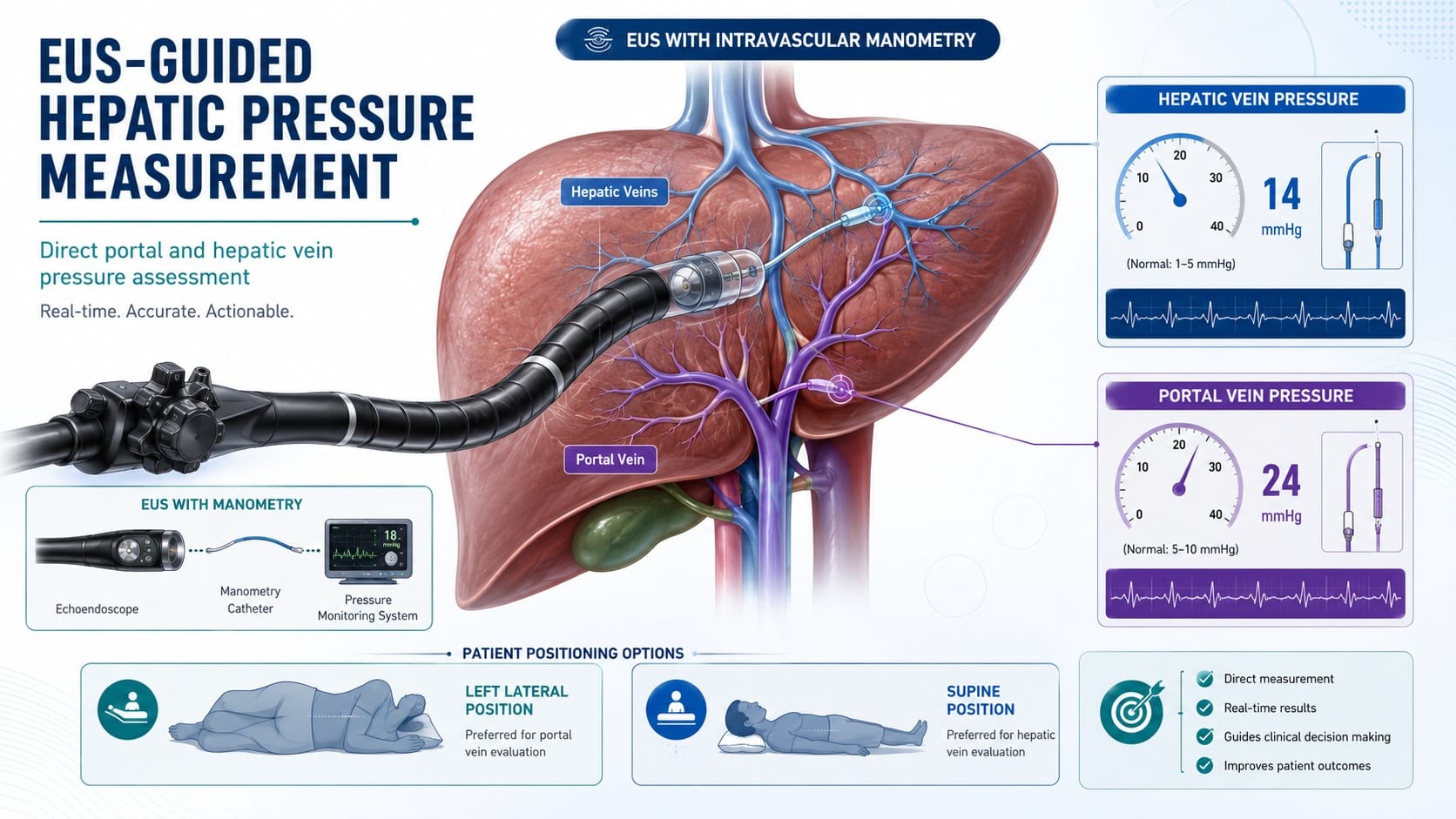
Endoscopic ultrasound-guided portal pressure gradient measurement, or EUS-PPG, is an emerging technique for evaluating portal hypertension. Instead of relying only on indirect assessment, EUS-PPG allows direct pressure measurement by accessing the portal vein and hepatic vein under EUS guidance. A recent review describes EUS-PPG as a modality in which portal pressure is measured by introducing a needle into the hepatic vein and portal vein.
Traditionally, portal pressure assessment has been dominated by hepatic venous pressure gradient, or HVPG, which remains the established reference standard for portal hypertension assessment. But as EUS-based hepatology interventions expand, the details of technique matter: patient position, sedation, needle stability, coughing, safety, and measurement reproducibility.
A new study in Gastrointestinal Endoscopy asked a practical but important question: Can EUS-PPG be performed reliably in the left lateral position, or does the patient need to be supine?
This question matters because routine EUS is commonly performed in the left lateral position, while EUS-PPG has often been performed in the supine position. If left lateral positioning produces comparable PPG values, it could simplify workflow and potentially reduce procedure-related challenges.
Why this update matters
This study is not about a new drug, device, or guideline. Its importance lies in procedural standardization.
EUS-PPG is still a developing technique. For centers that are adopting it, small technical decisions can affect safety, feasibility, training, and reproducibility. Positioning is one of those decisions. A position that improves patient stability, reduces coughing, and avoids repositioning may make the procedure easier and potentially safer.
The clinical relevance is especially clear for advanced endoscopists working at the intersection of hepatology and EUS. As EUS-guided liver biopsy, variceal therapy, portal pressure measurement, and other portal hypertension interventions evolve, procedural efficiency and consistency become increasingly important.
This study suggests that left lateral positioning may be a reasonable approach for EUS-PPG, at least in the study setting, because portal pressure gradient values were consistent with supine measurements.
What the study did
This was a prospective single-center study involving patients with portal hypertension undergoing EUS-guided portal pressure gradient measurement under moderate sedation.
The investigators measured portal vein pressure and hepatic vein pressure sequentially in both the left lateral and supine positions, without repeat puncture. Portal pressure gradient was calculated as the mean portal vein pressure minus the mean hepatic venous pressure.
The study screened 35 patients. Of these, 31 consented, and 29 completed measurements in both positions. In two patients, supine measurements could not be completed because coughing during repositioning dislodged the needle.
This detail is clinically relevant. The study was not only testing numerical agreement between two positions. It was also capturing feasibility issues that matter in real-world EUS procedures.
What the study found
The key finding was that although absolute portal vein pressure and hepatic venous pressure were lower in the left lateral position than in the supine position, the portal pressure gradient itself was similar between the two positions.
The reported PPG was 17.2 ± 7.4 mmHg in the supine position and 16.7 ± 6.9 mmHg in the left lateral position, with no statistically significant difference. PPG values showed a strong correlation between positions, with a correlation coefficient of r = 0.978, and Bland-Altman analysis showed good agreement.
The authors also reported fewer coughing events in the left lateral position. Their conclusion was that PPG measurements were consistent between left lateral and supine positioning, and that left lateral positioning under moderate sedation may improve procedural safety and convenience.
Clinical interpretation
The most important message is that the gradient appears stable even when absolute pressures change.
This makes physiologic sense. Portal pressure gradient is a difference between portal venous and hepatic venous pressures. If both pressure readings shift in the same direction with body position, the final gradient may remain clinically similar.
For endoscopists, the finding is reassuring. It suggests that EUS-PPG may not require supine positioning in every case. If left lateral positioning gives comparable PPG values, the procedure may align better with standard EUS workflow.
The coughing signal is also relevant. Coughing during an EUS-guided vascular puncture is not trivial. Needle stability matters when accessing vascular structures. In this study, coughing during repositioning led to needle dislodgement and prevented completion of supine measurements in two patients.
However, this should not be overinterpreted. The study was small, single-center, and performed under moderate sedation. It does not prove that left lateral positioning is universally safer, nor does it define the best position for all sedation strategies, patient anatomies, or disease settings.
Practical implications for gastroenterologists
For centers already performing EUS-PPG, this study supports a practical workflow question: Can the procedure be done in the left lateral position without compromising the portal pressure gradient result?
Based on this study, the answer appears to be yes, with caution.
Left lateral positioning may reduce the need for repositioning, fit more naturally into routine EUS practice, and reduce coughing events under moderate sedation. This may be particularly useful in patients who are difficult to reposition, prone to coughing, or undergoing combined EUS procedures.
For advanced endoscopy units, the study may support local protocol review. If EUS-PPG is being introduced, positioning should be standardized and documented. Units should track feasibility, adverse events, sedation type, needle dislodgement, technical success, and agreement with clinical findings.
For hepatologists, the study is a reminder that portal pressure numbers are not just abstract hemodynamic values. Technique influences measurement. As EUS-PPG becomes more available, clinicians interpreting the results should understand how the measurement was performed.
Limitations and caution
This study should be viewed as early but useful procedural evidence.
The sample size was small. Only 29 patients completed measurements in both positions. The study was conducted at a single center, which may limit generalizability. Operator expertise, sedation practices, equipment, and patient selection may differ across institutions.
The study compared positions during the same procedure without repeat puncture, which is methodologically practical but may not fully represent independent measurements on different days or across different operators.
It also does not establish whether left lateral positioning should replace supine positioning in all cases. Patients with altered anatomy, severe respiratory compromise, massive ascites, unusual vascular access windows, or deep sedation/general anesthesia may require individualized decisions.
Most importantly, this study does not change the clinical thresholds or management of portal hypertension by itself. It is about how to measure, not how to treat.
GastroAGI takeaway
This Gastrointestinal Endoscopy study addresses a deceptively simple but clinically relevant question: does patient position affect EUS-guided portal pressure gradient measurement?
The answer appears reassuring. In this prospective single-center study, left lateral and supine positioning produced consistent PPG values, while left lateral positioning was associated with fewer coughing events under moderate sedation.
For advanced endoscopists, the practical implication is that left lateral EUS-PPG may be feasible, convenient, and potentially safer in selected settings. For hepatologists, the message is to pay attention to technique when interpreting portal pressure measurements.
This is not yet a practice-changing study. But it is exactly the kind of procedural standardization research that will matter as EUS-guided hepatology continues to mature.

We are pioneers in clinical intelligence, dedicated to helping gastroenterologists harness the power of artificial intelligence to drive precision, efficiency, and patient growth.