
Sphingolipid Metabolism and KRAS in Pancreatic Cancer: A New Translational Signal
A Gut study links SMPD1-driven sphingolipid metabolism to KRAS membrane enrichment and pancreatic cancer progression.


Introduction
Pancreatic ductal adenocarcinoma remains one of the most difficult cancers in GI oncology. Despite progress in systemic therapy, surgery, molecular profiling, and supportive care, pancreatic cancer continues to be defined by late diagnosis, aggressive biology, early metastasis, and limited durable treatment responses.
One of the central biological drivers of pancreatic cancer is KRAS signaling. KRAS-mutant biology has long been recognized as fundamental to pancreatic carcinogenesis, but targeting KRAS directly has historically been challenging. The emergence of mutant-selective KRAS inhibitors has renewed interest in understanding what allows KRAS-driven tumors to survive, signal, adapt, and resist therapy.
A new Gut study adds an important mechanistic layer to this discussion. The article, titled “Dysregulated sphingolipid metabolism drives pancreatic carcinogenesis through plasma membrane Kras enrichment,” explores how altered sphingolipid metabolism may influence KRAS localization and oncogenic signaling in pancreatic ductal adenocarcinoma.
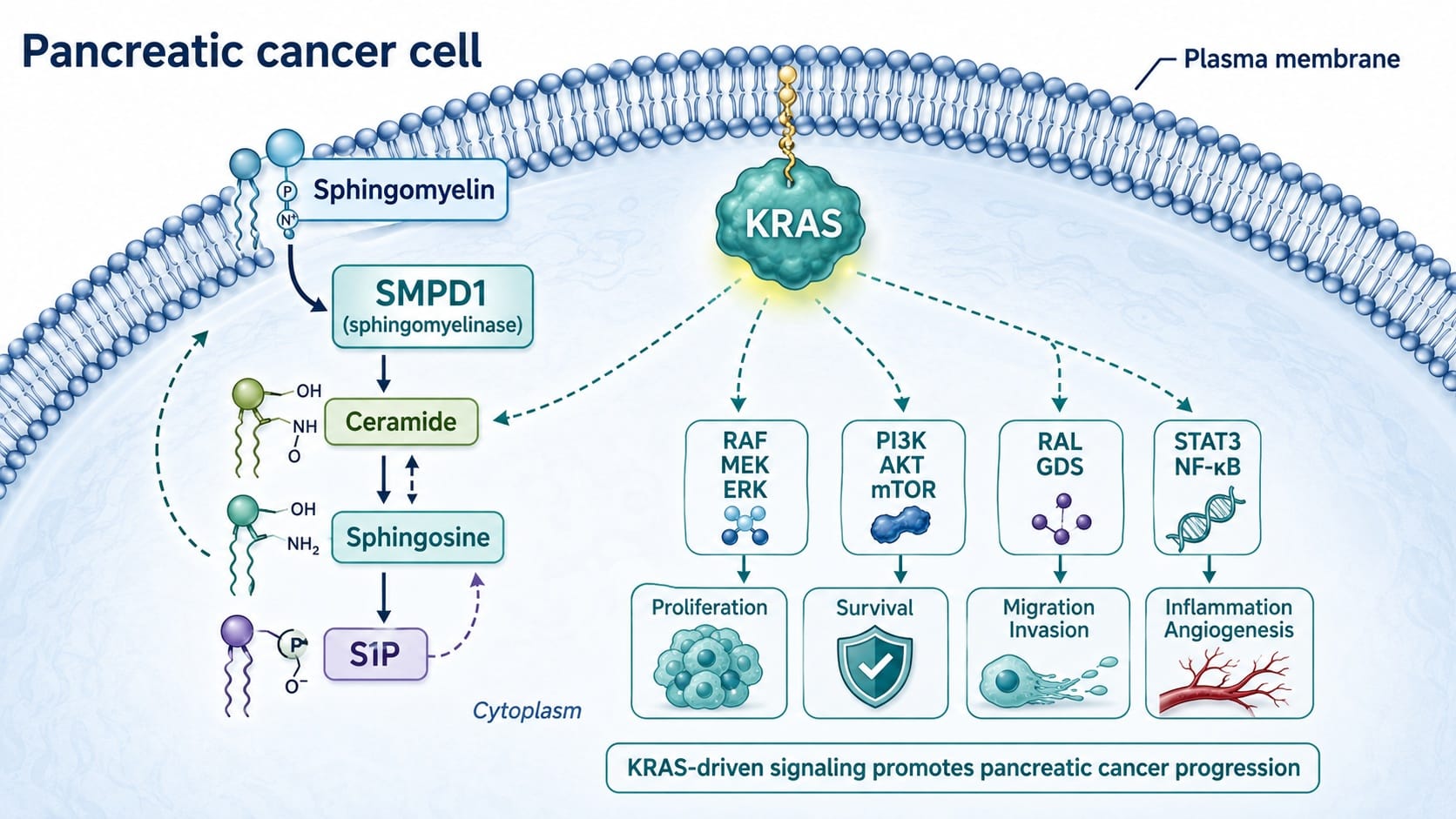
The study focuses on SMPD1, also known as acid sphingomyelinase, an enzyme involved in sphingolipid metabolism. SMPD1 converts sphingomyelin to ceramide, a lipid involved in membrane structure and signaling regulation.
For clinicians, the key point is not that SMPD1 is ready to become a therapeutic target tomorrow. The more useful takeaway is that pancreatic cancer biology may depend not only on genetic drivers such as KRAS, but also on the lipid environment that helps organize oncogenic signaling at the cell membrane.
Why this update matters
The clinical relevance of this study comes from the intersection of three major themes in pancreatic cancer research: KRAS dependency, metabolic rewiring, and treatment resistance.
KRAS signaling depends on proper cellular localization. It is not enough for a cancer cell to carry an oncogenic KRAS mutation; KRAS must also interact with the right cellular membrane compartments to transmit downstream signals. This study suggests that sphingolipid metabolism, through SMPD1-dependent changes, may support KRAS enrichment at the plasma membrane and thereby strengthen oncogenic signaling.
That is clinically interesting because it reframes lipid metabolism as more than a background metabolic feature. It may actively shape how oncogenic signaling is organized.
The study also matters because pancreatic cancer therapy is moving toward more targeted approaches. If KRAS signaling can be influenced by the lipid composition of the plasma membrane, then metabolic pathways may eventually become rational combination partners with KRAS-directed therapies. However, this remains a research concept, not a clinical recommendation.
What the study found
According to the study summary available through PubMed and Gut, tumor cell-autonomous expression of SMPD1 in pancreatic ductal adenocarcinoma was associated with poorer patient outcomes. In experimental models, Smpd1 ablation in murine PDAC cells reduced proliferation and migration in vitro and decreased metastases and tumor burden in vivo.
The investigators used integrated transcriptomic, metabolomic, and proteomic analyses. These approaches suggested that disrupting SMPD1 impaired KrasG12D oncogenic signaling, which was linked to reduced tumor burden.
Mechanistically, reduced plasma membrane interaction of KrasG12D was associated with SMPD1-dependent sphingolipid metabolism. In simpler terms, altered sphingolipid metabolism appeared to influence whether oncogenic KRAS was enriched at the plasma membrane, where it can effectively signal.
The study also reported that inhibition of Smpd1 was synergistic with KrasG12D inhibition, which is one of the most clinically intriguing parts of the work.
This does not mean that SMPD1 inhibition is ready for pancreatic cancer treatment. It does suggest that membrane lipid biology may become an important part of future KRAS-targeted combination strategies.
Clinical interpretation
For gastroenterologists, hepatopancreatobiliary specialists, GI oncologists, and researchers, this study should be read as a mechanistic signal rather than a clinical directive.
The major clinical idea is that pancreatic cancer may use lipid metabolism to support oncogenic signaling architecture. KRAS activity is not only determined by mutation status. It is also shaped by cellular context, membrane localization, metabolic dependencies, feedback pathways, and tumor microenvironment interactions.
SMPD1 is especially interesting because it connects metabolism and membrane biology. Acid sphingomyelinase converts sphingomyelin into ceramide, and this process can alter membrane properties and signal transduction.
If SMPD1 helps organize a membrane environment that favors KRAS signaling, then blocking this pathway could theoretically weaken KRAS-driven tumor behavior. The study’s finding of synergy between Smpd1 inhibition and KrasG12D inhibition makes this hypothesis more compelling, but it remains preclinical.
The clinically responsible interpretation is this:
This study identifies a potentially important KRAS-supporting mechanism in pancreatic cancer, but it does not yet establish a new treatment pathway.
Practical implications for gastroenterologists and GI oncology teams
For clinicians, this study has no immediate effect on standard pancreatic cancer management. Patients should continue to be treated according to established multidisciplinary pathways, including staging, surgical assessment, systemic therapy, radiation where appropriate, molecular profiling when indicated, nutritional support, pain control, biliary or gastric outlet obstruction management, and clinical trial consideration.
The main practical value is educational and research-oriented.
First, it provides a useful way to explain why pancreatic cancer remains biologically difficult. KRAS mutation status is important, but KRAS-driven tumors are supported by complex cellular systems, including lipid metabolism and membrane organization.
Second, it reinforces the value of translational research. Studies like this help identify vulnerabilities that may not be obvious from sequencing alone. A tumor may carry a KRAS mutation, but its dependence on membrane lipid biology could influence how strongly that pathway signals or how it responds to targeted inhibition.
Third, it supports the rationale for combination strategies. Future pancreatic cancer trials may increasingly combine direct oncogene inhibition with agents that alter signaling dependencies, metabolic state, tumor immune contexture, stromal interactions, or adaptive resistance pathways.
Fourth, it highlights why clinicians should be cautious when communicating early science. This is not evidence that a supplement, lipid-lowering strategy, dietary manipulation, or off-label SMPD1-targeting approach treats pancreatic cancer. The study is mechanistic and should remain in the research domain until clinical evidence emerges.
Limitations and caution
The most important limitation is that this is preclinical and translational work. The study includes experimental models and associations with patient outcomes, but it does not test an SMPD1-targeting therapy in pancreatic cancer patients.
Experimental ablation or inhibition in models does not automatically translate into safe or effective treatment in humans. Pancreatic cancer is highly heterogeneous, and tumor metabolism can vary across patients, disease stages, treatment exposures, and microenvironmental contexts.
Another caution is that lipid metabolism is complex. Ceramide and sphingolipid pathways can have different effects depending on cell type, subcellular compartment, timing, and disease context. A pathway that appears tumor-promoting in one setting may not behave identically in another.
The synergy with KrasG12D inhibition is scientifically important, but it should be interpreted as a rationale for further research, not as a treatment recommendation.
GastroAGI takeaway
This Gut study provides a compelling translational insight: dysregulated sphingolipid metabolism, through SMPD1, may help pancreatic cancer cells enrich oncogenic KRAS at the plasma membrane and strengthen tumor-promoting signaling.
For clinicians, the message is not to change practice today. The message is to understand where pancreatic cancer research is moving.
KRAS-targeted therapy is no longer only about blocking the mutant protein. It may also require understanding the cellular environment that allows KRAS to signal effectively. SMPD1 and sphingolipid metabolism may represent one such supportive mechanism.
The GastroAGI angle is clear:
In pancreatic cancer, the next generation of KRAS strategies may need to look beyond the mutation itself—and into the membrane biology that helps KRAS drive disease.
Key Points
A new Gut study links dysregulated sphingolipid metabolism to pancreatic carcinogenesis through plasma membrane Kras enrichment.
The study focuses on SMPD1, an acid sphingomyelinase involved in converting sphingomyelin to ceramide.
Tumor cell-autonomous SMPD1 expression in PDAC was associated with poorer patient outcomes.
Smpd1 ablation reduced proliferation and migration in vitro and decreased metastases and tumor burden in vivo.
Integrated omics suggested that SMPD1 disruption impaired KrasG12D oncogenic signaling.
Smpd1 inhibition appeared synergistic with KrasG12D inhibition in experimental models.
This is a promising translational signal, but it is not practice-changing and should not guide treatment outside research settings.
Reference / Source
Alnatsha A, et al. Dysregulated sphingolipid metabolism drives pancreatic carcinogenesis through plasma membrane Kras enrichment. Gut. Published online July 3, 2026. DOI: 10.1136/gutjnl-2025-337363.
Primary source link: Gut Online First article.
PubMed record: PubMed indexed abstract and study summary.
Optional supporting background reference, only if you want an extra mechanistic citation:
Liu J, et al. Glycolysis regulates KRAS plasma membrane localization and function through glycosphingolipid synthesis. Nature Communications. 2023.

We are pioneers in clinical intelligence, dedicated to helping gastroenterologists harness the power of artificial intelligence to drive precision, efficiency, and patient growth.