
VTE After Endoscopic Sleeve Gastroplasty: Rare Event, Important Safety Signal
A GIE study finds VTE after endoscopic sleeve gastroplasty is rare, but supports risk-based prophylaxis planning.


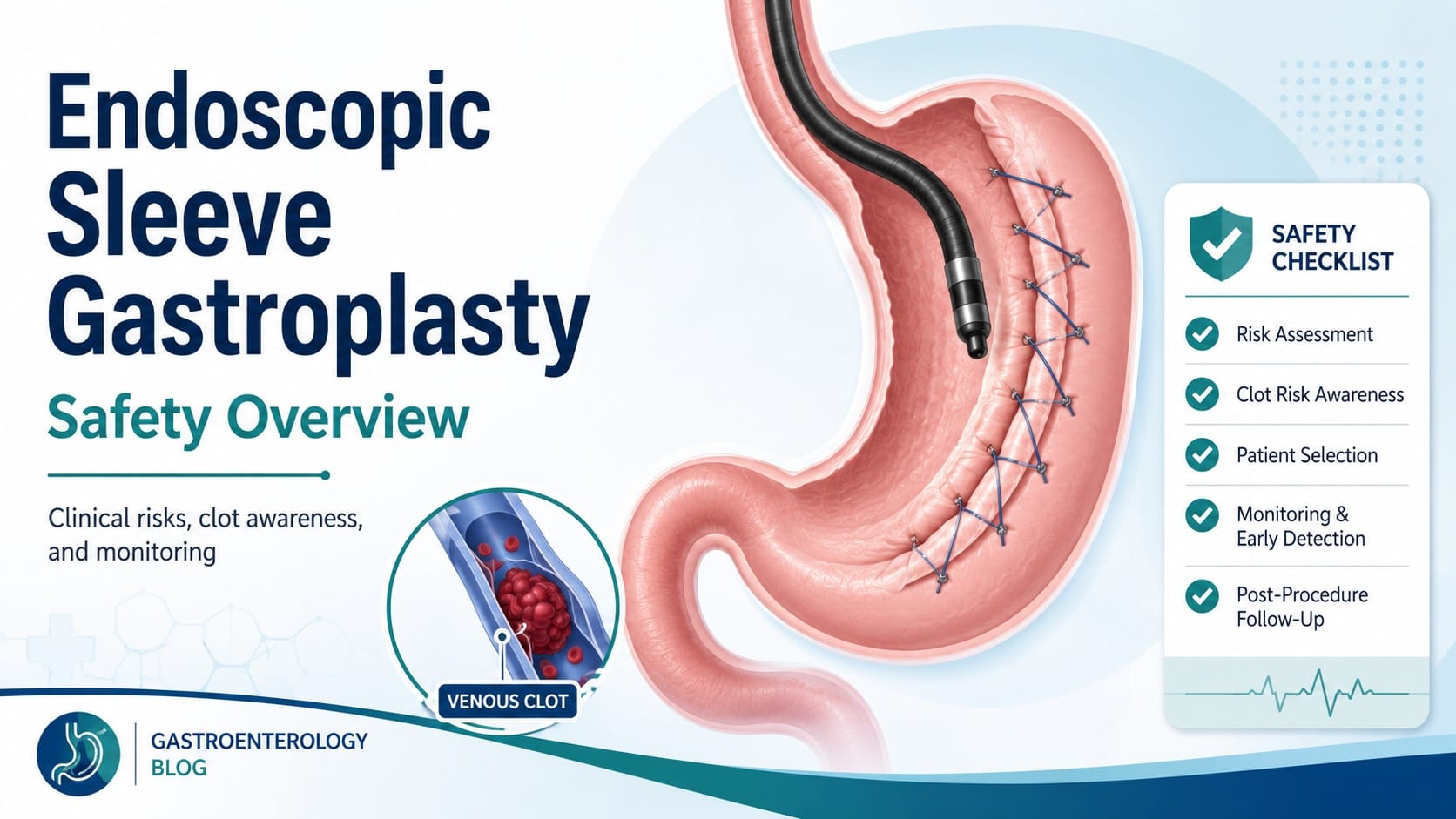
Introduction
Endoscopic sleeve gastroplasty, or ESG, is increasingly becoming part of the therapeutic landscape for patients with obesity. It offers a less invasive, incisionless option compared with surgical bariatric procedures and is now moving further into mainstream metabolic endoscopy practice.
A new article in Gastrointestinal Endoscopy addresses an important safety question: how often does venous thromboembolism occur after ESG, and what are current prophylaxis patterns?
The study, titled “Venous Thromboembolism Following Endoscopic Sleeve Gastroplasty,” was authored by Benjamin M. Moy, Rolando Barajas, Chloe Savino, and Allison R. Schulman. It was published online ahead of print in Gastrointestinal Endoscopy, with DOI 10.1016/j.gie.2026.06.065.
This is clinically relevant because ESG is expanding at the same time that obesity medicine, bariatric endoscopy, and metabolic care pathways are rapidly evolving. As more patients undergo ESG, endoscopists need practical data on uncommon but potentially serious adverse events.
Why this update matters
Venous thromboembolism, or VTE, includes deep venous thrombosis and pulmonary embolism. Even when uncommon, VTE matters because PE can be life-threatening and because obesity itself is a known risk context for thrombosis.
The study is timely because the authors note that there are currently no established guidelines specifically addressing peri-procedural VTE management after ESG.
That gap is important. ESG sits between traditional endoscopy and bariatric surgery. It is performed endoscopically, but patients often have metabolic risk factors, elevated BMI, obstructive sleep apnea, limited mobility, prior VTE history, or other comorbidities that may influence peri-procedural risk.
The broader field is also changing. The joint ASGE–ESGE guideline provides evidence-based recommendations on endoscopic bariatric and metabolic therapies in adults with obesity, and ESG has also gained increasing recognition in clinical and coding pathways.
That makes safety data increasingly important. Clinicians need to know whether VTE after ESG is common enough to justify routine prophylaxis, or rare enough that prophylaxis should remain individualized.
What the study found
The study analyzed patients who underwent ESG from 2020 to 2023 using the Metabolic and Bariatric Surgery Accreditation and Quality Improvement Program, or MBSAQIP, database. The primary outcome was 30-day post-ESG DVT and PE. Secondary outcomes included VTE prophylaxis methods and comorbid predictors.
A total of 2,371 ESG patients were included. The cohort had a mean age of 45 years, was 85.8% female, and had a mean BMI of 40 kg/m². Before ESG, 29 patients, or 1.2%, had a history of DVT, and 38 patients, or 1.6%, were on therapeutic anticoagulation.
Prophylaxis patterns varied substantially. Mechanical prophylaxis alone was used in 46.7%, pharmacologic prophylaxis alone in 0.7%, both mechanical and pharmacologic prophylaxis in 12.4%, and no prophylaxis in 40.2%.
The 30-day incidence of postoperative DVT was 0.3%, and the incidence of PE was 0.2%. Two-thirds of patients who developed VTE were not receiving prophylaxis.
The authors’ conclusion is reassuring but not dismissive: VTE after ESG appears to be extremely low in this large multicenter database, with events occurring in fewer than 0.5% of cases.
Clinical interpretation
The headline is simple: VTE after ESG is rare.
But the clinical interpretation should be more nuanced. Rare does not mean irrelevant, especially when an adverse event can be serious. The key message is not that every ESG patient needs pharmacologic prophylaxis. The better message is that ESG programs should have a clear, risk-based approach to VTE assessment.
This study supports the overall safety profile of ESG, but it also shows variation in prophylaxis practice. Nearly half of patients received mechanical prophylaxis alone, while about 40% received no prophylaxis. Pharmacologic-only prophylaxis was uncommon, and combined prophylaxis was used in a minority of patients.
That variation likely reflects real-world uncertainty. ESG is not identical to laparoscopic bariatric surgery, but it is also not a routine diagnostic endoscopy. It involves anesthesia, procedural time, obesity-related risk factors, and a post-procedure recovery period. Therefore, a one-size-fits-all approach may be inappropriate.
For low-risk patients, the very low VTE rate may argue against routine pharmacologic prophylaxis. For higher-risk patients, including those with prior VTE, marked obesity, limited mobility, thrombophilia, active cancer, estrogen exposure, prolonged procedure time, or other risk factors, more deliberate prophylaxis planning may be reasonable.
Practical implications for gastroenterologists
For endoscopists and bariatric endoscopy programs, this study should encourage structured pre-procedure planning.
First, VTE risk should be assessed before ESG. This does not necessarily require a complex protocol for every patient, but history of prior DVT or PE, anticoagulant use, BMI, mobility, smoking, hormone therapy, thrombophilia, cancer history, and obstructive sleep apnea should be reviewed.
Second, prophylaxis decisions should be documented. If mechanical prophylaxis is used, that should be clear. If pharmacologic prophylaxis is withheld, the rationale should be clear, especially in patients with risk factors.
Third, anticoagulation management should be individualized. Some patients undergoing ESG may already be on therapeutic anticoagulation. In those cases, clinicians must balance thrombotic risk against bleeding risk from the procedure.
Fourth, recovery instructions should include VTE awareness. Patients should know to seek urgent care for unilateral leg swelling, calf pain, sudden shortness of breath, chest pain, syncope, or unexplained tachycardia. This is especially important because many events occur after discharge.
Fifth, ESG programs should consider whether their existing bariatric surgery pathways, anesthesia pathways, and endoscopy pathways are aligned. ESG lives at the intersection of all three.
Limitations and caution
This study is useful, but it should not be overinterpreted.
It is an observational database analysis, not a randomized trial of prophylaxis strategies. Therefore, it cannot prove that one prophylaxis approach is superior to another. Patients who received prophylaxis may have had higher baseline risk, and patients who received no prophylaxis may have been lower risk.
The study also focuses on 30-day outcomes. Events outside that window would not be captured in the primary outcome. In addition, database studies depend on accurate coding and reporting of events.
Most importantly, the finding that VTE incidence is low should not be translated into “no prophylaxis is needed.” Instead, it should support rational risk stratification and avoidance of unnecessary anticoagulation in low-risk patients while maintaining vigilance in higher-risk groups.
GastroAGI takeaway
VTE after endoscopic sleeve gastroplasty appears to be rare, with reported 30-day DVT and PE rates of 0.3% and 0.2%, respectively.
For clinicians, the key point is not to overreact or ignore the signal. ESG remains a generally safe endoscopic bariatric procedure, but expanding procedural volume requires mature safety pathways.
The practical GastroAGI message: ESG programs should move toward risk-based VTE assessment, clear prophylaxis documentation, and patient education—rather than routine anticoagulation for everyone or no structured assessment at all.
Reference / Source
Moy BM, Barajas R, Savino C, Schulman AR. Venous Thromboembolism Following Endoscopic Sleeve Gastroplasty. Gastrointestinal Endoscopy. Published online ahead of print, 2026. DOI: 10.1016/j.gie.2026.06.065.
Key Points
VTE after ESG appears uncommon in a large multicenter database.
The study included 2,371 ESG patients from 2020–2023.
Reported 30-day DVT incidence was 0.3%, and PE incidence was 0.2%.
Prophylaxis practice varied: mechanical only, pharmacologic only, combined prophylaxis, and no prophylaxis were all represented.
Two-thirds of patients who developed VTE were not on prophylaxis.
The study supports risk-based assessment, not automatic anticoagulation for all ESG patients.
This is awareness-generating and clinically useful, but not by itself practice-changing.
Explore GastroAGI
If you are a gastroenterologist, trainee, researcher, or medical educator navigating journals, guidelines, conferences, and clinical questions every day, GastroAGI is built for you.
GastroAGI brings GI-focused intelligence into one structured platform — helping users learn, reason, and communicate with more clarity across Student, Clinician, and Patient modes.
Explore how specialized AI can support modern gastroenterology workflows.
Visit GastroAGI: https://gastroagi.com
References

We are pioneers in clinical intelligence, dedicated to helping gastroenterologists harness the power of artificial intelligence to drive precision, efficiency, and patient growth.