
(2026 Updated) Acute Pancreatitis in 2026: Predicting Severity, Timing Intervention, and Avoiding Common Pitfalls
How to predict severity, use antibiotics correctly in necrotising pancreatitis, and time intervention - updated for 2026 practice.



A 58-year-old woman is admitted with her first episode of acute pancreatitis. Gallstones are the cause. Her initial SIRS criteria are met on two counts, and her creatinine is creeping up. She looks uncomfortable but not critically ill. The question isn't whether she has pancreatitis — it's whether she's about to declare severe disease, whether you should be scanning her now, and whether she'll need a drain or an OR before this admission ends. That decision tree is what this post is built around.
Acute pancreatitis severity prediction remains one of the more underappreciated clinical skills in gastroenterology. The condition runs the gamut from a 48-hour admission with oral refeeding to a multi-week ICU course with infected necrosis and multiorgan failure. Textbooks present a clean severity spectrum; the ward presents a patient who looks well at 6 hours and crashes at 36. The 2024 ACG guidelines reinforced what experienced clinicians already know: no single score, biomarker, or imaging study predicts severity with enough precision to replace serial clinical reassessment. But used correctly, the available tools — Revised Atlanta Classification, CTSI scoring, and dynamic organ failure tracking — do sharpen decision-making considerably. Where clinicians consistently lose ground is in three places: over-relying on admission scores, misapplying antibiotic indications in necrotising pancreatitis, and misjudging the window for intervention.
Have you asked your Gastroenterology doubts to GastroAGI? It's free!
Predicting Severity: Why Admission Scores Only Get You Halfway
The Revised Atlanta Classification (RAC), endorsed by the ACG and IAP/APA guidelines, stratifies acute pancreatitis into mild, moderately severe, and severe — with persistent organ failure beyond 48 hours defining the severe category. This is not merely semantic. Patients with persistent single-organ failure carry a mortality of roughly 20–40%; those with persistent multiorgan failure approach or exceed 50% in most series. The RAC operationalises what matters: not how bad the patient looks at hour four, but whether their organ dysfunction resolves or declares itself over the first two days.
The Bedside Index of Severity in Acute Pancreatitis (BISAP) gives you a rapid five-point score at admission — BUN >25, impaired mental status, SIRS criteria ≥2, age >60, pleural effusion — and a score of ≥3 correlates meaningfully with increased mortality. It is useful for early triage decisions. APACHE II performs similarly but is cumbersome at the bedside. Neither replaces the 48-hour reassessment window that the RAC requires.
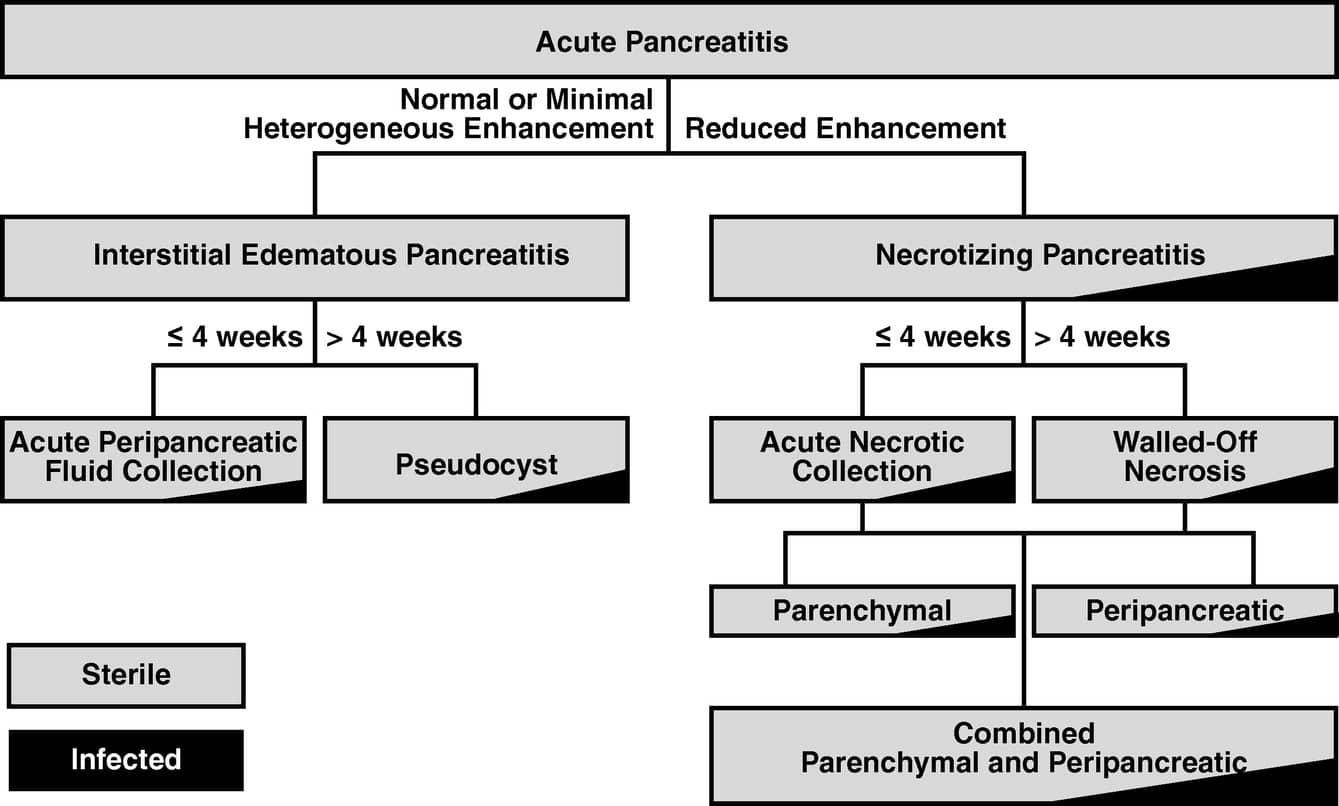
CT severity index (CTSI) enters the picture only when indicated — typically at 48–72 hours if the clinical trajectory is deteriorating and you need to characterise local complications. Per the 2024 ACG guidelines, routine early CT is not recommended; it does not change initial management and can delay fluid resuscitation. The CTSI grades necrosis extent and peripancreatic collections and correlates with morbidity, but a high CTSI score alone does not trigger intervention. What matters is whether necrosis becomes infected — and that question can only be answered later.
Case in Point
A 44-year-old male with a 15-unit/week alcohol history presented to the emergency department with epigastric pain and a lipase of 12× the upper limit of normal. BISAP score was 2. He was admitted to the ward with IV fluid resuscitation and kept nil by mouth. At 24 hours, he remained haemodynamically stable, but his creatinine had risen from 88 to 164 μmol/L and he remained oliguric despite adequate fluid input. Organ failure, however transient, had declared itself.
A contrast-enhanced CT at 48 hours revealed 50% pancreatic necrosis with extensive peripancreatic fat stranding — a CTSI of 8. He was stepped up to a high-dependency unit. Over the following five days, his renal function recovered with continued resuscitation. The key decision was restraint: no antibiotics, no drainage, no procedural intervention. The necrosis was sterile, the organ failure resolved, and he was discharged on day 14 after a step-up to oral feeding. The lesson here is that high CTSI and early organ failure do not mandate immediate intervention — they mandate close monitoring.
Antibiotics in Necrotising Pancreatitis: A Narrower Indication Than You Think
This is where the most persistent clinical error occurs. Necrotising pancreatitis, particularly in the first week, is not an infection — it is inflammation. Prophylactic antibiotics in sterile necrosis do not reduce the rate of infected necrosis, do not reduce mortality, and do increase the risk of selecting resistant organisms and fungal superinfection. The 2024 ACG guidelines make this explicit: prophylactic antibiotics are not recommended in acute pancreatitis, including the necrotising form, in the absence of confirmed or strongly suspected infection.
The indication for antibiotics in necrotising pancreatitis is infected necrosis. Clinically, this is suggested by clinical deterioration after initial improvement (the "double-hump" pattern), persistent fever beyond 7–10 days, and rising inflammatory markers after a prior plateau. CT showing gas within the necrotic collection is near-diagnostic. Fine-needle aspiration (FNA) for culture has fallen out of routine use in many centres — it carries procedural risk and false-negative rates, and clinical + radiological criteria now guide most decisions.
When antibiotics are indicated, coverage should target enteric gram-negatives and anaerobes. Carbapenems remain the most studied class with adequate pancreatic tissue penetration, though quinolones and metronidazole combinations are reasonable alternatives in non-critically ill patients. Antifungal cover should be considered early if the patient has been on prolonged antibiotics or is immunocompromised — fungal co-infection in necrotising pancreatitis carries a substantially worse prognosis and is frequently missed until it is late.
.png&w=1920&q=70)
Surgical Timing: Later Than Your Instinct Suggests
The step-up approach — percutaneous or endoscopic drainage before surgical necrosectomy — is now the established standard for infected necrotising pancreatitis, supported by the landmark PANTER trial and affirmed in the 2024 ACG and IAP/APA guidelines. Open surgical necrosectomy as a primary intervention carries mortality rates in excess of 25% in the acute setting; the step-up approach reduces that substantially, and a significant proportion of patients managed with drainage alone never require surgery.
The timing question is equally important. Where possible, intervention should be deferred until the necrotic collection has become walled-off — typically after three to four weeks from symptom onset. Walled-off necrosis (WON) is technically safer to drain, endoscopically accessible via lumen-apposing metal stents, and carries lower procedure-related morbidity than intervening on acute necrotic collections. Early surgery — before four weeks, in the absence of abdominal compartment syndrome or haemorrhage — is associated with higher mortality and should be avoided unless the clinical situation forces it.
The exception that catches clinicians: abdominal compartment syndrome (ACS) in the context of aggressive early fluid resuscitation. Intra-abdominal hypertension, defined as sustained intra-abdominal pressure >12 mmHg, and ACS (>20 mmHg with new organ failure) may require decompressive laparotomy earlier in the course — this is not a pancreatic indication, but an abdominal pressure indication, and one that is underappreciated in resuscitation-heavy ICU management.
Read more about NAFLD & MASH Treatment 2026
A Frequently Overlooked Point: The Nutritional Window
Most of the clinical attention in severe pancreatitis goes to fluids, antibiotics, and drainage decisions. The nutritional strategy receives far less focus — and delays in enteral feeding are consistently associated with worse outcomes. The gut does not rest in pancreatitis; prolonged nil by mouth accelerates bacterial translocation, increases infectious complications, and worsens the systemic inflammatory response. Per current guidelines, early enteral nutrition — via nasogastric or nasojejunal route — should be started within 24–48 hours in severe pancreatitis if tolerated, and total parenteral nutrition reserved only for those in whom enteral access genuinely cannot be established. The preference for nasojejunal over nasogastric has largely been overturned; gastric feeding is equivalent in most patients and logistically simpler.
Bottom Line for Clinical Practice
Use the Revised Atlanta Classification to anchor severity — persistent organ failure beyond 48 hours defines severe disease, regardless of how the patient looked at admission. Do not rely on BISAP or APACHE II alone.
CT is not an early reflex — obtain contrast-enhanced CT at 48–72 hours only if the clinical trajectory is deteriorating or intervention is being considered. Early CT delays resuscitation and rarely changes management.
Prophylactic antibiotics in necrotising pancreatitis are not indicated — reserve antibiotics for confirmed or strongly suspected infected necrosis, guided by clinical deterioration + imaging (gas in necrosis), not fever alone.
Defer intervention until walled-off necrosis has formed (typically ≥4 weeks), follow a step-up approach, and involve an experienced endoscopist or interventional radiologist before proceeding to surgical necrosectomy.
Start enteral nutrition within 24–48 hours in severe pancreatitis — this is not a comfort measure, it is an evidence-based intervention that reduces infectious complications and systemic inflammatory burden.
Next time you're managing a patient with necrotising pancreatitis and the team is debating antibiotics or timing the drain, walk GastroAGI through the clinical picture — severity scores, organ failure trajectory, CT findings, and nutritional status. It will return a reasoned, guideline-anchored response in seconds, calibrated to the specific decision you're facing.

We are pioneers in clinical intelligence, dedicated to helping gastroenterologists harness the power of artificial intelligence to drive precision, efficiency, and patient growth.