
ESGE Days 2026 Milan: What Every Gastroenterologist Needs to Take Back to Practice
ESGE Days 2026 in Milan delivered 40+ sessions, landmark trial data, and 3 new SIG launches. Here are the key takeaways for clinical practice.


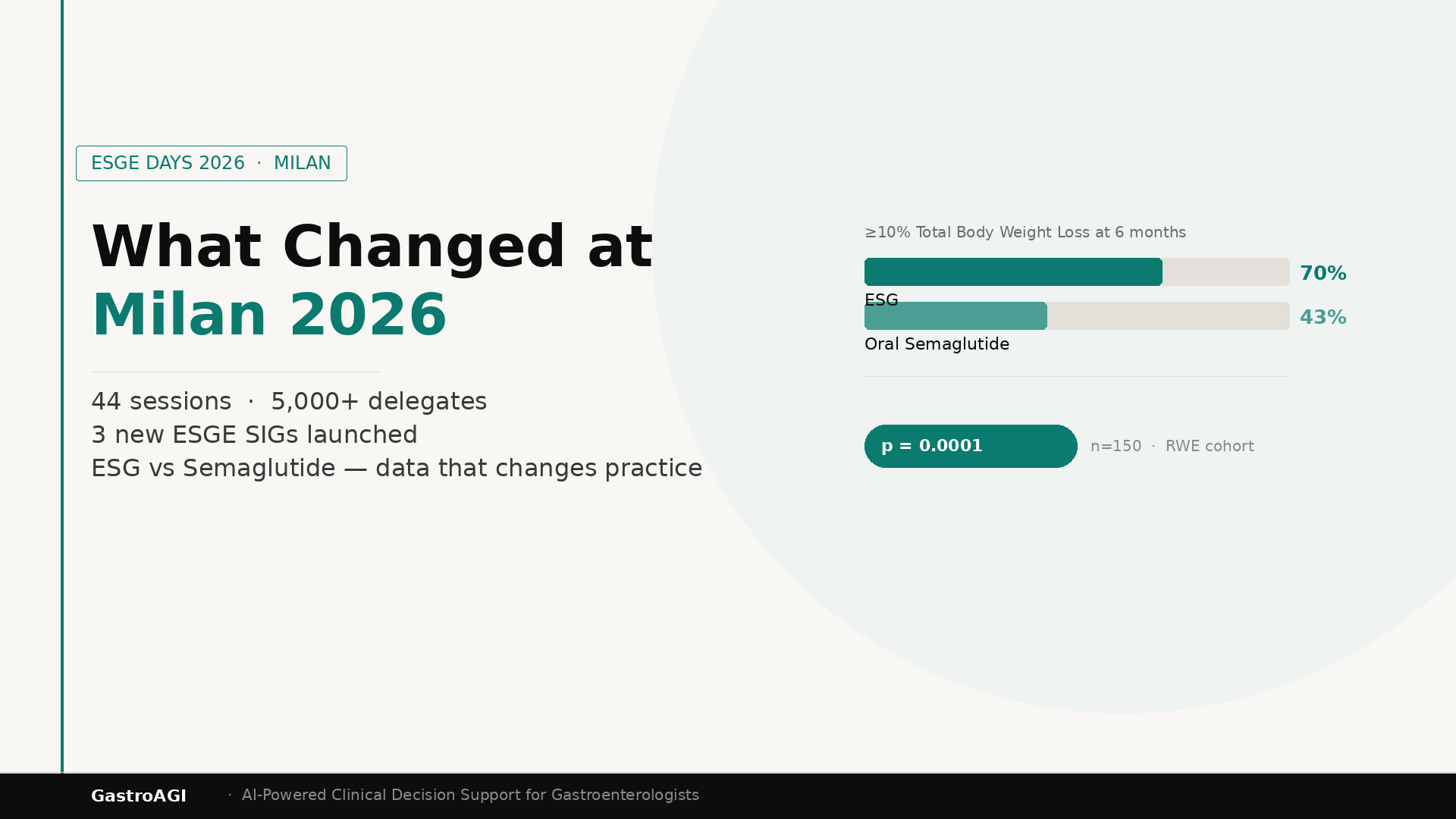
Over 5,000 endoscopists descended on Milan's Allianz MiCo Convention Centre from May 14–16 for what has become the most important GI endoscopy congress in Europe. Three days, 44 educational sessions, live endoscopy from the Humanitas University Medical School, landmark trial data, and a record-breaking abstract haul. If you weren't there - or if you were and couldn't see everything - here is the clinical substance that matters.
ESGE Days 2026 marked a turning point in several areas simultaneously: the obesity space was shaken by a head-to-head comparison between endoscopic sleeve gastroplasty and oral semaglutide, new randomised data landed for Crohn's strictures and gastroparesis, and the society formally launched three Special Interest Groups that will define the agenda for the next decade. The breadth of the scientific programme - from yoga in the endoscopy unit to robotic ERCP - reflected just how rapidly the field is evolving. Not every session changes practice immediately, but several clearly will.
The Headline Data: Bariatric Endoscopy Challenges the GLP-1 Era
The single most-discussed finding from the congress was a comparative study presented on Friday, May 15, examining endoscopic sleeve gastroplasty (ESG) versus oral semaglutide for obesity. In 150 patients from routine clinical practice, ESG produced a mean total body weight loss of 12.7% at six months versus 8.7% with 14mg oral semaglutide - a 4.0% difference that was statistically significant (p=0.0001) and remained robust across multiple sensitivity analyses.
The clinical implications extend beyond the numbers. At the 10% weight loss threshold - a marker associated with metabolic benefit - 70% of ESG patients responded versus 43% on semaglutide. At the 15% threshold, the gap widened dramatically: 36% for ESG versus just 7%. Adverse event profiles were comparable between groups, with no serious complications or mortality in either arm. Lead author Dr. Nitin Jagtap framed the data correctly: this is real-world comparative evidence, not a manufactured superiority trial. For patients asking "procedure or pill?", endoscopists now have data to anchor that conversation.
This finding directly feeds into the broader EBMT (Endoscopy Bariatric and Metabolic Treatment) sessions at the congress, which positioned endoscopic bariatric therapy alongside pharmacotherapy rather than below it in the obesity management hierarchy.
Case in Point: When the Algorithm Breaks Down
A 48-year-old woman with a BMI of 37, type 2 diabetes, and previous failed pharmacotherapy was referred for obesity management. She was already on a GLP-1 analogue for six months with modest response - 6% weight loss - and her HbA1c had improved marginally. Her hepatologist flagged concurrent metabolic-associated steatotic liver disease (MASLD). The question posed to the MDT: escalate semaglutide dose, switch agent, or refer for ESG?
The MDT opted for ESG. At six months post-procedure, her total weight loss was 14.3%, HbA1c had normalised, and liver enzyme trends had reversed. The decision rested not just on efficacy data but on the durability argument - ESG's mechanism is structural rather than appetite-dependent, and the new ESGE Days data suggests that patients who do not achieve ≥10% weight loss with GLP-1 agents may particularly benefit from an endoscopic approach. The ESGE Days data now provides the benchmarks to make that case explicitly.
Trial Data That Shifts the Management of Crohn's and Gastroparesis
Two practice-changing randomised controlled trials were featured in the ESGE Research Champions' Den - the congress's flagship research showcase, this year backed by a doubled grant pool of €50,000.
The DECISION-CD study compared endoscopic stricturotomy against balloon dilation for short Crohn's disease strictures. This matters because balloon dilation has been the default for strictures under 4–5 cm, but recurrence rates at 12 months remain substantial. The stricturotomy data presented at ESGE Days 2026 will inform whether the next iteration of ESGE Crohn's guidelines shifts that default - a topic extensively debated in the dedicated session.
The second RCT addressed one of the most contested debates in therapeutic endoscopy: G-POEM versus endoscopic balloon dilation for gastroparesis, covering idiopathic, post-surgical, and diabetic subtypes in a multicenter double-blind design. G-POEM has been gaining ground for refractory gastroparesis, and the randomised comparison data presented here will likely settle the head-to-head question that observational series never could.
Both studies were presented alongside ESGE guideline sessions covering the same topics - a deliberate programme design that positioned trial data immediately within its clinical application framework.
What Clinicians Commonly Underestimate: The Structural Shifts at This Congress
The single most underreported story from ESGE Days 2026 is not a study - it's three launches. ESGE formally inaugurated Special Interest Groups (SIGs) in ESD, HPB Endoscopy, and Bariatric Endoscopy. These are not just networking forums; they are long-term collaborative structures that will generate ESGE position statements, training curricula, and quality benchmarks in subspecialty areas that have until now developed somewhat independently of central ESGE oversight. For endoscopists working in these areas, SIG membership in the coming year will be worth more than most CME activities - because it directly shapes the guidelines you will one day be asked to implement.
The congress also premiered a new Multidisciplinary Team session format covering HPB oncology and colorectal neoplasia - a deliberate acknowledgment that endoscopic decision-making increasingly happens within MDT frameworks rather than in the endoscopy suite in isolation.
Bottom Line for Clinical Practice
ESG outperforms oral semaglutide at 6 months (12.7% vs 8.7% weight loss; 70% vs 43% achieving ≥10% loss) - this data supports positioning ESG as a first-line structural option rather than a fallback after pharmacotherapy failure.
DECISION-CD and the G-POEM RCT are the two studies most likely to influence ESGE Crohn's and gastroparesis guidelines in the next 12–18 months - track the full publications in Endoscopy journal.
Three new ESGE SIGs (ESD, HPB, Bariatric Endoscopy) launched at Milan - engagement now positions you at the frontier before these groups produce their first formal guidance documents.
The Best Abstract Award went to six authors spanning Barrett's oesophagus (PREFER study low LNM recurrence data), post-ERCP pancreatitis prevention (FLUYT-2), and post-colonoscopy CRC detection - all three are worth a full read.
Record abstract submissions and a fully sold-out hands-on training programme confirm ESGE Days' status as Europe's premier endoscopy meeting - abstracts will be published in Endoscopy (IF 12.8) and are available on-demand until July 31, 2026.
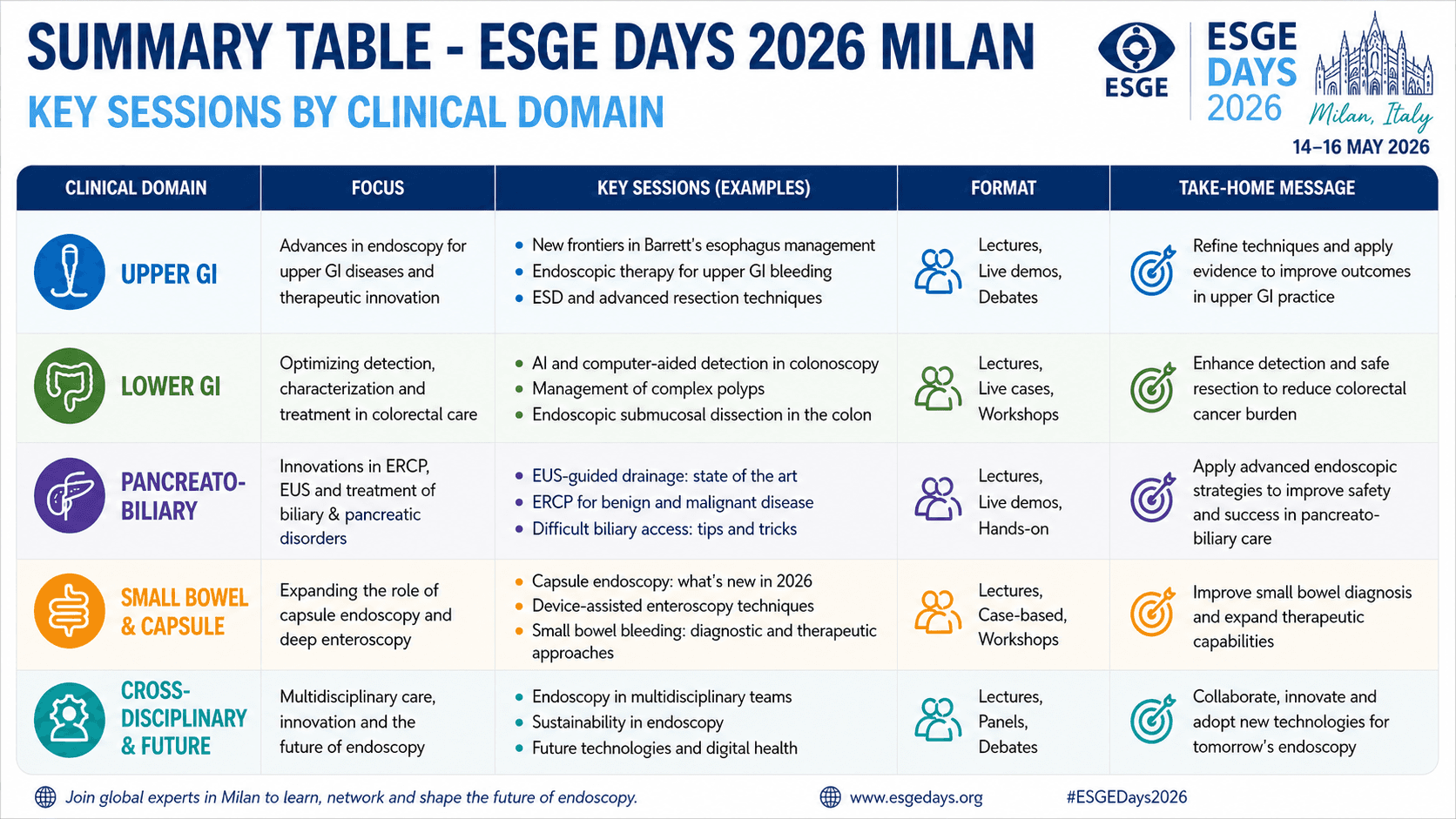
ESGE Days comes once a year. The data presented in Milan this week will take 12–18 months to filter into guidelines and curricula. GastroAGI tracks all of it in real time - next time a Crohn's stricture or a bariatric referral lands on your list, run the case through GastroAGI for a guideline-anchored, up-to-date clinical response.
Also read: DDW 2026 Highlights: Day-by-Day Conference Insights for Gastroenterologists
People also read: APASL 2026 Istanbul: Key Clinical Takeaways Every Hepatologist Needs to Know

We are pioneers in clinical intelligence, dedicated to helping gastroenterologists harness the power of artificial intelligence to drive precision, efficiency, and patient growth.