
Spontaneous Bacterial Peritonitis in Cirrhosis: PMN Threshold, Antibiotic Selection, and Prophylaxis Protocol
PMN threshold, empirical antibiotics, albumin indications, and primary vs secondary SBP prophylaxis - a clinical decision-tree guide for cirrhosis.


A 58-year-old man with Child-Pugh C alcoholic cirrhosis presents with low-grade fever, mild abdominal tenderness, and worsening encephalopathy. His ascites is long-standing, his last tap was six weeks ago, and his creatinine has crept up over 48 hours. Every finding points somewhere - and one of those somewhere-s is SBP. The clinical decision at this moment is not whether he has it. It's whether you are treating it fast enough.
Spontaneous bacterial peritonitis diagnosis treatment decisions in cirrhosis carry a weight that the textbook PMN count does not fully convey. A 10–30% in-hospital mortality, a 70% one-year mortality without prophylaxis, and a risk of hepatorenal syndrome that rises sharply with delayed albumin - these are the stakes. Guidelines from EASL (2018) and AASLD are reasonably aligned on the core protocol, but the places clinicians go wrong are rarely the big decisions. They are the threshold edges, the albumin indications, and the distinction between primary and secondary prophylaxis.
The PMN Threshold That Defines the Diagnosis and Starts the Clock
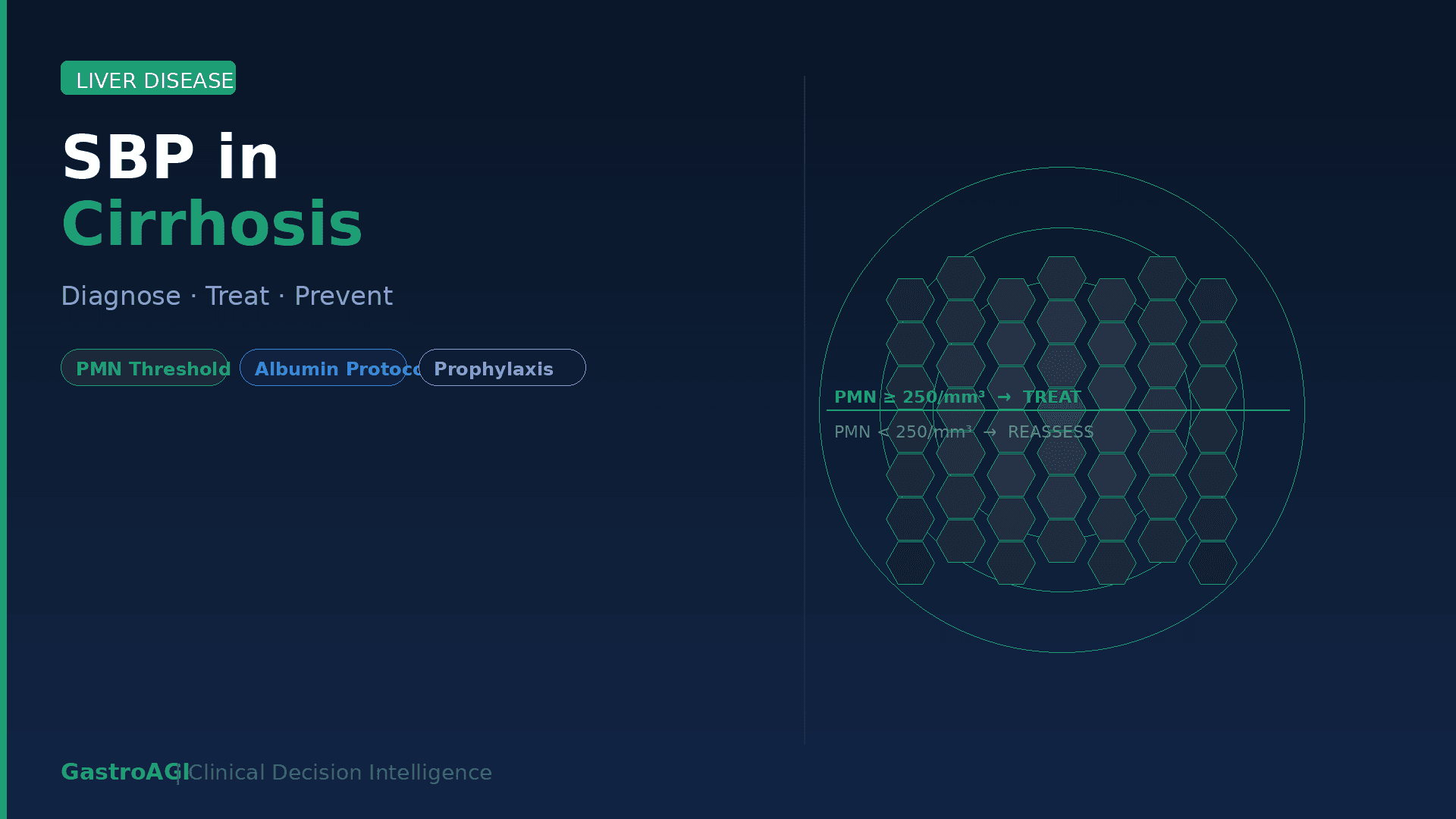
The diagnostic standard remains straightforward: a polymorphonuclear leukocyte count ≥ 250 cells/mm³ in ascitic fluid is sufficient to diagnose SBP and initiate empirical antibiotics - you do not wait for culture results. Cultures are important for de-escalation and resistance tracking, but they are positive in only 40–50% of SBP episodes. A negative culture with a PMN count above threshold is still SBP.
The PMN count is calculated directly: total white cell count × percentage of neutrophils on the ascitic differential. If the fluid is blood-tinged (common after traumatic taps), a correction factor applies - subtract 1 neutrophil for every 250 red blood cells. Skip this correction and you will over-diagnose SBP in bloody taps, or, more dangerously, fail to flag a real infection as clinically significant.
For patients who present with clinical features of infection but a PMN count between 250 and 500 - where laboratory error is plausible - a 12–24 hour repeat tap is reasonable if culture is pending and the patient is not deteriorating. In any hemodynamically unstable patient, do not wait for a second tap. Treat empirically. The cost of undertreating proven SBP far exceeds the cost of a short antibiotic course in someone who turns out to have culture-negative neutrocytic ascites (CNNA), which, per EASL guidelines, is managed identically to culture-positive SBP anyway.
Clinical scenario
A 49-year-old woman with NASH cirrhosis is admitted with two days of diffuse abdominal discomfort, low-grade fever (37.9°C), and a rise in creatinine from 0.9 to 1.4 mg/dL. She has no history of prior SBP. Diagnostic paracentesis returns a PMN count of 480/mm³. Ascitic protein is 1.1 g/dL. Bilirubin is 5.2 mg/dL.
She was started immediately on cefotaxime 2g IV every 8 hours and - critically - albumin 1.5 g/kg on day 1, with 1 g/kg planned for day 3, based on her bilirubin exceeding 4 mg/dL and her rising creatinine. A repeat paracentesis at 48 hours showed a PMN count of 190/mm³ - a greater than 25% reduction - confirming treatment response. She completed a 5-day course, was discharged on norfloxacin 400 mg daily as secondary prophylaxis, and was referred for transplant evaluation.
.png&w=1920&q=70)
Empirical Antibiotics and the Albumin Decision You Cannot Afford to Miss
Antibiotic selection follows a community-versus-healthcare-associated split that has become increasingly important as quinolone-resistant and ESBL-producing organisms are isolated more frequently from cirrhotic patients on long-term norfloxacin prophylaxis.
For community-acquired SBP with no prior quinolone exposure, cefotaxime 2g IV every 8 hours for 5 days remains the EASL-preferred regimen - it covers the gram-negative enteric organisms responsible for most cases (E. coli, Klebsiella, Streptococcus species) without unnecessary broad-spectrum pressure. Ceftriaxone 1g IV daily is an acceptable alternative with equivalent efficacy and simpler dosing.
For nosocomial SBP or healthcare-associated SBP in units with documented MDRO prevalence, the threshold to escalate to piperacillin-tazobactam or a carbapenem should be low. Per EASL 2018, local microbiological patterns should drive this choice - a unit where 30% of SBP isolates are ESBL-positive cannot safely default to third-generation cephalosporins. Culture results at 48–72 hours allow de-escalation.
The albumin decision is frequently delayed or omitted, and the evidence here is not subtle. The landmark Sort et al. trial (NEJM 1999) established that IV albumin at 1.5 g/kg on day 1 followed by 1 g/kg on day 3 reduced rates of hepatorenal syndrome from 33% to 10% and hospital mortality from 29% to 10% in patients meeting any of three criteria: serum creatinine > 1 mg/dL, BUN > 30 mg/dL, or total bilirubin > 4 mg/dL. These thresholds define the indication - patients who do not meet any criterion have a low enough baseline risk of HRS that albumin confers no significant mortality benefit.
A Frequently Overlooked Point: Primary vs. Secondary Prophylaxis Are Not Interchangeable Decisions
The most common clinical mistake around SBP prophylaxis is treating it as a binary - either the patient is on prophylaxis or they are not. The indication for primary prophylaxis is specific: a patient who has never had SBP but has ascitic protein below 1.5 g/dL and either a Child-Pugh score ≥ 9 with bilirubin ≥ 3, serum creatinine ≥ 1.2 mg/dL, BUN ≥ 25 mg/dL, or serum sodium ≤ 130 mEq/L. Norfloxacin 400 mg/day fulfils this indication. Secondary prophylaxis after a documented SBP episode is lifelong - the 1-year recurrence rate without it approaches 70%. What gets missed is the transition: patients who survive an index SBP episode and are not started on prophylaxis at discharge. That gap is where the second episode - often more severe - occurs. If norfloxacin is unavailable, ciprofloxacin 500 mg/day is the accepted alternative, though the evidence base is comparatively thinner.
Bottom line for clinical practice
Treat at PMN ≥ 250/mm³ - do not wait for culture results. Culture-negative neutrocytic ascites is managed identically to culture-positive SBP.
Start albumin at the time of antibiotics, not as an afterthought - it is indicated whenever creatinine exceeds 1 mg/dL, BUN exceeds 30, or bilirubin exceeds 4 mg/dL. The window for preventing HRS is narrow.
In units with high MDRO prevalence or in healthcare-associated SBP, default to pip-tazo or carbapenem upfront - do not wait to see if cefotaxime fails.
Confirm treatment response with a 48-hour repeat paracentesis - a PMN reduction < 25% from baseline signals non-response and should prompt antibiotic escalation and secondary cause evaluation.
Initiate secondary prophylaxis at discharge after every SBP episode without exception; audit your unit's discharge prescribing - this is a consistently documented gap in real-world practice.
When you are managing SBP in a patient who is also deteriorating with worsening renal function or encephalopathy, having a reasoning partner matters. Walk GastroAGI through the clinical picture - PMN count, albumin indication, prophylaxis history - and get a guideline-anchored assessment in seconds.
Read Next: NAFLD & MASH Treatment 2026: Resmetirom, Lifestyle & Right Therapy Sequencing
Loved by our readers: Acute Pancreatitis in 2026

We are pioneers in clinical intelligence, dedicated to helping gastroenterologists harness the power of artificial intelligence to drive precision, efficiency, and patient growth.