


Rockall vs AIMS65 vs Glasgow-Blatchford: Which Score to Use for Upper GI Bleeding Risk Stratification in 2026
Published on 24/04/2026
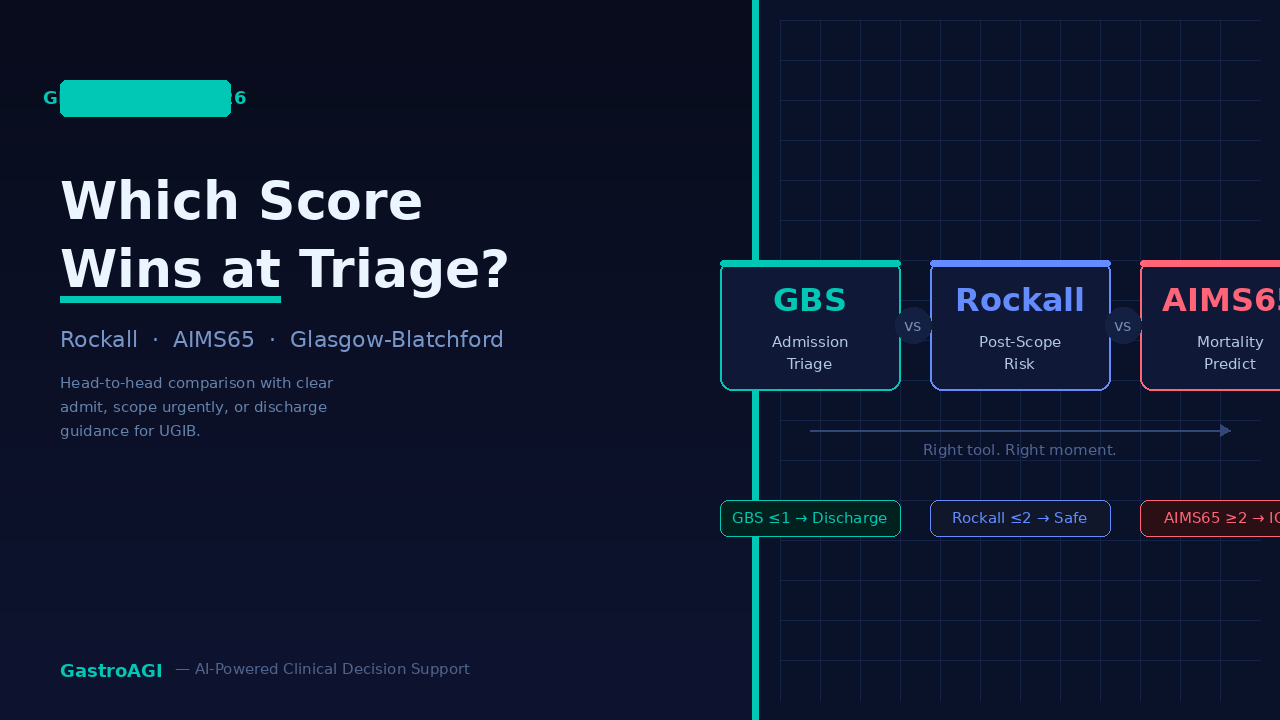
Rockall, AIMS65, or Glasgow-Blatchford - which score to use for UGIB in 2026? A head-to-head breakdown with clear admit, scope urgently, or discharge guidance.
A 58-year-old man walks into the ED at 11 PM with two episodes of hematemesis, a heart rate of 104, and a haemoglobin of 9.2. He's on low-dose aspirin. His BP is 98/64. The emergency physician wants to know: can he go to the ward, or does he need scoping tonight? You reach for a scoring system - and then pause, because you have three to choose from. This post tells you exactly which one to use, and when.
The problem with upper GI bleeding risk stratification scoring is not a lack of tools - it is too many tools, with overlapping purposes that guidelines fail to clearly delineate. The Glasgow-Blatchford Score (GBS), Rockall Score, and AIMS65 are all validated, all widely used, and all different enough that deploying the wrong one at the wrong decision point can lead to either over-admission or undertriage. A 2020 Lancet study showed that GBS identified low-risk patients eligible for outpatient management with significantly higher sensitivity than Rockall in pre-endoscopy assessment, a distinction that still gets collapsed in everyday practice. Understanding what each score was built for - and where its discriminatory power actually sits - is the clinical skill this post addresses.
Glasgow-Blatchford Score: The Right Tool for the Admission Decision
The Glasgow-Blatchford Score was designed for one question: does this patient need hospital-based intervention at all? It uses entirely pre-endoscopic variables - blood urea nitrogen, haemoglobin, systolic BP, heart rate, presence of melaena, syncope, hepatic disease, and cardiac failure. No endoscopy required. No pathology report. Just bedside data.
A GBS of 0 identifies patients at very low risk of requiring transfusion, endoscopic intervention, or surgery. Multiple validation cohorts, including the BSG 2024 guidelines on acute upper GI bleeding, support using GBS ≤1 as a threshold for consideration of early discharge and outpatient endoscopy. In some centres, a GBS of 0 is sufficient to discharge from the ED without admission.
This is where GBS outperforms the others: at the front door. Its sensitivity for predicting need for intervention is superior to Rockall in the pre-endoscopy phase. The tradeoff is specificity - GBS over-admits. A score of 7 does not tell you the bleed is from a Forrest Ia ulcer. It tells you this patient should not be sent home. For the admission-or-not decision, that is exactly what you need.
Clinical use: Apply GBS at first contact, before scoping, to determine: admit vs discharge, urgency of inpatient monitoring, and need for urgent vs elective endoscopy referral.
Clinical Scenario
A 34-year-old woman presents with melaena and pre-syncope. No prior GI history, no NSAID use, no liver disease. BP 112/70, HR 96. Haemoglobin 11.1, urea 9.2 mmol/L. No haematemesis. Examination is unremarkable apart from mild epigastric tenderness.
Her GBS is 5. She is admitted for endoscopy the following morning. Upper endoscopy reveals a small duodenal ulcer with a clean base - Forrest IIc. No active bleeding, no visible vessel. Her post-endoscopy Rockall Score is 2. She is risk-stratified as low risk for rebleeding, started on oral PPI, and discharged the same day with a H. pylori test pending. The GBS got her in the door appropriately; the Rockall Score confirmed she was safe to leave.
Rockall Score: Use It After Endoscopy, Not Before
The original Rockall Score (1996) combines pre-endoscopic variables - age, haemodynamic status, comorbidity - with endoscopic findings (diagnosis and stigmata of recent haemorrhage). Its purpose is rebleeding and mortality prediction, not admission triage. A complete Rockall requires you to have scoped the patient. Using the pre-endoscopic Rockall alone - as some departments do - throws away its most discriminating component.
Post-endoscopy Rockall ≤2 identifies patients at low risk of rebleeding and death. Rockall ≥5 signals elevated risk and should prompt consideration of intensive monitoring, repeat endoscopy planning, and in selected cases, interventional radiology or surgical standby.
Where Rockall earns its place is in the post-scope conversation: who goes to a high-dependency setting, who gets a 72-hour admit, and who can be safely discharged after endoscopy. For variceal bleeding, Rockall is less discriminating - it was validated primarily in non-variceal UGIB. For that population, condition-specific scores (Child-Pugh, MELD) take precedence.

A Frequently Overlooked Point: AIMS65 Is a Mortality Score, Not a Triage Tool
AIMS65 - Albumin <30 g/L, INR >1.5, altered Mental status, Systolic BP <90, Age >65 - is consistently misused in UGIB triage as if it were interchangeable with GBS. It is not. AIMS65 was derived and validated for in-hospital mortality prediction in patients already admitted. Its discriminatory power for identifying who needs intervention before endoscopy is inferior to GBS. A patient with AIMS65 of 0 can still have active variceal bleeding requiring immediate endoscopy. Using AIMS65 to decide who gets admitted will lead you to undertriage haemodynamically stable patients with high-risk lesions. Use AIMS65 where it belongs: to predict which admitted patients are at highest mortality risk and may benefit from ICU-level monitoring, early palliative input, or aggressive resuscitation planning.
Bottom Line for Clinical Practice
GBS ≤1: Strong evidence supports safe discharge from ED or outpatient endoscopy - apply this confidently at triage.
GBS ≥7 with active haematemesis or haemodynamic instability: Admit to a monitored bed, ensure IV access and crossmatch, target endoscopy within 12–24 hours per BSG 2024 guidance.
Complete Rockall Score ≤2 post-endoscopy: Low risk of rebleeding - use this to drive discharge decisions after scoping, not before.
AIMS65 ≥2: Flag for elevated in-hospital mortality risk - escalate monitoring, involve seniors early, and reconsider the ceiling of care in frail or elderly patients.
Do not use pre-endoscopic Rockall alone: It omits the endoscopic variables that give the score its predictive weight. If you haven't scoped, use GBS.
The next time a patient with haematemesis lands in front of you at 2 AM, walk the clinical details through GastroAGI - it will apply the right score at the right decision point and return a reasoned, guideline-anchored triage recommendation in seconds. No searching, no second-guessing.
Read Next: Gut Microbiome Research in India
Our readers loved: NAFLD & MASH Treatment 2026