
2026 ESGE–ESGENA Sedation Guideline for GI Endoscopy: Practical Lessons for Safer Clinical Practice
A practical, clinician-led interpretation of the 2026 ESGE–ESGENA guideline on sedation for gastrointestinal endoscopy, patient safety, monitoring, recovery, and endoscopy-unit practice.


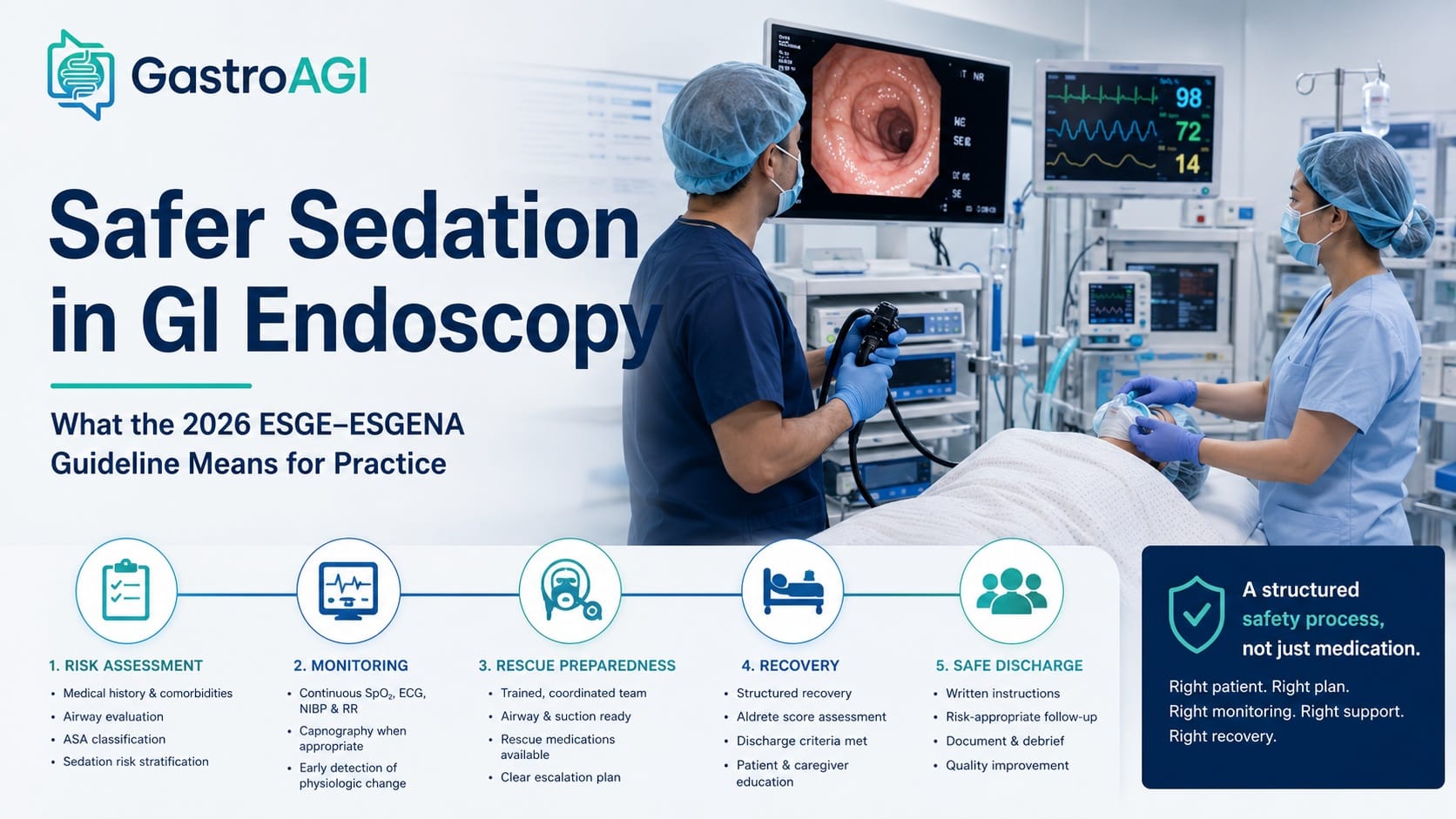
After 25 years in gastroenterology, I have learned that the word routine deserves cautious handling.
A routine colonoscopy may suddenly become technically difficult. A routine upper gastrointestinal endoscopy may encounter an unexpected bleeding lesion. A patient who looked perfectly comfortable in the assessment area may become hypoxic shortly after sedation begins.
Sedation itself is often described as routine. In practice, it is anything but trivial.
When sedation works well, almost nobody notices it. The patient is comfortable, the endoscopist can concentrate, the nursing team remains calm, and recovery proceeds without incident. When sedation is poorly planned, however, it can dominate the entire procedure.
The newly published “Sedation for gastrointestinal endoscopy: ESGE and ESGENA Guideline” places this familiar but safety-critical part of endoscopy back where it belongs: at the centre of procedural planning.
The guideline was published online on July 21, 2026, in Endoscopy by the European Society of Gastrointestinal Endoscopy (ESGE) and the European Society of Gastroenterology and Endoscopy Nurses and Associates (ESGENA). Its DOI is 10.1055/a-2898-6540.
This is a professional society guideline rather than a clinical trial. There is no randomized treatment arm, comparator group, predefined patient population, or single outcome measure. Instead, the document is intended to guide the safe organization and delivery of sedation across gastrointestinal endoscopy services.
That distinction matters. Guidelines rarely provide the dramatic headline of a positive randomized trial. Their value is quieter but often broader: they help clinicians examine whether everyday practice is as safe, consistent, and defensible as it should be.
The sedative is only one part of sedation safety
When discussing endoscopy sedation, conversations frequently begin with the drug.
Which agent should be used? How much should be given? Who should administer it?
These are important questions, but they are not the whole story.
Sedation safety begins before the medication is drawn up and continues long after the endoscope has been removed. It includes:
Pre-procedure risk assessment
Patient selection
Informed consent
Procedure-specific planning
Appropriate staffing
Physiological monitoring
Airway preparedness
Recognition of deterioration
Recovery supervision
Discharge assessment
Documentation
Post-procedure instructions
In other words, sedation is not a syringe. It is a clinical pathway.
Consider two patients scheduled on the same list.
The first is a healthy 42-year-old undergoing diagnostic gastroscopy for dyspepsia. The second is a frail 79-year-old with cardiopulmonary disease, possible obstructive sleep apnea, and a prolonged therapeutic procedure planned.
Both are attending for gastrointestinal endoscopy. That does not mean they have the same sedation needs.
A safe service does not ask only, “What sedation do we normally give for this procedure?” It asks, “What level of sedation risk does this particular patient bring to this particular procedure in this particular setting?”
The repetition is intentional. Sedation decisions should be individualized, not inherited from habit.
Why a new endoscopy sedation guideline matters in 2026
Modern endoscopy is not the same service it was two decades ago.
Diagnostic procedures remain central, but the field has become increasingly interventional. Endoscopic resection, advanced pancreatobiliary procedures, EUS-guided interventions, bariatric endoscopy, foreign body removal, emergency haemostasis, and complex therapeutic procedures may require longer procedure times, greater patient immobility, and more controlled operating conditions.
At the same time, the patients arriving in endoscopy units are often older and medically more complex.
The endoscopist may therefore face a familiar clinical tension: the procedure requires stable conditions, but deeper or prolonged sedation may increase risk in precisely the patient who most needs the procedure.
This is why sedation cannot be reduced to a standard medication protocol attached to a procedure name.
A planned ERCP in a medically fit patient, an urgent endoscopy for gastrointestinal bleeding, and an advanced resection in a frail individual may all involve different considerations. The appropriate approach depends on the patient’s condition, procedure complexity, anticipated duration, team competence, monitoring capacity, and availability of additional support.
The 2026 ESGE–ESGENA sedation guideline is timely because it encourages clinicians and endoscopy units to review sedation as part of endoscopy-service quality, not merely patient comfort.
Comfort matters greatly. But comfort without safety is not a successful sedation strategy.
A guideline about teamwork, not professional territory
One of the most meaningful features of the guideline is the collaboration between ESGE and ESGENA.
Sedation is delivered within a team. The endoscopist may lead the procedure, but safe sedation also depends on the vigilance, training, communication, and judgment of nursing staff, recovery personnel, anesthesia colleagues, and the wider endoscopy service.
Anyone who has worked in a busy endoscopy unit knows that deterioration is not always announced dramatically. It may begin with a subtle change in respiratory pattern, a declining oxygen saturation, altered responsiveness, or simply an experienced nurse saying, “This patient does not look quite right.”
That sentence has prevented more trouble than many sophisticated devices.
The involvement of ESGENA reinforces an important truth: nursing observation, monitoring, documentation, recovery assessment, and escalation are not secondary functions. They are central components of sedation safety.
The guideline should therefore not be interpreted as a debate about which professional group “owns” sedation.
Patients are rarely impressed by territorial arguments. They expect the entire team to recognize risk, communicate clearly, and respond appropriately.
The more useful question is whether the chosen sedation model matches:
Patient risk
Procedure complexity
Staff training
Monitoring resources
Rescue capability
Local regulations
Access to anesthesia support
From comfort medication to procedural risk management
For many clinicians, the most valuable shift may be conceptual.
Sedation is often framed primarily as a way to improve comfort and tolerance. That is correct, but incomplete.
Sedation is also a form of procedural risk management.
The sedation plan can affect whether the procedure can be completed, whether the patient remains physiologically stable, whether the endoscopist can work safely, and whether the team can respond rapidly if complications occur.
Imagine a technically demanding endoscopic procedure expected to last considerably longer than routine diagnostic endoscopy. The patient becomes restless, sedation is repeatedly increased, monitoring becomes more difficult, and the team gradually moves from a planned strategy to reactive medication administration.
This is a common type of scenario—not because the team lacks skill, but because the sedation requirements may not have been fully anticipated.
Good sedation planning attempts to solve that problem before it develops.
The correct question is not simply whether the patient can tolerate the first five minutes of the procedure. It is whether the planned sedation model remains appropriate throughout the expected duration and complexity of the intervention.
That requires foresight, not merely familiarity with sedative drugs.
Pre-procedure assessment should change the plan when necessary
A pre-endoscopy assessment becomes meaningful only when its findings are capable of changing management.
Recording age, comorbidities, medication exposure, cardiopulmonary status, frailty, aspiration risk, and possible obstructive sleep apnea has limited value if every patient then receives the same pathway.
The purpose of assessment is risk recognition.
For example, suppose a patient is listed for an apparently straightforward procedure but has significant respiratory disease, reduced physiological reserve, and features suggesting sleep-disordered breathing.
The correct response is not necessarily to cancel the procedure or automatically request anesthesia involvement. Nor is it to ignore the findings because “we use this sedation every day.”
The findings should trigger a structured decision:
Is the planned level of sedation appropriate?
Is the setting adequately equipped?
Is enhanced monitoring required?
Is additional support advisable?
Should the procedure be modified or rescheduled?
Is the anticipated benefit sufficient to justify the sedation risk?
Guidelines are most useful when they improve these decisions before the patient enters the procedure room.
Different procedures create different sedation demands
A diagnostic upper GI endoscopy, screening colonoscopy, therapeutic ERCP, EUS-guided intervention, endoscopic resection, bariatric procedure, foreign body retrieval, or emergency haemostasis should not automatically be approached as variations of the same sedation problem.
Procedure complexity matters.
Expected duration matters.
Patient positioning matters.
The likelihood of discomfort, immobility requirements, aspiration concerns, and the potential need for urgent intervention all matter.
In practice, procedure lists often encourage standardization because standardization improves efficiency. But safe standardization should create reliable pathways, not erase clinically important differences.
There is a difference between a protocol and an autopilot.
A good protocol ensures that the same relevant questions are asked for every patient. Autopilot assumes the answers will always be the same.
Monitoring is not simply a documentation exercise
Monitoring sometimes becomes so familiar that it risks being treated as a collection of numbers that must appear in the record.
That is not its purpose.
The purpose of monitoring is to identify physiological change early enough for the team to act before deterioration becomes difficult to reverse.
A monitor displaying reassuring values does not replace direct clinical observation. Equally, clinical observation alone may not detect every developing problem promptly. Safe sedation depends on integrating both.
The exact monitoring requirements, thresholds, and procedure-specific recommendations should be taken from the complete guideline and interpreted according to local practice and regulations.
However, the broader principle is clear: monitoring must be appropriate to the patient, the planned sedation depth, and the procedure being performed.
It should also be accompanied by a predefined response.
Detecting deterioration without having trained staff, airway equipment, escalation protocols, or rescue capability is similar to installing a smoke alarm without considering how people will leave the building.
The alarm is helpful. The response system is what saves the situation.
Recovery is still part of the procedure
Endoscopists naturally focus on the period during which the endoscope is inside the patient. Sedation does not respect that boundary.
A procedure may be technically complete while the patient remains under the physiological effects of sedation.
Recovery assessment therefore deserves the same seriousness as pre-procedure assessment and intraprocedural monitoring. Patients must be observed appropriately, assessed against defined discharge criteria, and given clear instructions.
A patient opening their eyes and asking for tea is encouraging. It is not, by itself, a validated discharge strategy.
Endoscopy units should have consistent recovery and discharge processes rather than relying solely on informal impressions. The patient’s level of alertness, physiological stability, mobility where relevant, supervision arrangements, and understanding of post-procedure advice may all affect safe discharge.
Again, the detailed criteria should be taken from the complete guideline and local policy. The broader message is that the sedation pathway ends only when recovery has been assessed properly and responsibility has been transferred safely.
What experienced clinicians should reconsider
Experience is invaluable in endoscopy, but it carries one occupational hazard: familiar practice can begin to feel equivalent to best practice.
They are not always the same.
A clinician may have administered sedation in a particular way for many years without encountering a major event. That experience is reassuring, but it does not remove the need to review current guidance.
Absence of a previous complication does not prove that the system is optimally designed. It may reflect good practice, fortunate patient selection, skilled staff, or simply the rarity of serious events.
The mature clinical approach is not to reject guidelines because experience exists. Nor is it to abandon judgment in favour of rigid rules.
The better approach is to place experience in conversation with current guidance.
Guidelines show what contemporary evidence and expert consensus suggest. Experienced clinicians understand how recommendations behave in real units, with real staffing limitations, real patients, and the occasional endoscopy list that appears to have been organized by someone with a personal objection to lunch.
Both perspectives are needed.
What fellows and trainees should learn from the guideline
Trainees understandably focus on scope handling, lesion recognition, cannulation, biopsy technique, polypectomy, haemostasis, and resection skills.
Sedation can appear to sit in the background—until it suddenly becomes the main clinical problem in the room.
A well-trained endoscopist should understand not only how to perform the procedure but also when the proposed sedation plan is unsuitable.
This includes recognizing:
High-risk patients
Procedures likely to be prolonged
Situations requiring additional support
Early signs of sedation-related deterioration
When the procedure should be paused
When escalation is necessary
When patient safety should take priority over procedural completion
There is no technical prize for completing an endoscopy that should have been stopped.
Judgment includes knowing when not to proceed, when to modify the plan, and when to ask for help.
The ESGE guideline list also includes an earlier ESGE–ESGENA position statement addressing sedation training in gastrointestinal endoscopy. This reinforces the idea that sedation is a formal competency, not something trainees should absorb casually by watching how different supervisors happen to work.
Questions every endoscopy unit should now ask
The most practical response to the 2026 ESGE–ESGENA endoscopy sedation guideline is a local audit.
Unit leaders and clinical teams should examine whether their present system answers the following questions clearly:
Is there a written sedation policy?
Are patients assessed consistently before endoscopy?
Are high-risk patients identified early?
Does procedure complexity influence sedation planning?
Are expected duration and therapeutic demands considered?
Are monitoring responsibilities clearly assigned?
Are observations documented consistently?
Can staff recognize early sedation-related deterioration?
Is airway rescue equipment immediately available?
Are escalation pathways defined?
Is anesthesia support requested according to clear clinical criteria?
Are recovery and discharge standards consistent?
Are staff competencies reviewed and updated?
Are sedation-related adverse events audited?
The point is not to create paperwork for its own sake.
The point is to ensure that safety does not depend entirely on which clinician, nurse, or recovery staff member happens to be working that day.
Reliable systems protect patients and professionals alike.
What clinicians should not claim from the available source
This article remains deliberately cautious because the accessible source confirms the guideline’s identity and publication details but does not present the complete recommendation text.
The guideline should not be described as proving that one sedation model reduces mortality, improves adenoma detection, increases cannulation success, improves completion rates, or produces better patient satisfaction unless those conclusions are explicitly supported in the full document.
Similarly, the accessible source does not justify claiming that the guideline mandates:
One universal sedative drug
One sedation-provider model
Anesthesia involvement for every advanced procedure
A single monitoring threshold
A universal staffing ratio
One discharge scoring system
A procedure-specific algorithm applicable to every setting
Those details must be checked in the full ESGE–ESGENA guideline.
Clinical interpretation must also account for local regulations, available personnel, institutional policy, procedure volume, patient characteristics, and access to anesthesia services.
A European guideline can inform practice internationally, but implementation should not ignore the realities of the local healthcare environment.
Strengths of the 2026 ESGE–ESGENA guideline
The guideline has several important strengths.
First, it comes from ESGE and ESGENA, bringing together medical endoscopy and nursing perspectives.
Second, it addresses a high-frequency clinical issue relevant to virtually every gastrointestinal endoscopy service.
Third, it is positioned within endoscopic service guidance rather than being restricted to one disease or procedure category.
Fourth, its 2026 publication provides a contemporary opportunity to reassess sedation practice as endoscopy becomes increasingly complex and patient populations become older and more medically vulnerable.
Finally, the guideline encourages a systems-based view of sedation. This is important because adverse events rarely result from one decision alone. They often arise from an interaction between patient vulnerability, procedure demands, medication effects, monitoring, communication, staffing, and delayed escalation.
Limitations of this interpretation
This blog uses only information supported by the accessible source.
The source confirms:
The full guideline title
ESGE and ESGENA involvement
Publication in Endoscopy
Online publication on July 21, 2026
DOI 10.1055/a-2898-6540
Its position within ESGE endoscopic service guidance
The accessible page does not provide the full graded recommendations. Therefore, this article does not attempt to reproduce detailed guidance on medication selection, exact dosing, monitoring thresholds, staffing requirements, discharge scores, or procedure-specific sedation pathways.
Clinicians and endoscopy-unit leaders should consult the complete guideline before changing formal protocols.
This article is intended to explain why the guidance matters and how an experienced clinician might approach it—not to replace the original document.
Clinical Takeaway
The 2026 ESGE–ESGENA guideline on sedation for gastrointestinal endoscopy should encourage every endoscopy service to examine sedation as a complete patient-safety pathway.
The central lesson is not that one sedation technique is correct for every patient.
It is that sedation should be planned according to:
Individual patient risk
Procedure complexity
Expected duration
Required sedation depth
Team competence
Monitoring capability
Recovery resources
Availability of escalation and rescue support
For gastroenterologists, sedation should be understood not merely as a way to make endoscopy tolerable, but as a form of procedural risk management.
For trainees, it should be treated as a formal clinical competency.
For endoscopy nurses and recovery teams, the guideline reinforces their central role in monitoring, communication, deterioration recognition, and safe discharge.
For unit leaders, the practical next step is an audit: Are sedation decisions systematic, individualized, documented, monitored, and supported by trained staff?
If the answer is uncertain, the guideline has already served a useful purpose.
After all, the safest endoscopy units are not those that assume complications will never occur. They are the ones that have thought carefully about what to do when the routine procedure stops being routine.
Five Key Clinical Takeaways
The 2026 ESGE–ESGENA sedation guideline was published online in Endoscopy on July 21, 2026, with DOI 10.1055/a-2898-6540.
It is a professional society guideline, not a clinical trial, and should not be presented as generating new randomized patient-level outcome data.
Sedation should be viewed as a complete pathway involving pre-assessment, individualized planning, monitoring, rescue readiness, recovery, discharge, documentation, and training.
The ESGE–ESGENA collaboration highlights the central role of multidisciplinary teamwork, particularly endoscopy nursing, monitoring, recovery, and escalation processes.
Clinicians should use the complete guideline to review local sedation policies while avoiding claims about specific drugs, provider models, monitoring thresholds, or clinical outcomes that are not confirmed by the full document.
Source Reference
Triantafyllou K, Tziatzios G, Tham TC, Beilenhoff U, Lorenzo-Zúñiga V, Pouw RE, Roelandt P, van Malenstein H, Vilmann P, Voiosu T, Abu-Freha N, Becq A, Coron E, Garborg K, Hollenbach M, Kovacevic B, Manno M, Parrella A, Pontone S, Romańczyk M, Sá PA, Soria San Teodoro MT, Turnbull D, Sidhu R. Sedation for gastrointestinal endoscopy: ESGE and ESGENA Guideline. Endoscopy. Published online July 21, 2026. DOI: 10.1055/a-2898-6540.
Source: ESGE guideline page.
References

We are pioneers in clinical intelligence, dedicated to helping gastroenterologists harness the power of artificial intelligence to drive precision, efficiency, and patient growth.