
AASLD Releases The Liver Meeting 2026 Abstracts: What the Research Agenda Signals for Hepatology
AASLD’s TLM 2026 abstract release highlights MASLD, transplant, portal hypertension, ALD, liver cancer, HBV, and cholestatic disease.


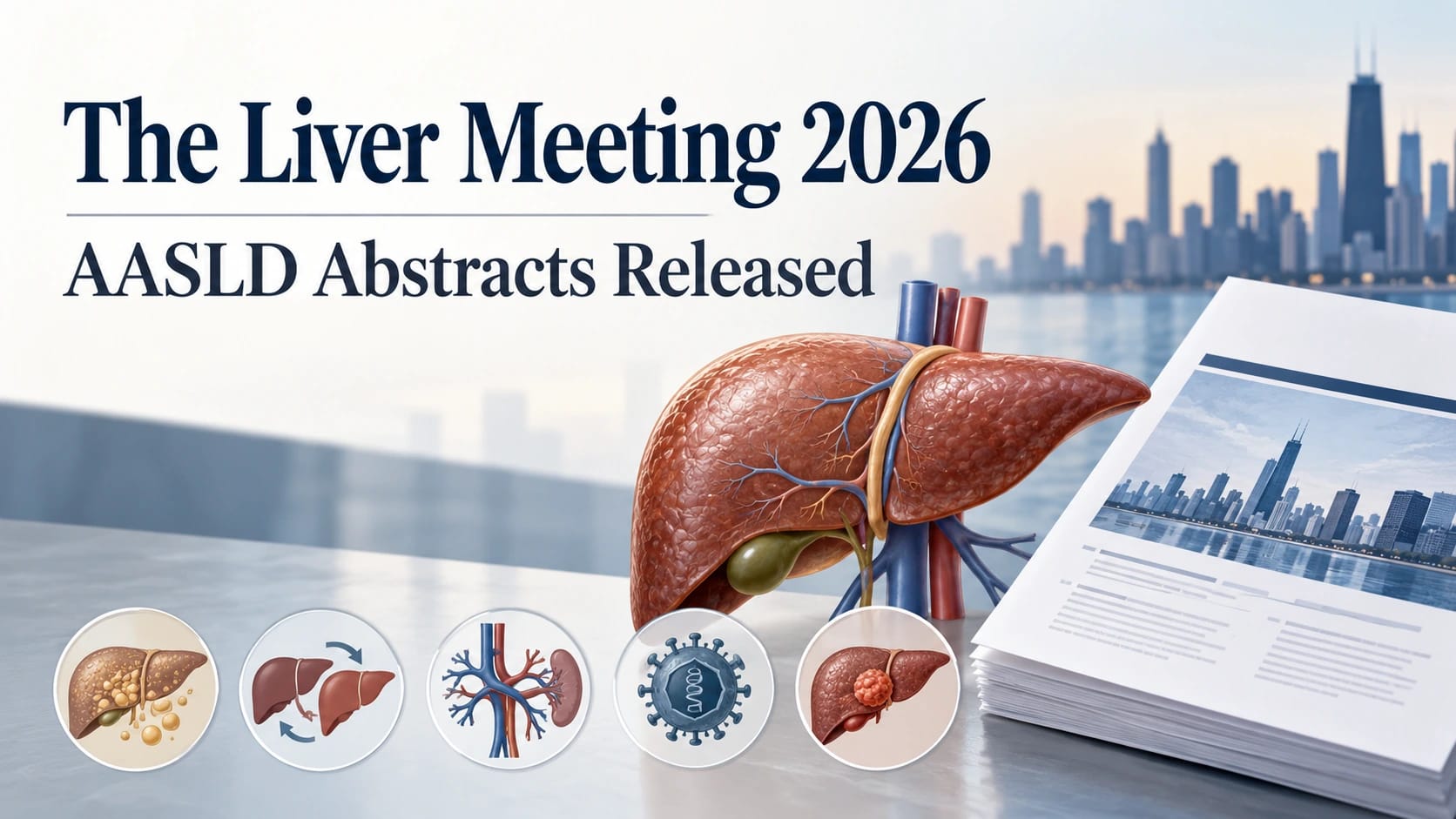
What does a major liver meeting reveal before the meeting even begins? Not definitive answers, not practice-changing recommendations, and not final peer-reviewed conclusions. But it can reveal where the hepatology field is concentrating its questions.
On October 5, 2026, the American Association for the Study of Liver Diseases published a news item titled “AASLD Lifts Press Embargo for The Liver Meeting® 2026 Abstracts.” The announcement states that AASLD lifted the press embargo on abstracts submitted for The Liver Meeting® 2026, to be held in Denver, and that more than 2,900 abstracts had been submitted to date. The submissions span 24 topic areas, including MASLD, liver transplantation, liver surgery, and hepatitis B.
This is not a journal article reporting a single study. It is not a randomized trial, observational cohort, guideline, meta-analysis, or clinical practice recommendation. The source is a society news release announcing availability of the regular abstract supplement and summarizing the leading abstract categories. Therefore, the “population,” “intervention,” “exposure,” “outcomes,” and “conclusions” cannot be interpreted in the way they would be for a clinical study. The relevant “evidence type” is conference abstract release / society news, and the appropriate clinical stance is awareness and horizon scanning, not immediate practice change.
What Was Actually Released
The AASLD announcement reports that the press embargo for regular abstracts was lifted on October 5, 2026. The AASLD embargo policy page independently states that the press embargo for regular abstracts lifted on Monday, October 5, 2026, at 8 AM MT, with publication of regular abstracts occurring on the same day. It also states that the late-breaking abstract embargo will lift on Thursday, November 5, 2026, at 8 AM MT.
A separate AASLD TLM26 guide page states that the Regular Abstract Supplement for The Liver Meeting® 2026 is available and describes it as featuring studies, clinical insights, and innovations from investigators around the world. That page also notes that regular abstracts can be accessed through AASLD or read in HEPATOLOGY starting Monday, October 5, at 8 AM MT.
For clinicians, this distinction matters. The abstract supplement is a research preview. Abstracts may include preliminary analyses, incomplete follow-up, subgroup findings, mechanistic work, early-phase clinical data, retrospective analyses, implementation studies, or emerging therapeutic observations. Some may later become full peer-reviewed manuscripts; others may change substantially after further analysis. AASLD’s embargo policy also clarifies that additional information not released in the abstract—such as discussion during the scientific presentation or new data presented at the meeting—remains subject to embargo until the relevant time.
The practical message is simple: the abstract release allows clinicians to identify themes, not to rewrite practice pathways.
The Dominant Signal: MASLD and MASH Remain Central
The largest category listed in the AASLD release is MASLD and MASH, with 676 abstracts. This is the most visible numerical signal in the announcement. It suggests that metabolic liver disease remains a major focus of hepatology research activity at TLM26.
The source does not provide individual MASLD abstract findings, trial names, drug classes, endpoints, fibrosis outcomes, or population characteristics. Therefore, it would be inappropriate to infer that the category count reflects clinical efficacy of any intervention or a change in standard care. What can be said, based on the AASLD announcement, is that MASLD and MASH represent the leading abstract category in the regular supplement.
For gastroenterologists and hepatologists, this reinforces the need to follow the MASLD/MASH space carefully, but critically. The burden of metabolic liver disease is clinically familiar, but conference abstracts should be filtered through study design, endpoint validity, patient selection, histologic or noninvasive assessment strategy, duration of follow-up, safety signals, and external validity. Until individual abstracts are reviewed, the category count is best interpreted as a map of research intensity, not a summary of evidence.
Transplantation, Surgery, and Portal Hypertension Share High Visibility
The AASLD release lists Liver Transplantation and Liver Surgery with 234 abstracts, and Portal Hypertension and Other Complications of Cirrhosis with another 234 abstracts. These two categories are highly relevant to tertiary hepatology, advanced liver disease clinics, transplant programs, endoscopy units, and inpatient liver services.
Again, the announcement does not provide study-level conclusions. It does not identify whether these abstracts focus on organ allocation, perioperative outcomes, living donor transplantation, surgical techniques, portal pressure assessment, ascites, variceal bleeding, hepatic encephalopathy, acute-on-chronic liver failure, or other complications. The appropriate interpretation is that advanced liver disease and transplant-related research remain prominent components of the TLM26 program.
Clinically, these domains are where incremental evidence can have real-world consequences. Small changes in risk stratification, referral timing, complication prevention, or peri-transplant management may alter patient trajectories. However, abstract-level findings should be assessed for patient selection, comparator groups, confounding, outcome definitions, and whether the work is hypothesis-generating or confirmatory.
For fellows, this is a useful reminder that hepatology is not divided neatly into “outpatient liver disease” and “transplant medicine.” The research agenda presented by AASLD spans metabolic disease, complications of cirrhosis, surgical decision-making, and long-term system-level care.
Alcohol-Associated Liver Disease Continues to Command Attention
The AASLD announcement reports 216 abstracts under Alcohol-Associated Liver Diseases, Clinical and Experimental. This category is clinically important because alcohol-associated liver disease sits at the intersection of hepatology, addiction medicine, critical care, transplant ethics, psychosocial assessment, and public health.
The source does not identify the design or results of these abstracts. It does not state whether they involve clinical outcomes, biomarkers, alcohol use disorder treatment pathways, transplant eligibility, severe alcohol-associated hepatitis, epidemiology, or experimental models. Therefore, no specific clinical claim can be drawn from the category count alone.
What can reasonably be interpreted is that alcohol-associated liver disease remains a substantial research theme at the meeting. For clinicians, this is worth watching because research in this field often challenges hepatology to integrate disease-directed care with behavioral treatment, longitudinal follow-up, and multidisciplinary support. The abstract release should prompt attention, but not overstatement.
Hepatobiliary Neoplasia and Hepatitis B: Two Different Research Imperatives
The AASLD release lists Hepatobiliary Neoplasia with 214 abstracts and Hepatitis B with 204 abstracts. These are distinct research worlds, but both remain central to liver-related morbidity and mortality.
For hepatobiliary neoplasia, clinicians may be watching for work related to hepatocellular carcinoma surveillance, diagnostic strategy, systemic therapy, locoregional therapy, biomarkers, risk prediction, or multidisciplinary care. However, the AASLD news item does not provide individual findings, so none should be inferred.
For hepatitis B, the category count confirms continued research attention. The source does not state whether the abstracts involve antiviral therapy, functional cure strategies, biomarkers, perinatal prevention, surveillance, global implementation, or special populations. It would be inaccurate to suggest any specific breakthrough based only on this announcement.
The clinical value of these categories lies in their signal function. They show that TLM26 will contain substantial hepatobiliary cancer and HBV content. They do not yet define what clinicians should do differently on Monday morning.
Cholestatic and Autoimmune Liver Disease Remain in the Research Conversation
The AASLD announcement lists Human Cholestatic and Autoimmune Liver Diseases with 201 abstracts. For hepatologists who manage primary biliary cholangitis, primary sclerosing cholangitis, autoimmune hepatitis, overlap syndromes, cholestatic pruritus, and related immune-mediated liver conditions, this category deserves attention.
The source does not describe the content or conclusions of the individual abstracts. Therefore, the blog cannot claim new diagnostic, therapeutic, or prognostic findings. The correct interpretation is that cholestatic and autoimmune liver disease remain active areas of research within the TLM26 abstract program.
This is clinically relevant because these diseases often require long-term monitoring, nuanced interpretation of biochemical response, individualized treatment decisions, and attention to patient-centered outcomes. But clinicians should wait for study-level review before applying any abstract-derived message to practice.
Global Participation: A Meeting Snapshot, Not an Outcomes Claim
AASLD states that the global reach of TLM is reflected in the 2026 abstract call, with China, India, South Korea, Japan, and Canada ranking among the top five international contributors. AASLD also states that overall abstract submissions are beginning to approach pre-COVID numbers.
This is a meeting-level observation, not clinical evidence. It does not indicate research quality, patient outcomes, or practice readiness. Still, it is relevant to the field. Hepatology is deeply global: HBV epidemiology, MASLD prevalence, liver cancer burden, transplant access, alcohol-associated disease patterns, viral hepatitis elimination, and cholestatic disease care vary across regions.
The presence of substantial international contribution may improve the diversity of clinical questions represented at the meeting. It may also help clinicians see how liver disease challenges are being studied across different health systems. But the source does not support conclusions about comparative performance between countries or the generalizability of any specific abstract.
How Clinicians Should Read This Abstract Release
For clinicians, the safest way to use the AASLD abstract release is as a research-navigation tool. The category counts highlight where to look first. MASLD/MASH leads numerically. Transplantation and liver surgery, portal hypertension and complications of cirrhosis, alcohol-associated liver disease, hepatobiliary neoplasia, hepatitis B, and cholestatic/autoimmune liver diseases all have substantial representation.
But abstract releases require disciplined interpretation. An abstract is often short, selective, and constrained by word limits. It may not provide full methods, complete safety data, subgroup context, statistical detail, or peer-review depth equivalent to a full manuscript. Some abstracts may be robust and practice-informing; others may be preliminary or exploratory. The evidence label should remain “conference abstract” until a full peer-reviewed publication or guideline update supports stronger conclusions.
This is particularly important for social media. Conference abstracts can easily be amplified beyond their evidentiary weight. GastroAGI coverage should avoid phrases such as “breakthrough,” “practice-changing,” or “new standard of care” unless a specific abstract, full dataset, and expert context justify that language. For now, the AASLD release supports a “what to watch” article, not a clinical recommendation update.
What This Means for GastroAGI Coverage
The most useful GastroAGI angle is not to summarize every abstract. The source does not provide enough detail for that. Instead, the blog can frame TLM26 as a hepatology research map.
A reasonable editorial approach would be to create follow-up content once individual abstracts are reviewed. Potential series could include: “Top MASLD/MASH Abstracts to Watch,” “Portal Hypertension and Cirrhosis Complications at TLM26,” “What’s New in Hepatobiliary Neoplasia,” “HBV Research Signals from AASLD,” and “Cholestatic/Autoimmune Liver Disease: Emerging Questions.” Each follow-up should separately verify study design, sample size, population, endpoints, results, limitations, and whether the work is hypothesis-generating or practice-informing.
The present announcement is best used as a launch point for responsible conference coverage. It tells clinicians where the meeting energy is concentrated. It does not tell them which treatments work, which surveillance strategy is superior, or which patients should be managed differently.

Clinical Takeaway
AASLD’s October 5, 2026 announcement that the press embargo has lifted for The Liver Meeting® 2026 regular abstracts is clinically relevant as a research agenda signal, not as practice-changing evidence. More than 2,900 abstracts have been submitted across 24 topic areas, with leading categories including MASLD/MASH, liver transplantation and surgery, portal hypertension and complications of cirrhosis, alcohol-associated liver disease, hepatobiliary neoplasia, hepatitis B, and cholestatic/autoimmune liver disease.
Clinicians should use the release to prioritize what to read, what to discuss, and what to follow during the meeting. They should not change clinical practice based on category counts or embargo-lift announcements. The late-breaking abstract embargo is scheduled to lift on November 5, 2026, at 8 AM MT, meaning additional data may become available once TLM26 begins.
Five Key Clinical Takeaways
This is society news, not a clinical study. The AASLD item announces the release of TLM26 abstracts; it does not report patient-level outcomes from a single investigation.
More than 2,900 abstracts were submitted across 24 topic areas, making this a broad snapshot of current hepatology research activity.
MASLD/MASH is the largest listed category, with 676 abstracts, indicating strong research attention but not implying any specific practice-changing result.
Advanced liver disease, transplant, alcohol-associated liver disease, hepatobiliary neoplasia, HBV, and cholestatic/autoimmune disease all remain prominent themes in the TLM26 abstract program.
Conference abstracts should be interpreted cautiously until individual methods, results, limitations, and full peer-reviewed publications are reviewed.
Source Reference and Link
American Association for the Study of Liver Diseases. “AASLD Lifts Press Embargo for The Liver Meeting® 2026 Abstracts.” AASLD News. Published October 5, 2026. Source:
Related source: AASLD. The Liver Meeting® 2026 Embargo Policy. Regular abstracts embargo lifted October 5, 2026; late-breaking abstract embargo scheduled for November 5, 2026.

We are pioneers in clinical intelligence, dedicated to helping gastroenterologists harness the power of artificial intelligence to drive precision, efficiency, and patient growth.