
EUROSTAR Consensus: Standardising Symptom Care After Oesophago-Gastric Cancer Surgery
EUROSTAR consensus offers practical guidance for monitoring, investigating, and managing symptoms after oesophagectomy or gastrectomy.


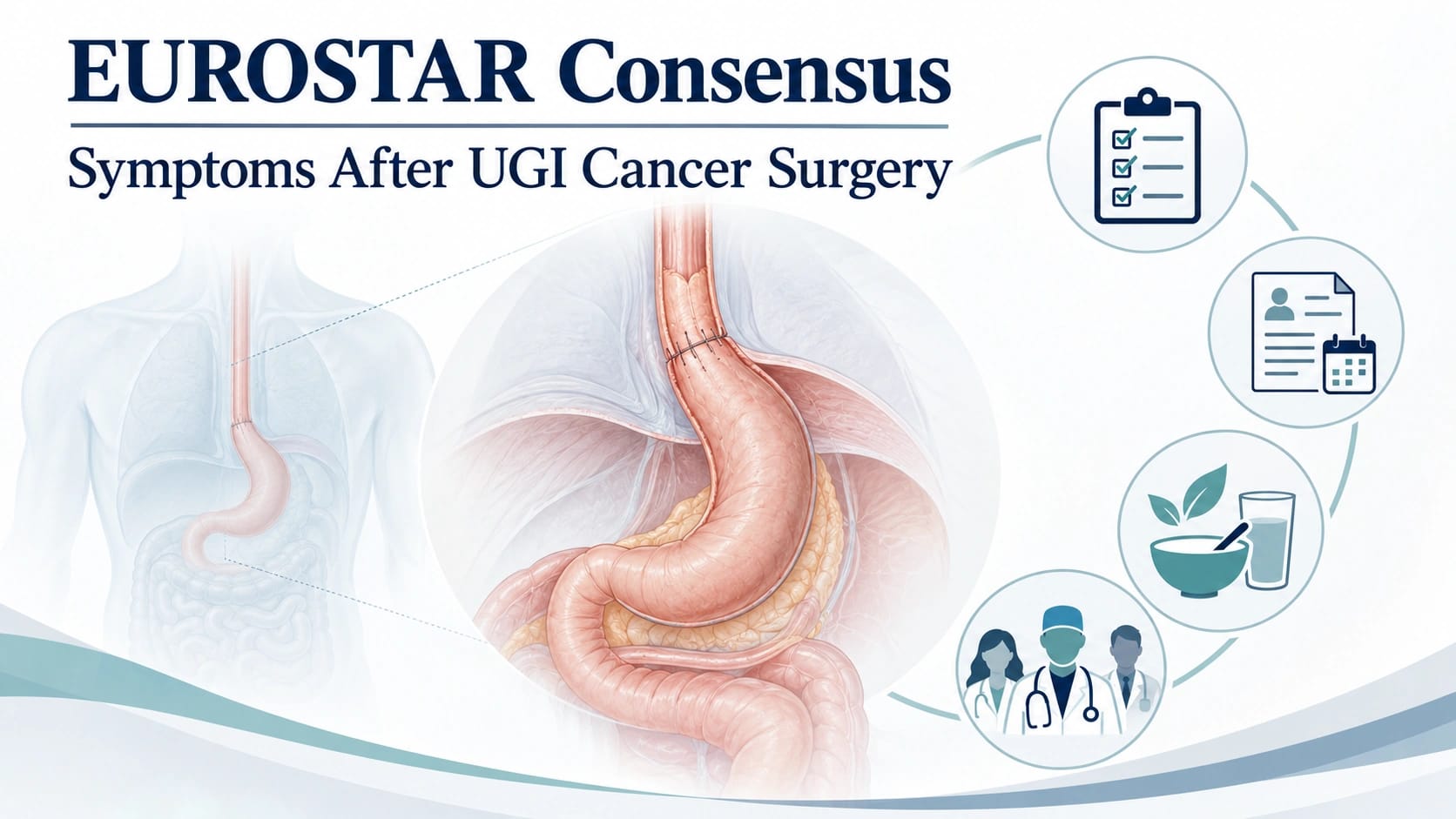
After curative-intent oesophago-gastric cancer surgery, survival is only part of the clinical story. Many patients live with reflux, dysphagia, dumping symptoms, diarrhoea, weight loss, nutritional deficiency, or non-specific symptoms that overlap across several postoperative conditions. The unresolved question is practical: how should clinicians move from symptom recognition to structured investigation, treatment, follow-up, and research-ready definitions?
The article addressed here is “EUropean consensus on the Resolution Of SympToms After oesophago-gastric Resection (EUROSTAR): Peri-Operative Quality Initiative (POQI) consensus statement,” published in Gut in 2026 and indexed online ahead of print on 25 September 2026. It is a society-endorsed European consensus statement, not a randomized trial, observational cohort, or drug-intervention study. The target population is patients after major upper gastrointestinal cancer surgery, specifically oesophagectomy or gastrectomy. The document focuses on symptom monitoring, service provision, diagnostic criteria, investigation pathways, and management of common postoperative conditions.
The Survivorship Problem Behind EUROSTAR
The consensus begins from a clinically familiar but often under-structured problem: symptoms after UGI cancer surgery are common, frequently overlapping, and can substantially affect quality of life. The authors note that curative-intent treatment often combines chemo-radiotherapy and surgery, producing irreversible changes in gastrointestinal anatomy and physiology. They also state that routine postoperative symptom monitoring is not standard in many centres and that patients may feel unsupported in managing the consequences of treatment.
This is important for gastroenterologists because post-surgical symptoms do not always map neatly to one diagnosis. Dysphagia, regurgitation, early satiety, weight loss, diarrhoea, bloating, fatigue, or pain may reflect anastomotic stricture, delayed gastric emptying, reflux, bile acid diarrhoea, small intestinal bacterial overgrowth, exocrine pancreatic insufficiency, dumping syndrome, recurrent cancer, or multiple conditions occurring together. EUROSTAR’s contribution is not the discovery of a new disease entity; it is an attempt to standardise a field where clinical acumen alone may be insufficient and where inconsistent definitions hinder both care and research.
How the Consensus Was Developed
EUROSTAR expanded on the UK-based RESTORE work and used a modified Delphi process developed by POQI. A multidisciplinary expert group from 10 European countries participated, with societal support from the British Society of Gastroenterology, the European Society for Diseases of the Esophagus, the Association of Upper GI Surgeons of Great Britain and Ireland, the UK and Ireland Oncology Group, and the Oesophageal Patients Association.
Participants were divided into working groups and reviewed predefined topics covering service specifications and postoperative conditions. The authors define a “statement” as a fact supported by evidence and a “recommendation” as a suggested course of action supported by evidence and expert opinion. Evidence quality was graded using a modified GRADE structure, and recommendations were graded as strong or weak. Final POQI statements were accepted only with 100% participant agreement.
The output was substantial: 8 statements, 13 recommendations, diagnostic criteria, investigation pathways, management recommendations, and 16 future research priorities. This makes the article clinically useful, but it should be interpreted correctly. It is consensus-based guidance informed by literature review and expert multidisciplinary discussion, not direct proof that any single pathway improves survival or quality of life in a randomized comparison.
From Symptom Lists to Structured Follow-Up
A key general recommendation is that patients should have a systematic approach to assessment, investigation, and management, because this may lead to faster symptom resolution and improved quality of life. The statement also recommends testing before treatment where possible, given substantial symptom overlap, while allowing empirical treatment for selected conditions if response is documented.
This is a practical message for clinics. EUROSTAR does not argue that every symptom requires every test. It argues that symptom evaluation should be deliberate: document the symptom burden, consider surgical anatomy, oncologic therapy, medications and pre-existing disease, test when feasible, and record response when empirical treatment is used. That final step—recording response—is particularly important. It turns empiricism into a traceable clinical decision rather than an undocumented trial of therapy.
The consensus also recommends patient-reported outcome measures to document symptom burden and trajectory. This is relevant because postoperative symptoms can fluctuate over time and may be underreported unless patients are asked systematically. In routine practice, a validated questionnaire can support history-taking rather than replace it.
Multidisciplinary Care Is a Core Recommendation, Not an Optional Add-On
EUROSTAR gives strong support to regular follow-up and access to clinical teams after surgery. The stated aims are to identify symptoms requiring investigation, monitor for possible recurrence, and provide holistic care that may improve quality of life. The optimal follow-up model remains unknown, but the authors note that it may combine face-to-face, virtual, remote, and patient- or questionnaire-initiated contacts.
The consensus also recommends individualised follow-up, which may need to be long term for some patients, and access to a designated multidisciplinary team meeting for complex cases. Multidisciplinary expertise may include upper GI surgery, gastroenterology, oncology, nursing, dietetics, psychology, and other allied health professionals.
For gastroenterologists, this is a strong implementation point. These patients should not be left in a gap between cancer surveillance, surgical follow-up, and primary care. The document specifically frames follow-up as multifaceted and holistic, addressing symptoms proactively while also considering recurrence, nutrition, psychological needs, social issues, and financial consequences. Dietetic input is highlighted as a core component of follow-up.
Nutrition, Micronutrients, and the Postoperative GI Physiology Lens
The EUROSTAR recommendations emphasise full history-taking, including dietary history, timing and pattern of symptoms, and pre-existing conditions. Nutritional issues are described as common, and specialist dietitian input during follow-up is recommended. Weight loss and micronutrient deficiency are also described as common, with monitoring recommended to ensure requirements are being met and deficiencies mitigated.
The statement recommends long-term parenteral vitamin B12 supplementation for all patients after total gastrectomy, with close monitoring and appropriate supplementation after subtotal gastrectomy or oesophagectomy. It also states that complete multivitamin and mineral supplementation should be considered after oesophagectomy or gastrectomy, with calcium and vitamin D also considered, although that recommendation is weak and based on low-quality evidence.
The clinical interpretation is balanced: nutrition is central to survivorship, but not every supplementation question is settled. The document itself identifies research gaps around routine versus targeted micronutrient supplementation, bone health, vitamin B12 frequency, and oral B12 efficacy after UGI cancer surgery.
Common Conditions: Practical Pathways, Not One-Size-Fits-All Rules
EUROSTAR provides condition-specific pathways for several postoperative problems. For acid reflux after oesophagectomy, the authors describe disruption of normal antireflux barriers and recommend lifestyle advice, correct timing of medication, and empirical proton pump inhibitor therapy as first-line treatment, while noting that endoscopy may help assess overlapping conditions such as anastomotic stricture or delayed gastric emptying.
The document also addresses bile reflux, anastomotic stricture, delayed gastric emptying, dumping syndrome, bile acid diarrhoea, carbohydrate malabsorption, small intestinal bacterial overgrowth, exocrine pancreatic insufficiency, and recurrence. For example, anastomotic stricture pathways include suggestive symptoms, diagnostic criteria using OGD or contrast study, and dilation-based treatment options. Delayed gastric emptying pathways include symptoms such as nausea, vomiting, dysphagia, early satiety, regurgitation, reduced intake, weight loss, heartburn, and belching, with diagnostic options including OGD, timed contrast studies, or gastric emptying studies.
For dumping syndrome, dietary advice guided by a specialist dietitian is recommended as first-line treatment, with octreotide and acarbose positioned later depending on early or late dumping features. For bile acid diarrhoea, SeHCAT testing is described as an established diagnostic approach, with bile acid sequestrants and dietary modification included in management. For SIBO, the consensus recognises breath testing, small bowel aspirate approaches, antibiotic therapy, recurrence, and weak evidence for additional strategies such as probiotics, prokinetics, low-FODMAP diet, and correcting underlying causes.
The key is not to memorise every box as a rigid algorithm. The more clinically important message is that postoperative symptom care should become diagnosable, documentable, and auditable.
Recurrence Must Remain in the Differential
EUROSTAR explicitly states that recurrent cancer should be considered when symptoms deviate significantly from the postoperative baseline. The recurrence section notes that symptoms can be variable and non-specific, and it categorises concerning symptoms into luminal and non-luminal patterns. First-line investigation for luminal symptoms includes upper GI endoscopy, with CT thorax, abdomen, and pelvis recommended in parallel when suspicion is high or endoscopy is abnormal; CT is recommended first-line for extra-luminal symptoms.
This distinction is clinically important. Many postoperative symptoms are benign or functional consequences of altered anatomy, but “new” or changing symptoms after a stable baseline should not be assumed to be survivorship symptoms. The consensus does not claim that symptoms reliably predict recurrence in all cases; indeed, it identifies symptom-driven versus routine or intensive surveillance as a future research priority.
Strengths, Limits, and What Clinicians Should Not Overstate
The major strength of EUROSTAR is its broad, society-endorsed, multidisciplinary consensus process across European health systems. It provides a common language for symptoms, conditions, investigations, management pathways, and service design after major UGI cancer surgery.
The limitations are equally important. The authors acknowledge that participants may have been enthusiasts for proactive symptom follow-up and may not represent the whole UGI cancer community. They also acknowledge relatively few high-quality studies informing the guidance, even though a detailed literature review of 162 studies was conducted. The management of postoperative symptoms is expected to evolve, meaning this guidance will require updating.
Therefore, clinicians should not describe EUROSTAR as definitive proof that one follow-up model improves survival or quality of life. They should describe it as a structured, consensus-based framework that supports standardised survivorship care and provides a benchmark for future prospective studies.

Clinical Takeaway
EUROSTAR is clinically relevant because it moves post-oesophago-gastric cancer surgery care from reactive symptom troubleshooting toward structured survivorship medicine. It supports systematic assessment, symptom questionnaires, documented response to treatment, individualised follow-up, multidisciplinary access, nutrition and micronutrient monitoring, condition-specific diagnostic pathways, and vigilance for recurrent cancer when symptoms deviate from baseline.
Its evidence level should be framed accurately: this is consensus guidance informed by literature review and modified GRADE, not a trial proving causation or a single intervention effect. Its most immediate influence is likely on clinic structure, documentation standards, multidisciplinary pathways, and research design.
Five Key Clinical Takeaways
EUROSTAR is a Gut 2026 POQI consensus statement, not a randomized trial or observational outcomes study.
Symptoms after major UGI cancer surgery are common, overlapping, and quality-of-life limiting, requiring structured rather than ad hoc assessment.
The consensus produced 8 statements and 13 recommendations, plus diagnostic and management pathways and 16 research priorities.
Systematic assessment, PROM-based monitoring, testing where feasible, and documented response to empirical therapy are central practice messages.
Long-term, multidisciplinary survivorship care is emphasized, including gastroenterology, surgery, oncology, dietetics, nursing, psychology, and allied health input.
Source Reference and Link
Barman S, Chevallay M, Gisbertz SS, et al. EUropean consensus on the Resolution Of SympToms After oesophago-gastric Resection (EUROSTAR): Peri-Operative Quality Initiative (POQI) consensus statement. Gut. 2026; online ahead of print, 25 September 2026. DOI: 10.1136/gutjnl-2025-337109.
References

We are pioneers in clinical intelligence, dedicated to helping gastroenterologists harness the power of artificial intelligence to drive precision, efficiency, and patient growth.