
Serrated Polyposis Syndrome: What the 2026 US Multi-Society Task Force Consensus Means for CRC Prevention
The 2026 USMSTF consensus highlights SPS recognition, colon clearing, surveillance, surgery, genetics, and family screening.


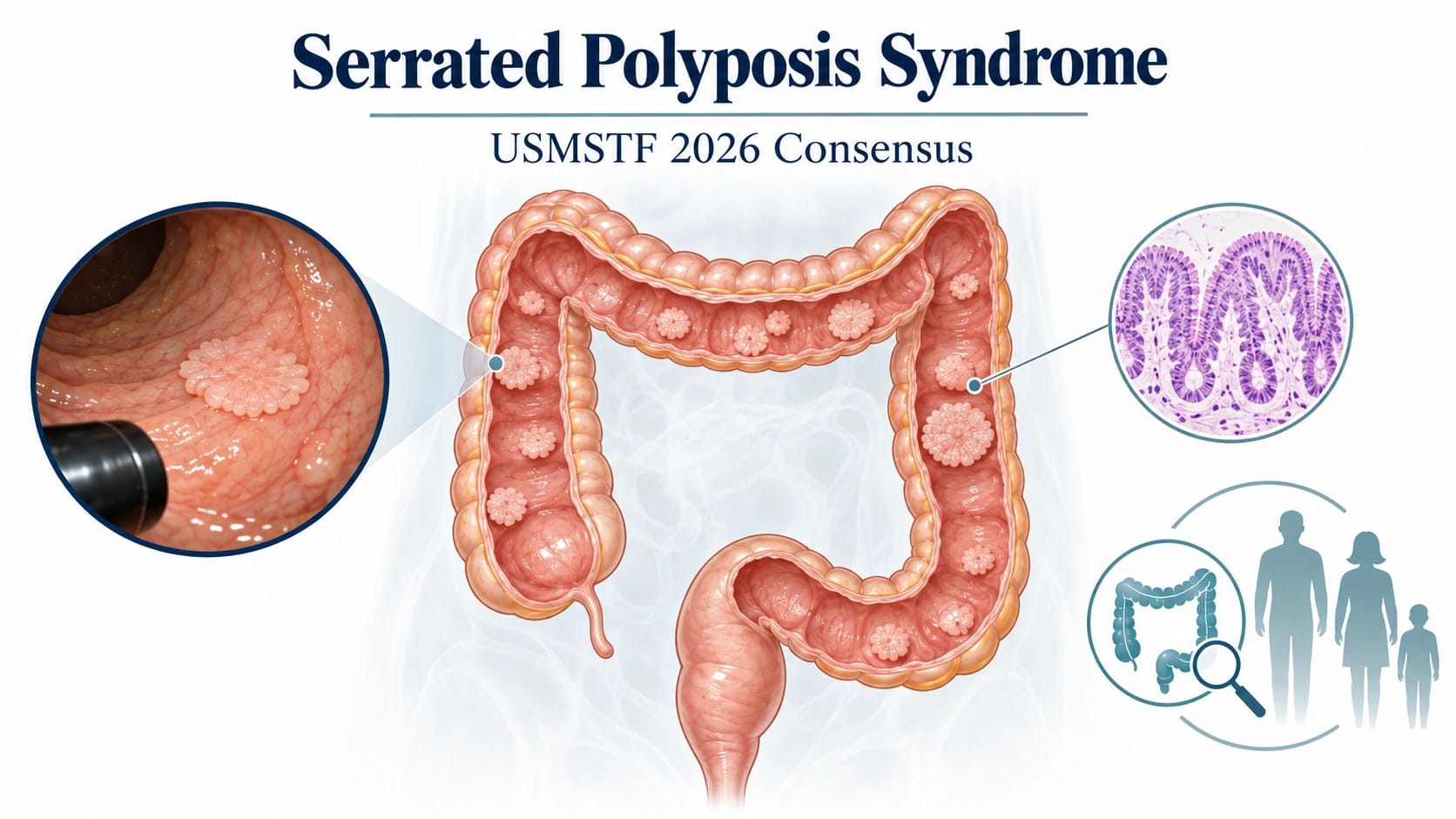
How often does a busy colonoscopist see the early signal of serrated polyposis syndrome but fail to name it? That is the clinical tension at the center of the 2026 US Multi-Society Task Force statement on serrated polyposis syndrome. The article’s core message is not that SPS is a rare curiosity, but that it is a common gastrointestinal polyposis syndrome that may be missed unless endoscopists deliberately count, size, localize, and longitudinally track serrated lesions.
The verified article title is “Serrated Polyposis Syndrome: A Review and Consensus Statement by the US Multi-Society Task Force on Colorectal Cancer.” It was published online on September 30, 2026, and appears as an in-press corrected proof in Gastrointestinal Endoscopy. The same statement was also indexed in Gastroenterology and The American Journal of Gastroenterology, with the article noted as jointly published across the three journals with minor stylistic differences. The ACG guideline page lists the document under September 2026 consensus statements, with Douglas K. Rex, MD, MACP, MACG, listed as lead author.
This is best understood as a review and consensus statement / practice guideline, not a randomized trial, cohort study, or interventional study. The population addressed includes patients with SPS and affected relatives. The clinical focus is identification, diagnosis, colonoscopic management, surgery when needed, genetic testing considerations, and screening of first-degree relatives. The outcomes of concern are colorectal cancer risk, incident colorectal cancer, and post-colonoscopy colorectal cancer prevention, but the accessible abstract does not provide new effect sizes, comparative intervention outcomes, or randomized evidence.
SPS as a Recognition Problem, Not Just a Polyp Burden
The consensus statement begins from a practical observation: SPS is the most common polyposis syndrome, yet it often goes unrecognized. For clinicians, this framing matters. Many colorectal cancer prevention failures do not arise from lack of colonoscopy access alone; they may arise from incomplete recognition of risk patterns during colonoscopy and follow-up.
SPS diagnosis depends on clinical criteria established by the World Health Organization, incorporating the size, cumulative lifetime number, and location of serrated polyps throughout the colon. That creates an immediate operational challenge. Diagnosis is not based on a single histology result in isolation. It requires accurate endoscopic documentation, pathology correlation, and cumulative tracking across procedures.
This is where SPS differs from a simple “polyp found, polyp removed” model. The syndrome may emerge over time. A patient may not meet diagnostic criteria at one examination but may approach or cross the threshold after subsequent colonoscopies. The task force therefore emphasizes systematic recording of serrated polyp size, number, and location in patients with multiple serrated polyps as a critical first step for sensitive SPS diagnosis.
For fellows and practicing endoscopists, the practical implication is clear: reporting quality is not administrative detail. In SPS, the colonoscopy report may determine whether the syndrome is recognized at all.
Why This Consensus Statement Is Clinically Timely
The US Multi-Society Task Force on Colorectal Cancer includes representatives from the American College of Gastroenterology, American Gastroenterological Association, and American Society for Gastrointestinal Endoscopy. Its role is to develop recommendations for colorectal cancer screening, surveillance, and prevention. This consensus is important because it focuses on a syndrome that sits at the intersection of endoscopic detection, pathology terminology, cancer prevention, genetics, and family-risk counseling.
The journal page states that SPS may have a prevalence of approximately 1 in 250 individuals in screening colonoscopy cohorts, meaning it may be encountered more often than many clinicians assume. This estimate should not be overgeneralized to every population or clinical setting, but it supports the document’s central concern: SPS is not so rare that endoscopists can afford to treat it as an occasional hereditary-polyposis footnote.
The statement also notes that SPS, and even serrated polyp burdens that approach but do not meet the current clinical definition, are associated with heightened risk of prevalent and incident colorectal cancer. The wording here is important. This is an association with increased risk; it should not be interpreted as proof that every individual serrated lesion burden has the same trajectory or that a single intervention eliminates risk. The clinical message is risk recognition and risk-adapted management, not deterministic prediction.
What the Task Force Investigated
The scope of the document is broad but clinically focused. It addresses major issues related to identification and diagnosis of SPS in patients and affected relatives, as well as management of SPS. Clinically relevant statements were developed by content experts whose clinical practice and research focus includes colonoscopy. The literature search, supported by a research librarian, covered English-language medical literature in MEDLINE, EMBASE, the Database of Abstracts of Reviews and Effects, and the Cochrane Database of Systematic Reviews from January 1, 2005, to June 20, 2025.
This methodology matters because the statement is not presenting a single new dataset. It is synthesizing available literature and expert consensus into clinically usable recommendations. That makes it valuable for practice, but it also defines its limits. The document’s conclusions should be interpreted as consensus guidance derived from the available evidence base, not as the result of a newly conducted prospective trial.
The article keywords include USMSTF, polyposis, serrated polyposis syndrome, and colorectal cancer, reinforcing its intended clinical domain. The abbreviations listed by the journal include terms central to everyday endoscopy and prevention practice, including CRC, EMR, FIT, PCCRC, SPS, and USMSTF.
Diagnosis Starts With Documentation
The consensus statement emphasizes that SPS diagnosis is based on WHO clinical criteria involving serrated polyp size, cumulative lifetime number, and colonic location. This means diagnosis is vulnerable to under-documentation.
If the endoscopist does not carefully record the number of serrated lesions, estimate or measure size, specify location, and integrate pathology, the patient may never be identified as having SPS. Similarly, if prior colonoscopy and pathology reports are not reviewed, cumulative lifetime burden may be underestimated.
This has direct implications for colonoscopy reporting. A high-quality report in a patient with multiple serrated lesions should do more than state “polyps removed.” It should support future syndrome recognition. The consensus statement’s emphasis on systematic recording is a reminder that SPS prevention begins at the level of lesion recognition and reporting infrastructure.
This is also relevant for non-expert endoscopists, community gastroenterologists, and training programs. Serrated lesions can be subtle, flat, mucus-capped, and more common in the proximal colon. Although the accessible source does not provide detailed optical diagnosis teaching points, the implication is that meticulous inspection and complete documentation are foundational.
Colon Clearing and Surveillance: The Endoscopic Core
The abstract states that individuals with SPS have increased risk of prevalent and incident colorectal cancer, and that meticulous inspection, clearing of the colon, and frequent surveillance colonoscopy are recommended to decrease incident CRC. This is the endoscopic center of the consensus statement.
“Clearing the colon” should be understood as a clinical strategy rather than a single procedural act. Patients with SPS may have multiple lesions distributed throughout the colon, and complete management may require careful inspection, removal of visible serrated lesions, staged procedures in selected cases, referral to expert endoscopists, and structured surveillance. The accessible abstract supports the principle of meticulous inspection, colon clearing, and frequent surveillance, but it does not provide specific interval schedules or lesion-size thresholds. Therefore, clinicians should consult the full consensus document before adopting specific surveillance intervals.
The source also links SPS diagnosis to shorter surveillance interval recommendations than might otherwise be warranted based on polyp findings alone. This is clinically important. If SPS is not recognized, the patient may be assigned a routine post-polypectomy interval that does not reflect their syndrome-level risk. Recognition changes the management category.
The consensus also frames SPS management as an opportunity to reduce post-colonoscopy colorectal cancer in SPS patients. That point is particularly relevant to quality programs. PCCRC prevention depends not only on interval selection, but also on mucosal inspection, complete resection, bowel preparation quality, pathology communication, and recall systems.
Surgery Has a Defined but Limited Role
The abstract states that colorectal surgery is indicated for individuals diagnosed with cancer or whose polyp burden cannot be managed endoscopically by expert endoscopists. This statement is clinically useful because it avoids two extremes.
On one side, SPS should not automatically be equated with colectomy. Many patients may be managed endoscopically if the lesion burden can be cleared and surveillance can be maintained. On the other side, repeated attempts at endoscopic control may not be appropriate when cancer is present or when the polyp burden exceeds what can be safely and effectively managed, even by expert endoscopists.
The phrase “expert endoscopists” matters. It implies that surgical referral decisions should account for the availability and feasibility of advanced endoscopic management. A patient with high polyp burden may need referral to a center with expertise in serrated lesion detection and complex polypectomy before surgery is considered solely because of local endoscopic limitations. However, this should not delay appropriate cancer care or necessary surgical management when endoscopic control is not realistic.
Genetics: Avoid Over-Testing, But Do Not Ignore Syndromic Clues
One of the most practical messages in the abstract is that there is no common germline pathogenic variant associated with SPS. This distinguishes SPS from several other hereditary colorectal cancer syndromes where germline testing is central to diagnosis.
The consensus statement says germline genetic testing is indicated only in individuals who meet criteria for a known hereditary syndrome in the appropriate clinical setting. This is a balanced position. It discourages reflexive genetic testing for every SPS diagnosis while preserving the need to identify patients whose phenotype, age, family history, histology, or extracolonic features suggest another hereditary syndrome.
For clinicians, this means SPS is primarily a clinical diagnosis, but genetic thinking remains necessary. The task is not to test indiscriminately; it is to recognize when SPS may coexist with or mimic a defined hereditary cancer syndrome that warrants formal genetic evaluation.
Family Members: The Risk Extends Beyond the Index Patient
The abstract states that first-degree relatives of patients with SPS are at heightened risk of colorectal cancer and should undergo colonoscopic screening. This is one of the most important practice implications.
Once SPS is diagnosed, the clinical responsibility expands from the index colonoscopy to family-risk communication. A patient’s first-degree relatives may not be symptomatic, and they may not perceive themselves as high risk. The gastroenterologist’s role includes ensuring that the diagnosis is communicated clearly and that relatives are advised to undergo colonoscopic screening according to the consensus guidance.
The accessible source does not provide the exact age to begin screening or interval details for relatives. Those operational recommendations should be checked in the full article. The supported message is that first-degree relatives have heightened CRC risk and should receive colonoscopic screening.
What Clinicians Should and Should Not Conclude
Clinicians should conclude that SPS is common enough to matter in routine colonoscopy practice, often underrecognized, associated with increased CRC risk, and dependent on careful documentation for diagnosis. They should also conclude that management requires meticulous inspection, colon clearing, frequent surveillance, selective surgery, careful genetic judgment, and screening of first-degree relatives.
Clinicians should not conclude that the abstract alone provides all management details. It does not specify surveillance intervals, colon-clearing protocols, resection strategies, surgical extent, family-screening schedules, or detailed genetic-testing criteria. The full consensus statement should be used for implementation.
Clinicians should also avoid implying causation where the source describes risk association. The statement says SPS is associated with increased prevalent and incident CRC risk; this supports surveillance and prevention strategies, but individual risk remains heterogeneous and evidence quality may vary across clinical questions.
Remaining Gaps and Implementation Priorities
The most immediate implementation gap is recognition. The consensus explicitly states that SPS often goes unrecognized. Improving recognition will likely require colonoscopy reporting templates that capture serrated lesion number, size, and location; pathology-endoscopy reconciliation; cumulative polyp tracking; and recall systems that flag patients approaching SPS criteria.
Future work should clarify how best to identify underdiagnosed SPS in existing endoscopy databases, how to standardize surveillance pathways, and how to support family screening. Because SPS diagnosis depends on cumulative findings, digital systems may play an important role in reducing missed cases.

Clinical Takeaway
The 2026 US Multi-Society Task Force consensus reframes serrated polyposis syndrome as a common, underrecognized CRC-risk condition that requires systematic endoscopic documentation, colon clearing, surveillance, selective surgical referral, careful use of genetic testing, and family screening. It is not a new interventional trial, and the accessible abstract does not provide granular management intervals. Its immediate value lies in improving recognition and converting scattered serrated polyp findings into a coherent cancer-prevention strategy.
Five Key Clinical Takeaways
SPS is described as the most common polyposis syndrome, but it often goes unrecognized.
Diagnosis is clinical and based on WHO criteria involving serrated polyp size, cumulative lifetime number, and location.
Patients with SPS have increased risk of prevalent and incident CRC, supporting meticulous inspection, colon clearing, and frequent surveillance colonoscopy.
Surgery is reserved for patients with cancer or polyp burden that cannot be managed endoscopically by expert endoscopists.
There is no common germline pathogenic variant associated with SPS; first-degree relatives are at heightened CRC risk and should undergo colonoscopic screening.
Source Reference and Link
Rex DK, Anderson JC, Burke CA, Jacobson BC, May FP, Patel SG, Samadder NJ, Stoffel EM, Robertson DJ. Serrated Polyposis Syndrome: A Review and Consensus Statement by the US Multi-Society Task Force on Colorectal Cancer. Gastrointestinal Endoscopy. Published online September 30, 2026.

We are pioneers in clinical intelligence, dedicated to helping gastroenterologists harness the power of artificial intelligence to drive precision, efficiency, and patient growth.