
Preventive Care in Cirrhosis: What the 2026 ACG Guideline Means for Hepatology Practice
ACG’s 2026 cirrhosis preventive care guideline reframes routine care around surveillance, vaccines, nutrition, exercise, and clinic implementation.


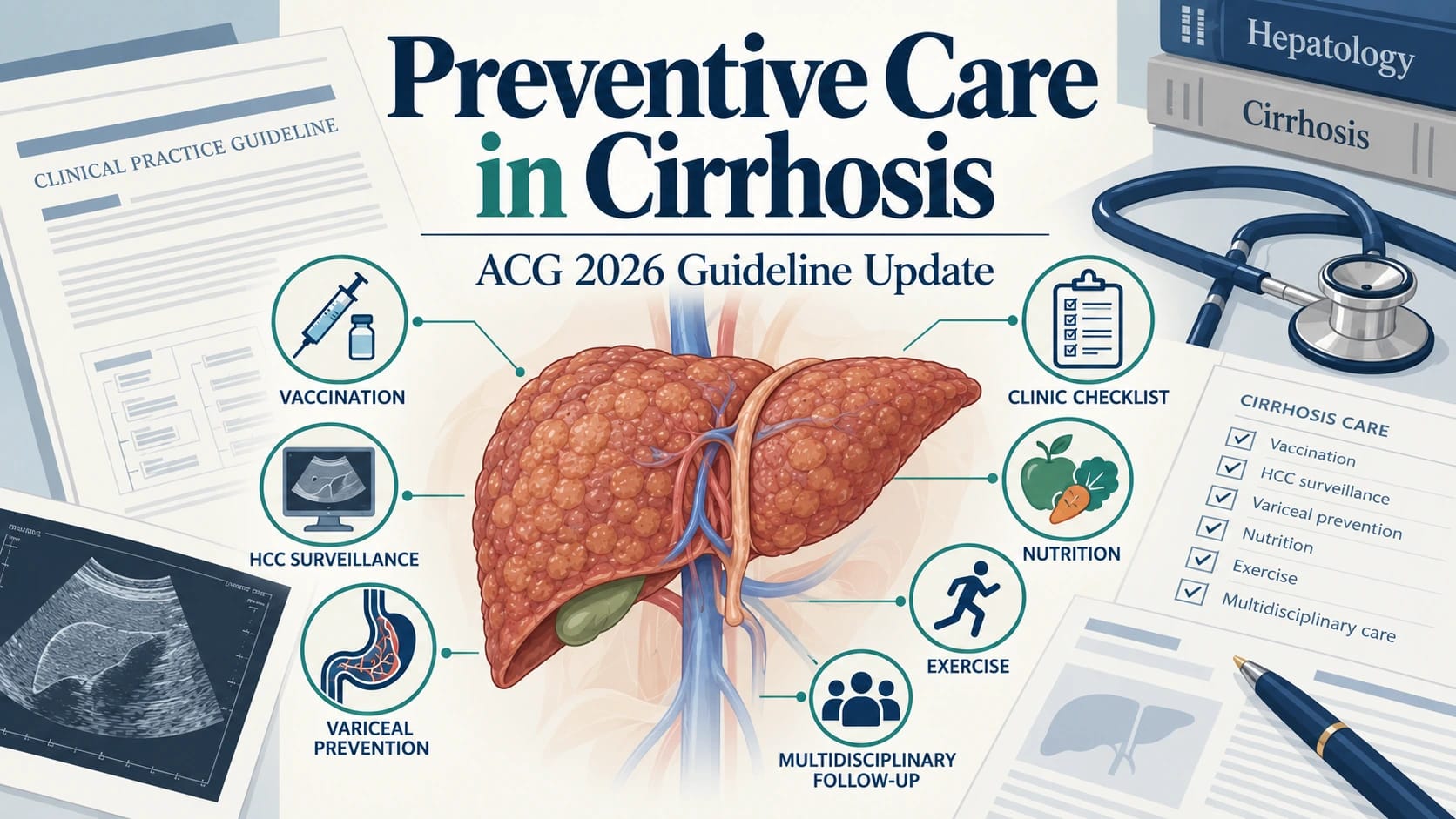
For many clinicians, cirrhosis care is still triggered by events: ascites, variceal bleeding, encephalopathy, infection, hospitalization, or transplant referral. The central question raised by the 2026 American College of Gastroenterology guideline is different: what should be done systematically before these events occur—or after a decompensating event, before the next one? The ACG guideline page lists “Liver: Preventive Care for Patients With Cirrhosis – Guideline”, dated October 2026, with Elliot Tapper, MD, as the listed lead author on the guideline page. The indexed article record identifies the full article as “ACG Clinical Guideline: Preventive Care for Patients With Cirrhosis,” published in The American Journal of Gastroenterology on October 5, 2026, authored by Elliot B. Tapper, Ani Kardashian, Jose Debes, Janet Gripshover, Andrew M. Moon, John J. Kim, and Jennifer C. Lai.
This is not a randomized trial and does not report a newly enrolled patient cohort. It is a clinical practice guideline developed under the auspices of the ACG Practice Parameters Committee. According to the indexed abstract, a hepatology expert writing group and two GRADE methodologists developed PICO questions, performed librarian-assisted searches of PubMed, Embase, and the Cochrane Library, and prioritized systematic reviews, meta-analyses, and randomized trials. The patient population is broad: adults with cirrhosis, including those with early-stage disease and those who may recompensate after decompensation. The guideline’s clinical premise is that cirrhosis prevention should be delivered deliberately, not opportunistically.
Why a Prevention-Focused Cirrhosis Guideline Matters
The abstract states that cirrhosis affects more than two million Americans and is associated with substantial healthcare use, impaired quality of life, and mortality. That burden is familiar to hepatologists, but the framing is important. Cirrhosis is not only a terminal pathway of chronic liver injury; it is also a longitudinal condition in which preventable complications may determine whether a patient remains stable, decompensates, is hospitalized, becomes transplant-eligible, or loses physiologic reserve.
Preventive care in cirrhosis is difficult because it cuts across several clinical lanes. Some elements are classically “liver-specific,” such as variceal bleeding prevention and hepatocellular carcinoma surveillance. Others are infection-related, such as vaccination and antibiotic prophylaxis in defined settings. Others are functional and metabolic, including nutrition, structured exercise, osteoporosis care, smoking cessation, and post-discharge management of alcohol use disorder. The new guideline is clinically useful because it organizes these areas into a preventive framework rather than treating them as scattered checklist items.
The abstract describes four domains: prevention of cirrhosis-specific complications, infection prevention, lifestyle factors, and non-liver-specific conditions. That structure is practical for clinic design. It implies that cirrhosis visits should not focus only on MELD score, ascites control, and transplant timing. A high-value visit may also include surveillance status, immunization review, nutrition referral, exercise planning, bone health assessment, alcohol use disorder care, and smoking cessation counseling.
What the Guideline Evaluated
The guideline produced 18 GRADE-assessed recommendations and 6 key concept statements. The use of GRADE is relevant because it separates the strength of a recommendation from the certainty of evidence. In practice, clinicians sometimes assume that a strong recommendation must rest on uniformly high-quality evidence. This guideline is a reminder that recommendations may be strong when the balance of expected benefit, harm, feasibility, and clinical priority is compelling—even if the underlying evidence is not high certainty.
The abstract specifically identifies several strong recommendations: carvedilol or variceal ligation for high-risk esophageal varices, semiannual hepatocellular carcinoma surveillance, hepatitis A testing and vaccination, influenza immunization, SARS-CoV-2 immunization, respiratory syncytial virus immunization, and smoking-cessation counseling. It also identifies conditional recommendations addressing lactulose for minimal hepatic encephalopathy, adjunctive rifaximin after hospitalization, short-course antibiotic prophylaxis for upper gastrointestinal bleeding, post-discharge behavioral therapy for alcohol use disorder, dietitian-guided nutrition, structured exercise, and bisphosphonates for osteoporosis.
Those statements are the boundary of what can be responsibly summarized from the accessible abstract. The abstract does not provide the full recommendation table, dosing details, eligibility criteria, contraindications, or evidence profiles for each recommendation. Therefore, any operational protocol—such as exactly which patient should receive which intervention, how therapy should be sequenced, or how to handle edge cases—should be checked against the full AJG guideline before implementation.
From Decompensation Response to Longitudinal Prevention
One clinically important shift is the guideline’s emphasis that early-stage disease has a favorable prognosis and that decompensated patients can recompensate. This statement does not mean every patient with decompensated cirrhosis will improve or that prevention can replace disease-directed therapy, transplant evaluation, or management of portal hypertension. It does, however, support a more proactive mindset: cirrhosis care should be structured around reducing the probability of avoidable complications and preserving function.
For compensated cirrhosis, prevention often means identifying silent risk: clinically significant portal hypertension, high-risk varices, occult HCC, under-immunization, sarcopenia risk, osteoporosis risk, ongoing alcohol exposure, smoking, and frailty trajectories. For patients after hospitalization, prevention may mean closing the gap between discharge and relapse: infection recurrence, encephalopathy readmission, alcohol use disorder care, malnutrition, and progressive functional decline.
The guideline’s breadth may be particularly useful for fellows and early-career clinicians. It highlights that cirrhosis management is not a single-problem discipline. It is simultaneously portal hypertension care, cancer surveillance, infectious disease prevention, behavioral health coordination, nutrition medicine, geriatric-risk mitigation, and systems-based practice.
Strong Recommendations: Where the Signal Appears Most Actionable
The abstract lists several strong recommendations, but does not provide the underlying certainty rating for each individual statement in the accessible text. Clinically, these strong recommendations fall into areas already central to hepatology practice: preventing first variceal hemorrhage, performing regular HCC surveillance, preventing vaccine-preventable infections, and addressing smoking.
The inclusion of carvedilol or variceal ligation for high-risk esophageal varices reinforces that variceal bleeding prevention remains a core quality issue in cirrhosis care. The guideline abstract does not specify the full definitions of high-risk varices, the decision pathway between carvedilol and ligation, or the patient-level circumstances that should guide selection. For clinical implementation, that nuance matters. Blood pressure, renal function, ascites status, tolerance, endoscopy access, local expertise, and patient preference may all influence the practical choice, but those details should be drawn from the full guideline rather than inferred from the abstract alone.
The recommendation for semiannual hepatocellular carcinoma surveillance is also notable because missed or delayed surveillance remains a common real-world gap. From a practice-design standpoint, the key question is not only whether surveillance is recommended, but whether the clinic has a reliable tracking system. A recommendation delivered verbally during a visit is not the same as a closed-loop surveillance program that identifies overdue imaging, follows abnormal tests, and communicates results.
The vaccination recommendations—hepatitis A testing and vaccination, influenza, SARS-CoV-2, and RSV immunization—place infection prevention squarely inside hepatology care. This does not imply that hepatologists must personally administer every vaccine. It does imply that vaccination status should be visible, reviewed, and acted upon. In many systems, the implementation challenge will be less scientific than operational: ownership, documentation, reminders, and coordination with primary care.
Smoking-cessation counseling is also listed among the strong recommendations. Its inclusion is a useful reminder that cirrhosis prevention is not limited to liver-specific pharmacology or procedures. Behavioral risk modification belongs in the cirrhosis visit, even when clinic time is short.
Conditional Recommendations: Important, but Context-Dependent
The conditional recommendations listed in the abstract should be interpreted carefully. Conditional does not mean unimportant. It usually signals that patient selection, values, feasibility, evidence certainty, or risk-benefit balance requires more individualized application.
The guideline addresses lactulose for minimal hepatic encephalopathy and adjunctive rifaximin after hospitalization. These are clinically relevant because covert or minimal encephalopathy can affect function, driving, adherence, work, caregiver burden, and subsequent hospitalization risk. However, the accessible abstract does not provide diagnostic criteria for minimal encephalopathy, testing strategy, duration of therapy, or the specific post-hospitalization population intended for adjunctive rifaximin. Clinicians should avoid overextending the abstract into a universal treatment rule.
The conditional recommendation for short-course antibiotic prophylaxis for upper gastrointestinal bleeding is consistent with the broader concept that infection prevention is integral to acute cirrhosis care. The abstract does not specify antibiotic selection, duration, local resistance considerations, or patient exclusions. These details are central to safe practice and should be checked in the full guideline and adapted to local antimicrobial stewardship policies.
The recommendations on post-discharge behavioral therapy for alcohol use disorder, dietitian-guided nutrition, and structured exercise are among the most clinically interesting because they shift attention from the hospital event to the recovery trajectory. For patients with cirrhosis, post-discharge care is often fragmented. A patient may leave hospital with medication changes but without a structured plan for alcohol use disorder treatment, nutrition rehabilitation, or activity restoration. These recommendations suggest that prevention after discharge should include behavioral and functional recovery, not only laboratory follow-up.
The recommendation addressing bisphosphonates for osteoporosis places bone health within routine cirrhosis prevention. Again, the abstract does not define screening thresholds, treatment eligibility, renal considerations, or safety exclusions. The appropriate clinical message is that osteoporosis deserves systematic attention in cirrhosis care, while individual therapy decisions require the full guideline and patient-specific assessment.
Evidence Strength: Useful Guidance, Mostly Low-Certainty Evidence
The abstract explicitly states that most evidence was of low certainty. This is one of the most important parts of the guideline for academic interpretation. A preventive care guideline can be clinically valuable even when much of the evidence base is imperfect, but clinicians should avoid presenting all recommendations as equally definitive.
Low-certainty evidence may reflect heterogeneous study designs, indirectness, limited trial populations, imprecision, or difficulty conducting large randomized trials in cirrhosis populations. It does not mean the recommendations are unsupported; rather, it means confidence in the exact magnitude of benefit may be limited. For GastroAGI readers, this distinction matters. The guideline should be understood as an evidence-based clinical framework, not as proof that every intervention has the same level of outcome evidence across all cirrhosis subgroups.
This also affects communication with patients. A clinician might say: “This is recommended because available evidence and expert guideline review support its benefit in cirrhosis prevention, but the strength of evidence varies by intervention.” That is more accurate than either overstating certainty or dismissing preventive measures because not every recommendation is backed by high-certainty randomized trial data.
Implementation May Be the Real Clinical Test
The abstract notes that the guideline provides an implementation framework involving education, stakeholder engagement, and practice integration. That emphasis is appropriate. Many preventive practices fail not because clinicians disagree with them, but because systems do not make them easy to deliver.
A cirrhosis preventive care program needs more than physician awareness. It may require EHR prompts for overdue HCC surveillance, vaccine review workflows, endoscopy tracking, nutrition referral pathways, alcohol use disorder referral mechanisms, post-discharge follow-up slots, and structured exercise or rehabilitation partnerships. It also requires clarity about who owns each task: hepatology, gastroenterology, primary care, nursing, pharmacy, dietetics, addiction medicine, or care coordination.
The guideline therefore has implications beyond individual decision-making. It can be used to audit a clinic’s cirrhosis care processes. Are patients with high-risk varices identified and treated? Is HCC surveillance reliably performed every six months? Are hepatitis A immunity and vaccination status visible? Are influenza, SARS-CoV-2, and RSV immunizations reviewed? Are nutrition, exercise, osteoporosis, smoking, and alcohol use disorder addressed systematically? These questions convert the guideline from a document into a quality-improvement agenda.
What Clinicians Should Not Conclude
Clinicians should not conclude that the abstract alone is sufficient to change every local protocol. The accessible abstract verifies the domains, recommendation categories, examples of strong and conditional recommendations, methodology, and overall low-certainty evidence profile. It does not provide all clinical thresholds, contraindications, dosing, monitoring, or subgroup-specific guidance.
Clinicians should also not treat conditional recommendations as optional extras with no clinical importance. Conditional guidance often identifies areas where individualized care is essential. For example, nutrition and exercise may be difficult to study with the same precision as a drug intervention, but functional status and nutritional reserve are highly relevant to cirrhosis outcomes and patient-centered care.
Finally, the guideline should not be interpreted as replacing etiologic treatment of liver disease, transplant evaluation when appropriate, management of established complications, or multidisciplinary care. Preventive care is an added layer of structured practice, not a substitute for disease-specific hepatology management.
Evidence Gaps and Future Directions
The most important evidence gap is embedded in the abstract’s statement that most evidence was low certainty. Future research should clarify which preventive interventions deliver the greatest absolute benefit in specific cirrhosis phenotypes: compensated versus decompensated disease, alcohol-associated versus metabolic versus viral etiologies, patients with frailty, patients after hospitalization, and those with limited access to specialty care.
Implementation research may be equally important. The field needs studies testing cirrhosis care bundles, EHR-based surveillance systems, pharmacist-led vaccine interventions, dietitian-integrated hepatology clinics, post-discharge alcohol use disorder pathways, and structured exercise programs adapted for patients with portal hypertension, sarcopenia, or frailty. The question is not only “what works?” but “how can it be delivered reliably?”
Clinical Takeaway
The 2026 ACG guideline reframes cirrhosis care around prevention across four domains: cirrhosis-specific complications, infection prevention, lifestyle factors, and non-liver-specific conditions. It offers 18 GRADE-assessed recommendations and 6 key concept statements, with strong recommendations including high-risk variceal management, semiannual HCC surveillance, selected immunizations, hepatitis A testing and vaccination, and smoking-cessation counseling. Conditional recommendations address encephalopathy-related care, antibiotic prophylaxis in upper GI bleeding, alcohol use disorder behavioral therapy after discharge, nutrition, exercise, and osteoporosis treatment.
The practice signal is clear: cirrhosis care should be proactive, structured, and multidisciplinary. The confidence level varies because most evidence is low certainty, so implementation should be careful, patient-specific, and aligned with the full guideline. For hepatology clinics, the most immediate value may be using the guideline as a preventive care checklist and quality-improvement framework.
Five Key Clinical Takeaways
This is a clinical practice guideline, not a new randomized trial. It was developed through PICO questions, librarian-assisted evidence searches, and GRADE methodology.
The guideline organizes cirrhosis prevention into four domains: cirrhosis-specific complications, infection prevention, lifestyle factors, and non-liver-specific conditions.
Strong recommendations include carvedilol or variceal ligation for high-risk esophageal varices, semiannual HCC surveillance, hepatitis A testing and vaccination, influenza, SARS-CoV-2, RSV immunization, and smoking-cessation counseling.
Conditional recommendations require individualized application and include lactulose for minimal hepatic encephalopathy, adjunctive rifaximin after hospitalization, short-course antibiotic prophylaxis for upper GI bleeding, post-discharge behavioral therapy for alcohol use disorder, dietitian-guided nutrition, structured exercise, and bisphosphonates for osteoporosis.
Most evidence was low certainty, so clinicians should avoid overstating the strength of evidence while still recognizing the guideline’s practical value as a structured preventive care framework.
Source Reference and Link
Tapper EB, Kardashian A, Debes J, Gripshover J, Moon AM, Kim JJ, Lai JC. ACG Clinical Guideline: Preventive Care for Patients With Cirrhosis. The American Journal of Gastroenterology. Published October 5, 2026. The official ACG guideline page lists the guideline under Liver, October 2026.

We are pioneers in clinical intelligence, dedicated to helping gastroenterologists harness the power of artificial intelligence to drive precision, efficiency, and patient growth.