
When Is ACLF-3 Too Sick for Transplant? What Extreme Life Support Data Say About Futility
A JHEP Reports study examines liver transplantation in extreme ACLF-3 patients requiring ventilation, vasopressors, and dialysis, identifying factors associated with futility.


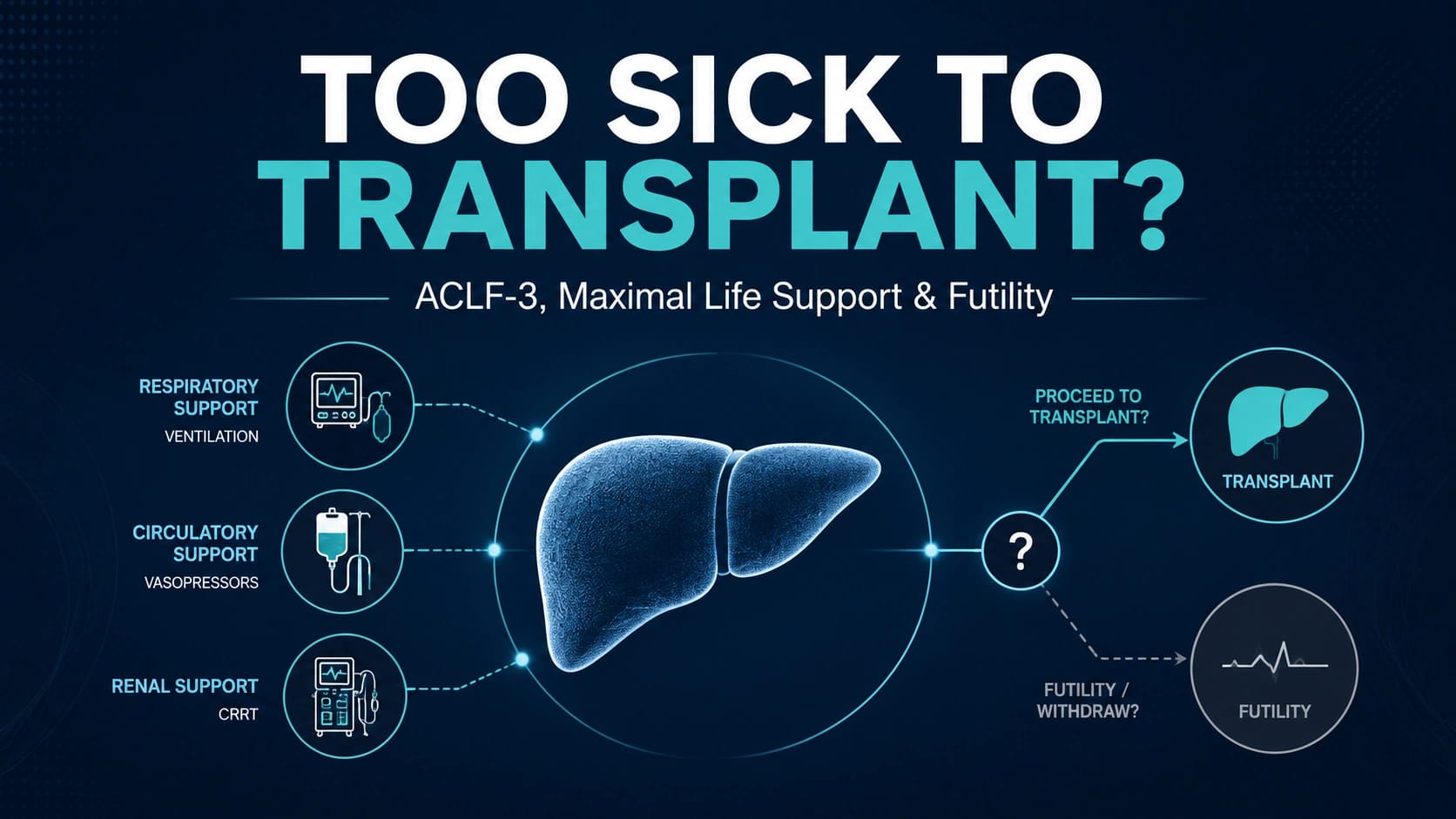
The Question Nobody on a Transplant Team Takes Lightly
There are few moments in hepatology more difficult than discussing liver transplantation for a patient with ACLF-3 who is already intubated, receiving vasopressors, and dependent on dialysis.
The urgency is obvious.
Without transplantation, mortality can be extraordinarily high. Yet transplantation does not remove the responsibility to ask whether the patient has enough physiologic reserve to survive the operation, recover from critical illness, and derive meaningful benefit from a scarce donor organ.
That is where the uncomfortable word futility enters the discussion.
The study “Liver Transplantation at the Extreme: Analysis of Outcomes and Predictors of Futility in Acute-on-Chronic Liver Failure Grade 3 Patients on Maximal Life Support,” by Melehy and colleagues, published online in JHEP Reports on August 5, 2026, examines precisely this group.
These were not simply patients with ACLF-3.
The investigators defined an extreme ACLF-3, or eACLF-3, phenotype in which every patient required mechanical ventilation, vasopressors, and dialysis at the time of liver transplantation.
The study then asked two important questions:
Can selected patients at this level of critical illness still achieve acceptable post-transplant survival?
And if so, which pre-transplant factors are associated with a higher likelihood that transplantation will ultimately prove futile?
This was an observational outcomes and risk-factor analysis, not a randomized study.
That distinction is central because the patients included had already passed through a transplant-selection process. The findings therefore inform selection; they do not tell us what would happen if every patient with eACLF-3 were transplanted.
“Extreme” Means More Than Three Organ Failures
ACLF-3 is already defined by severe multisystem dysfunction, with at least three organ failures and very high short-term mortality.
The study deliberately moved further toward the edge of that spectrum.
Every patient in the eACLF-3 cohort required three forms of major organ support at transplantation:
invasive mechanical ventilation
vasopressor therapy
renal replacement therapy
That is clinically important.
Two patients may both be classified as ACLF-3 while looking very different at the bedside. One may have relatively stable cardiovascular physiology and limited respiratory support. Another may require escalating vasopressors, worsening oxygenation, and continuous dialysis.
Combining those patients under one severity label can hide clinically meaningful heterogeneity.
This analysis focuses specifically on the second group—the patients for whom the transplant discussion is often occurring in the ICU, with the anesthesiologist, intensivist, hepatologist, surgeon, and family all aware that the margin for error is extremely small.
What the Investigators Studied
The investigators identified adult eACLF-3 liver transplant recipients between January 2010 and December 2021.
They compared patients who did and did not experience what the study defined as a futile outcome:
in-hospital mortality or death within one year of transplantation.
The analysis examined a range of recipient, physiologic, operative, and donor-related variables to determine which factors were associated with that endpoint.
The results were then externally evaluated using data from the Multi-Organ Dysfunction and Evaluation for Liver Transplantation Consortium, or MODEL Consortium.
That external comparison strengthens the study.
But again, the question is not whether transplantation is appropriate for ACLF-3 in general.
The study addresses something narrower and more difficult:
Among patients already at the extreme end of ACLF-3, can we distinguish those who still have meaningful transplant potential from those at particularly high risk of poor outcome?
Maximal Life Support Did Not Equal Universal Futility
At the authors’ centre, 1,608 adults underwent liver transplantation.
Of these, 177, or 11%, met the eACLF-3 definition.
Among those 177 recipients, 35 patients—20%—experienced the study-defined futile outcome.
That figure deserves a moment.
It means that even among patients who were intubated, receiving vasopressors, and dependent on dialysis at the time of transplantation, poor outcome was not inevitable.
Most selected patients in this cohort did not meet the futility endpoint.
The centre reported survival of:
89% at 3 months
85% at 6 months
80% at 12 months
For comparison, eACLF-3 patients in the MODEL Consortium had reported survival of:
83% at 3 months
79% at 6 months
70% at 12 months
Five-year survival was more similar between the cohorts:
63% versus 59%.
The important word here remains selected.
These results should not be converted into the claim that any patient with ACLF-3 on maximal organ support should proceed to transplantation.
They demonstrate something more nuanced:
Extreme acuity alone does not automatically make transplantation futile.
The Predictors Were More Informative Than the Organ-Failure Count
The study identified several variables associated with the futility endpoint:
previous upper abdominal surgery
sepsis within 14 days before transplantation
intubation because of pneumonia or ARDS
rapidly increasing MELD-Na
worsening PaO₂₂ ratio
worse pre-transplant base deficit
higher donor risk index
Several associations were substantial.
Prior upper abdominal surgery carried a reported odds ratio of 4.78.
Sepsis within 14 days before transplantation had an odds ratio of 6.68.
Ventilation because of pneumonia or ARDS had an odds ratio of 3.843.
A rise in MELD-Na of at least 6% per week was associated with an odds ratio of 3.07.
A worsening PaO₂₂ ratio of at least 12% per week had an odds ratio of 4.26.
Worst pre-transplant base deficit carried an odds ratio of 1.33 per unit decrease.
Higher donor risk index had an odds ratio of 2.542 per unit increase.
These are associations, not deterministic thresholds.
The useful clinical signal lies in the pattern.
Futility appears less related to the simple fact that a patient has three organ failures—everyone in the cohort already did—and more related to trajectory, infection, pulmonary disease, shock physiology, operative complexity, and donor quality.
Mechanical Ventilation Is Not One Prognostic Category
One of the most useful insights concerns respiratory failure.
Every patient in this cohort was intubated.
Therefore, intubation itself could not distinguish survivors from patients experiencing futile outcomes.
What mattered more was why the patient was ventilated and whether respiratory physiology was worsening.
Patients intubated because of pneumonia or ARDS had higher odds of futility.
A worsening PaO₂₂ ratio was also associated with poor outcome.
This fits an important bedside distinction.
A patient intubated primarily for airway protection in severe hepatic encephalopathy is not necessarily physiologically equivalent to a patient with severe inflammatory lung injury, infection, or progressive hypoxemia.
Both may appear identical in a database column labelled “mechanically ventilated.”
They are not identical patients.
The study does not provide an absolute PaO₂₂ threshold beyond which transplantation should be refused.
Nor should it be used that way.
Its message is more useful: respiratory phenotype and respiratory trajectory matter more than the ventilation label alone.
Recent Sepsis Deserves Particular Attention
Sepsis within the preceding 14 days was one of the strongest predictors associated with futility.
Anyone involved in ACLF transplantation will recognize the difficulty here.
“Is the infection controlled?” sounds like a binary question.
In practice, it rarely is.
Cultures may have cleared while vasopressor requirements remain high.
Antibiotics may be appropriate, yet oxygenation is worsening.
The source may have been controlled, but the patient remains metabolically unstable.
Or a patient may still require broad-spectrum therapy despite an improving hemodynamic trajectory.
The study does not establish a universal waiting period after sepsis.
It does not define an exact point at which infection becomes sufficiently controlled to proceed.
And it cannot prove that recent sepsis itself caused post-transplant death.
What it does show is that recent severe infection identifies a substantially higher-risk phenotype in this already critically ill population.
The practical response should therefore be better characterization of infection trajectory—not simply adding “sepsis: yes/no” to a checklist.
Trajectory May Matter More Than the Snapshot
Two of the predictors were explicitly dynamic:
increasing MELD-Na
worsening PaO₂₂ ratio
That is clinically important.
Transplant decisions are often made using measurements recorded at a particular moment.
But ACLF is not a static disease.
A patient with a MELD-Na of 38 that has been stable may not carry the same risk as another patient whose MELD-Na is rapidly worsening toward the same value.
Likewise, a patient with impaired oxygenation that is improving may be different from one whose gas exchange is deteriorating despite support.
The study supports an approach transplant clinicians have long used intuitively:
Direction matters.
The patient’s trajectory over the preceding hours and days may tell us more about physiologic reserve than a single laboratory value taken at 06:00.
Base Deficit: A Window Into Physiologic Reserve
Worsening pre-transplant base deficit was also associated with futility.
Base deficit is not a liver-specific variable.
That is precisely why it is useful here.
In a critically ill ACLF patient, worsening metabolic acidosis may reflect inadequate tissue perfusion, shock physiology, renal failure, sepsis, or a combination of several processes.
The association suggests that transplantation outcomes are influenced not only by how dysfunctional the liver is, but by how deeply the rest of the patient’s physiology has been pushed.
The liver can be replaced.
The consequences of prolonged multisystem shock are rather less cooperative.
Again, this is not a validated bedside exclusion threshold.
It is a marker that may help transplant teams judge the overall physiologic direction of travel.
Donor Quality Becomes Part of the Futility Equation
The presence of donor risk index among the predictors is especially interesting.
We often discuss transplant futility as though it belongs entirely to the recipient.
This analysis suggests otherwise.
When a recipient is already operating with very limited physiologic reserve, the characteristics of the graft may influence whether transplantation succeeds.
That does not mean higher-risk donor organs should never be used in ACLF-3.
The study does not provide such an allocation rule.
But it reinforces the importance of donor-recipient matching.
An eACLF-3 patient with recent sepsis, worsening oxygenation, significant metabolic derangement, and rapidly progressing disease may tolerate additional graft-related risk differently from a more stable recipient.
The transplant decision is therefore not simply:
“Is this patient transplantable?”
It may also be:
“Is this particular graft appropriate for this particular patient at this particular moment?”
Why Previous Upper Abdominal Surgery May Matter
Previous upper abdominal surgery was also associated with futility.
The study identifies the association but does not establish the exact mechanism behind it.
A plausible clinical interpretation is that prior surgery may increase operative complexity, adhesions, blood loss, or technical difficulty, but these possibilities should not be converted into proven causal explanations from this study alone.
The appropriate conclusion is simpler.
In patients whose physiologic reserve is already minimal, factors that may make transplantation more technically demanding deserve additional attention.
The operating room is not separate from ICU physiology.
The more difficult the transplant, the more reserve the patient may need to recover from it.
What the Study Supports
Several conclusions can reasonably be drawn.
First, eACLF-3 should not automatically be equated with transplant futility.
Selected patients receiving ventilation, vasopressors, and dialysis can achieve meaningful short- and longer-term survival after transplantation.
Second, patient selection remains critical.
The favourable outcomes in this report were achieved in patients who had already been selected for transplantation by an experienced centre.
Third, transplant assessment should extend beyond MELD-Na and organ-failure counts.
Recent sepsis, respiratory phenotype, oxygenation trend, metabolic shock physiology, disease trajectory, prior surgery, and donor characteristics may all contribute useful information.
Fourth, the relevant question is not simply how sick the patient is.
It is whether the patient appears recoverably sick or continues to deteriorate despite maximal support.
That distinction remains difficult, but this study offers several variables that may help define it more rigorously.
What Clinicians Should Not Conclude
The study does not show that all patients with eACLF-3 should undergo transplantation.
It does not establish any single variable as an absolute contraindication.
Recent sepsis does not automatically mean transplantation is futile.
ARDS does not automatically rule out transplantation.
A worsening MELD-Na or PaO₂₂ ratio does not create an independently validated stopping threshold.
Nor does a higher donor risk index automatically make a graft inappropriate.
These factors were associated with futility within an observational analysis.
Their value is likely cumulative and contextual.
The study also should not encourage transplant teams to delay referral while waiting for a patient to “declare themselves.”
ACLF-3 can deteriorate rapidly.
Futility assessment is only useful if transplant evaluation begins early enough for the team to observe trajectory, control infection, evaluate organ support, and make a decision before the window closes.
Selection Bias Is Not a Footnote
The most important limitation is inherent to the study design.
This was an observational analysis of patients who received transplantation.
They had already been selected.
Patients considered too unstable, too infected, too frail, or otherwise unsuitable may never have reached the operating room and therefore are not represented in the outcomes.
This creates unavoidable selection bias.
The finding that 80% of transplanted eACLF-3 patients avoided the study’s futility endpoint does not mean that 80% of all patients with eACLF-3 would benefit from transplantation.
That would be a very different study.
Residual confounding is also unavoidable.
The centre’s transplant expertise, ICU practices, donor selection, operative management, and thresholds for transplantation may all influence outcomes.
External evaluation through the MODEL Consortium strengthens confidence that the findings are not entirely centre-specific, but it does not eliminate those limitations.
Predictors Are Not Yet a Futility Score
The risk factors identified are clinically useful.
They are not yet a validated universal decision tool.
Prospective studies are needed to determine whether these variables can be combined into a reproducible score that improves transplant selection beyond expert multidisciplinary judgment.
Any future tool would also need to answer a difficult question:
What probability of one-year or in-hospital mortality should be considered unacceptable?
Medicine can build a model.
Defining futility remains partly a clinical and ethical judgment.
That decision involves expected benefit, organ scarcity, alternative candidates, reversibility of organ failures, patient values, and centre-specific outcomes.
A number can inform that discussion.
It cannot conduct it for us.
The Practical Message for the Transplant Team
The most useful way to read this study is not as permission to transplant every patient at the edge of survival, nor as a list of reasons to exclude them.
It is an argument for more disciplined selection.
When evaluating an eACLF-3 patient, the team should look beyond the fact that the patient is on three forms of life support.
Ask instead:
Is the infection controlled or still evolving?
Why is the patient intubated?
Is oxygenation improving or deteriorating?
Is MELD-Na stable or rising rapidly?
Is metabolic shock improving?
What operative challenges are anticipated?
What is the quality of the available donor organ?
And perhaps most importantly:
Is the overall trajectory suggesting recovery potential, or progressive loss of physiologic reserve?
Those are not new questions.
This study gives them stronger empirical footing.
Clinical Takeaway
This JHEP Reports study challenges the assumption that ACLF-3 patients requiring maximal life support are automatically beyond the point of meaningful liver transplantation.
Among 177 selected eACLF-3 recipients who were all intubated, receiving vasopressors, and dependent on dialysis at transplantation, 20% experienced the study-defined futile outcome, while reported survival reached 80% at one year in the primary cohort.
The more important finding, however, is not the survival number alone.
It is the pattern of risk.
Recent sepsis, pneumonia- or ARDS-related ventilation, worsening oxygenation, rapidly increasing MELD-Na, metabolic acidosis, prior upper abdominal surgery, and higher donor risk were all associated with futility.
These variables should not become isolated contraindications.
They should sharpen multidisciplinary assessment.
The study is practice-informing rather than independently practice-changing. It supports the idea that extreme acuity alone should not close the transplant door, while reminding us that successful transplantation depends on identifying patients whose critical illness is severe but still potentially reversible.
In ACLF-3, “too sick to transplant” is rarely a single number.
It is a trajectory.
Five Key Clinical Takeaways
eACLF-3 represented an exceptionally high-acuity population. Every patient required mechanical ventilation, vasopressors, and dialysis at the time of transplantation.
Maximal life support did not mean universal futility. Among 177 selected eACLF-3 recipients, 20% met the composite endpoint of in-hospital or one-year mortality.
Dynamic physiology mattered. Recent sepsis, pneumonia or ARDS, worsening PaO₂₂, increasing MELD-Na, and worse base deficit were associated with poor outcomes.
Donor and operative factors also contributed. Higher donor risk index and previous upper abdominal surgery were among the identified predictors, reinforcing that futility assessment extends beyond recipient liver severity alone.
These findings are not absolute transplant contraindications. They come from an observational, selected transplant population and require prospective validation before becoming a formal futility decision tool.

Source Reference
Melehy A, Thepbunchonchai A, Tran BV, Hernaez R, et al. Liver Transplantation at the Extreme: Analysis of Outcomes and Predictors of Futility in Acute-on-Chronic Liver Failure Grade 3 Patients on Maximal Life Support. JHEP Reports. Available online August 5, 2026; Article 101959. DOI: 10.1016/j.jhepr.2026.101959.
References

We are pioneers in clinical intelligence, dedicated to helping gastroenterologists harness the power of artificial intelligence to drive precision, efficiency, and patient growth.