
AI For Gastroenterology
Explore how AI for gastroenterology is transforming GI education, hepatology updates, clinical reasoning, endoscopy learning, IBD care, liver disease communication, and evidence-based digestive disease intelligence through GastroAGI.


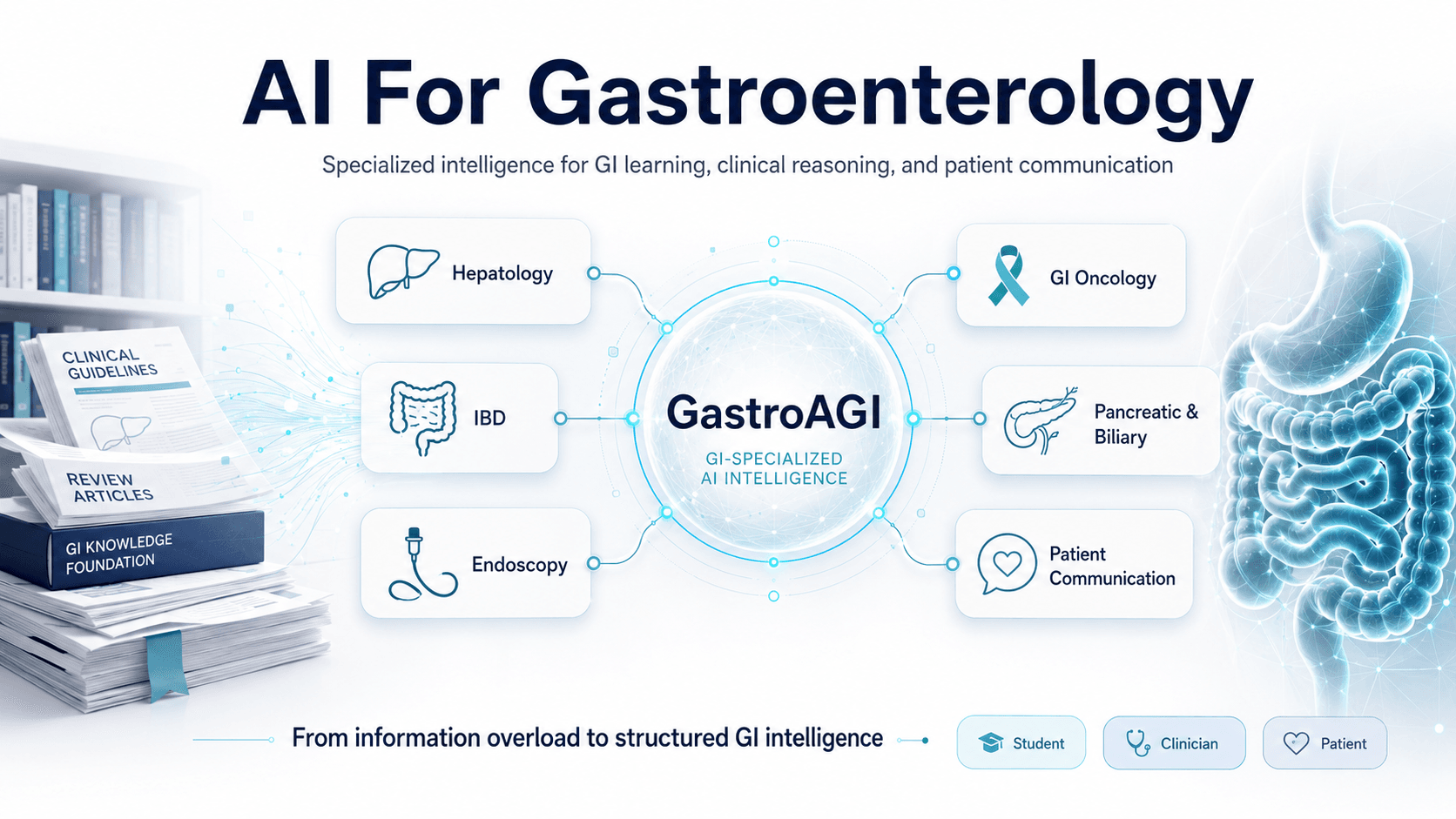
Gastroenterology is one of the most knowledge-dense fields in modern medicine. A gastroenterologist is expected to follow updates across hepatology, inflammatory bowel disease, endoscopy, pancreatobiliary disorders, gastrointestinal oncology, motility, nutrition, functional bowel disorders, and patient-centered communication. At the same time, new clinical guidelines, society recommendations, journal articles, conference abstracts, and therapeutic developments continue to expand at a pace that is difficult for any individual clinician, trainee, or researcher to track manually.
This is where the idea of AI for gastroenterology becomes important.
The future of medical AI is not simply about asking a chatbot a question. It is about building focused intelligence systems that understand the language, workflow, reasoning style, and safety requirements of a specific medical specialty. Gastroenterology needs more than generic artificial intelligence. It needs AI that can organize digestive disease knowledge, support gastroenterology education, assist with clinical reasoning, simplify complex GI topics, and communicate safely with patients.
GastroAGI was created around that idea: a trusted, HIPAA-ready HI-AI intelligence platform built specifically for gastroenterology.
It is designed not as a replacement for physicians, but as a structured intelligence layer for GI-focused learning, clinical context, and patient-friendly communication.
Why Gastroenterology Needs Specialized AI
The volume of information in gastroenterology has become overwhelming. Clinicians regularly move between PubMed, society guidelines, journal websites, conference highlights, clinical calculators, institutional protocols, and patient education resources. Each source may be valuable, but the workflow is fragmented.
A single clinical question may require reviewing several layers of information:
What do the latest GI guidelines recommend?
What does recent gastroenterology research suggest?
Are there hepatology updates relevant to this patient?
Is the answer different for a student, clinician, or patient?
Are there red flags that require urgent evaluation?
How should the information be explained safely?
Generic search engines return links. Generic AI may return broad explanations. But gastroenterology often needs something more refined: structured, context-aware, GI-specialized intelligence.
This is especially important in areas such as:
GERD and dyspepsia
Inflammatory bowel disease
MASLD and MASH
Cirrhosis and portal hypertension
Hepatitis B and hepatitis C
Hepatocellular carcinoma
Pancreatic cysts and pancreatic cancer
Acute pancreatitis
Biliary obstruction and ERCP
Colorectal cancer screening
Chronic diarrhea
Endoscopy education
Patient counseling and safety communication
Each topic carries different levels of urgency, evidence, complexity, and communication need.
A student asking about GERD symptoms does not need the same answer as a clinician evaluating progressive dysphagia with weight loss. A patient asking about fatty liver does not need dense guideline language; they need clarity, reassurance, and safe next steps.
That is why mode-adaptive AI for gastroenterology matters.
The Problem With Generic AI in GI Practice
Generic AI systems can be useful for broad explanations, but medicine requires a higher standard. Gastroenterology is full of high-stakes distinctions:
IBS versus IBD
GERD versus cardiac chest pain
benign dyspepsia versus alarm symptoms
uncomplicated jaundice versus cholangitis
prerenal AKI versus hepatorenal syndrome
autoimmune pancreatitis versus pancreatic adenocarcinoma
compensated cirrhosis versus decompensated liver disease
simple fatty liver versus advanced fibrosis
low-risk pancreatic cyst versus high-risk cystic lesion
A generic answer may sound confident while missing the clinical priority. In gastroenterology, that can be dangerous.
A GI-focused AI platform should do more than provide information. It should recognize red flags, preserve clinical nuance, explain uncertainty, avoid unsupported claims, and adapt the answer to the user’s role.
For example:
A student may ask:
“What is portal hypertension?”
A clinician may ask:
“How do I evaluate suspected hepatorenal syndrome versus other causes of AKI in cirrhosis?”
A patient may ask:
“My abdomen is swollen and I have liver disease. Should I worry?”
These questions may involve related concepts, but the correct answer style is different. The student needs teaching. The clinician needs prioritization and diagnostic reasoning. The patient needs plain language, safety guidance, and reassurance without false reassurance.
This is the difference between generic AI and specialized AI for gastroenterology.
GastroAGI: A GI-Specialized Intelligence Platform
GastroAGI is designed as a dedicated intelligence platform for gastroenterology and hepatology. Its purpose is to help users navigate GI knowledge more efficiently by bringing together the kinds of information that gastroenterology professionals already depend on:
journals
guidelines
conferences
clinical pearls
educational explanations
patient-friendly summaries
GI-focused reasoning pathways
The goal is not to replace clinical judgment. The goal is to reduce the burden of searching, organizing, and translating complex GI information into useful formats.
A gastroenterologist may want concise clinical reasoning. A postgraduate student may want structured learning. A patient may want an understandable explanation. GastroAGI is built around this role-based reality.
That is why the platform includes three key modes:
Student Mode
Clinician Mode
Patient Mode
Each mode is designed to answer differently.
Student Mode: GI Education and Concept Building
Gastroenterology education requires structure. Students need definitions, mechanisms, comparisons, flowcharts, and exam-oriented clarity. They need to understand not only “what” happens, but “why” it happens.
In Student Mode, GastroAGI is designed to support gastroenterology education by explaining concepts such as:
common symptoms of GERD
Crohn’s disease versus ulcerative colitis
pathophysiology of hepatic encephalopathy
portal hypertension and varices
AST versus ALT interpretation
role of bile in digestion
acute pancreatitis diagnosis
FIB-4 score and fibrosis assessment
alarm symptoms in dyspepsia
step-by-step approach to jaundice
This kind of AI-supported GI learning can help medical students, residents, fellows, and early-career clinicians revise complex topics in a structured format.
During internal stress testing, Student Mode showed strong teaching behavior, with a focus on clarity, exam pearls, definitions, and logical organization. It performed especially well as a learning-first interface for gastroenterology education.
Clinician Mode: Clinical Reasoning and Decision Support
Clinical gastroenterology is not only about knowing facts. It is about prioritizing risks, building differential diagnoses, identifying urgent conditions, and choosing appropriate next steps.
Clinician Mode is designed for this type of reasoning.
It can help structure questions such as:
What is the next step in progressive dysphagia with weight loss?
How should acute severe ulcerative colitis be managed?
When is urgent ERCP indicated in biliary disease?
How should indeterminate biliary stricture be evaluated?
How can autoimmune pancreatitis be differentiated from pancreatic cancer?
Can HCC be diagnosed without biopsy?
How should a pancreatic cyst be risk-stratified?
How should chronic diarrhea be evaluated after a normal colonoscopy?
How should upper GI bleeding be stabilized?
How should HRS-AKI be differentiated from other causes of AKI?
These are not simple search queries. They require clinical context.
A useful medical AI for gastroenterology should not simply list diseases. It should prioritize malignancy when alarm features are present. It should avoid routine urgent ERCP when not indicated. It should warn against empiric steroids when pancreatic cancer has not been reasonably excluded. It should recognize that HRS is a diagnosis of exclusion. It should distinguish variceal from non-variceal bleeding pathways.
This is where GI clinical decision support becomes meaningful: not by replacing clinicians, but by organizing reasoning in a structured and safe way.
Patient Mode: Safe and Clear GI Communication
Patient communication is one of the most important areas for healthcare AI. Patients often search online after seeing symptoms or reading medical reports. Without careful communication, AI can either create panic or provide unsafe reassurance.
Patient Mode is designed to explain digestive disease topics in plain language while preserving medical safety.
Examples include:
“Could my acidity after meals be GERD?”
“Is fatty liver dangerous?”
“I saw blood in my stool. Should I worry?”
“Can I live a normal life with hepatitis B?”
“My report says cirrhosis. What does that mean?”
“What foods should I avoid with acid reflux?”
“Why is my abdomen swollen in liver disease?”
“I have severe abdominal pain and vomiting. Can I wait?”
“What should I expect during colonoscopy?”
“I searched online and think I have pancreatic cancer. What should I do?”
These are emotionally sensitive questions. The answer must be medically accurate, but also calm, clear, and responsible.
A good patient-facing GI AI response should:
avoid jargon
explain possibilities without diagnosing
identify red flags
recommend timely medical care when needed
avoid false reassurance
reduce unnecessary fear
encourage professional evaluation
During internal evaluation, Patient Mode showed strong communication behavior, particularly around reassurance, emergency recognition, and plain-language explanation.
Stress-Testing GastroAGI Across Real GI Scenarios
Building an AI platform is only the first step. Testing how it behaves is equally important.
GastroAGI was evaluated using gastroenterology-focused questions across the three platform modes: Student, Clinician, and Patient. The purpose was not only to test factual recall, but to examine whether the platform could adapt tone, depth, reasoning style, and safety framing based on user intent.
The internal stress-test results showed:
Student Mode: approximately 8.4/10, with strong teaching structure and concept clarity
Clinician Mode: approximately 8.7/10, with strong clinical reasoning and guideline-aware responses
Patient Mode: approximately 9.0/10, with strong empathy, safety, and plain-language communication
The most important finding was not just the score. It was the mode separation.
GastroAGI behaved differently depending on who was asking:
Student Mode taught.
Clinician Mode reasoned.
Patient Mode reassured safely.
That distinction is central to the future of AI in gastroenterology.
Major GI Domains Where AI Can Support Knowledge Work
A platform for AI in gastroenterology must be able to cover the breadth of the specialty. GastroAGI’s long-term value comes from helping organize knowledge across major GI and hepatology domains.
Hepatology and Liver Disease
Hepatology continues to expand rapidly, especially in areas such as MASLD, MASH, cirrhosis, portal hypertension, hepatitis B, hepatitis C, liver fibrosis, hepatic encephalopathy, and hepatocellular carcinoma. Clinicians need updated guidance, risk stratification tools, patient education, and structured interpretation of liver-related questions.
AI can support hepatology updates by organizing information around fibrosis assessment, non-invasive testing, cirrhosis complications, HCC surveillance, and liver disease communication.
Inflammatory Bowel Disease
IBD care involves diagnosis, disease monitoring, biologic therapy, small molecule treatment, safety monitoring, endoscopy, imaging, and patient counseling. A GI-specialized AI system can help students understand Crohn’s disease versus ulcerative colitis, while helping clinicians reason through acute severe UC, steroid-refractory disease, and treatment escalation logic.
Endoscopy and Procedural GI
Endoscopy education requires understanding indications, risks, findings, complications, and follow-up. AI can support learning around colonoscopy, upper GI endoscopy, ERCP, EUS, polypectomy, GI bleeding, and surveillance strategies. For patients, it can explain what to expect during procedures in a calm and safe way.
Pancreatic and Biliary Disease
Pancreatobiliary disorders are high-stakes because delayed or incorrect reasoning can matter. Acute pancreatitis, pancreatic cysts, biliary obstruction, cholangitis, autoimmune pancreatitis, pancreatic cancer, and indeterminate biliary strictures all require careful context. AI for gastroenterology must avoid oversimplification in these areas.
GI Oncology
GI oncology includes colorectal cancer, gastric cancer, esophageal cancer, pancreatic cancer, cholangiocarcinoma, HCC, and neuroendocrine tumors. These topics require multidisciplinary thinking, staging awareness, alarm symptom recognition, and careful communication. AI can help organize knowledge, but it must avoid unsupported diagnostic certainty.
Why HIPAA-Ready AI Matters
As healthcare increasingly adopts AI, privacy and data governance become central. A trusted medical AI platform should be designed with privacy, security, and responsible use in mind. For a gastroenterology AI platform, HIPAA-ready architecture is not only a technical feature. It is part of clinical trust.
A HIPAA-ready AI approach should consider:
privacy boundaries
secure handling of health-related information
clear medical disclaimers
responsible patient communication
safe escalation for urgent symptoms
avoidance of unsupported diagnosis
clinical review pathways when appropriate
For clinicians and healthcare organizations, trust is built not only by good answers, but by responsible system design.
The Future of Gastroenterology Intelligence
The future of gastroenterology will not be defined by more information alone. It will be defined by better organization of information.
Doctors do not need endless tabs. Students do not need scattered notes. Patients do not need panic-driven search results. The specialty needs focused systems that can help convert information overload into structured gastroenterology intelligence.
AI for gastroenterology should be:
specialty-specific
evidence-aware
clinically structured
safe for patient communication
useful for education
adaptable to different user roles
clear about uncertainty
integrated into real workflows
GastroAGI is being developed around these principles.
It brings together the core idea that gastroenterology requires different answers for different contexts. A student, clinician, and patient may all ask about the same disease, but each needs a different type of response.
That is why mode-adaptive AI is not just a feature. It is a necessary design principle for medical AI.
Conclusion
AI for gastroenterology is not about replacing the gastroenterologist. It is about helping clinicians, trainees, and patients navigate an increasingly complex field with more clarity, speed, and context.
The strongest medical AI platforms will not be the broadest. They will be the most specialized, safest, and best aligned with real clinical workflows.
GastroAGI represents this direction: a trusted, HIPAA-ready HI-AI intelligence platform built specifically for gastroenterology. With Student Mode, Clinician Mode, and Patient Mode, it aims to support learning, reasoning, and communication across the GI ecosystem.
In a field shaped by journals, guidelines, conferences, endoscopy, hepatology, IBD, GI oncology, pancreatobiliary disease, and patient-centered care, the next step is clear.
Gastroenterology does not need generic AI.
It needs GI-specialized intelligence.
That is the future GastroAGI is building.
Explore GastroAGI
If you are a gastroenterologist, trainee, researcher, or medical educator navigating journals, guidelines, conferences, and clinical questions every day, GastroAGI is built for you.
GastroAGI brings GI-focused intelligence into one structured platform — helping users learn, reason, and communicate with more clarity across Student, Clinician, and Patient modes.
Explore how specialized AI can support modern gastroenterology workflows.
Visit GastroAGI: https://gastroagi.com
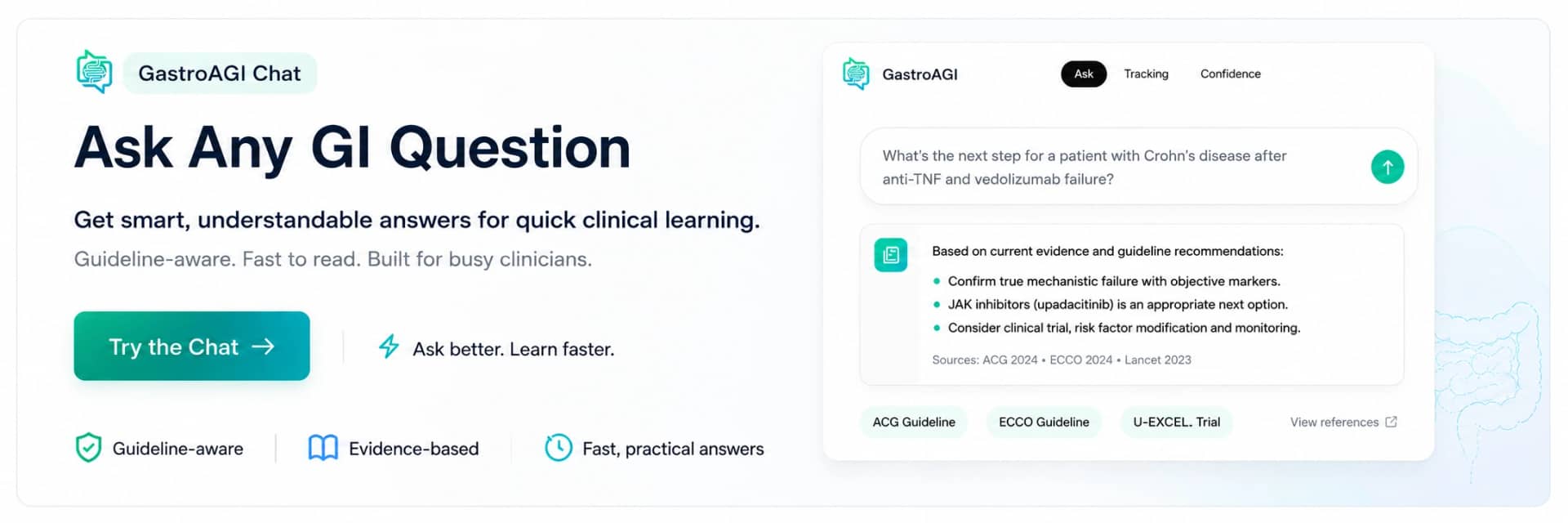

We are pioneers in clinical intelligence, dedicated to helping gastroenterologists harness the power of artificial intelligence to drive precision, efficiency, and patient growth.