
Once-Weekly Apraglutide in SBS–Intestinal Failure: What the STARS Phase 3 Trial Means for Parenteral Support Reduction
Phase 3 STARS trial shows once-weekly apraglutide reduced parenteral support volume in SBS–intestinal failure, with safety data.


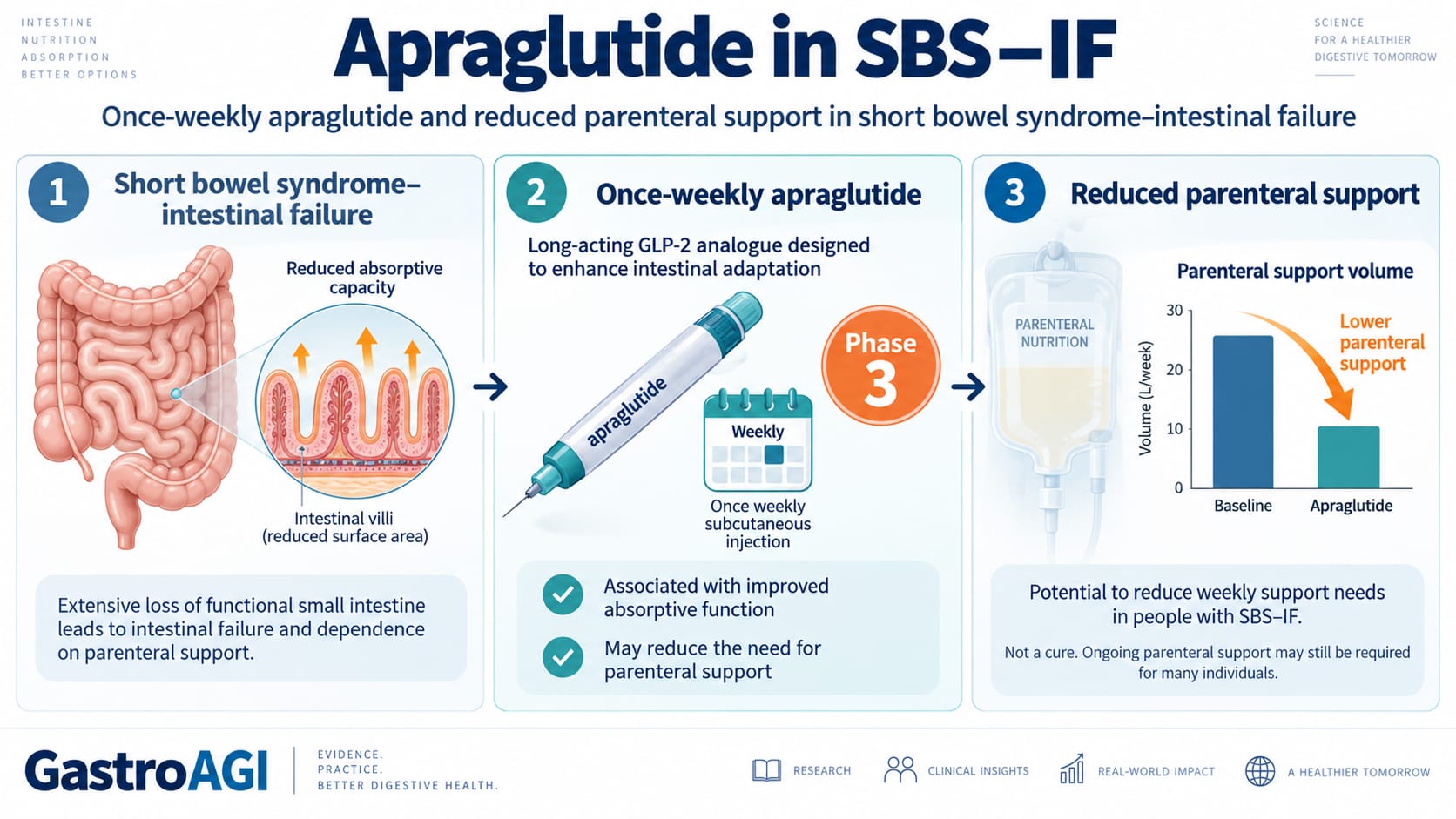
For patients with short bowel syndrome and intestinal failure, the defining clinical problem is not only reduced absorptive surface. It is dependency: dependency on parenteral support to maintain nutrition, hydration, electrolyte balance, and daily functioning. For clinicians managing intestinal failure, even a modest reduction in parenteral support can matter if it translates into fewer infusion days, less treatment burden, or a path toward partial independence. The unresolved question is whether pharmacologic stimulation of intestinal adaptation can reliably reduce that dependency in a clinically meaningful and safe way.
The phase 3 STARS trial addresses this question for apraglutide, a once-weekly, long-acting glucagon-like peptide-2 analog. The article, titled “STARS Phase 3 Trial: Once-Weekly Apraglutide Reduces Parenteral Support in Short Bowel Syndrome–Intestinal Failure,” was published online in Clinical Gastroenterology and Hepatology on September 3, 2026. The trial was designed to evaluate the efficacy and safety of once-weekly subcutaneous apraglutide compared with placebo in patients with short bowel syndrome–intestinal failure who required parenteral support to meet nutritional or fluid needs.
Why parenteral support reduction is a meaningful endpoint
Short bowel syndrome–intestinal failure is clinically burdensome because patients depend on parenteral support rather than enteral absorption alone to meet physiologic needs. The STARS abstract defines this population as patients with SBS–IF who depend on parenteral support for nutritional and fluid requirements. That dependency is more than a technical treatment label; it shapes daily life, care complexity, and the long-term goals of intestinal rehabilitation.
The primary endpoint in STARS was the relative change from baseline in weekly parenteral support volume at week 24. This endpoint is clinically understandable: if a drug improves functional absorption sufficiently, the amount of parenteral support required each week should fall. However, volume reduction should not be interpreted in isolation as cure, reversal of intestinal failure, or universal liberation from parenteral support. It is a measure of reduced support requirement within a structured clinical trial.
The trial also assessed secondary outcomes that may be particularly relevant to patients and clinicians, including days off parenteral support and enteral autonomy in the colon-in-continuity subgroup. These outcomes begin to connect volume reduction with the lived experience of therapy, although their statistical interpretation varies across endpoints.
Apraglutide and the GLP-2 rationale
Apraglutide is described in the source as a once-weekly, long-acting GLP-2 analog that promotes intestinal adaptation and may reduce parenteral support dependence. In clinician terms, the therapeutic logic is to enhance the residual intestine’s capacity to absorb fluid and nutrients after extensive bowel loss or dysfunction.
The important distinction is that STARS evaluates whether this biologic rationale translates into measurable reductions in parenteral support. The trial does not prove that all patients with SBS–IF will become independent of parenteral therapy, nor does it establish apraglutide as appropriate for patients outside the studied population. It tests once-weekly subcutaneous apraglutide against placebo under phase 3 trial conditions.
The once-weekly dosing schedule is clinically relevant because intestinal failure care is already complex. A therapy that requires less frequent administration may reduce treatment complexity compared with more frequent injection schedules, but the STARS source supports only the statement that apraglutide was administered once weekly; broader claims about adherence, preference, or cost-effectiveness are not established by the abstract.
How STARS was conducted
STARS was a global, phase 3, double-blind, placebo-controlled randomized trial. Eligible patients were randomized in a 2:1 ratio to once-weekly subcutaneous apraglutide or placebo. Randomization was stratified by remnant intestinal anatomy, specifically stoma or colon-in-continuity.
This stratification is important because anatomy can influence fluid and nutrient handling, clinical course, and the type of benefit that may be most realistic. The trial enrolled and dosed 163 patients, including 80 patients with stoma and 83 with colon-in-continuity.
The primary endpoint was assessed at week 24 in the overall population. Key secondary endpoints included relative change in parenteral support volume in the stoma subgroup, days off parenteral support in the overall and colon-in-continuity populations, and enteral autonomy in the colon-in-continuity group. A safety analysis was also conducted.
The design gives the trial several important strengths: randomization, placebo control, blinding, global enrollment, and prespecified anatomic stratification. These features support internal validity. However, like all phase 3 trials, interpretation still depends on endpoint hierarchy, subgroup power, follow-up duration, safety ascertainment, and the representativeness of enrolled patients.
The primary efficacy signal at week 24
The main result is clear: apraglutide significantly reduced weekly parenteral support volume from baseline compared with placebo at week 24 in the overall population. The mean relative change was −25.5% with apraglutide versus −12.5% with placebo, with a reported P value of .001. The source also describes this as a placebo-adjusted treatment difference of −13 percentage points.
This finding supports the trial’s primary conclusion that once-weekly apraglutide reduced parenteral support requirements in the studied SBS–IF population. It is not merely a numerical difference; it was statistically significant for the primary endpoint.
Clinically, the placebo response is also worth noting. The placebo group had a mean relative reduction of 12.5%, reminding clinicians that protocolized optimization, monitoring, and supportive care can themselves influence parenteral support volume. The treatment effect should therefore be interpreted as the incremental benefit of apraglutide over placebo in this trial context, not as a simple before-and-after effect attributable solely to the drug.
Stoma subgroup: a stronger anatomic signal
In the stoma subgroup, apraglutide was also associated with a significant reduction in weekly parenteral support volume. The mean relative change was −25.6% with apraglutide versus −7.8% with placebo, with P < .001.
This subgroup result is clinically relevant because stoma anatomy often presents distinct fluid and absorptive challenges. The source supports the conclusion that apraglutide reduced parenteral support volume in this subgroup. It does not, however, justify assuming that all stoma patients will achieve the same magnitude of benefit in routine practice.
The anatomic stratification makes the result more clinically interpretable, but subgroup findings still need cautious application. Gastroenterologists should consider baseline anatomy, residual bowel function, fluid losses, nutritional status, and individualized parenteral support targets when translating trial findings into practice discussions.
Days off parenteral support: moving from volume to burden
A key patient-centered question is whether reduced parenteral support volume translates into fewer days requiring infusion. In STARS, a higher proportion of patients receiving apraglutide achieved a reduction of at least one day per week of parenteral support at week 24 compared with placebo: 43.0% versus 27.5%, with P = .040.
This outcome is important because one fewer parenteral support day per week may be meaningful to patients and care teams. It may reduce treatment burden, although the source does not provide data on quality of life, complications, catheter events, healthcare utilization, or patient preference in the abstract. Therefore, any claim that apraglutide improves these outcomes would require additional evidence from the full article or other studies.
The finding does support a practical interpretation: apraglutide’s effect was not limited to a volume metric. In a subset of patients, it was associated with a reduction in the number of parenteral support days.
Colon-in-continuity outcomes at week 48
The colon-in-continuity subgroup was assessed for longer-term secondary outcomes at week 48. In this subgroup, the proportions achieving at least one fewer day per week of parenteral support were 51.8% with apraglutide versus 44.4% with placebo, with P = .348. The proportions achieving enteral autonomy were 12.5% versus 7.4%, with a nominal P = .387.
These data require careful language. Numerically, more patients in the apraglutide arm achieved these outcomes, but the reported P values do not show statistical significance for these comparisons. Therefore, clinicians should not conclude from these week 48 colon-in-continuity data that apraglutide definitively increases enteral autonomy in that subgroup.
The most responsible interpretation is that enteral autonomy occurred in some patients, but the evidence from this reported comparison remains uncertain. For clinical communication, this is a key distinction: the primary endpoint was positive; some secondary outcomes were supportive; other subgroup outcomes were numerically favorable but not statistically significant.
Safety and tolerability: reassuring but still incomplete from the abstract alone
The abstract states that apraglutide was well tolerated and had a favorable safety profile.
That statement is encouraging, particularly in a chronic, high-burden condition. However, the abstract does not provide detailed adverse event frequencies, discontinuation rates, serious adverse event patterns, laboratory signals, or long-term safety outcomes. For a therapy intended for patients with complex intestinal failure, those details matter.
Clinicians should therefore describe the safety signal as favorable within the reported phase 3 trial, while recognizing that detailed safety interpretation requires the full article and longer-term follow-up. The available source supports “well tolerated” and “favorable safety profile,” but not granular safety comparisons beyond that.
Funding and interpretation
The trial was funded by Ironwood Pharmaceuticals. The source states that the funder was involved in study design, data collection, analysis, and interpretation. Several author disclosures are also listed, including consulting, research, or employment relationships with companies involved in this therapeutic area.
Industry funding does not invalidate a trial, especially when the design is randomized, double-blind, placebo-controlled, and phase 3. But it does mean readers should examine protocol design, endpoint selection, statistical hierarchy, data transparency, and independent reproducibility carefully. The source notes that clinical trial data may be requested by qualified researchers under specified conditions, which is relevant for transparency.
For GastroAGI readers, this is not a reason to dismiss the findings. It is a reason to interpret them with the same disciplined scrutiny applied to any industry-sponsored pivotal trial.
What clinicians can reasonably conclude
The STARS trial supports the conclusion that once-weekly subcutaneous apraglutide significantly reduced weekly parenteral support requirements at week 24 compared with placebo in patients with SBS–intestinal failure. The evidence is strongest for the primary endpoint in the overall population and for parenteral support volume reduction in the stoma subgroup.
Clinicians can also say that more patients receiving apraglutide achieved at least one fewer day per week of parenteral support at week 24. This is clinically relevant because it moves beyond volume reduction toward reduced treatment frequency.
Clinicians should not conclude that apraglutide reliably produces enteral autonomy across all patients with SBS–IF. In the colon-in-continuity subgroup at week 48, enteral autonomy was numerically higher with apraglutide but not statistically significant based on the reported nominal P value.
Nor should clinicians infer from this source alone that apraglutide reduces catheter-related complications, improves survival, reduces hospitalization, improves quality of life, or is cost-effective. These may be important future questions, but they are not established by the reported abstract.
Evidence gaps and next questions
Several questions remain clinically important. First, which patient characteristics predict the greatest benefit? The trial stratified by anatomy, but clinicians will want more granular predictors such as baseline parenteral support volume, remnant bowel length, colon continuity, fluid versus calorie dependency, and duration of intestinal failure. The abstract does not provide those details.
Second, what is the durability of benefit beyond the reported time points? The article reports week 24 primary outcomes and week 48 colon-in-continuity outcomes, but long-term maintenance, discontinuation effects, and safety with prolonged exposure require continued assessment.
Third, how should apraglutide be positioned relative to existing intestinal rehabilitation strategies and other GLP-2 analog approaches? The STARS source establishes efficacy against placebo, not comparative effectiveness against other active treatments.
Finally, implementation will require practical protocols for parenteral support adjustment, hydration monitoring, nutritional assessment, and multidisciplinary oversight. A drug that reduces parenteral support requirements still needs careful clinical management to avoid under-replacement or destabilization.
Clinical Takeaway
The STARS phase 3 trial provides clinically meaningful evidence that once-weekly subcutaneous apraglutide reduces parenteral support volume in patients with short bowel syndrome–intestinal failure. The strongest signal is the statistically significant week 24 reduction in weekly parenteral support volume in the overall population, with additional supportive evidence in the stoma subgroup and in reduction of parenteral support days.
For gastroenterologists, hepatologists involved in intestinal failure programmes, nutrition teams, and fellows, the main message is balanced: apraglutide appears to offer a promising once-weekly pharmacologic strategy to reduce parenteral support burden in SBS–IF, but the evidence should not be overstated as universal enteral autonomy or disease reversal. The trial is practice-relevant and likely to influence future intestinal rehabilitation pathways, but patient selection, long-term safety, comparative positioning, and implementation protocols remain central questions.
Five key clinical takeaways
STARS was a phase 3, global, double-blind, placebo-controlled randomized trial of once-weekly subcutaneous apraglutide in SBS–intestinal failure.
The primary endpoint was met: weekly parenteral support volume fell more with apraglutide than placebo at week 24.
The stoma subgroup also showed a statistically significant reduction in parenteral support volume with apraglutide versus placebo.
More apraglutide-treated patients achieved at least one fewer parenteral support day per week at week 24, a clinically relevant treatment-burden outcome.
Enteral autonomy should be interpreted cautiously: in the colon-in-continuity subgroup at week 48, the difference was numerically higher with apraglutide but not statistically significant.
Source:
Joly F, Vanuytsel T, Kirby DF, et al. STARS Phase 3 Trial: Once-Weekly Apraglutide Reduces Parenteral Support in Short Bowel Syndrome–Intestinal Failure. Clinical Gastroenterology and Hepatology. Published online September 3, 2026. DOI: 10.1016/j.cgh.2026.08.026.
References

We are pioneers in clinical intelligence, dedicated to helping gastroenterologists harness the power of artificial intelligence to drive precision, efficiency, and patient growth.