
Artificial General Intelligence in Healthcare: What Gastroenterologists and Hepatologists Should Know Now
Evidence-based review of AGI in healthcare for GI clinicians, covering diagnostics, triage, workflows, limits, and the evidence gaps that matter today.


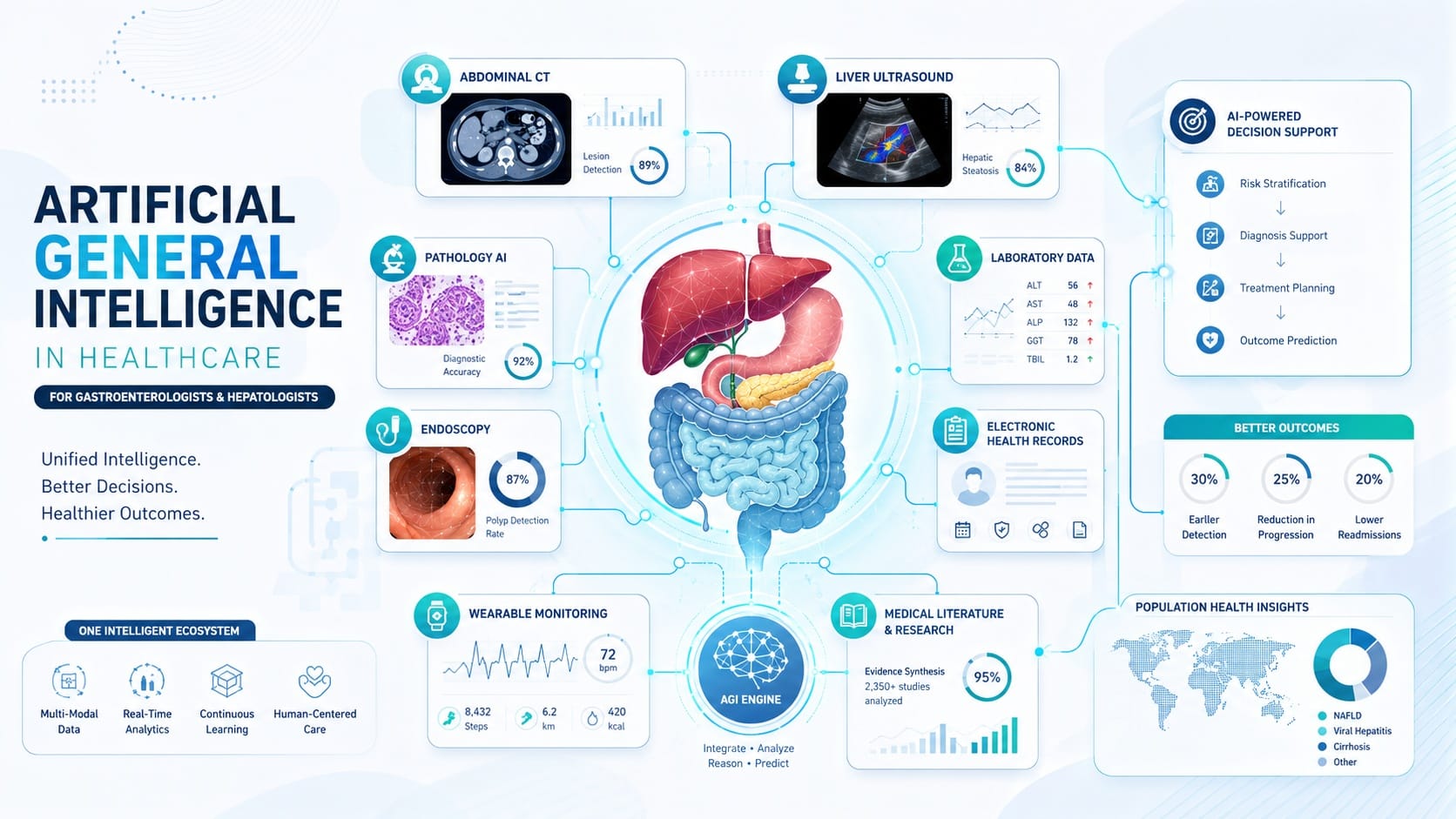
Could a future AI system integrate symptoms, laboratory data, longitudinal records, imaging, pathology, remote monitoring, and the literature well enough to act as a truly general clinical partner rather than a point tool? That is the unresolved question sitting underneath today’s excitement about artificial general intelligence in healthcare. The source base reviewed here suggests that healthcare is moving in that direction conceptually, but it also shows that most current deployment remains much closer to narrow AI or clinically bounded AI than to human-level general reasoning. For gastroenterologists, hepatologists, fellows, and researchers, the right starting point is therefore not triumphalism. It is disciplined curiosity.
Healthcare’s attraction to more capable AI is easy to understand. Several of the supplied sources describe a care environment overwhelmed by data: electronic health records, laboratory results, imaging, sensor streams, pathology, medical literature, and patient-generated information. LTTS points to electronic medical records, PACS, hospital systems, claims data, and surveys as major data streams, while Emorphis emphasizes records, labs, imaging, genomics, wearable data, claims, and clinical notes. HRS similarly frames AI’s appeal around improving decisions, supporting human judgment, and increasing efficiency. For subspecialists who routinely synthesize fragmented information across time, the clinical problem is recognizable even before one reaches the AGI question.
A useful clarification comes from Aidoc and Emorphis. Aidoc distinguishes healthcare AI from clinical AI: healthcare AI includes administrative and operational tools, whereas clinical AI is more directly aimed at patient care and clinician decision-making. Emorphis, by contrast, draws the line between today’s narrow AI and a hypothetical AGI that could reason across multiple domains, adapt to new scenarios, and integrate diverse types of information. That distinction matters for clinician expectations. Much of what is already being implemented in hospitals today belongs to the narrower side of that spectrum: image triage, workflow support, notification systems, documentation, or patient routing. The stronger the claim sounds like generalized physician reasoning, the weaker the evidence base becomes in the source set you provided.
One of the most clinically intuitive scenarios is multimodal diagnostic synthesis. Emorphis argues that an AGI-capable system could combine imaging, history, genetics, labs, lifestyle, and environmental context rather than interpret each stream in isolation. LTTS similarly describes AI-enabled EHRs that support suggestive diagnosis, disease risk estimation, and progression pathways, and it highlights radiology and pathology as areas where AI may improve speed and accuracy. Translated for a gastroenterology or hepatology reader, the attraction is obvious: many real patients do not present as single-data-type problems. They arrive with symptoms, prior procedures, medication exposure, serial labs, pathology, imaging, and changing risk factors. The source base supports the idea that broader data integration could improve diagnostic support, but it does not establish GI-specific performance, causation, or superiority over specialist care.
A second scenario is personalized treatment planning. Emorphis describes AGI as potentially able to evaluate prior treatment responses, monitor real-time change, predict complications, and recommend dynamic adjustments. LTTS puts similar weight on precision medicine, especially where genomics, environment, lifestyle, and history may allow a shift away from one-size-fits-all care. The Medium piece extends the same argument to individualized treatment selection. For clinicians in chronic digestive disease, this is an appealing vision: not because current sources prove it in GI, but because the logic of individualized longitudinal care is already central to subspecialty practice. What the sources support is a conceptual pathway toward more tailored recommendations. What they do not support is any conclusion that AGI has already validated treatment personalization in gastroenterology or hepatology, or that it should alter guideline-based care today.
A third scenario concerns care navigation, chronic disease follow-up, and remote monitoring. The BDJ paper describes AI-enabled personalized health information, virtual consultations, and remote monitoring as ways of improving access and allowing earlier intervention. Emorphis argues that wearable and home-device data could help detect deterioration and trigger proactive intervention. Infermedica’s AI-in-healthcare category emphasizes care navigation and digital triage, and HRS frames the broader future of AI around a shift from reactive to preventive care. For GI and liver clinicians, this is one of the more practical areas to watch because it starts from workflow and access, not from claims of autonomous diagnosis. Still, the source set remains largely descriptive. It supports the plausibility of earlier outreach and better routing, but it does not provide GI-specific evidence that such systems reduce decompensation, flare rates, procedure delays, or hospitalizations.
A fourth and more immediately tangible area is image and tissue interpretation, although this is arguably where the conversation is more about advanced clinical AI than AGI. Dave and Patel discuss AI in medical radiology and diagnostic histopathology, including image analysis, automated tissue segmentation, predictive analysis, and quality control. LTTS likewise describes AI contributions to medical imaging and pathology review, and Aidoc’s guide emphasizes the distinction between broader healthcare AI and patient-care-focused clinical AI. For clinician readers, this matters because it is closer to the present tense. The source set suggests that imaging and pathology are among the most concrete domains for implementation because the task boundaries are clearer and the inputs are more structured. But that should not be mistaken for proof that “general intelligence” has arrived. The most credible near-term reading is that bounded, validated, workflow-embedded tools are a more realistic bridge than full-spectrum AGI.
A fifth scenario is administrative relief and operational redesign. Emorphis lists workforce planning, scheduling, supply chain management, revenue cycle optimization, and workflow automation among likely AGI-related applications. LTTS similarly discusses appointment scheduling, billing, insurance claims, coding, demand forecasting, and regulatory monitoring. The Medium article adds patient flow and staffing optimization to the human-AI partnership theme. HRS, meanwhile, argues that AI is more likely to enhance clinicians than replace them. This cluster of use cases deserves more attention than it often gets in academic discussions because operational friction is itself a clinical issue. When documentation, routing, coding, or follow-up logistics fail, patient care degrades. Even so, operational usefulness should not be conflated with validated clinical outcome benefit. The sources support probable workflow value; they do not prove downstream causal improvements in specialty outcomes.
A sixth scenario is research acceleration and drug development. Emorphis and the Medium article describe AGI as a possible catalyst for hypothesis generation, target identification, drug interaction prediction, and simulation of clinical trial outcomes. LTTS adds in silico testing and large-scale analysis of clinical trial and real-world datasets. For researchers in digestive disease and hepatology, this may be one of the most strategically important long-range themes because the literature burden, biomarker complexity, and translational pipeline are already difficult to manage with conventional analytic approaches. Yet here again the evidence posture matters. The sources support a future-oriented claim that AI could accelerate discovery; they do not document a completed AGI-driven transformation in specialty therapeutics, and they do not establish whether faster model-driven discovery reliably translates into safer or better treatments.
The source set also raises an underappreciated domain for clinician leaders: education and professional adaptation. Dave and Patel explicitly extend the AI conversation into medical and dental education and even scientific publishing. HRS notes that healthcare workers will need stronger fluency in data and analytics as AI becomes more embedded in care delivery. Infermedica’s 2025 materials add a complementary emphasis on validation and regulated deployment, suggesting that the clinical task is not merely learning to use AI tools, but learning to interrogate them: What was validated, for whom, under what regulatory framework, and with what failure modes? That mindset may be especially important for fellows and early-career clinicians, because the real change may be less about replacing decision-makers and more about changing what competent decision-making requires.
So what should clinicians conclude from this evidence base? First, there is consistent cross-source agreement that AI’s opportunities in healthcare cluster around data synthesis, earlier identification of risk, personalization, triage, monitoring, clinical support, workflow redesign, and research acceleration. Second, there is also cross-source agreement that privacy, bias, transparency, safety, patient trust, and regulation are not side issues; they are core adoption constraints. Emorphis names privacy, explainability, bias mitigation, and trust directly. LTTS emphasizes privacy, security, and compliance. Infermedica’s recent validation- and certification-focused materials show that some parts of the field are moving from abstract enthusiasm toward trust-building and quality systems.
What clinicians should not conclude is equally important. The current source set does not justify the claim that AGI has been proven to improve GI-specific outcomes. It does not show that AGI should replace specialist judgment, that it is ready to redefine standards of care, or that conceptual scenarios in personalization and multimodal reasoning already constitute established clinical guidance. Most of the material is scenario-driven, strategic, or implementation-oriented. Even the strongest academic source is a narrative perspective, not a comparative effectiveness study. That difference is the line between possibility and proof.
For practice and research, the most responsible path is therefore incremental and evidence-seeking. In the near term, GI and hepatology leaders should probably be most interested in clinically bounded tools with transparent workflows, measurable task definitions, and some validation or regulatory maturity. In the medium term, the more ambitious promise is connective intelligence: systems that can unify records, imaging, pathology, monitoring, and literature into actionable support. In the long term, the AGI question remains open. But if that future arrives, it will still have to earn clinical trust the old-fashioned way: by showing where it works, where it fails, and whether it improves decisions, workflows, or patient outcomes in defined settings rather than in abstract prose.
Key clinical takeaways
The strongest scholarly source in the supplied set is a peer-reviewed perspective paper, not a clinical trial, so the overall evidence base is best read as conceptual and implementation-oriented rather than outcomes-proving.
The most realistic near-term benefits for clinicians appear to be bounded clinical AI and workflow tools such as diagnostic support, digital triage, remote monitoring, pathology or imaging support, and documentation or operational automation.
The supplied sources consistently frame future value around multimodal data integration, personalization, earlier detection, and proactive care, but they do not establish GI-specific causal benefit or justify changing specialty standards of care.
For clinician adoption, validation, explainability, privacy, bias mitigation, regulatory compliance, and trust are not secondary concerns; they are central determinants of whether an AI tool should be used at all.
The most defensible practice stance today is to treat AGI as a strategic horizon while evaluating present-day tools task by task, with clear attention to workflow fit, clinical governance, and specialty-specific evidence gaps.
Source references
Primary peer-reviewed source: Dave M, Patel N. Artificial intelligence in healthcare and education. British Dental Journal. May 2023; 234(10):761–764.
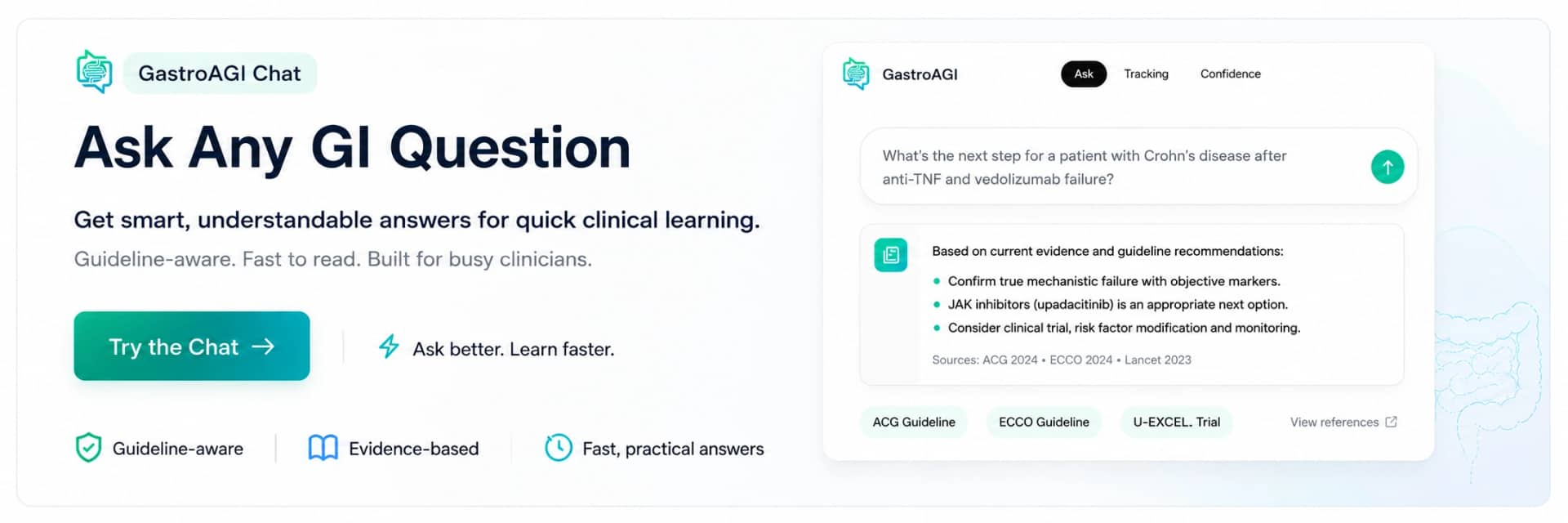

We are pioneers in clinical intelligence, dedicated to helping gastroenterologists harness the power of artificial intelligence to drive precision, efficiency, and patient growth.