
Cholesterol Metabolism in Pancreatic Cancer 2026: Why FOLFIRINOX Resistance May Start With a Lipid Pathway, Not a Mutation
New NCI-funded research links the ZC3H15-KDM3A-cholesterol axis to FOLFIRINOX resistance in pancreatic cancer, and tests rosuvastatin as a chemosensitizer.


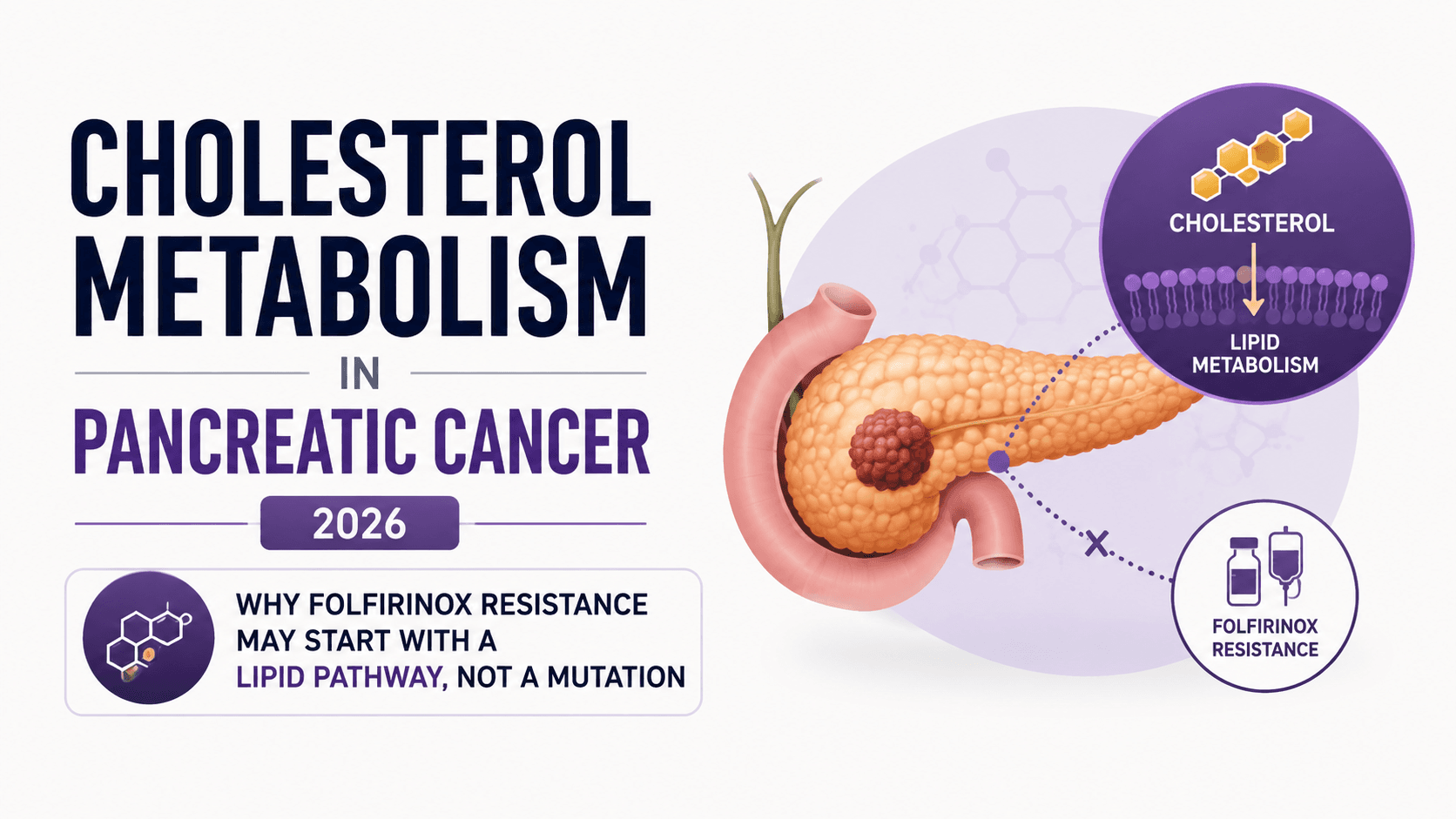
A 61-year-old man with borderline-resectable PDAC completes six cycles of neoadjuvant FOLFIRINOX. Restaging imaging shows a tumor that has barely moved, and repeat biopsy shows a spindled, mesenchymal-appearing population that wasn't dominant on the original specimen. Genomic testing is unremarkable - no new KRAS variant, no acquired resistance mutation. The tumor didn't mutate its way out of chemotherapy. It may have metabolically reprogrammed its way out instead, and new NCI-funded work out of the University of Oklahoma is pointing at cholesterol handling as the mechanism.
The core clinical problem
PDAC's resistance to FOLFIRINOX and gemcitabine-based regimens is well documented, but most of the mechanistic literature centers on stromal density, hypoxia, and drug efflux transporters - targets that have been difficult to translate into anything actionable at the bedside. What's newer, and what this research direction adds, is a specific molecular route by which pancreatic cancer cells appear to reprogram cholesterol metabolism under therapeutic stress, and in doing so acquire both drug tolerance and a more invasive, epithelial-to-mesenchymal transition phenotype. If tumor ZC3H15 expression tracks with treatment failure the way early data suggest, cholesterol metabolism moves from a peripheral finding to a plausible therapeutic target - one that happens to already have an FDA-approved, inexpensive drug sitting on the shelf.
The ZC3H15–KDM3A–cholesterol axis
The University of Oklahoma team, led by investigator Sunil Kumar Shukla and supported by a five-year, $2 million NCI R01 grant, identified ZC3H15 as an RNA-binding protein that stabilizes transcripts encoding KDM3A, a histone demethylase. By protecting the RNA instructions for producing KDM3A, ZC3H15 appears to change how pancreatic cancer cells use cholesterol. In preliminary studies, tumors with high ZC3H15 expression were associated with chemotherapy resistance and worse survival - a correlation strong enough to justify the funded mechanistic follow-up.
The downstream consequence is where this gets clinically interesting. The cholesterol-related changes triggered by this axis appear to drive epithelial-to-mesenchymal transition, making cancer cells more mobile and adaptable rather than simply making them proliferate faster. That distinction matters: a tumor that survives chemotherapy by becoming more resistant to apoptosis and more capable of dissemination behaves differently on imaging and in the clinic than one that is simply growing through treatment. It helps explain a pattern many gastroenterologists and GI oncologists have seen anecdotally - post-FOLFIRINOX tumors that look biologically tougher, not just bigger.
Case in point
A 58-year-old woman with metastatic PDAC to the liver responds well to first-line FOLFIRINOX for four months - CA 19-9 drops by more than 80%, and hepatic lesions shrink on CT. At month five, CA 19-9 begins climbing again despite continued therapy, and a new liver lesion appears outside the previously treated field, with morphology suggesting a more infiltrative growth pattern than the original disease.
The oncology team faces the familiar dilemma of whether this represents true progression warranting a regimen switch or a transient flare. What the ZC3H15–KDM3A framework offers, if validated, is a biological explanation for why "resistant" PDAC so often reappears as more aggressive rather than merely unresponsive - a metabolic shift toward EMT rather than a static drug-efflux problem. It reframes the question from "which second-line regimen" to "is there a metabolic vulnerability worth targeting alongside cytotoxic therapy."
Rosuvastatin as a chemosensitizer - the translational hook
The most immediately actionable part of this research program is the plan to test whether rosuvastatin, a widely prescribed statin, can restore chemosensitivity when combined with FOLFIRINOX. The investigators will evaluate whether rosuvastatin, despite being prescribed primarily to lower cholesterol, can also disrupt the cholesterol-related changes that help pancreatic cancer resist chemotherapy, using patient-derived tumor models and genetically engineered mouse models over the five-year grant period.
The appeal here is practical rather than purely scientific. Statins are cheap, familiar to every clinician, have a well-characterized safety profile, and are already used in a large proportion of PDAC patients for cardiovascular indications - meaning any positive signal could move toward clinical testing faster than a novel compound would. That said, "well-tolerated and already prescribed" is not the same as "proven to chemosensitize PDAC in humans." This work is currently confined to laboratory models grown from patient tumors and specially bred mice; there is no clinical trial data yet, and extrapolating a benefit to patients on statins for cardiovascular reasons would be premature.
A frequently overlooked point
Clinicians tend to treat incidental statin use in PDAC patients as background noise - a comorbidity medication unrelated to the cancer itself. This research suggests that assumption deserves reconsideration, not because there's yet evidence to change prescribing, but because the biological plausibility of a cholesterol-lowering drug interacting with tumor behavior is no longer speculative. It's also worth remembering that EMT-associated resistance doesn't show up on genomic panels - a patient with a "clean" resistance workup and no actionable mutation may still be undergoing a metabolic transition that current testing simply isn't built to detect.
Bottom line for clinical practice
Genomically "unremarkable" chemoresistant PDAC may still be undergoing metabolic reprogramming - absence of a resistance mutation doesn't rule out a biological escape route.
The ZC3H15–KDM3A–cholesterol axis is preclinical and correlative at this stage; do not adjust statin prescribing or treatment selection based on this pathway yet.
Track this research program (NCI award R01CA316828-01) for early signals on rosuvastatin plus FOLFIRINOX combination data before it reaches clinical trial stage.
Consider that post-treatment tumors with a more invasive phenotype on imaging or biopsy may reflect EMT-driven adaptation rather than simple undertreatment.
Cholesterol metabolism as a druggable vulnerability in PDAC is still five years of laboratory work away from bedside relevance, but it's the kind of mechanism worth tracking now - because the proposed intervention is a drug already in your patients' medicine cabinets. When you're working through a resistant PDAC case and the genomics come back clean, GastroAGI can help you reason through the less obvious explanations, including emerging metabolic and epigenetic resistance pathways like this one.

We are pioneers in clinical intelligence, dedicated to helping gastroenterologists harness the power of artificial intelligence to drive precision, efficiency, and patient growth.