
Clinical Decision Support in Gastroenterology: Why General Medical AI Keeps Falling Short
Tools like Glass Health and Nabla weren't designed for the diagnostic complexity of GI. A frank look at what general medical AI gets right - and where it leaves gastroenterologists without an answer.


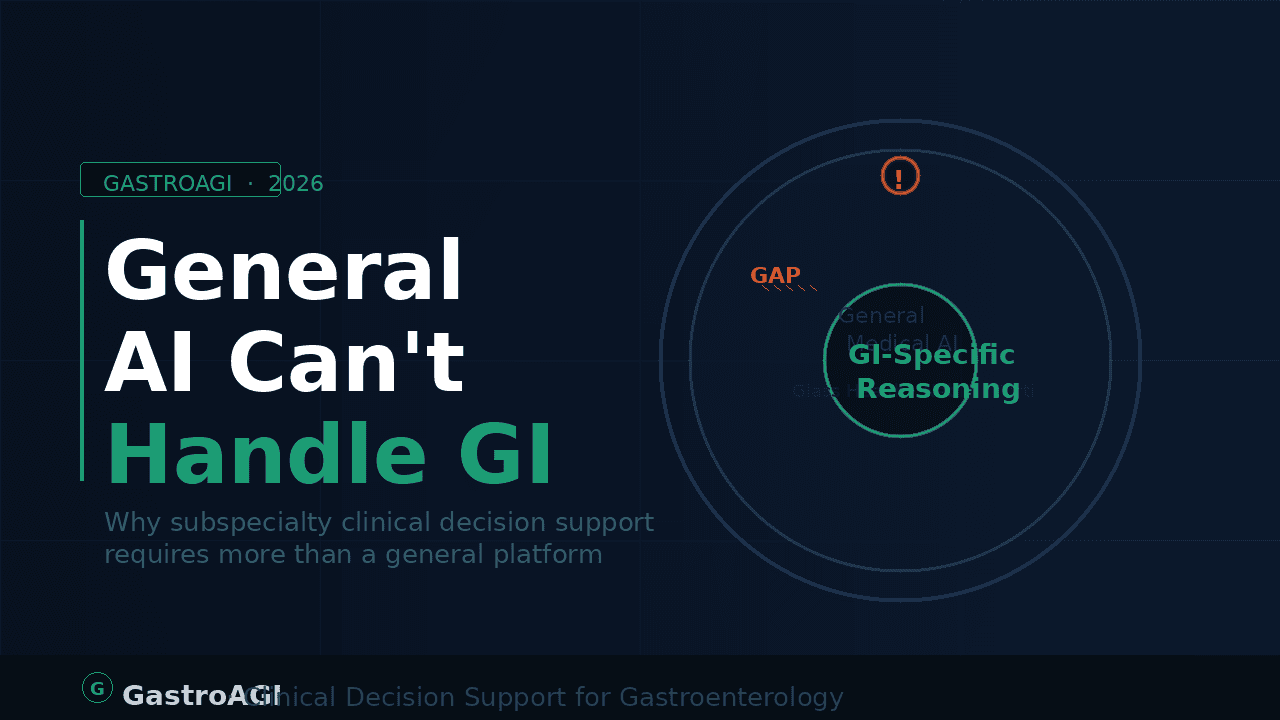
A GI fellow presents a 38-year-old with a third IBD flare in eight months - prior biologics failing, CRP climbing, and an upcoming infusion appointment that may need to change today. She types the case into a well-regarded general AI tool. The response is accurate, well-organized, and completely useless: it outlines the stepwise management of IBD as if she opened a textbook to page one. What she needed was a reasoned opinion on whether to step up to a JAK inhibitor, bridge with steroids, or expedite surgical review - and the confidence that the answer was grounded in current ECCO and ACG guidance, not a language model's best guess. She closes the tab.
This scenario plays out dozens of times a day in GI practices that have tried to integrate AI into clinical workflows. The tools exist. They are polished, well-funded, and genuinely useful for a broad swath of medicine. Clinical decision support in gastroenterology, however, is a different problem - one that general-purpose platforms were not built to solve, and that their architects have not yet prioritized. Understanding where the gap sits and why it matters clinically is worth walking through carefully before choosing which tools earn a place in a GI workflow.
What general AI tools for gastroenterologists actually do well
To be fair to the tools currently on the market, ambient scribing is genuinely solved. Nabla, which raised $70M in mid-2025 and now supports over 85,000 clinicians, cuts documentation time by more than half in peer-reviewed studies from the University of Iowa Health Care and Denver Health. Corti, used in over 100 million patient interactions annually, listens to live consultations and auto-generates structured clinical notes while checking guidelines in real time. Glass Health, the platform most comparable to a bedside reasoning aid, takes a natural-language case description and returns a ranked differential with suggested workup. For a primary care physician managing undifferentiated chest pain or fatigue, these tools cover a lot of ground.
The documentation problem in medicine is real, and these platforms address it well. A gastroenterologist running 20 clinic patients a day benefits from ambient scribing as much as any internist. Corti's multilingual real-time transcription is legitimately impressive. Glass Health's clean interface - no menus, no friction, just type and receive - has made it popular with residents across specialties for exactly this reason.
Per the 2025 ASGE AI Task Force consensus statements, the near-term clinical applications of AI in gastroenterology most likely to be adopted are documentation support, patient communication, and administrative workflow. On those dimensions, the current generation of general tools performs adequately. The problem surfaces the moment a case demands subspecialty reasoning rather than clean documentation - and in GI, that happens constantly.
Clinical scenario
A 61-year-old male with compensated cirrhosis (Child-Pugh B, MELD-Na 14) presents with a two-day history of low-grade confusion, increased abdominal girth, and a serum sodium of 129. His last paracentesis was three weeks ago. Outpatient lactulose compliance is uncertain. He is not febrile, and his creatinine has risen from 0.9 to 1.4 over four weeks.
The attending types this presentation into Glass Health. The differential returns hepatic encephalopathy, hyponatremic encephalopathy, and spontaneous bacterial peritonitis - all correct, all appropriate. What the response does not do: it does not apply the West Haven Criteria to grade the encephalopathy, it does not flag that a creatinine rise from 0.9 to 1.4 in a cirrhotic patient meets criteria for acute kidney injury requiring diagnostic paracentesis to exclude SBP regardless of fever, and it does not reason through whether this patient's sodium trajectory puts him at risk for osmotic demyelination if correction is too aggressive. These are not obscure nuances - they are the decisions that determine whether this patient is managed safely as an outpatient, admitted to a general ward, or escalated to hepatology. A tool that generates a correct but operationally inert differential has not provided clinical decision support. It has provided reassurance.
Why GI complexity defeats horizontal AI platforms
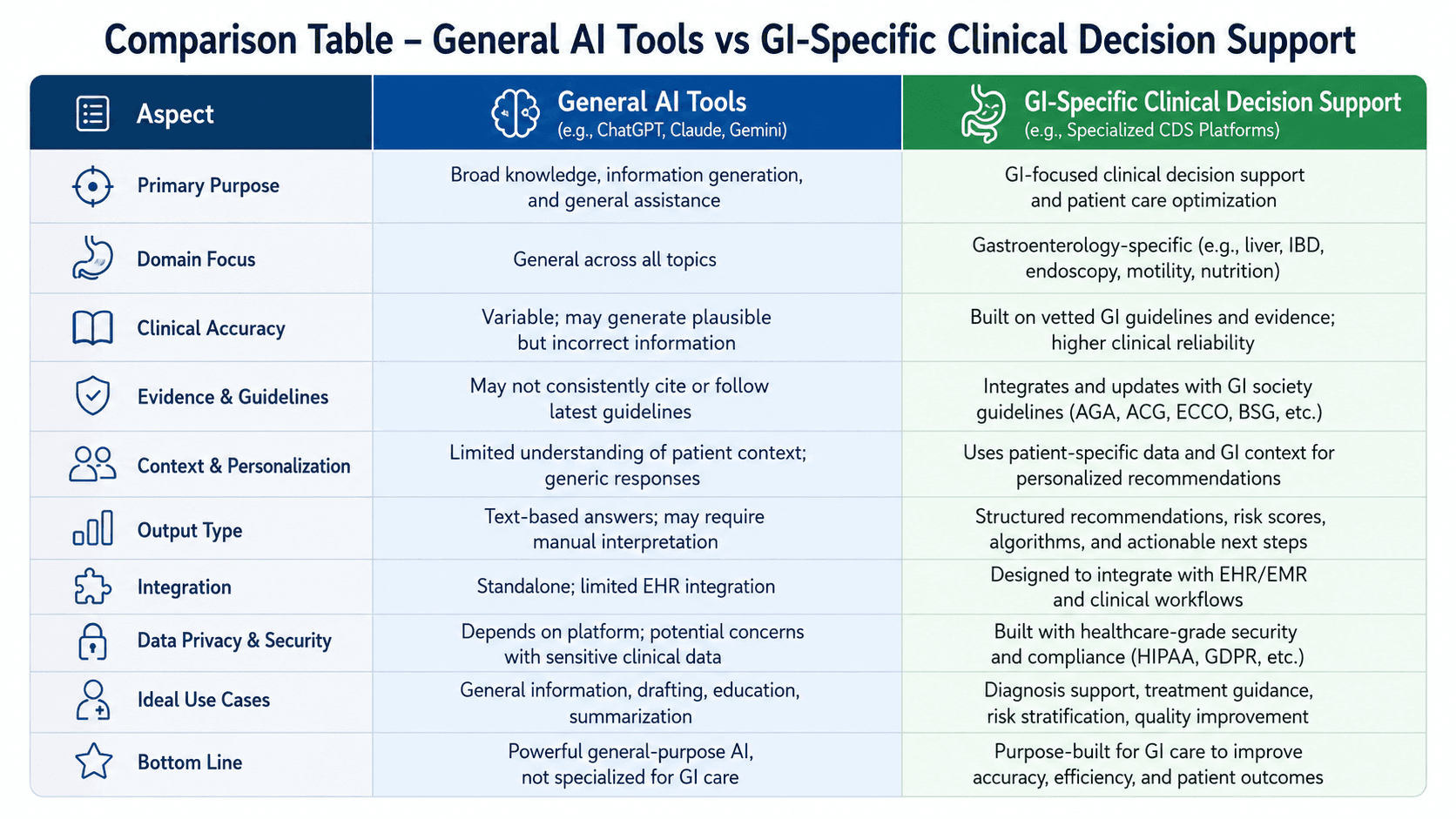
The subspecialty problem in AI for gastroenterologists and hepatology is structural, not incidental. General platforms are trained to perform well across medicine broadly - which means their reasoning is calibrated for the median clinical scenario, not the complex GI case. Three specific failure modes recur.
First, scoring systems. Gastroenterology and hepatology run on validated scoring tools - MELD-Na for transplant listing, Harvey-Bradshaw for Crohn's activity, the Baveno VII criteria for varices screening, Glasgow-Blatchford for upper GI bleeding triage, Lille score for alcoholic hepatitis steroid response. These are not optional enhancements to clinical reasoning; they are the reasoning. A platform that cannot apply them accurately and interpret them contextually is generating informed-sounding prose, not clinical decision support. Glass Health, reviewed extensively in 2026, explicitly does not provide drug dosing or evidence citations - both of which are inseparable from scoring-based GI management.
Second, guideline specificity. The ACG, ASGE, EASL, and ECCO publish subspecialty guidelines that are detailed, frequently updated, and clinically decisive. When a GI fellow asks whether to test for H. pylori after a negative biopsy in a patient on PPIs, the answer depends on whether the test used was a urea breath test, stool antigen, or rapid urease test - and the 2023 ACG H. pylori guidelines address this directly. A generalist AI trained on broad medical corpora will approximate this answer. A tool built around current subspecialty guidance will give it precisely. For AI GI fellows and residents in training, the difference between an approximate answer and a precise one is not academic - it shapes clinical habits that persist for decades.
Third, evidence currency. The IBD biologic landscape changed materially between 2022 and 2025. JAK inhibitor positioning, the ECCO guidance on IL-12/23 inhibitors, updated STRIDE-II treat-to-target criteria - these are clinically active decisions in every moderate-to-severe IBD follow-up. A platform not specifically updated against subspecialty GI literature will lag in exactly the areas that matter most.
A frequently overlooked point about AI adoption in GI
The most expensive failure mode in clinical AI is not the tool that gives a wrong answer - it is the tool that gives a confidently incomplete one. A gastroenterologist who receives a polished, well-structured response that stops just short of the decision they need will either fill the gap with their own judgment (no harm done, no benefit gained) or, more dangerously in a trainee, mistake comprehensiveness of format for completeness of reasoning. General tools are very good at looking thorough. Subspecialty clinical decisions in GI require more than a well-organized differential. They require a tool that knows what question comes next.
Bottom line for clinical practice
Ambient scribing tools (Nabla, Corti) solve the documentation burden well - adopt them for that purpose, but do not expect them to reason through a hepatic encephalopathy grading or a Baveno VII varices decision.
Glass Health's differential diagnosis engine is useful for case structuring and trainee education, but independent reviewers confirm it provides no evidence citations and limited reliability on complex multi-system presentations - both of which are routine in GI hepatology.
Scoring systems are not optional add-ons in GI - MELD-Na, Glasgow-Blatchford, Lille, Harvey-Bradshaw, and others are clinical decisions. Any AI tool for gastroenterologists that cannot apply and contextualise these is providing partial support at best.
Current ASGE and ACG guidance on AI in GI clinical practice specifically calls for tools that generate real-world evidence on patient outcomes - not just documentation efficiency. Hold AI tools to that standard before integrating them into complex case management.
For GI fellows building clinical reasoning habits: the tool you train with shapes how you think. A tool that approximates subspecialty answers is a worse teacher than one that reasons from current GI guidelines explicitly.
When you're in clinic and the case is moving faster than a textbook chapter can keep up with - a decompensating cirrhotic, a steroid-refractory IBD flare, an upper GI bleed where the Glasgow-Blatchford score changes your triage decision - the gap between a general AI response and a GI-specific one is not a matter of preference. Walk the case through GastroAGI → and see what subspecialty clinical decision support in gastroenterology actually looks like.

We are pioneers in clinical intelligence, dedicated to helping gastroenterologists harness the power of artificial intelligence to drive precision, efficiency, and patient growth.