
Coffee and Gut Microbiota: What the 2024 Metagenomic Data Means for GI Practice
Coffee's GI effects go beyond caffeine-driven motility. Here's what the 2024 metagenomic data on gut microbiota, dysbiosis risk, and dosage thresholds means for practice.


A 42-year-old patient returns from a colon resection and is back on solid food by day three, weeks ahead of the ward's usual timeline. Her surgeon credits the two cups of coffee she insisted on the morning after surgery. She's not wrong to give coffee the credit - but the mechanism she assumes, caffeine kicking the bowel into gear, is likely only half the story. A growing body of metagenomic and clinical data suggests coffee's gut effects run through the microbiota itself.
The core clinical problem
For decades, coffee's effect on bowel function has been attributed almost entirely to the gastrocolic reflex - caffeine-driven stimulation of colonic motility and transient hormonal signaling. That explanation is tidy, but it doesn't hold up against several inconvenient findings: decaffeinated coffee produces similar motility effects in vitro, caffeine alone fails to replicate coffee's post-surgical recovery benefit, and coffee-associated shifts in gut microbiota composition persist independent of caffeine content. The clinical relevance of coffee and gut microbiota research isn't academic. Patients ask about coffee constantly - after GI surgery, with IBS, with reflux, with IBD - and "it stimulates your colon" is an incomplete answer that misses the polyphenol- and melanoidin-driven mechanisms now documented at scale.
Coffee-Responsive Bacteria and the Lawsonibacter Signal
The clearest evidence for a direct coffee-microbiota interaction comes from a 2024 Nature Microbiology analysis of metagenomic data from more than 54,000 stool samples paired with dietary records from over 22,000 participants across European and US cohorts. The study identified a consistent, dose-related association between coffee intake and increased abundance of Lawsonibacter asaccharolyticus - a species whose functional role is still being characterized. Critically, this association held across independent cohorts with different dietary backgrounds and was present even among decaffeinated coffee drinkers, which rules out caffeine as the sole driver. In vitro work in the same study showed coffee directly promoting bacterial growth in culture, supporting a biological rather than purely epidemiologic link.
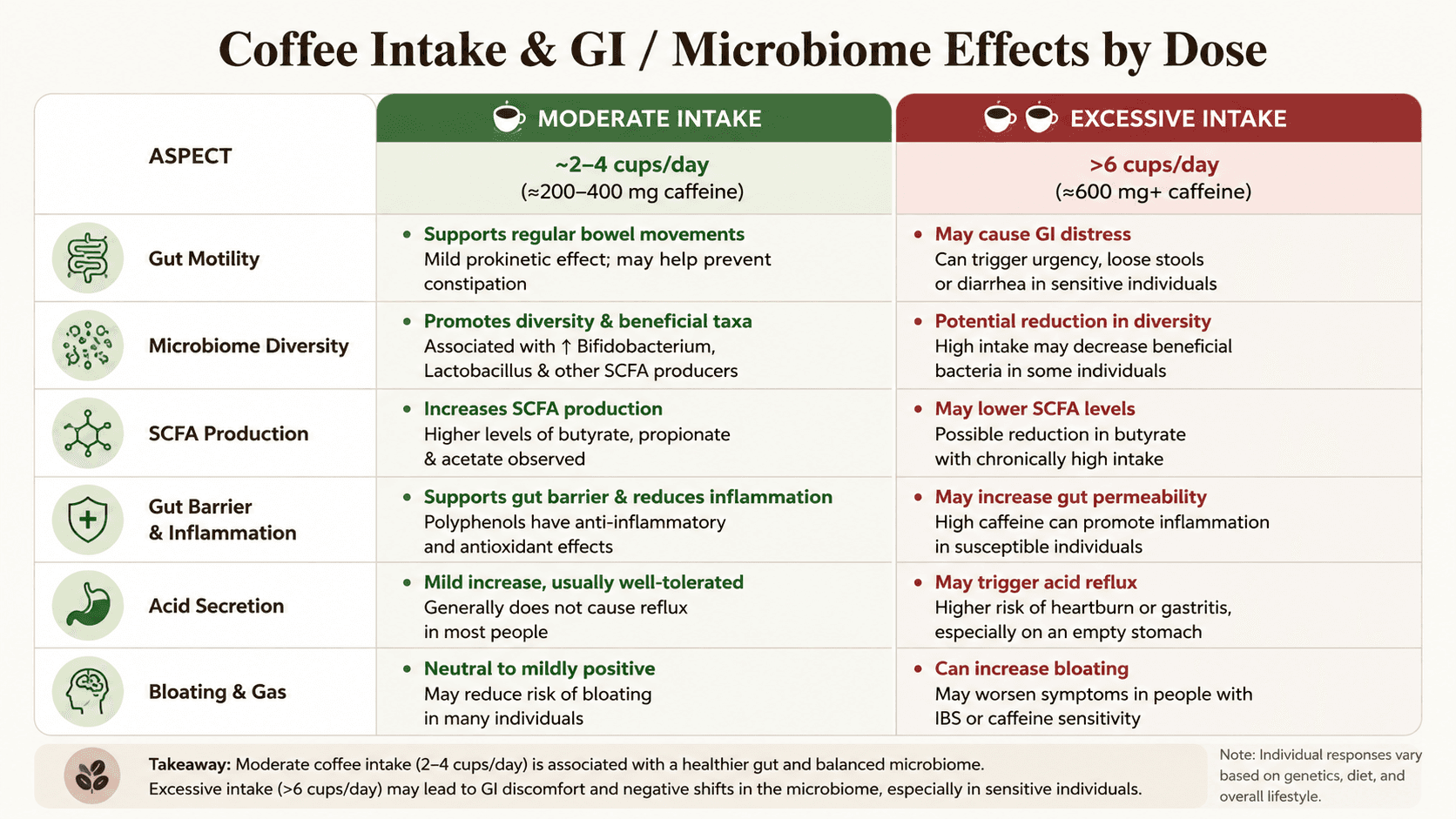
A separate 2024 Nutrients review adds texture to this picture: moderate coffee intake (roughly under four cups daily) was associated with higher Bifidobacterium abundance, lower Enterobacteriaceae - a family that signals dysbiosis when it overgrows - and greater overall microbial diversity. For clinicians, that diversity signal matters more than any single taxon; it's one of the more reproducible markers of a resilient gut ecosystem across microbiome literature.
Case in point
A 55-year-old man with quiescent Crohn's disease reports a new pattern of loose stools and mild abdominal cramping over the past two months. His medications are unchanged, his calprotectin is mildly elevated but not flaring-range, and he mentions, almost as an aside, that he's increased his coffee intake to six or seven cups a day since starting a demanding new job.
The workup didn't reveal a flare requiring escalation. Instead, the timeline pointed to intake above the threshold - more than five cups daily - that has been associated with both GERD and Crohn's disease progression in recent population data. Cutting back to two to three cups resolved his symptoms within two weeks, without any medication change. The lesson isn't that coffee is dangerous in IBD; it's that dose matters, and a dietary detail easily dismissed as incidental can be the actual variable driving symptoms.
Beyond Caffeine: Mechanism and Dose Thresholds
The bioactive compounds most likely responsible for coffee's microbiota effects are chlorogenic acid derivatives and melanoidins. Chlorogenic acid polyphenols reach the colon largely intact, where bacterial metabolism converts them into bioactive metabolites; melanoidins formed during roasting are partially fermentable and appear to act as prebiotic substrates. Together, these compounds plausibly explain why decaffeinated coffee reproduces effects that caffeine alone does not.
Dose matters in both directions. Moderate intake correlates with favorable shifts - higher Bifidobacterium, lower Enterobacteriaceae, greater diversity - but the same literature flags more than five cups daily as a threshold associated with increased GERD risk and Crohn's disease progression. A separate 2025 population study linked excessive caffeine intake specifically to chronic constipation, a useful counterpoint for patients who assume more coffee always means more regularity. The practical takeaway for counseling: moderate coffee intake is not something to routinely restrict, but intake above roughly four to five cups daily deserves a specific conversation, especially in patients with reflux or active/quiescent IBD.
A frequently overlooked point
The instinct in clinic is to treat coffee as a binary - recommend it after GI surgery, discourage it in reflux or functional bowel disease - without asking about quantity or caffeination status. That binary approach misses the dose-response relationship the recent data actually describes, and it ignores that decaffeinated coffee is not a "safe" substitute that removes GI risk; it carries much of the same microbiota-modulating activity as regular coffee, just without the caffeine-driven motility kick. A patient switching to decaf to manage reflux may still be getting a meaningful polyphenol and melanoidin exposure worth discussing.
Bottom line for clinical practice
Counsel post-GI-surgery patients that moderate coffee intake (caffeinated or decaf) may support earlier bowel recovery through microbiota effects, not caffeine alone.
Flag intake above five cups daily as a threshold associated with GERD symptoms and Crohn's disease progression - worth asking about directly in flare or reflux workups.
Don't assume decaffeinated coffee is GI-neutral; its polyphenol and melanoidin content still interacts with the microbiota.
In patients reporting new or excess caffeine intake with constipation, consider intake reduction before escalating a functional workup.
Moderate coffee intake (under ~4 cups/day) is associated with higher microbial diversity and Bifidobacterium abundance - a reasonable talking point when patients ask if coffee is "bad" for their gut.
Closing
The next time a patient's GI symptoms don't fit the expected pattern, a two-line dietary history on coffee intake and caffeination status might surface the variable the standard workup misses. Walk a case like this through GastroAGI for a guideline-anchored, evidence-checked read in seconds.


We are pioneers in clinical intelligence, dedicated to helping gastroenterologists harness the power of artificial intelligence to drive precision, efficiency, and patient growth.