
Cryptogenic Steatotic Liver Disease in Lean Patients: A Hidden Risk Signal for Hepatology Practice
A Gut study suggests lean steatotic liver disease without cardiometabolic risk factors may still carry liver injury and mortality risk.


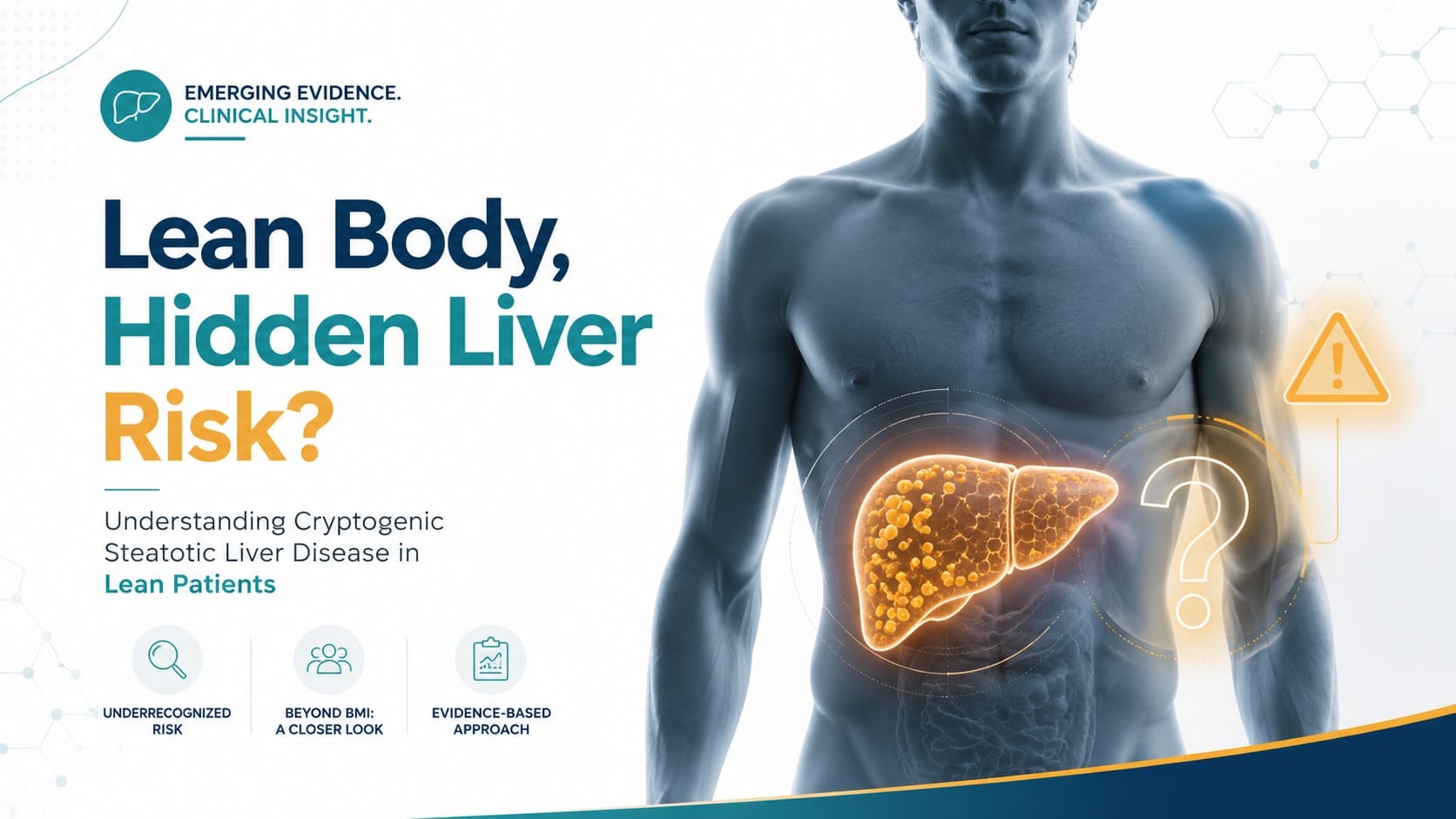
What should clinicians do when hepatic steatosis is present in a lean patient who has no recorded cardiometabolic risk factors?
That question sits at the edge of the current steatotic liver disease framework. In many clinics, steatosis is interpreted through a metabolic lens. When obesity, diabetes, dyslipidemia, hypertension, or other cardiometabolic risk factors are present, the diagnostic pathway is relatively intuitive. But a smaller group of patients do not fit that pattern. They have steatotic liver disease, yet they are lean and have no documented cardiometabolic risk factors. The clinical temptation is to consider them lower risk, atypical, or simply “cryptogenic.”
A recent Gut article challenges that assumption. The verified article title is “Cryptogenic steatotic liver disease: a lean phenotype associated with increased liver-related mortality.” It was published online ahead of print on July 16, 2026, with DOI 10.1136/gutjnl-2026-339142. The accessible source does not support the alternative wording “distinct gut microbiome features”; microbiome findings are not reported in the PubMed-indexed abstract. The article instead focuses on the clinical phenotype and outcomes of operationally defined cryptogenic steatotic liver disease.
A phenotype that does not fit the usual metabolic script
The study addresses a definitional and clinical gap: cryptogenic steatotic liver disease remains undefined. To make this group measurable, the investigators operationalised cryptogenic SLD as lean SLD without recorded cardiometabolic risk factors. This matters because modern SLD classification depends heavily on metabolic and alcohol-related categories, yet some patients with hepatic steatosis do not clearly meet those categories.
This was not an interventional study. There was no drug, procedural exposure, or lifestyle intervention being tested. The main exposure of interest was a clinical phenotype: lean steatotic liver disease without recorded cardiometabolic risk factors. The investigators compared this phenotype with other SLD and non-SLD groups, assessed liver-related features, and examined longitudinal outcomes.
The population was drawn from several large cohorts. Clinical characteristics were evaluated in the UK Biobank magnetic resonance proton density fat fraction cohort, where SLD was defined as PDFF ≥5%. Findings were then assessed in a hepatic steatosis index-based UK Biobank cohort and externally validated in three cross-sectional cohorts, including the National Health and Nutrition Examination Survey and the Korean National Health Insurance Service cohorts. Longitudinal outcomes were examined using Cox regression in two cohorts: the UK Biobank hepatic steatosis index cohort and the Korean National Health Insurance Service cohort.
What the investigators found
In the UK Biobank MR-PDFF cohort, there were 30,847 participants. Among them, 1,195 participants, or 3.4%, had non-obese SLD, defined by body mass index below 25 kg/m². Within this non-obese SLD group, 13.7% had operationally defined cryptogenic SLD, while 86.3% had lean metabolic dysfunction-associated SLD.
The key message is that cryptogenic SLD was not simply a benign “lean fatty liver” category. Across cohorts, cryptogenic SLD showed less favourable metabolic and liver-related profiles than participants without SLD and without cardiometabolic risk factors. This wording is important. It indicates an observed association, not proof that cryptogenic SLD itself causes worse outcomes.
The investigators also reported cohort-specific signals that suggest biological heterogeneity. In the UK Biobank MR-PDFF cohort, cryptogenic SLD showed higher contrast-enhanced T1-weighted image values and an increased prevalence of PNPLA3 and TM6SF2 risk variants. In the magnetic resonance elastography cohort, higher fibrosis rates were observed. These findings suggest that the phenotype may include patients with measurable liver injury or fibrotic risk despite the absence of recorded cardiometabolic risk factors.
The outcome signal was clinically important. In longitudinal analyses, cryptogenic SLD was associated with liver-related death in the Korean National Health Insurance Service cohort, with a hazard ratio of 2.5 and 95% confidence interval 1.4 to 4.3. A similar but less precise association was observed in the UK Biobank hepatic steatosis index cohort, with a hazard ratio of 13.2 and 95% confidence interval 1.9 to 92.4. The Korean cohort association persisted after stricter alcohol exclusion.
Why this is clinically relevant
For gastroenterologists and hepatologists, the practical relevance is straightforward: absence of obesity and recorded cardiometabolic risk factors should not automatically reassure clinicians when steatosis is present.
The study does not say that every lean patient with steatosis is high risk. It does not provide a new management algorithm. It does not establish that cryptogenic SLD should be treated like advanced MASLD. But it does suggest that a subset of lean patients with apparently unexplained steatosis may have liver injury markers, genetic risk enrichment, higher fibrosis rates in one cohort, and increased liver-related mortality in longitudinal analyses.
This is especially relevant in real-world practice because lean patients with steatosis may be under-prioritized. Clinicians often focus fibrosis assessment on patients with diabetes, obesity, metabolic syndrome, or abnormal liver enzymes. A lean patient without obvious cardiometabolic disease may not be triaged with the same urgency. The current study supports a more cautious approach: cryptogenic SLD should not be dismissed merely because the metabolic phenotype is not obvious.
The evidence should still be interpreted within its design. This was observational research using cohort data. The association with liver-related death is important, but association is not causation. The phenotype may be a marker for unmeasured risk factors, genetic susceptibility, unrecorded metabolic dysfunction, alcohol exposure not fully captured, medication-related steatosis, or other causes not identified in the available datasets. The study’s operational definition is useful for research, but it is not the same as a complete etiologic diagnosis in an individual patient.
A useful reminder about “recorded” cardiometabolic risk
A subtle but important phrase in the abstract is “without recorded cardiometabolic risk factors.” That does not necessarily mean that cardiometabolic risk factors were biologically absent. It means they were not recorded within the datasets according to the study’s operational criteria.
This distinction matters clinically. In practice, a patient may lack a formal diagnosis of diabetes or hypertension but still have insulin resistance, visceral adiposity, sarcopenic obesity, evolving dyslipidemia, or other metabolic abnormalities not captured by standard diagnostic labels. The study does not provide enough detail in the accessible abstract to determine how completely these possibilities were assessed. Therefore, clinicians should avoid interpreting cryptogenic SLD as a purely non-metabolic disease entity.
The finding that cryptogenic SLD had less favourable metabolic and liver-related profiles than non-SLD/no-CMRF participants also complicates the idea of a completely “metabolically healthy” group. The available source does not specify which metabolic measures drove that less favourable profile, but the direction of the finding suggests that absence of recorded cardiometabolic risk factors may not equal absence of relevant risk.
Genetic signals: intriguing, not deterministic
The reported enrichment of PNPLA3 and TM6SF2 risk variants in the UK Biobank MR-PDFF cohort is one of the more interesting aspects of the study. These variants are named in the abstract as being more prevalent in cryptogenic SLD.
For clinicians, the correct interpretation is cautious. The finding supports the possibility that genetic susceptibility may contribute to steatosis or liver injury in some lean patients without recorded cardiometabolic risk factors. However, the abstract does not establish that these variants explain the phenotype, nor does it report whether genetic testing should be used clinically. It also does not provide management recommendations based on genotype.
The practical implication is not routine genetic testing for every lean patient with steatosis. Rather, the finding should encourage clinicians and researchers to think beyond body mass index and conventional metabolic labels when evaluating steatotic liver disease. It also supports the need for future studies that integrate genetics, imaging, metabolic phenotyping, alcohol exposure assessment, and longitudinal outcomes.
Fibrosis and mortality: the signal that should change our level of attention
The most clinically meaningful part of the abstract is not simply that cryptogenic SLD exists. It is that this phenotype was associated with liver injury markers and liver-related mortality. The authors’ conclusion states that operationally defined cryptogenic SLD accounted for a substantial proportion of lean SLD and, despite no recorded cardiometabolic risk factors, was associated with liver injury markers and liver-related mortality.
That conclusion should shift the clinician’s level of attention, but not yet the standard of care. A reasonable response is heightened clinical vigilance: confirm the presence and degree of steatosis, assess fibrosis risk, review alcohol intake carefully, exclude secondary causes where appropriate, and monitor according to clinical context. However, those actions are general clinical reasoning rather than specific new recommendations from this abstract. The abstract itself does not prescribe a diagnostic or management algorithm.
The mortality association also needs careful interpretation. The Korean National Health Insurance Service cohort produced a more precise association than the UK Biobank hepatic steatosis index cohort. The UK Biobank estimate had a wide confidence interval, indicating uncertainty around the magnitude of risk. The direction was similar, but the precision was limited.
This is a key point for evidence-based communication. The study suggests a risk signal; it does not define the exact individual-level risk for a patient sitting in clinic.
Strengths of the study
Several strengths make this article worth attention for GastroAGI readers.
First, the investigators used large population-based resources rather than a single specialty clinic cohort. The UK Biobank MR-PDFF cohort provided imaging-defined steatosis, while additional cohorts were used for assessment and validation.
Second, the study did not stop at cross-sectional characterization. It examined longitudinal outcomes using Cox regression in two cohorts. That is important because the clinical relevance of any SLD phenotype ultimately depends on outcomes, not merely imaging or biochemical differences.
Third, the phenotype was examined across multiple settings, including UK Biobank, NHANES, and Korean National Health Insurance Service cohorts. External validation across different datasets strengthens the credibility of the signal, although it does not eliminate concerns about residual confounding or measurement differences.
Fourth, the study incorporated more than one type of liver-related assessment. The abstract mentions MR-PDFF, contrast-enhanced T1-weighted imaging values, magnetic resonance elastography, genetic variants, and liver-related mortality. This multidimensional approach is useful because cryptogenic SLD is unlikely to be explained by one marker alone.
Limitations clinicians should keep in mind
The accessible source is an abstract-level summary, so some important details are not available. It does not provide the complete phenotype definitions, variable lists, missing-data handling, alcohol thresholds, medication exclusions, liver enzyme values, fibrosis thresholds, cause-of-death adjudication methods, or full adjustment models.
The operational definition also has limitations. “Lean SLD without recorded cardiometabolic risk factors” may group together biologically different patients. Some may have unmeasured metabolic dysfunction. Some may have genetic predisposition. Some may have alcohol exposure below documented thresholds. Others may have secondary causes that were not fully captured. The study’s conclusion acknowledges the phenotype but does not resolve its underlying cause.
Another limitation is that the study should not be interpreted as proving causality. The association with liver-related mortality may reflect the phenotype itself, associated genetic factors, unmeasured confounders, diagnostic misclassification, or other factors. Observational cohort design can identify risk signals, but it cannot by itself prove that cryptogenic SLD causes liver-related death.
Finally, because the source does not report gut microbiome data, clinicians should not use this article to make microbiome-based claims about cryptogenic SLD. Any discussion of microbiome mechanisms would require a different source.
What clinicians should and should not conclude
Clinicians should conclude that operationally defined cryptogenic SLD is a measurable phenotype within lean SLD and that, in this study, it was associated with less favourable liver-related profiles and liver-related mortality. They should also recognize that a lack of recorded cardiometabolic risk factors does not necessarily mean a patient with steatosis is low risk.
Clinicians should not conclude that the study creates a new treatment pathway, proves causality, or justifies genotype-based management. They should not conclude that cryptogenic SLD is microbiome-driven based on this source. They should also not assume that all lean patients with steatosis have the same prognosis. The phenotype is heterogeneous, and the available abstract does not provide enough detail for individualized risk prediction.
For fellows and researchers, the study is a strong reminder that nomenclature is not just semantics. How we classify SLD affects who is studied, who is monitored, and who may be missed. Cryptogenic SLD may represent a diagnostic blind spot rather than a benign residual category.
Where future research should go
The next research step is clearer phenotyping. Future studies should determine whether cryptogenic SLD represents unmeasured metabolic dysfunction, genetic susceptibility, environmental exposures, alcohol misclassification, medication effects, sarcopenia-related risk, or multiple overlapping pathways.
Prospective studies are also needed. A clinically useful framework would show how to identify these patients in routine practice, which fibrosis assessment strategy is most appropriate, and whether earlier recognition changes outcomes. The current study identifies an association with liver-related mortality, but it does not show that intervention based on this phenotype reduces that risk.
More granular reporting would also help. Clinicians need to know how risk varies by age, sex, ethnicity, liver enzyme profile, fibrosis markers, imaging features, and genotype. Without that information, cryptogenic SLD remains clinically important but incompletely actionable.
Clinical Takeaway
This Gut study suggests that cryptogenic steatotic liver disease, operationalised as lean SLD without recorded cardiometabolic risk factors, should not be dismissed as a benign phenotype. In large cohort analyses, this group represented a meaningful subset of non-obese SLD and was associated with liver injury markers and liver-related mortality.
The evidence is clinically relevant but observational. It should increase awareness and encourage careful fibrosis-oriented assessment in lean patients with steatosis, while avoiding premature causal claims or unsupported management recommendations. Most importantly, the verified source supports a mortality-risk phenotype—not a microbiome-based conclusion.
Five key clinical takeaways
The verified article title is “Cryptogenic steatotic liver disease: a lean phenotype associated with increased liver-related mortality,” published in Gut on July 16, 2026.
The study operationalised cryptogenic SLD as lean steatotic liver disease without recorded cardiometabolic risk factors.
In the UK Biobank MR-PDFF cohort, cryptogenic SLD accounted for 13.7% of non-obese SLD.
Cryptogenic SLD was associated with liver injury markers, higher fibrosis rates in an MRE cohort, and liver-related mortality in longitudinal analyses.
This is observational evidence and should be interpreted as a risk signal, not proof of causation or a new clinical guideline.

Source reference and link
Yoon EL, Lee HY, Lee J, et al. Cryptogenic steatotic liver disease: a lean phenotype associated with increased liver-related mortality. Gut. Published online July 16, 2026. DOI: 10.1136/gutjnl-2026-339142.
References

We are pioneers in clinical intelligence, dedicated to helping gastroenterologists harness the power of artificial intelligence to drive precision, efficiency, and patient growth.