
CYP2C19 Genotype and PPI Response in Pediatric EoE: Does Dose Matter?
A new AJG cohort study suggests CYP2C19 genotype may influence histologic PPI response in pediatric eosinophilic esophagitis.


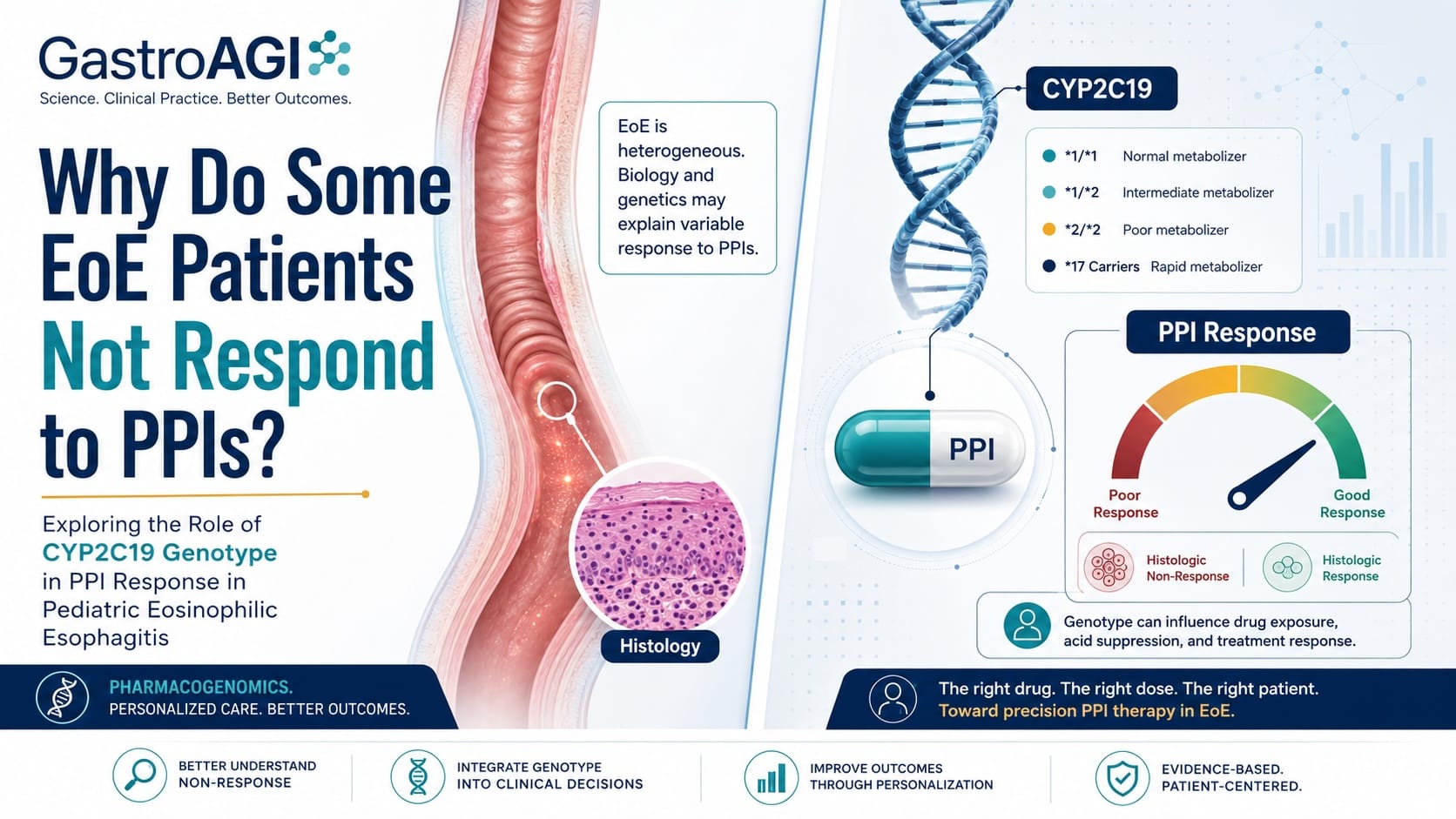
Why do some children with active eosinophilic esophagitis respond histologically to proton pump inhibitor therapy, while others do not?
For gastroenterologists and pediatric GI clinicians, this question is clinically familiar. A child is diagnosed with active histologic eosinophilic esophagitis, treated with a proton pump inhibitor, and then reassessed. In some patients, esophageal eosinophilia improves. In others, it persists despite therapy. The decision that follows may involve continuing treatment, changing therapy, adding another approach, or rethinking whether the dose was adequate for that individual patient.
A new article in The American Journal of Gastroenterology brings pharmacogenetics into this discussion. The verified title is “Dose May Matter: CYP2C19 Genotype and PPI Response in Pediatric Eosinophilic Esophagitis.” The article was published in July 2026 with DOI 10.14309/ajg.0000000000004117. The available source identifies it as an article by Paroma Bose, Chizoba N. Umeweni, Anthony Perkins, Elizabeth Jensen, and additional authors.
The key question is focused: does proton pump inhibitor metabolism, as reflected by CYP2C19 genotype, influence treatment response in pediatric EoE? The authors state that little is known about the effect of PPI metabolism based on CYP2C19 genotype on treatment response in pediatric eosinophilic esophagitis.
This is an important but early piece of evidence. It is not a guideline, not a randomized trial, and not a mandate for routine genetic testing. It is a cohort study of pediatric subjects with active histologic EoE treated with PPI therapy, in whom whole blood samples were tested for CYP2C19 genotype.
A precision-medicine question hiding inside a common clinical pathway
The clinical appeal of this study is easy to understand. PPI therapy is already part of the therapeutic landscape for EoE, but response is variable. The source does not provide a complete background review of EoE treatment, nor does it specify response rates, patient numbers, dosing duration, or endoscopic findings. What it does clearly establish is that the investigators were interested in whether PPI metabolism, defined through CYP2C19 genotype, helps explain histologic response in pediatric EoE.
That framing matters. Many EoE discussions focus on disease phenotype, allergic inflammation, diet, topical steroid therapy, biologics, or fibrostenotic complications. This article asks a different but practical question: could some apparent PPI non-response reflect pharmacologic exposure rather than only disease biology?
The title itself—“Dose May Matter”—is appropriately cautious. It does not claim that genotype fully determines response. It does not claim that a specific genotype-based dosing algorithm is established. It suggests that dose and metabolism may interact in a clinically meaningful way.
For clinicians, this is exactly the kind of hypothesis that needs careful handling. It is plausible and potentially useful, but the source supports association with histologic response, not proof that genotype-guided dosing improves outcomes.
What the study investigated
The study design was a cohort study. The population was pediatric subjects with active histologic eosinophilic esophagitis. The intervention or treatment exposure was PPI therapy. The pharmacogenetic exposure was CYP2C19 genotype, assessed through testing of whole blood samples. The outcome highlighted in the abstract was histologic response to PPI therapy.
The available source does not provide sample size, age distribution, sex distribution, PPI type, treatment duration, exact histologic response threshold, number of subjects in each genotype group, or the statistical model used. Because those details are not available in the provided source, they should not be inferred.
What can be verified is the core structure:
Children had active histologic EoE. They were treated with PPI therapy. Their CYP2C19 genotype was assessed using whole blood. The investigators then evaluated how metabolizer status related to histologic response, particularly in the context of high-dose PPI exposure.
This is clinically relevant because histologic response is a tissue-level endpoint. The source does not report symptom response, endoscopic response, quality of life, stricture outcomes, food impaction rates, or long-term remission. Therefore, the blog interpretation must remain centered on histology.
The key finding: response differed by metabolizer status at higher PPI dose
The central finding reported in the abstract is that among subjects prescribed a high PPI dose greater than 1 mg/kg/day, intermediate or slow PPI metabolizers were significantly more likely to have histologic response to PPI therapy compared with normal and rapid PPI metabolizers. The abstract also states that no ultra-rapid metabolizers responded to PPI therapy.
This is the clinically provocative signal.
The finding suggests that PPI metabolism may influence whether a given dose achieves sufficient pharmacologic effect in some children with EoE. Intermediate or slow metabolizers may have greater exposure to PPI therapy at the same or similar dose, while normal, rapid, or ultra-rapid metabolizers may have lower effective exposure. The source supports the observed association between metabolizer category and histologic response; it does not prove the pharmacokinetic mechanism directly unless drug levels or acid-suppression metrics were measured, and those details are not provided in the accessible source.
The dose qualifier is also important. The result is described specifically among subjects prescribed high PPI dose >1 mg/kg/day. This means the finding should not be generalized to all PPI doses, all dosing regimens, or all pediatric EoE patients without additional data.
Why the phrase “dose may matter” is clinically meaningful
The article’s title is well chosen because it points to an interaction clinicians already recognize in practice: the same prescribed drug dose does not necessarily produce the same biologic effect in every patient.
In this study, the relevant variable is CYP2C19 genotype, used as a marker of PPI metabolism. The authors report that metabolizer status was associated with histologic response among children receiving high-dose PPI therapy.
This raises a practical question: when a child with EoE does not respond histologically to a PPI, is the issue that the disease is PPI-nonresponsive, or that the patient’s metabolism leads to inadequate drug effect at the prescribed dose?
The source does not answer that question definitively. It does, however, support the idea that CYP2C19 genotype may help explain variability in response. The discussion statement in the abstract is that knowing CYP2C19 genotype may optimize PPI dose for EoE treatment in individual patients.
That wording is important. “May optimize” is not the same as “should routinely guide.” It signals a potential future direction rather than established clinical guidance.
Practical interpretation for gastroenterologists
For clinicians, the finding should be interpreted as a pharmacogenetic association with histologic response, not as a new standard of care.
A reasonable interpretation is that CYP2C19 metabolizer status may identify pediatric EoE patients in whom a standard or even high PPI dose is less likely to produce histologic response. The most striking reported observation is that no ultra-rapid metabolizers responded to PPI therapy in the cohort.
However, without knowing the number of ultra-rapid metabolizers, confidence intervals, absolute response rates, PPI agents used, adherence assessment, treatment duration, and adjustment for confounders, clinicians should avoid overinterpreting this finding. A result can be statistically significant and still require replication before it changes practice.
The study is especially relevant for pediatric gastroenterologists and fellows because it reframes PPI response as potentially influenced by host pharmacogenetics. It also fits within a broader movement toward individualized therapy in EoE. But the evidence provided here does not establish how to adjust the dose, which PPI should be selected for different genotypes, whether split dosing matters, or whether genotype-guided therapy improves outcomes compared with usual care.
What clinicians should conclude—and what they should not
Clinicians can conclude that this AJG article reports a cohort study in pediatric active histologic EoE treated with PPI therapy, with CYP2C19 genotype assessed from whole blood.
They can also conclude that, among children prescribed high-dose PPI therapy greater than 1 mg/kg/day, intermediate or slow PPI metabolizers were significantly more likely to show histologic response than normal or rapid metabolizers, and that no ultra-rapid metabolizers responded in the reported cohort.
Clinicians should not conclude that CYP2C19 testing is now required for every child with EoE. The available abstract does not provide a clinical algorithm. It does not compare genotype-guided dosing with standard dosing in a randomized design. It does not report prospective outcomes after genotype-based dose adjustment. It does not show whether changing dose based on genotype improves histologic remission, symptoms, endoscopic outcomes, or long-term disease course.
Clinicians should also not conclude that PPI non-response is fully explained by genotype. EoE response is likely multifactorial, but the provided source only supports the specific association between CYP2C19 metabolizer category, high-dose PPI therapy, and histologic response.
Association is not causation
This point deserves emphasis. The study reports an association between CYP2C19 metabolizer status and histologic response to PPI therapy in pediatric EoE. It does not prove that CYP2C19 genotype caused response or non-response. It also does not prove that increasing the PPI dose in rapid or ultra-rapid metabolizers would produce response.
The causal pathway is plausible, but it remains unproven by the accessible source. To establish causation and clinical utility, future studies would need to test whether genotype-guided dosing changes outcomes compared with non-genotype-guided care.
For example, an implementation study could assign children to genotype-guided PPI dosing versus usual PPI dosing and then compare histologic remission, symptom change, endoscopic change, adverse events, adherence, need for therapy escalation, and cost-effectiveness. The current source does not report such a trial.
Therefore, the safest interpretation is that CYP2C19 genotype may be a clinically relevant predictor or modifier of histologic PPI response, particularly at high-dose exposure, but this remains early evidence.
Strengths of the evidence
The study has several strengths based on the available source.
First, it addresses a clinically important problem: variability in response to PPI therapy in pediatric EoE. The authors explicitly state that little is known about the effect of PPI metabolism based on CYP2C19 genotype in this setting.
Second, the population is clinically specific: pediatric subjects with active histologic EoE treated with PPI therapy. This avoids extrapolating from adult acid-mediated disease or from non-EoE indications.
Third, the exposure is biologically coherent: CYP2C19 genotype as a marker of PPI metabolism. The study tested whole blood samples, which suggests direct genotyping rather than inferred metabolizer status from clinical response alone.
Fourth, the outcome highlighted is histologic response, which is central to EoE assessment. The source does not define the threshold used, but it clearly identifies histologic response as the reported endpoint.
Finally, the result is clinically interpretable: intermediate or slow metabolizers were more likely to respond than normal and rapid metabolizers among those receiving high-dose PPI, while ultra-rapid metabolizers did not respond.
Limitations and evidence gaps
The accessible source is concise and does not provide enough detail for complete critical appraisal.
The most important missing information is sample size. Without knowing how many children were included overall and how many fell into each metabolizer group, it is difficult to judge precision. The statement that no ultra-rapid metabolizers responded is important, but its clinical weight depends heavily on how many ultra-rapid metabolizers were studied.
The source also does not specify the PPI agent, dosing schedule, treatment duration, adherence assessment, baseline disease severity, distribution of eosinophil counts, or whether other therapies were excluded or controlled. These factors could influence histologic response.
The abstract does not report symptom outcomes. That matters because EoE management often requires integrating histology, symptoms, and endoscopic findings. A histologic signal is important, but clinicians should not infer symptom benefit unless reported.
The source also does not report safety outcomes. If genotype-guided dose escalation is considered in future studies, safety and tolerability will be essential, particularly in children.
Another limitation is that the study is observational. Cohort studies can identify clinically useful associations, but they cannot fully exclude confounding. Adherence, disease phenotype, timing of follow-up endoscopy, PPI selection, and clinical decision-making may all influence observed response.
How this may influence future research
This study creates a clear research agenda.
The next step should be larger prospective studies that report genotype distribution, PPI exposure, dosing schedule, adherence, histologic thresholds, endoscopic outcomes, symptoms, and safety. These studies should also clarify whether genotype has predictive value beyond standard clinical variables.
A more practice-oriented question is whether CYP2C19-guided PPI therapy improves outcomes. That requires an interventional design. It is not enough to show that genotype is associated with response; clinicians need to know whether acting on the genotype changes care in a beneficial way.
Researchers should also determine whether the effect differs by PPI type. The provided source does not specify the PPI agents used, so no conclusions can be made about one PPI versus another.
Implementation research will also matter. Even if genotype-guided dosing proves useful, clinicians will need practical answers: when should testing be ordered, how quickly must results return, which patients benefit most, what dose changes are appropriate, and how should nonresponse be managed?
Clinical Takeaway
“Dose May Matter: CYP2C19 Genotype and PPI Response in Pediatric Eosinophilic Esophagitis” is a clinically relevant AJG cohort study suggesting that CYP2C19 metabolizer status may influence histologic response to PPI therapy in pediatric EoE. Among children prescribed high-dose PPI therapy greater than 1 mg/kg/day, intermediate or slow metabolizers were significantly more likely to have histologic response than normal or rapid metabolizers, while no ultra-rapid metabolizers responded in the reported cohort.
The study supports a promising precision-medicine hypothesis: pharmacogenetics may help explain variable PPI response and could eventually help individualize dosing. But the current evidence is not yet practice-changing. It should be interpreted as observational, association-based evidence that requires larger validation and prospective genotype-guided treatment studies before routine clinical implementation.
Five key clinical takeaways
The verified article is “Dose May Matter: CYP2C19 Genotype and PPI Response in Pediatric Eosinophilic Esophagitis,” published in The American Journal of Gastroenterology in July 2026.
The study design was a cohort study of pediatric subjects with active histologic EoE treated with PPI therapy.
Whole blood samples were tested for CYP2C19 genotype, linking pharmacogenetic metabolizer status to PPI treatment response.
Among subjects prescribed high PPI dose >1 mg/kg/day, intermediate or slow metabolizers were significantly more likely to have histologic response than normal or rapid metabolizers; no ultra-rapid metabolizers responded.
The evidence is observational and association-based. It suggests genotype may help optimize PPI dosing in the future, but it does not establish routine CYP2C19-guided EoE management.

Source reference and link
Bose P, Umeweni CN, Perkins A, Jensen E, et al. Dose May Matter: CYP2C19 Genotype and PPI Response in Pediatric Eosinophilic Esophagitis. The American Journal of Gastroenterology. July 2026. DOI: 10.14309/ajg.0000000000004117.

We are pioneers in clinical intelligence, dedicated to helping gastroenterologists harness the power of artificial intelligence to drive precision, efficiency, and patient growth.