
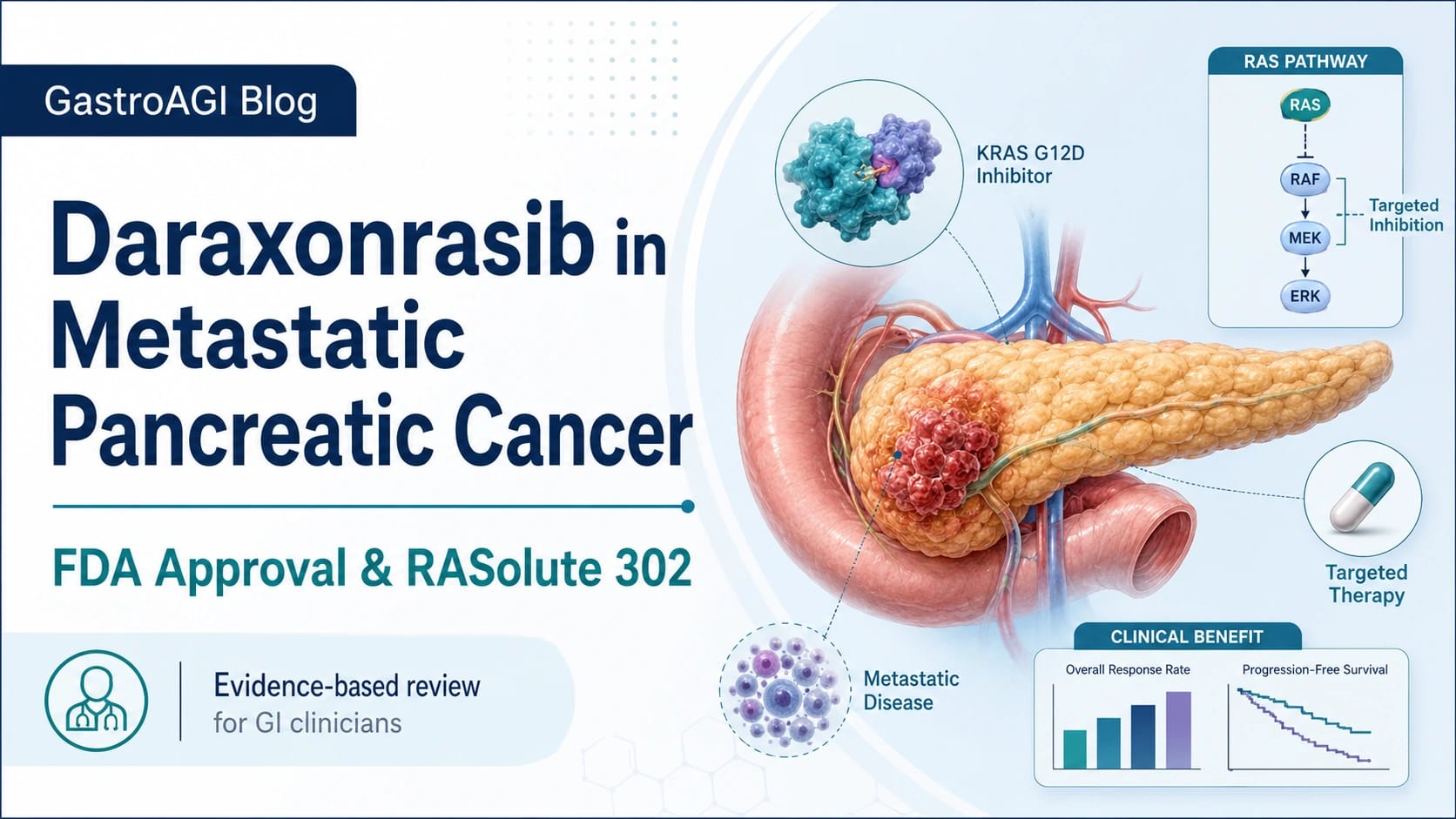
Daraxonrasib for Metastatic Pancreatic Cancer: What the FDA Approval and RASolute 302 Trial Mean for Clinicians
FDA approval of daraxonrasib marks a major advance in metastatic pancreatic cancer. Review RASolute 302 efficacy, safety, limits, and practice impact.


Evidence verification
BBC report: US drug agency approves breakthrough treatment for pancreatic cancer — published August 26, 2026.
Underlying study: Daraxonrasib or Chemotherapy in Previously Treated Metastatic Pancreatic Cancer.
Journal: The New England Journal of Medicine.
Publication: Published online May 31, 2026; published in the July 23, 2026 issue.
Study: RASolute 302, phase 3, international, randomized, open-label, multicenter trial.
Population: 500 patients with previously treated metastatic pancreatic ductal adenocarcinoma.
Intervention: Oral daraxonrasib versus investigator-selected chemotherapy.
Primary clinical finding: Daraxonrasib significantly prolonged overall and progression-free survival compared with chemotherapy in the prespecified RAS G12 population, with similar benefit in the overall randomized population.
Pancreatic Malignancy is one of the most difficult to treat malignancy. Usually once patient presented to the physician it is usually in advanced stage disease where someting meaninful cannot be done. Even after curative Resection, 5 years survival is dismal as we do not have any good Chemotherapy as well as Immunotherapy backup. These are the two most difficult part in Pancreatic Cancer managment. But with daraxonrasib data and rapid approval there is some light across the tunnel in patients suffiring from this difficult disease. I think this will open many doors in the managment in patients with pancreatic cancer.
On August 26, 2026, the US Food and Drug Administration approved daraxonrasib, marketed as Rasonque, for adults with metastatic pancreatic adenocarcinoma who have received at least one prior systemic therapy or who are not candidates for multiagent systemic therapy. The BBC report describing the approval highlighted the result that has attracted broad attention across gastrointestinal oncology: in a late-stage trial involving 500 patients, survival with the oral RAS inhibitor was substantially longer than with chemotherapy.
The approval is supported by RASolute 302, a phase 3 randomized trial published in The New England Journal of Medicine. Unlike early single-arm studies that can generate promising response signals but leave uncertainty about comparative benefit, RASolute 302 directly compared daraxonrasib against active chemotherapy and demonstrated an improvement in the endpoint that matters most in metastatic pancreatic cancer: overall survival.
Why RAS remains such an important target in pancreatic cancer
Pancreatic adenocarcinoma is characterized by aggressive biology, frequent late-stage presentation and historically limited therapeutic options after progression. Aberrant RAS signaling is central to this disease. More than 90% of pancreatic ductal adenocarcinomas harbor oncogenic RAS mutations, most commonly involving KRAS codon 12.
That molecular abnormality has been recognized for decades, but translating it into effective treatment has proved difficult.
Daraxonrasib is an oral RAS(ON) multiselective tri-complex inhibitor. It targets the active, guanosine triphosphate-bound state of mutant and wild-type RAS. In practical terms, rather than focusing on only one narrowly defined KRAS variant, the drug is designed to inhibit active RAS signaling across several forms of RAS.
The biological rationale is therefore compelling, but mechanism alone is not sufficient evidence of clinical value. What makes RASolute 302 important is that the molecular strategy translated into better outcomes in a randomized phase 3 comparison.
What exactly did RASolute 302 test?
RASolute 302 was an international, randomized, open-label, multicenter phase 3 trial enrolling 500 patients with previously treated metastatic pancreatic ductal adenocarcinoma.
Patients were randomized 1:1 to daraxonrasib or investigator-selected standard-of-care chemotherapy. A total of 248 patients received daraxonrasib and 252 received chemotherapy. Of the overall trial population, 91.8% had RAS G12 mutations.
The dual primary endpoints were overall survival and progression-free survival in patients with RAS G12 mutations. Key secondary outcomes included overall survival and progression-free survival in the overall population, which also included patients with other RAS alterations or without an identified RAS mutation. Objective response, patient-reported quality of life and safety were also assessed.
The open-label nature of the study deserves attention. Patients and investigators knew which treatment was being given. This can influence subjective outcomes, particularly symptoms, quality-of-life assessments and aspects of adverse-event reporting.
Overall survival, however, is an objective endpoint and is considerably less susceptible to this form of bias.
The survival result is the central finding
Among patients with RAS G12-mutated disease, median overall survival was 13.2 months with daraxonrasib versus 6.6 months with chemotherapy. The hazard ratio for death was 0.40.
The result was essentially reproduced in the overall randomized population: median overall survival was 13.2 months with daraxonrasib versus 6.7 months with chemotherapy, again with a hazard ratio of 0.40.
That is a clinically important result, but the statistics require careful communication.
A median survival of 13.2 months does not mean every patient receiving daraxonrasib will live approximately six months longer. Median survival describes the time at which half of the study population remained alive. Similarly, a hazard ratio of 0.40 should not be interpreted as guaranteeing a particular survival extension for an individual patient.
Rather, the randomized comparison indicates a substantially lower risk of death during follow-up among patients assigned to daraxonrasib compared with those assigned to chemotherapy.
This distinction also matters when discussing association versus causation.
RASolute 302 was not an observational study in which patients who happened to receive one treatment were compared retrospectively with those receiving another. Treatment assignment was randomized. Within the population studied, this design provides substantially stronger support for a causal treatment effect.
That does not mean the findings can automatically be extrapolated beyond that population.
Progression and tumor response moved in the same direction
The overall survival finding was supported by other efficacy endpoints.
In the RAS G12 population, median progression-free survival was 7.3 months with daraxonrasib versus 3.5 months with chemotherapy. In the overall randomized population, median progression-free survival was 7.2 versus 3.6 months, respectively.
The FDA also reported an objective response rate of approximately 30% with daraxonrasib versus 11% with chemotherapy in the overall population.
The consistency is clinically relevant. The survival improvement was accompanied by delayed disease progression and a higher probability of measurable tumor response rather than representing an isolated statistical signal.
For metastatic pancreatic cancer, where progression can be rapid and available treatment options after first-line therapy have historically been limited, this concordance strengthens the interpretation that daraxonrasib has meaningful antitumor activity.
Safety needs more nuance than “fewer side effects”
The BBC report noted lower rates of severe treatment-related toxicity with daraxonrasib than with chemotherapy. The underlying publications help clarify an important distinction between treatment-related severe adverse events and all grade 3 or higher adverse events, which are not identical measures.
In the NEJM report, grade 3 or higher adverse events occurring after treatment initiation were reported in 61.8% of patients receiving daraxonrasib and 69.6% receiving chemotherapy.
Treatment-related adverse events leading to treatment discontinuation occurred in 1.2% versus 11.2%, respectively.
The BBC's reported severe-toxicity figures of approximately 44% versus 57.5% are consistent with the separately reported rate of grade 3 or higher treatment-related adverse events, rather than all-cause severe adverse events. The distinction matters when clinicians communicate safety data.
Daraxonrasib should therefore not be described as a low-toxicity treatment.
The FDA lists common adverse effects including rash, diarrhea, stomatitis, nausea, fatigue, vomiting, abdominal pain, edema, decreased appetite and hemorrhage. The prescribing information contains warnings and precautions concerning dermatologic and soft-tissue toxicity, stomatitis and oral disorders, diarrhea, gastrointestinal perforation, interstitial lung disease or pneumonitis and embryo-fetal toxicity.
The appropriate interpretation is that daraxonrasib has a different toxicity profile from cytotoxic chemotherapy, with toxicity remaining clinically relevant and requiring active monitoring.
What exactly has the FDA approved?
The regulatory indication is worth reading carefully.
Daraxonrasib is approved for adults with metastatic pancreatic adenocarcinoma who have received at least one previous systemic therapy or who are not candidates for multiagent systemic therapy. The FDA-recommended dose is 300 mg orally once daily until disease progression or unacceptable toxicity.
The pivotal phase 3 evidence primarily comes from patients whose metastatic disease had progressed after one previous line of systemic therapy.
That distinction is important because regulatory indications and the precise populations studied in pivotal trials are related but not always identical.
The approval is also not restricted to documented RAS G12-mutated disease. Although 91.8% of trial participants had RAS G12 mutations and the dual primary endpoints were defined in this population, the survival benefit was also demonstrated in the overall randomized cohort.
This should not be interpreted as evidence that molecular characterization of pancreatic cancer is unimportant. Rather, RASolute 302 answers a specific treatment question; broader decisions about genomic profiling and sequencing of alternative targeted therapies involve clinical considerations beyond this trial.
What clinicians should not conclude
Several overinterpretations should be avoided.
Daraxonrasib has not been shown to cure metastatic pancreatic cancer. RASolute 302 demonstrated improved survival and disease control, not eradication of disease.
The findings also should not automatically be extrapolated to resectable disease, borderline-resectable disease, locally advanced pancreatic cancer, adjuvant therapy or first-line metastatic treatment. Those clinical settings were not established by the pivotal randomized study.
Similarly, oral administration should not be confused with absence of significant toxicity. Rash, gastrointestinal toxicity, stomatitis and other adverse events remain important.
Population-level median survival also cannot predict how long an individual patient will live. Individual outcomes can differ substantially according to disease biology, prior therapy, performance status, tumor burden, treatment tolerance and other clinical variables.
Finally, the RASolute 302 study was funded by Revolution Medicines, the manufacturer of daraxonrasib. Industry sponsorship does not invalidate the randomized trial or its outcomes, but sponsorship remains relevant when clinicians assess trial reporting, longer-term follow-up and the value of independent and post-marketing evidence.
Why the evidence is unusually compelling for this disease
Several features strengthen RASolute 302.
This was a phase 3 randomized trial, not a small early-phase cohort. The comparator was active chemotherapy rather than placebo or historical controls. The study included 500 patients and examined overall survival as a principal endpoint.
Furthermore, the direction of benefit was consistent across overall survival, progression-free survival and objective response.
The survival result also appeared both in the prespecified RAS G12 population and the overall randomized population.
Taken together, these features make the evidence considerably stronger than the observational or early-phase findings that often generate headlines around novel cancer therapies.
What remains unanswered
Important questions remain despite the positive phase 3 findings.
The trial primarily establishes daraxonrasib in previously treated metastatic pancreatic cancer. Whether similar benefits will occur if the drug is moved into first-line treatment, combined with other systemic therapies or evaluated in earlier-stage disease cannot be concluded from RASolute 302.
The molecular composition of the study also matters. More than nine in ten participants had RAS G12-mutated tumors. The overall analysis included patients with other RAS alterations and patients without an identified RAS mutation, but these represented a relatively small fraction of the population.
Further follow-up will also be important for understanding durability of response, longer-term toxicity and mechanisms of resistance.
Another major research question is whether broad RAS inhibition can be combined successfully with other approaches without producing prohibitive toxicity. The present trial establishes a new therapeutic benchmark; it does not determine the optimal future sequencing or combination strategy.
A major advance, without needing exaggerated language
The BBC described daraxonrasib as a potential breakthrough, and the randomized phase 3 data explain why the approval has received unusual attention.
For patients with previously treated metastatic pancreatic adenocarcinoma, increasing median overall survival from approximately 6.6–6.7 months to 13.2 months represents a substantial difference within the context of this disease.
The most appropriate clinical interpretation is therefore neither dismissive nor hyperbolic.
Daraxonrasib represents a major new treatment option and provides strong randomized evidence that pharmacologic targeting of active RAS signaling can translate into improved clinical outcomes in metastatic pancreatic cancer.
At the same time, the evidence does not yet establish its role in every pancreatic-cancer setting.
For gastroenterologists, pancreatologists, oncologists, surgeons, fellows and multidisciplinary pancreatic-cancer teams, the immediate significance is clear: the therapeutic landscape for previously treated metastatic pancreatic adenocarcinoma has changed.
The next questions concern implementation, toxicity management, resistance, treatment sequencing and whether the survival benefit can eventually be extended to earlier stages of disease.
Clinical Takeaway
Daraxonrasib is now FDA-approved for adults with metastatic pancreatic adenocarcinoma after prior systemic therapy or when multiagent systemic therapy is inappropriate. In the randomized phase 3 RASolute 302 trial, it substantially improved overall survival compared with chemotherapy. This is strong treatment-effect evidence in previously treated metastatic disease—but it should not yet be extrapolated to first-line, localized or perioperative pancreatic cancer without supporting trials.
Five key clinical takeaways
Daraxonrasib introduces a first-in-class RAS-targeted treatment option for metastatic pancreatic adenocarcinoma following FDA approval on August 26, 2026.
Overall survival was the major result: median OS was 13.2 months with daraxonrasib versus 6.6 months in the RAS G12 chemotherapy group and 6.7 months in the overall chemotherapy population.
The efficacy signal was consistent: progression-free survival and objective response also favored daraxonrasib.
Toxicity remains clinically important. Daraxonrasib produced substantial adverse events, although severe toxicity and treatment discontinuation were lower than with chemotherapy by several trial measures.
Do not overextend the evidence. RASolute 302 directly establishes benefit in previously treated metastatic disease; its role in first-line, localized, neoadjuvant or adjuvant therapy remains to be determined.

Source references and links
Primary news source
BBC News. US drug agency approves breakthrough treatment for pancreatic cancer. August 26, 2026.
BBC News article
Pivotal clinical trial used for verification
O’Reilly EM, et al. Daraxonrasib or Chemotherapy in Previously Treated Metastatic Pancreatic Cancer. New England Journal of Medicine. Published online May 31, 2026; published in issue July 23, 2026;395:325–337. DOI: 10.1056/NEJMoa2605555.
NEJM study
Regulatory verification
US Food and Drug Administration. FDA approves daraxonrasib for metastatic pancreatic adenocarcinoma. August 26, 2026.
FDA approval notice
References

We are pioneers in clinical intelligence, dedicated to helping gastroenterologists harness the power of artificial intelligence to drive precision, efficiency, and patient growth.