
Why the 6-Month Rule No Longer Holds Up | Early Liver Transplantation for Alcoholic Hepatitis:
The 6-month abstinence rule for alcoholic hepatitis transplant listing is not evidence-based. Here's what the 2026 data says about early transplant selection.



A 34-year-old woman with no prior liver disease presents with her first episode of severe alcoholic hepatitis — Maddrey's Discriminant Function of 68, MELD 28, non-responsive to corticosteroids at day 7. Her family is engaged, she has no prior treatment history, and she is asking the right questions. Your medical options are effectively exhausted. She will likely be dead in weeks. The question is not whether she deserves a transplant. The question is whether a number - six months - should decide that for you.
Severe alcoholic hepatitis carries a 30-day mortality of 30–50% in corticosteroid non-responders, and medical therapy has not materially improved in over a decade. Despite this, most transplant programs in the world still require six months of documented abstinence before listing - a threshold that was never derived from prospective data, never validated against relapse risk, and never subjected to a controlled trial before it became institutional policy. The early liver transplantation in alcoholic hepatitis debate is no longer theoretical. Evidence published in high-impact journals, including a 2026 NEJM Clinical Perspective, has brought it to the center of hepatology practice - and the data now make continued adherence to the six-month rule difficult to defend on clinical grounds.
Just Curious! Have you read ACLF vs ALF: How to Tell Them Apart?
What the Evidence on Early Transplant for Alcoholic Hepatitis Actually Shows
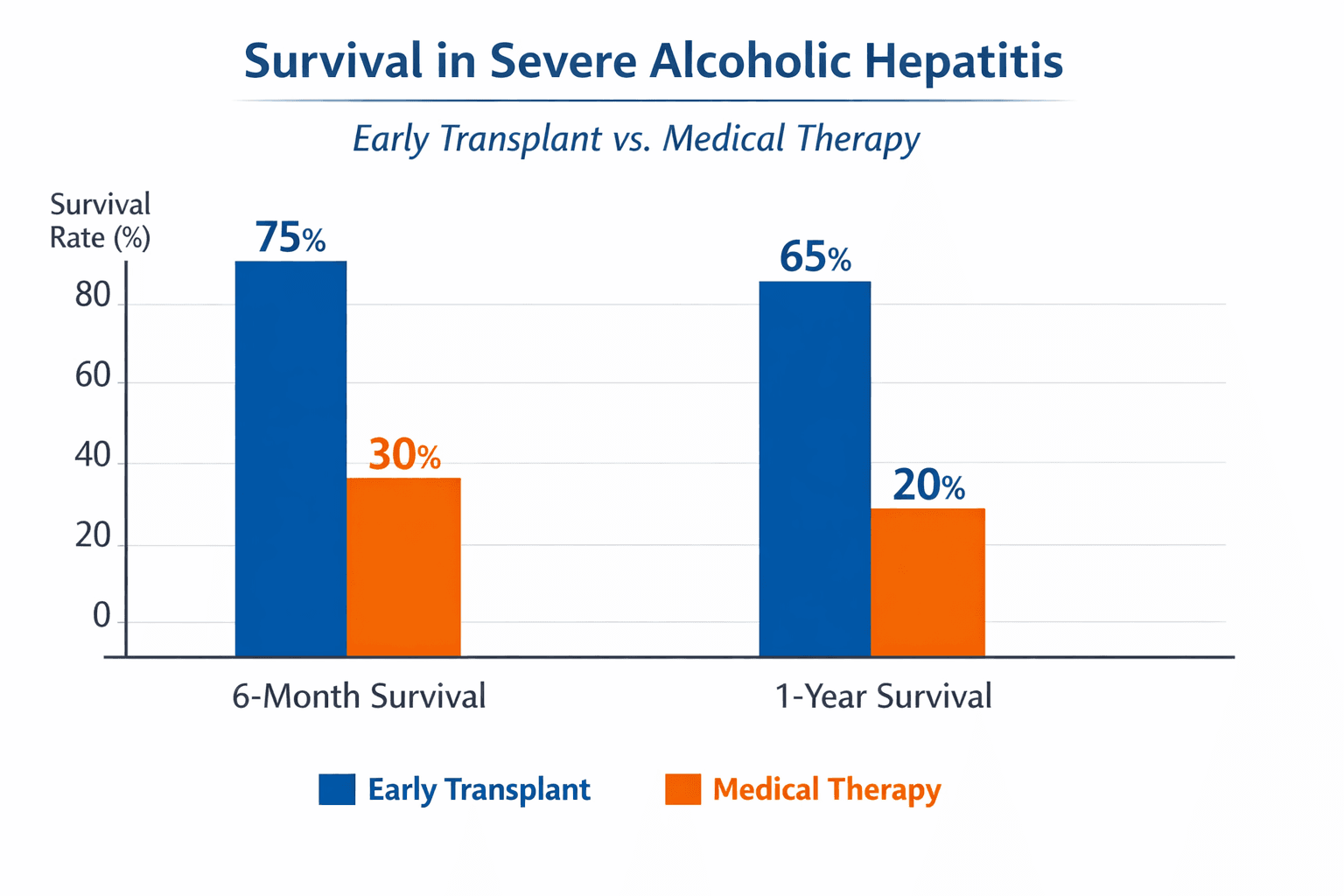
The clinical case for early liver transplantation in alcoholic hepatitis has been building since the landmark European study by Mathurin et al., which showed six-month survival of approximately 77% in carefully selected patients who underwent early transplant, compared to 23% in those who received medical therapy alone. That survival gap is not marginal — it is the difference between a condition that is survivable and one that is not.
More recent US cohort data, including multi-centre analyses published in the last three years, demonstrate one-year survival exceeding 90% in early transplant recipients. Post-transplant alcohol relapse — the primary concern used to justify the six-month rule — occurred in approximately 10–15% of patients in these series. Critically, that relapse rate is comparable to, or lower than, rates seen in patients transplanted for ALD after completing a six-month abstinence period. The abstinence duration did not protect against relapse. It only delayed the transplant.
Per the 2026 NEJM Clinical Perspective, outcomes in carefully selected alcoholic hepatitis patients are now comparable to those seen with other major transplant indications. That is a remarkable finding, and it carries a direct clinical implication: withholding transplant on the basis of a time threshold alone — rather than individualized clinical and psychosocial assessment — is no longer a defensible default. It is a policy decision that costs lives.
Clinical Scenario
A 41-year-old man with a three-year history of heavy alcohol use was admitted with jaundice, coagulopathy, and encephalopathy. MELD score on admission was 32. He was started on prednisolone; by day 7, his Lille score was 0.58 — a non-responder. His wife had been present at every consultation. He acknowledged his addiction clearly and without deflection. He had voluntarily enrolled in a hospital-linked addiction counselling programme two days after admission. His social worker's assessment was strongly supportive.
He did not have six months of abstinence. He had six days. The transplant team proceeded with psychosocial evaluation, addiction psychiatry review, and multidisciplinary consensus — and listed him. He received a transplant on day 23 of admission. At 14 months post-transplant, he remains abstinent, engaged in outpatient addiction support, and working. His case did not succeed because of a calendar. It succeeded because the evaluation was done properly.
How to Select Patients for Early Transplant: Moving Beyond the Abstinence Clock
The six-month rule was always a proxy — an imperfect attempt to identify patients likely to remain abstinent post-transplant. The problem is that duration of abstinence is a weak predictor of that outcome. What actually predicts post-transplant sobriety is a different set of variables entirely, and hepatology now has reasonable consensus on what those are.
Insight into addiction — the patient's capacity to name their illness, recognise its consequences, and engage with the idea of long-term recovery — is the single most important qualitative marker. Patients who minimise, externalise, or disengage are at substantially higher relapse risk regardless of how long they have been abstinent. Treatment engagement prior to or during the admission matters: a patient who voluntarily participates in addiction counselling before discharge has demonstrated behavioural readiness that a six-month sobriety counter does not capture.
Psychosocial stability — housing security, financial stability, absence of co-dependent relationships that perpetuate use — is independently predictive. So is family and social support: a consistent, present, non-enabling support system is one of the strongest protective factors against relapse identified in the literature on alcohol-related liver disease transplant outcomes.
Selection criteria used by programs with strong early transplant outcomes typically include: first liver decompensation (not multiple prior admissions), severe acute alcoholic hepatitis non-responsive to medical therapy, absence of other organ failure that independently limits transplant candidacy, and a rigorous addiction psychiatry evaluation with documented psychosocial support. These criteria are demanding — and appropriately so. They are also individualized. That is precisely the point.
A Frequently Overlooked Point: Bias, Not Biology, Is Driving the Wait
One dimension of this debate that rarely surfaces in clinical publications but is well-documented in transplant registry data: patients with alcohol-related liver disease wait longer for transplant than patients listed for other indications, even at equivalent MELD scores. That disparity is not entirely explained by clinical factors — it reflects institutional hesitation rooted in moral judgement rather than outcomes data. The evidence does not support the idea that ALD patients are worse transplant recipients. It supports the opposite. Acknowledging that the six-month rule has functioned partly as a gatekeeping mechanism — rather than a purely clinical tool — is necessary context for any honest discussion of why reform has been slow despite a decade of accumulating evidence.
Bottom Line for Clinical Practice
The six-month abstinence rule is not evidence-based and should not be applied as a fixed criterion for transplant listing in alcoholic hepatitis.
In corticosteroid non-responders with severe alcoholic hepatitis (MELD ≥25, Lille score ≥0.45 at day 7), early transplant evaluation should begin immediately — not after an abstinence calendar is satisfied.
Psychosocial evaluation by addiction psychiatry and social work is the cornerstone of patient selection; it should be rigorous, structured, and multidisciplinary — not a checkbox.
Post-transplant relapse rates in carefully selected patients are 10–15% — comparable to or lower than rates in patients transplanted after the traditional six-month window.
ALD burden is rising disproportionately in young adults and women; delayed listing in this population carries compounding mortality risk that the clinical community can no longer ignore.
When you encounter a case of severe alcoholic hepatitis where medical therapy is failing and the transplant question is on the table, bring GastroAGI into the clinical reasoning. Walk it through the MELD trajectory, Lille score, psychosocial data, and contraindications — it will return a structured, evidence-grounded assessment in seconds. Early decisions deserve early support. Try GastroAGI.
Also Read: Acute Pancreatitis in 2026: Predicting Severity, Timing Intervention, and Avoiding Common Pitfalls

We are pioneers in clinical intelligence, dedicated to helping gastroenterologists harness the power of artificial intelligence to drive precision, efficiency, and patient growth.