
13 Expert Tips on Electrosurgery in Therapeutic Endoscopy: What Every Endoscopist Should Revisit
AGA’s expert update highlights key electrosurgery principles for safer polypectomy, EMR, APC, ERCP sphincterotomy and third-space endoscopy.


Introduction
Electrosurgery is used every day in therapeutic endoscopy, but it is often learned informally: by observing seniors, memorizing generator settings, or copying unit-specific presets. The AGA’s recent expert update is a useful reminder that electrosurgery is not simply about pressing the blue or yellow pedal. It is about understanding how electrical energy interacts with tissue, how generator settings alter clinical effect, and how technique influences bleeding, perforation, and delayed adverse events.
The AGA Clinical Practice Update emphasizes that endoscopists should understand fundamental electrosurgical principles and know the specific electrosurgical unit and settings they are using. This matters because polypectomy, EMR, ESD, APC, sphincterotomy, hemostasis, and third-space endoscopy all depend on controlled energy delivery.
Why this update matters
Therapeutic endoscopy has become increasingly complex. Endoscopists are now expected to remove large lesions, manage intraprocedural bleeding, ablate residual margins, perform ERCP sphincterotomy, and in advanced units, perform third-space procedures such as POEM and ESD.
In each of these settings, electrosurgery can be both therapeutic and harmful. The same current that cuts or coagulates tissue can also cause deep injury, delayed perforation, post-polypectomy syndrome, pancreatitis risk during sphincterotomy, or unintended tissue damage. The AGA update is therefore especially relevant for fellows, early-career consultants, therapeutic endoscopists, and endoscopy units trying to standardize safety.
What the AGA expert update highlights
The first message is foundational: endoscopists should understand basic electrosurgical principles. This includes tissue resistance, current density, waveform, voltage, duty cycle, and how contact pressure, device position, tissue hydration, and activation time influence the final tissue effect.
The second message is practical: the endoscopist should know the electrosurgical unit being used and the related settings. This is important because different generators may use different terminology, modes, and algorithms, even when the clinical procedure appears similar.
The update also addresses clinical applications. It notes that either cut- or coagulation-predominant current may be considered in some endoscopic applications, depending on the desired tissue effect and procedural context. In other words, there is no universal “safe setting.” Safety comes from matching energy mode, device, tissue target, and technique.
A particularly important caution is soft coagulation. The update notes that soft coagulation can be effective for hemostasis and ablation, but endoscopists should recognize its potential for deep tissue injury and delayed perforation. This is highly relevant after EMR, during visible vessel treatment, and when applying thermal therapy to thin-walled areas such as the right colon or duodenum.
The AGA update also discusses adjunctive techniques, including hot forceps avulsion with cutting current for focal non-lifting fibrotic areas, argon plasma coagulation as a non-contact method of delivering electrosurgical energy, ERCP sphincterotomy, and third-space endoscopy.
Clinical interpretation
The main clinical message is simple: electrosurgery should be treated as a procedural skill, not just an equipment setting.
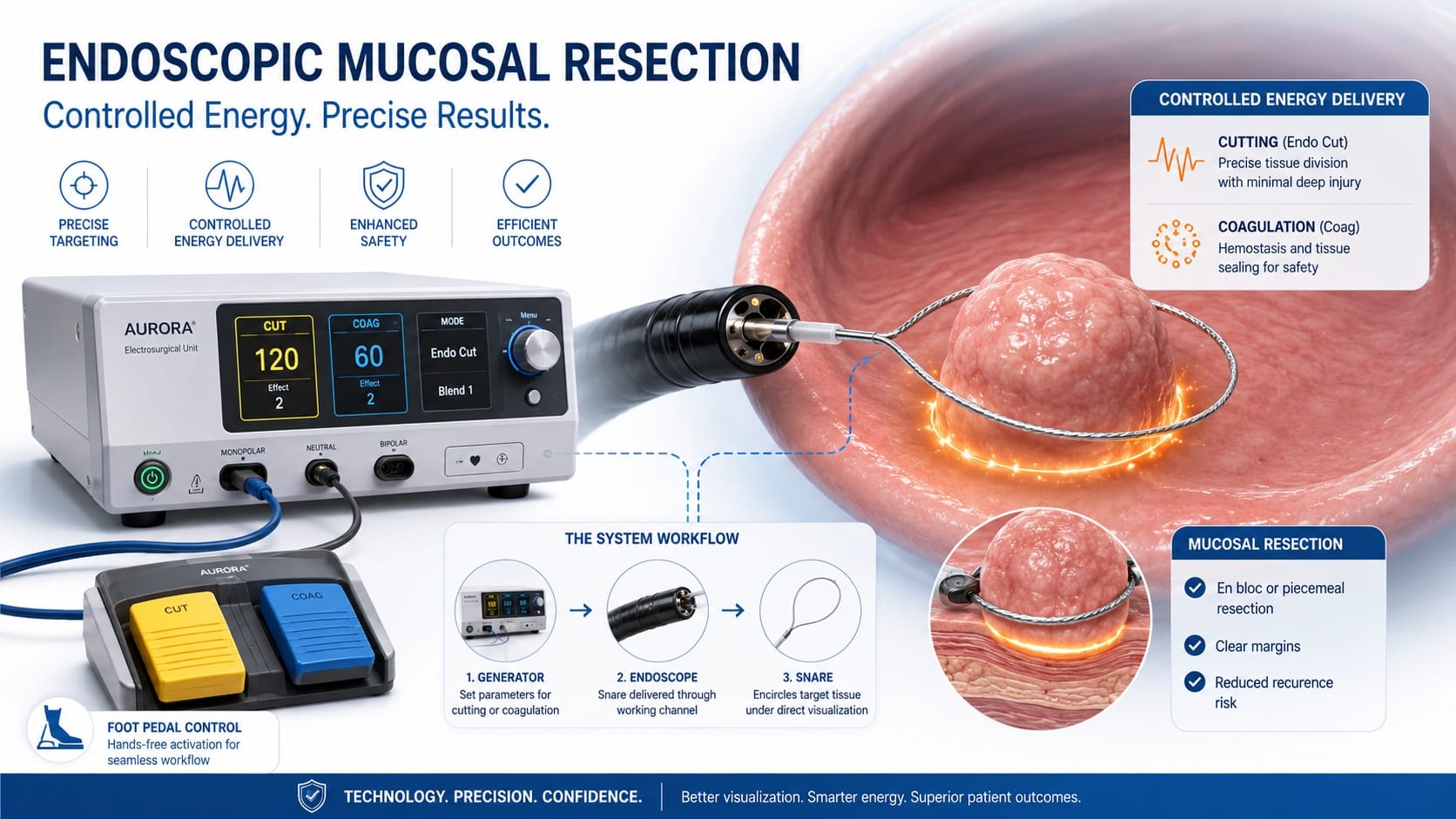
For polypectomy and EMR, the decision is not only cold versus hot. When electrosurgery is used, the endoscopist must understand whether the goal is cutting, coagulation, blended effect, vessel sealing, margin ablation, or rescue hemostasis. Each goal requires different thinking.
For APC, the update reinforces that gas flow and power parameters influence the tissue effect. This is clinically important because APC is sometimes perceived as “gentle” because it is non-contact, but it can still create clinically significant thermal injury.
For ERCP, the update emphasizes optimizing electrosurgical delivery during sphincterotomy while minimizing immediate or delayed bleeding and pancreatitis risk. This is a useful teaching point: sphincterotomy technique is not only about cannulation and anatomy; energy delivery matters.
For third-space endoscopy, the AGA advises that endoscopists performing these procedures should have an in-depth understanding of how to optimize desired tissue effects while minimizing off-target tissue damage. This is particularly relevant for POEM, G-POEM, Z-POEM, and ESD, where dissection planes are narrow and complications can occur quickly.
Practical implications for gastroenterologists
For general gastroenterologists, this update is a reminder to avoid passive use of generator presets. Before using electrosurgery, the operator should know the indication, device, current type, expected tissue effect, and safety concern.
For fellows, this is a useful curriculum topic. Electrosurgery teaching should include more than “use forced coag here” or “use Endocut there.” Trainees should learn why a setting is chosen, what tissue effect is expected, and what complication it is trying to prevent.
For endoscopy units, the update supports standardization. Teams should know which generator is used, where settings are documented, how foot pedals are assigned, how return electrodes are placed when required, and how communication occurs during activation.
For advanced endoscopists, the update reinforces the need for procedure-specific energy planning. EMR, ESD, ERCP sphincterotomy, APC, hemostasis, and third-space procedures should not be approached with the same mental model.
Limitations and caution
This AGA Clinical Practice Update is expert guidance, not a randomized trial. AGA notes that Clinical Practice Updates include evidence-based information and, where evidence is limited, best consensus opinion. Therefore, the update should be used as a practical safety and education framework rather than as a rigid protocol.
Local equipment, generator model, accessory device, lesion location, tissue thickness, patient factors, and operator experience all influence the safest approach. Endoscopists should follow institutional policies, manufacturer guidance, and local training standards.
GastroAGI takeaway
Electrosurgery is one of the most important but under-discussed skills in therapeutic endoscopy. The AGA’s 13 expert tips are valuable because they move the conversation beyond memorized settings and toward principled, intentional energy use.
For GastroAGI readers, the key takeaway is this: safe electrosurgery requires understanding the generator, the waveform, the tissue target, the accessory device, and the complication you are trying to avoid.
In therapeutic endoscopy, energy is not just delivered. It is prescribed.


We are pioneers in clinical intelligence, dedicated to helping gastroenterologists harness the power of artificial intelligence to drive precision, efficiency, and patient growth.