
Fluorescence-Guided Molecular Imaging in GI Oncology: What the AGA Lumicell Spotlight Signals for Future Cancer Resection
AGA’s Lumicell spotlight highlights fluorescence-guided molecular imaging as a real-time cancer detection strategy with GI oncology potential.


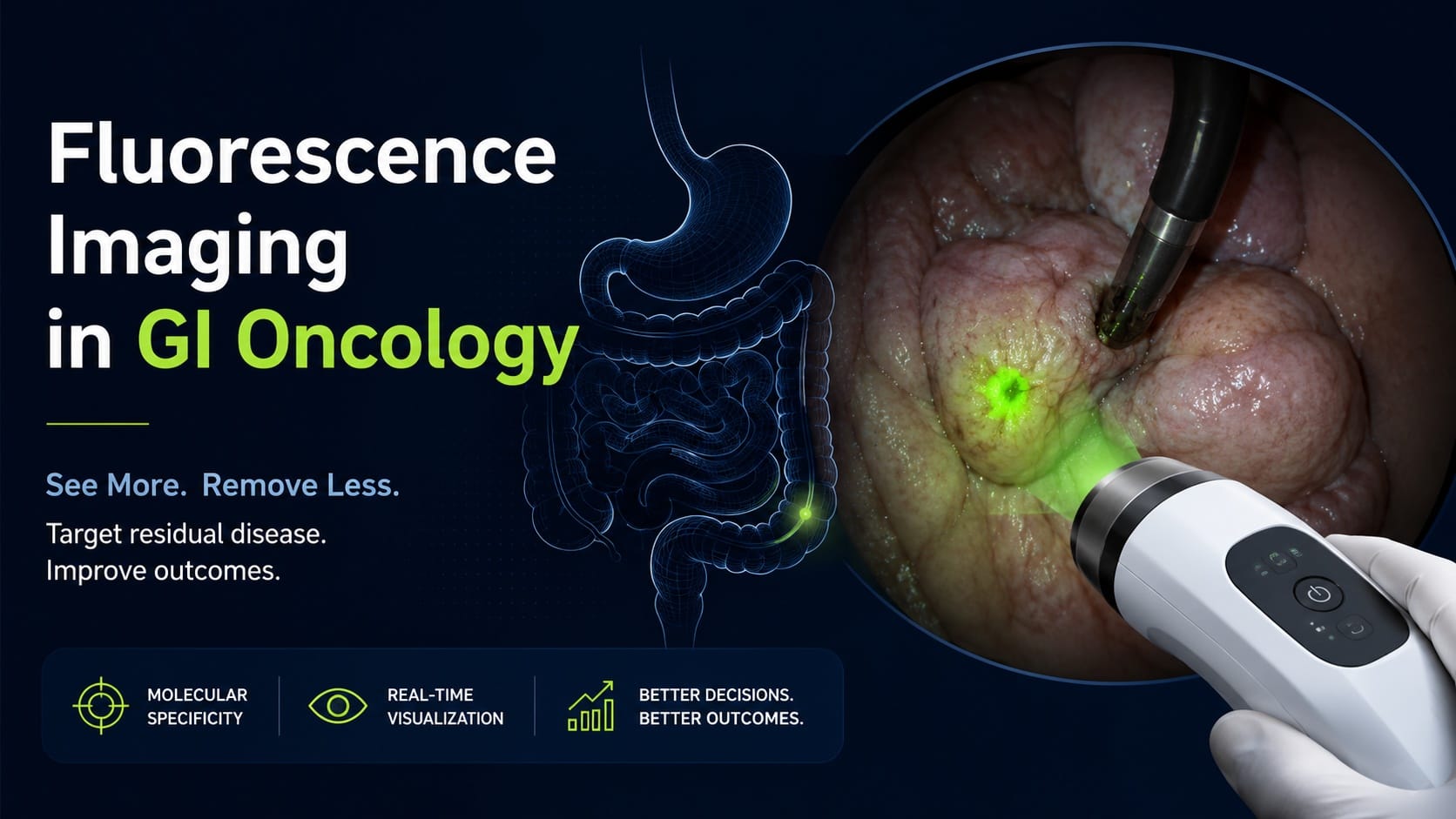
For every clinician involved in gastrointestinal cancer care, one question remains central after a tumor is removed: was all clinically meaningful disease actually cleared?
Surgeons, therapeutic endoscopists, oncologists, pathologists, radiologists, and gastroenterologists approach this question from different angles. The surgeon sees the operative field. The endoscopist sees mucosal and submucosal planes. The pathologist sees the specimen after removal. The oncologist thinks in terms of recurrence risk and systemic disease. Yet the decision that matters most to patients is often made across time: cancer is removed during the procedure, but certainty about residual microscopic disease may come later.
A recent American Gastroenterological Association innovation spotlight, titled “Startup spotlight: Lumicell – illuminating the future of surgical oncology,” published on July 20, 2026, brings this unresolved problem into focus. The piece highlights Lumicell, a 2026 AGA Shark Tank participant developing fluorescence-guided molecular imaging for real-time cancer detection during surgery. The technology is not currently presented as established GI oncology practice. Rather, the AGA spotlight frames it as an innovation with potential implications for surgical oncology and, possibly in the future, advanced endoscopic interventions.
The clinical problem: residual disease is often a delayed diagnosis
The AGA spotlight identifies one of the most difficult problems in solid tumor surgery: knowing before the operation ends whether all cancer has truly been removed. Despite advances in imaging and pathology, microscopic residual disease may remain undetected during surgery. In breast-conserving surgery, this uncertainty can lead to second operations after postoperative pathology identifies positive margins. The AGA article notes that similar challenges exist in gastrointestinal oncology, where clinicians must balance oncologically sound resection with preservation of healthy tissue.
That balance is especially relevant to GI cancer care. Colorectal, gastric, pancreatic, and esophageal cancer operations often require careful trade-offs between complete tumor clearance and preservation of organ function, anastomotic integrity, quality of life, and procedural morbidity. Even in advanced endoscopy, the same logic applies at a different scale: endoscopic mucosal resection, endoscopic submucosal dissection, and endoscopic full-thickness resection increasingly aim to remove early neoplasia while preserving anatomy.
The limitation of current practice is not that clinicians lack skill or imaging altogether. It is that intraoperative and intraprocedural decision-making remains constrained by what can be seen, palpated, sampled, or later confirmed by pathology. The AGA spotlight describes current surgical reliance on visual inspection, palpation, frozen section, and permanent pathology, while noting that these approaches may either lack sensitivity or not be available in real time.
What the AGA spotlight investigated
This update is best classified as society innovation news, not a clinical trial report, guideline, systematic review, or practice recommendation. The article profiles Lumicell as a 2026 AGA Shark Tank participant and describes the company’s technology, regulatory milestone in breast-conserving surgery, and potential relevance to broader surgical oncology.
The technology focus is fluorescence-guided molecular imaging for real-time cancer detection during surgery. The AGA source describes Lumicell as founded in 2008, headquartered in Newton, Massachusetts, and at a commercial stage with an FDA-approved platform for breast cancer resection while GI oncology work is ongoing.
That distinction is essential. The population directly connected to FDA approval in the AGA article is breast-conserving surgery, not GI cancer. The GI relevance is forward-looking and translational. The article does not report a completed GI oncology randomized trial, GI-specific diagnostic accuracy estimates, recurrence outcomes, margin-negative resection rates, or survival data. Therefore, any GastroAGI interpretation must treat the GI implications as plausible future directions rather than established clinical benefit.
The technology: molecular signal at the surgical cavity
Lumicell’s platform, as described by AGA, combines an intravenously administered, protease-activated fluorescent imaging agent, LUMISIGHT™ / pegulicianine, with a handheld imaging device that detects fluorescence within the surgical cavity after the primary tumor has been removed. The purpose is to help surgeons visualize suspicious residual tissue during the same operation rather than waiting days for pathology results.
This concept is important because it shifts imaging from anatomy alone toward molecular activity. The AGA article frames the platform as a combination of molecular imaging, optical engineering, and real-time clinical decision support. In practical terms, the promise is not merely a brighter operative field. It is the possibility of identifying tissue that may carry a tumor-associated molecular signal and using that information while there is still an opportunity to resect additional tissue.
However, the clinical word “suspicious” matters. Fluorescence is not the same as a final histopathological diagnosis. The AGA spotlight does not state that fluorescence-guided imaging replaces pathology, nor does it provide GI-specific accuracy metrics. For clinicians, the correct interpretation is that molecular imaging could become an adjunct to operative or endoscopic judgment, not a substitute for pathological confirmation.
Why GI clinicians should care, even before GI adoption
At first glance, a technology approved for breast-conserving surgery may seem distant from everyday gastroenterology. But the AGA spotlight argues that the underlying concept has broader implications for surgical oncology, including gastrointestinal malignancies where complete tumor removal remains fundamental to outcomes.
This is where the update becomes relevant for gastroenterologists and GI oncologists. Modern GI cancer care is increasingly multidisciplinary. Gastroenterologists diagnose and stage disease, identify high-risk lesions, perform therapeutic resections for selected early cancers, manage surveillance, and participate in MDT decisions about surgery, oncology, and follow-up. Technologies that improve intraoperative or intraprocedural detection of residual neoplasia could eventually affect these workflows.
The AGA article specifically points toward complex colorectal, gastric, pancreatic, and esophageal cancer resections, where complete tumor removal must be balanced against preserving normal tissue. It also notes that molecular imaging may eventually influence advanced endoscopic interventions as EMR, ESD, and full-thickness resection become more sophisticated.
That “eventually” should not be ignored. It signals potential, not readiness. But it is a relevant potential because advanced endoscopy is moving toward increasingly precise, organ-preserving oncologic therapy. Better visualization of residual neoplasia could theoretically support more complete resection, better margin assessment, or more informed decisions about additional therapy. The current AGA source does not prove those outcomes in GI practice.
The AGA innovation ecosystem around this update
The Lumicell spotlight sits within a broader AGA strategy to connect clinicians, researchers, entrepreneurs, and industry around GI innovation. AGA’s New Technology & Techniques page states that the organization is committed to driving innovation so future gastroenterologists have new tools to care for digestive disease patients. It also lists the AGA Incubator Showcase at DDW 2026 and describes AGA’s partnership with MATTER, through which members can access resources for building health care solutions.
AGA also describes a GI Opportunity Fund, launched with Varia Ventures, dedicated to investing in fast-growing early-stage companies in the GI space. The same AGA innovation page lists examples of supported companies working across AI-fueled endoscopic procedure recording and trial recruitment, attachable EUS platforms, unsedated transnasal endoscopy, virtual digestive care, and other digestive disease technologies.
This matters because innovation in GI is no longer limited to devices used during procedures. It now includes AI-enabled documentation and recruitment, minimally invasive diagnostics, care delivery platforms, molecular imaging, procedure-based therapeutics, and reimbursement-aware implementation strategies. AGA’s presidential innovation coverage from DDW 2026 similarly described innovation as spanning technology, care delivery, workforce development, genomics, proteomics, AI, and policy advocacy.
For clinicians, this broader ecosystem matters because the success of a technology rarely depends on performance alone. Adoption also requires training, workflow fit, reimbursement, regulatory clarity, safety monitoring, equitable access, and evidence that the tool improves clinically meaningful outcomes.
What clinicians can reasonably infer
From the AGA spotlight, clinicians can conclude that fluorescence-guided molecular imaging is being actively developed as a real-time cancer detection strategy and that Lumicell’s platform has achieved FDA approval for breast-conserving surgery. The AGA article states that Lumicell received simultaneous FDA approval in April 2024 for both its imaging agent and imaging system, supported by a multicenter clinical development program in breast-conserving surgery.
Clinicians can also conclude that AGA considers this type of platform relevant to the GI innovation community because of its potential implications for surgical oncology and possibly advanced endoscopic interventions. The update explicitly links the concept to colorectal, gastric, pancreatic, and esophageal cancer resections and to the broader evolution of EMR, ESD, and full-thickness resection.
But clinicians should not infer GI clinical efficacy from this spotlight. The AGA source does not present GI-specific trial results. It does not establish that fluorescence-guided molecular imaging reduces repeat surgery in GI cancers, improves R0 resection rates, reduces recurrence, improves survival, or changes endoscopic management. Those would require GI-specific prospective evidence.
What this does not mean for current practice
This update should not be interpreted as a recommendation to incorporate Lumicell’s platform into routine GI oncology or advanced endoscopy practice today. The AGA source describes GI oncology work as ongoing, while the current FDA-approved platform referenced is for breast cancer resection.
It also should not be interpreted as evidence that molecular imaging can replace frozen section, permanent pathology, endoscopic assessment, cross-sectional imaging, or multidisciplinary review. The technology is described as providing real-time decision support, not definitive histology.
For gastroenterologists, the appropriate stance is informed caution. The field should watch fluorescence-guided molecular imaging closely, particularly as organ-preserving approaches expand. But it should demand the same evidence standards expected of other cancer technologies: clearly defined indications, diagnostic accuracy, effect on management decisions, patient-centered outcomes, procedural safety, cost-effectiveness, and reproducibility across centers.
Evidence gaps that matter before GI implementation
Several evidence gaps remain.
First, GI-specific diagnostic performance is not established in the AGA spotlight. Future studies would need to define sensitivity, specificity, positive predictive value, and negative predictive value for residual cancer detection in specific GI tumors and procedural contexts.
Second, clinical utility must be demonstrated. A test can detect a signal without improving outcomes. The clinically relevant question is whether fluorescence-guided imaging changes intraoperative or endoscopic decisions in ways that improve margin status, reduce repeat procedures, avoid unnecessary tissue removal, or improve oncologic outcomes.
Third, anatomical and biological differences across GI cancers matter. Colorectal, gastric, pancreatic, and esophageal tumors differ in operative field, stromal environment, depth of invasion, lymphatic spread, neoadjuvant therapy exposure, and margin assessment. A platform useful in one setting may not translate uniformly across all GI malignancies.
Fourth, implementation must be practical. Intravenous imaging agents, handheld devices, operative timing, fluorescence interpretation, regulatory indications, training, and cost all influence whether a technology can move from innovation showcase to routine care.
Finally, the role in advanced endoscopy requires separate evaluation. EMR, ESD, and full-thickness resection operate in different visual and technical environments than open or minimally invasive surgery. The source notes potential future relevance to advanced endoscopic interventions, but does not provide evidence of endoscopic performance.
Why this is still worth GastroAGI attention
The reason to cover this update is not that it changes clinical practice today. It is worth covering because it illustrates the direction of GI oncology innovation: moving from delayed pathology-dependent feedback toward real-time, biologically informed procedural decision support.
This direction aligns with several visible trends in gastroenterology. AGA’s innovation materials highlight AI-fueled endoscopic recording and patient recruitment tools, attachable EUS platforms, unsedated transnasal upper endoscopy, and virtual digestive care models. AGA’s DDW innovation coverage also emphasized AI, genomics, proteomics, workforce development, and systems-level readiness for future GI care.
Lumicell fits into this broader narrative as a molecular imaging example. It is neither purely software nor a conventional device. It represents a drug-device imaging platform designed to make cancer biology visible during a procedure. For clinicians and researchers, that is an important conceptual shift.
Clinical Takeaway
AGA’s “Startup spotlight: Lumicell – illuminating the future of surgical oncology” is a society innovation update, not a GI clinical trial or guideline. It highlights a fluorescence-guided molecular imaging platform that is FDA-approved for breast-conserving surgery and being explored for broader oncology applications, with GI oncology work ongoing.
For gastroenterologists, hepatologists, fellows, and GI oncology researchers, the key message is cautious interest. Real-time molecular imaging could eventually support more precise cancer resection and possibly advanced endoscopic therapy, but the current source does not establish GI-specific clinical benefit. The update is useful for awareness, innovation tracking, and research horizon scanning—not for changing current GI cancer management.
Five key clinical takeaways
Evidence label: Society innovation news / technology spotlight, not a guideline, randomized trial, or GI outcome study.
Article verified: AGA published “Startup spotlight: Lumicell – illuminating the future of surgical oncology” on July 20, 2026.
Technology described: Lumicell’s platform uses an intravenously administered protease-activated fluorescent imaging agent with a handheld imaging device to detect fluorescence in the surgical cavity after tumor removal.
Current approval context: The AGA source states that the platform is FDA-approved for breast cancer resection, while GI oncology work is ongoing.
Clinical interpretation: The GI relevance is promising but unproven; clinicians should not infer improved GI cancer margins, recurrence, survival, or endoscopic outcomes without GI-specific prospective evidence.
Source reference and link
American Gastroenterological Association. “Startup spotlight: Lumicell – illuminating the future of surgical oncology.” Published July 20, 2026. Source: AGA News.


We are pioneers in clinical intelligence, dedicated to helping gastroenterologists harness the power of artificial intelligence to drive precision, efficiency, and patient growth.