
GLP-1 Receptor Agonists and Aspiration Risk During Endoscopy: What Clinicians Should Take From the New CGH Article
A clinician-focused review of the new CGH article on GLP-1 receptor agonists and pulmonary aspiration during endoscopy and colonoscopy.


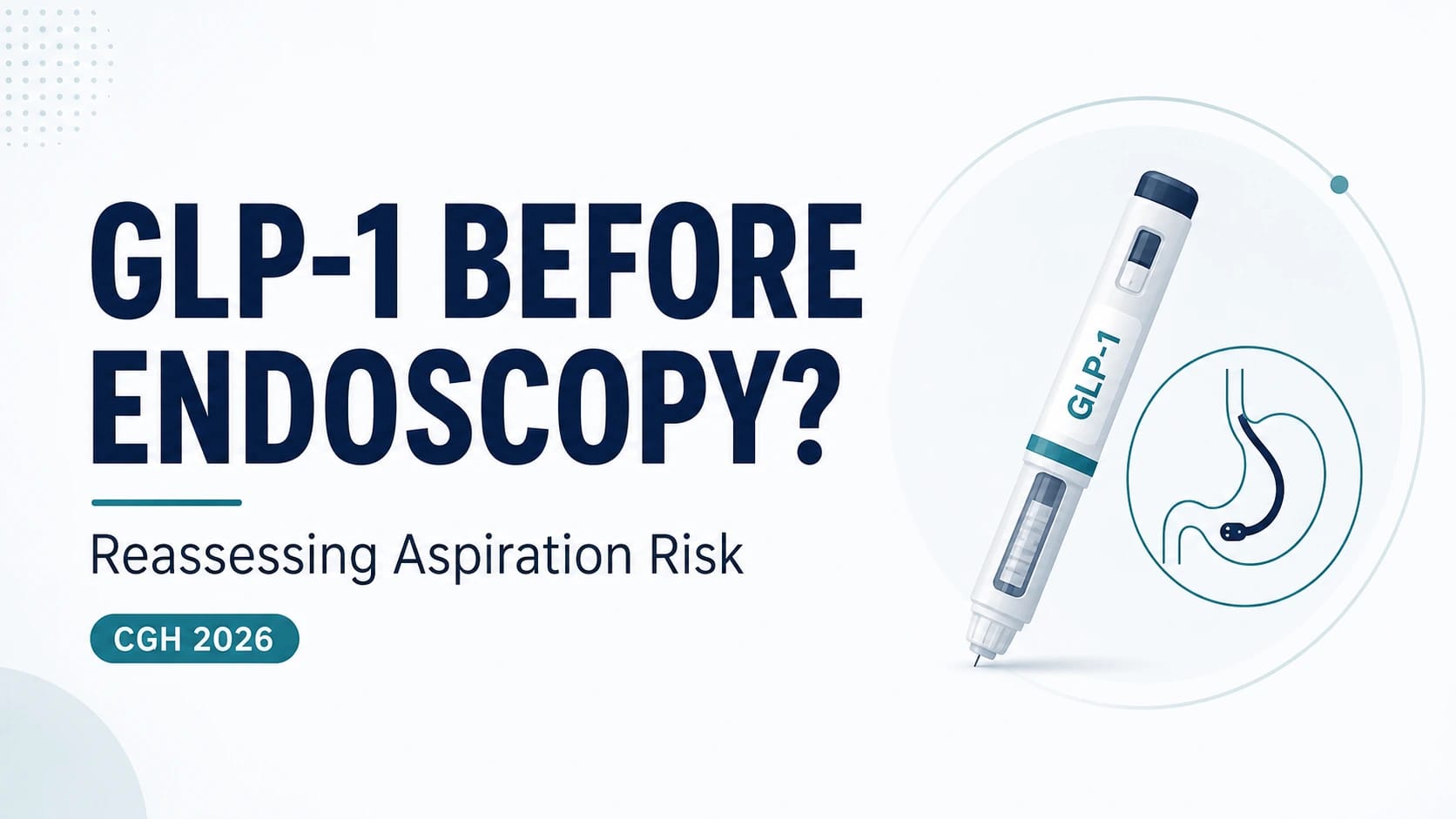
The question now arriving at almost every endoscopy unit
It is an increasingly familiar pre-procedure conversation.
A patient scheduled for elective endoscopy is taking a glucagon-like peptide-1 receptor agonist for type 2 diabetes, obesity, or both. The medication may slow gastric emptying. Someone on the team asks whether aspiration risk is higher. Then come the practical questions: Should the procedure go ahead? Should the medication have been withheld? Does anesthesia need to approach the case differently?
These are not theoretical questions anymore. GLP-1 receptor agonists have become common enough that gastroenterologists encounter them across routine practice—in patients undergoing colorectal cancer screening, evaluation of dyspepsia or reflux symptoms, bariatric assessment, metabolic liver disease care, and standard diagnostic endoscopy.
The new Clinical Gastroenterology and Hepatology article, “Glucagon-Like Peptide-1 Receptor Agonists Are Not Associated with Increased Pulmonary Aspiration During Endoscopy and Colonoscopy,” directly addresses the outcome that has generated much of this concern.
The article was authored by Jeong Yun Yang, Ling Chen, Jason D. Wright, and Chin Hur and published online on July 22, 2026.
There is, however, an important limitation before we go any further: the accessible source confirms the article title, journal, authors, and publication date, but does not provide the complete abstract, methods, study population, exposure definitions, outcome definitions, or numerical effect estimates.
That means the clinically responsible interpretation must remain deliberately narrow.
The title tells us that GLP-1 receptor agonist use was not associated with increased pulmonary aspiration during endoscopy and colonoscopy.
It does not tell us, from the material currently available, precisely how that conclusion was reached.
That distinction matters.
Why GLP-1 therapy became an aspiration concern in the first place
The concern is biologically reasonable.
GLP-1 receptor agonists can delay gastric emptying. Delayed emptying can lead to retained gastric contents. Retained gastric contents, particularly around sedation or upper gastrointestinal procedures, raise concern about regurgitation and pulmonary aspiration.
The chain of reasoning is therefore straightforward:
GLP-1 therapy → slower gastric emptying → retained gastric contents → possible aspiration.
But clinical medicine rarely allows us to treat a plausible physiological pathway as though every step has already been proven to translate into a meaningful clinical event.
A drug may increase retained gastric contents without producing a measurable increase in aspiration. Aspiration itself is uncommon, procedural teams may alter their approach when retained contents are encountered, and fasting or bowel preparation may change the amount and character of gastric contents.
So the clinically important question is not merely whether GLP-1 receptor agonists affect gastric emptying.
We already know why that concern exists.
The more relevant question is whether patients taking these medications actually experience more pulmonary aspiration during endoscopic procedures.
The title of the CGH article suggests that, in the population studied, they did not.
That is reassuring.
It is not the same as saying the risk is zero.
What we can say with confidence—and what we cannot
The accessible source supports a small number of firm conclusions.
The article was published in Clinical Gastroenterology and Hepatology, appeared online on July 22, 2026, and reports in its title that GLP-1 receptor agonists were not associated with increased pulmonary aspiration during endoscopy and colonoscopy.
Beyond that, caution is necessary.
We cannot independently verify from the available material whether this was a retrospective cohort, database analysis, case-control study, prospective study, systematic review, or another design. We do not have the sample size, inclusion criteria, comparator group, medication exposure window, procedure distribution, anesthesia setting, or method used to identify aspiration events.
Those details are not academic housekeeping.
They determine how much weight we should place on the result.
A very large administrative database, for example, may be useful when studying a rare event such as aspiration but may depend heavily on diagnostic coding and have limited granular procedural information.
A smaller endoscopy cohort might tell us more about retained gastric contents, sedation, fasting, and symptoms but have inadequate statistical power to detect uncommon pulmonary events.
Different designs answer slightly different questions.
Without the methods, it would be inappropriate to pretend we know which question this study answered best.
“Not associated” is not the same as “cannot happen”
This is perhaps the most important language point in the paper.
The title says GLP-1 receptor agonists were not associated with increased pulmonary aspiration.
That is an association statement.
It does not mean a patient taking a GLP-1 receptor agonist cannot aspirate. Nor does it establish that medication exposure is irrelevant in every individual clinical situation.
Aspiration is rarely a single-variable event.
A patient with nausea, vomiting, marked early satiety, known gastroparesis, diabetes-related autonomic dysfunction, obesity, opioid exposure, poor fasting adherence, or an urgent procedural indication is not clinically identical to an asymptomatic patient presenting for a routine elective procedure.
The type of procedure also matters. So may the depth of sedation, airway strategy, positioning, and overall comorbidity burden.
That is why population-level reassurance should not eliminate bedside judgment.
At the same time, the reverse mistake is equally easy to make.
A physiologically plausible concern, or even a series of memorable case reports, does not automatically establish that every patient taking a GLP-1 receptor agonist carries a materially increased aspiration risk.
We have all seen how quickly peri-procedural caution can turn into a blanket rule.
The challenge is to avoid making the medication list more important than the patient sitting in front of us.
Colonoscopy deserves separate thought
One detail in the article title is easy to overlook: it explicitly includes both endoscopy and colonoscopy.
That matters because these are not physiologically or procedurally identical settings.
Patients presenting for colonoscopy usually undergo bowel preparation and often follow a period of liquid intake before the procedure. This may alter retained solid gastric content compared with a patient undergoing an upper endoscopy after standard fasting alone.
Colonoscopy also does not involve direct instrumentation of the upper gastrointestinal tract.
That does not mean aspiration is impossible during colonoscopy. Sedation, nausea, positioning, insufflation, and patient comorbidities can still influence pulmonary risk.
What we should not do, however, is assume that because both procedures appear in the article title they necessarily carried the same risk, contributed equally to the dataset, or produced estimates with the same degree of precision.
The accessible source does not provide that level of detail.
For an endoscopist, that is an important limitation because procedure-specific decisions are precisely where this evidence may eventually prove most useful.
The practical implication is not “ignore GLP-1 therapy”
The most sensible clinical reading is more nuanced.
GLP-1 receptor agonist exposure should not automatically be treated as synonymous with high aspiration risk.
But it should not be ignored either.
The more useful distinction may be between medication exposure and patient-level procedural risk.
Consider two patients.
One is on stable long-term GLP-1 therapy, has no nausea, vomiting, early satiety, abdominal distension, or known gastroparesis, and arrives for a screening colonoscopy after completing bowel preparation.
Another has recently escalated the dose, reports persistent nausea and early satiety, and is scheduled for upper endoscopy.
Even without making assumptions about the exact study population, few clinicians would view those patients as interchangeable.
The source itself emphasizes that symptoms, procedural context, and other risk factors remain important considerations.
What the article appears to add is reassurance against the idea that GLP-1 receptor agonist use by itself should automatically be equated with pulmonary aspiration.
That is a useful distinction.
What this article should not become
There are several conclusions that would go beyond what the available evidence supports.
First, the title should not be translated into “aspiration does not occur in GLP-1 users.”
Rare events can occur even when there is no measurable increase at a population level.
Second, the article should not be used to dismiss retained gastric contents as clinically irrelevant.
Retained contents may still affect visualization, procedure completion, anesthesia decisions, and cancellations. The reported outcome in the title is pulmonary aspiration, not every possible consequence of delayed gastric emptying.
Third, this should not automatically be converted into a universal medication-management protocol.
A study can inform a guideline.
It is not necessarily a guideline.
The accessible material does not provide a protocol instructing clinicians to continue or discontinue GLP-1 therapy before every procedure.
Fourth, we should resist extending the finding to populations we have not confirmed were studied.
Urgent endoscopy, advanced procedures, severe gastroparesis, active vomiting, high-risk anesthesia, and recent GLP-1 initiation or dose escalation may represent quite different clinical circumstances.
Finally, absence of increased association is not evidence of benefit.
The correct interpretation remains neutral: GLP-1 receptor agonist use was not associated with a higher observed aspiration risk in the setting examined by the investigators.
That may sound overly precise.
In this case, precision is the entire point.
The questions that remain unanswered
Even a reassuring aspiration signal does not solve the operational problem facing endoscopy units.
Clinicians still need to know which symptoms should lead to postponement, anesthesia consultation, altered fasting, gastric ultrasound, or airway protection.
We need to understand whether risk varies by individual drug, daily versus weekly dosing, recent dose escalation, indication for therapy, diabetes status, obesity, and symptoms suggestive of delayed gastric emptying.
We also need better procedure-specific information.
Is the risk profile the same for upper endoscopy and colonoscopy?
Does bowel preparation meaningfully modify retained gastric contents?
How should we balance procedural safety against the consequences of repeated cancellations, delayed diagnosis, interrupted metabolic treatment, or disrupted glycemic control?
The source identifies these as unresolved implementation questions and emphasizes the need for future studies with more granular information on procedure type, sedation depth, airway management, medication exposure, symptoms, fasting, bowel preparation, and objective clinical outcomes.
That is where the field now needs to move.
Not merely toward determining whether GLP-1 drugs are “safe” or “unsafe,” but toward identifying which patient, undergoing which procedure, under which circumstances, requires additional precaution.
That is a much more clinically useful question.
Clinical Takeaway
The new Clinical Gastroenterology and Hepatology article by Yang, Chen, Wright, and Hur addresses one of the most debated periendoscopic concerns surrounding GLP-1 receptor agonists.
The source-supported headline is reassuring: GLP-1 receptor agonists were not associated with increased pulmonary aspiration during endoscopy and colonoscopy.
But the limits of what we currently have access to are equally important.
The available source does not provide sufficient methodological detail to verify the study design, sample size, population, exposure definition, procedural characteristics, outcome ascertainment, or effect estimates. The result should therefore be read as an association-based finding rather than proof of zero risk.
For gastroenterologists and endoscopy teams, the useful message is not that GLP-1 therapy can be forgotten before a procedure.
It is that GLP-1 use alone should probably not become a surrogate for aspiration risk.
Symptoms still matter.
Procedure type matters.
Sedation and airway strategy matter.
The broader clinical context matters.
And until more granular evidence is available, periendoscopic decisions should remain individualized rather than being driven by a medication name in isolation.
After a few decades in gastroenterology, one becomes wary of both extremes: doing too little because an event is uncommon, and doing too much because an event is imaginable.
The emerging evidence around GLP-1 receptor agonists and endoscopy may ultimately help us find the more sensible middle ground.
Five points worth carrying into practice
The verified finding is an association statement. The article reports that GLP-1 receptor agonists were not associated with increased pulmonary aspiration during endoscopy and colonoscopy.
Do not interpret this as zero individual risk. Aspiration remains multifactorial, and patient symptoms and procedural circumstances remain relevant.
Retained gastric contents and pulmonary aspiration are not interchangeable outcomes. The absence of increased aspiration does not establish that delayed gastric emptying has no procedural consequences.
This is not automatically a medication-management guideline. The accessible source does not support a blanket instruction to continue or withhold GLP-1 receptor agonists before every procedure.
Methodological uncertainty matters. The accessible source does not provide sufficient detail to verify the study design, population, exposure definitions, outcome definitions, or numerical effect estimates.
Source
Yang JY, Chen L, Wright JD, Hur C. Glucagon-Like Peptide-1 Receptor Agonists Are Not Associated with Increased Pulmonary Aspiration During Endoscopy and Colonoscopy. Clinical Gastroenterology and Hepatology. Published online July 22, 2026.

We are pioneers in clinical intelligence, dedicated to helping gastroenterologists harness the power of artificial intelligence to drive precision, efficiency, and patient growth.