
H. Pylori Treatment in 2026: Choosing the Right Regimen Based on Local Resistance Patterns
Bismuth quad, concomitant, or sequential — which H pylori regimen first in India? A decision framework mapped to local clarithromycin resistance data. Updated for 2026.


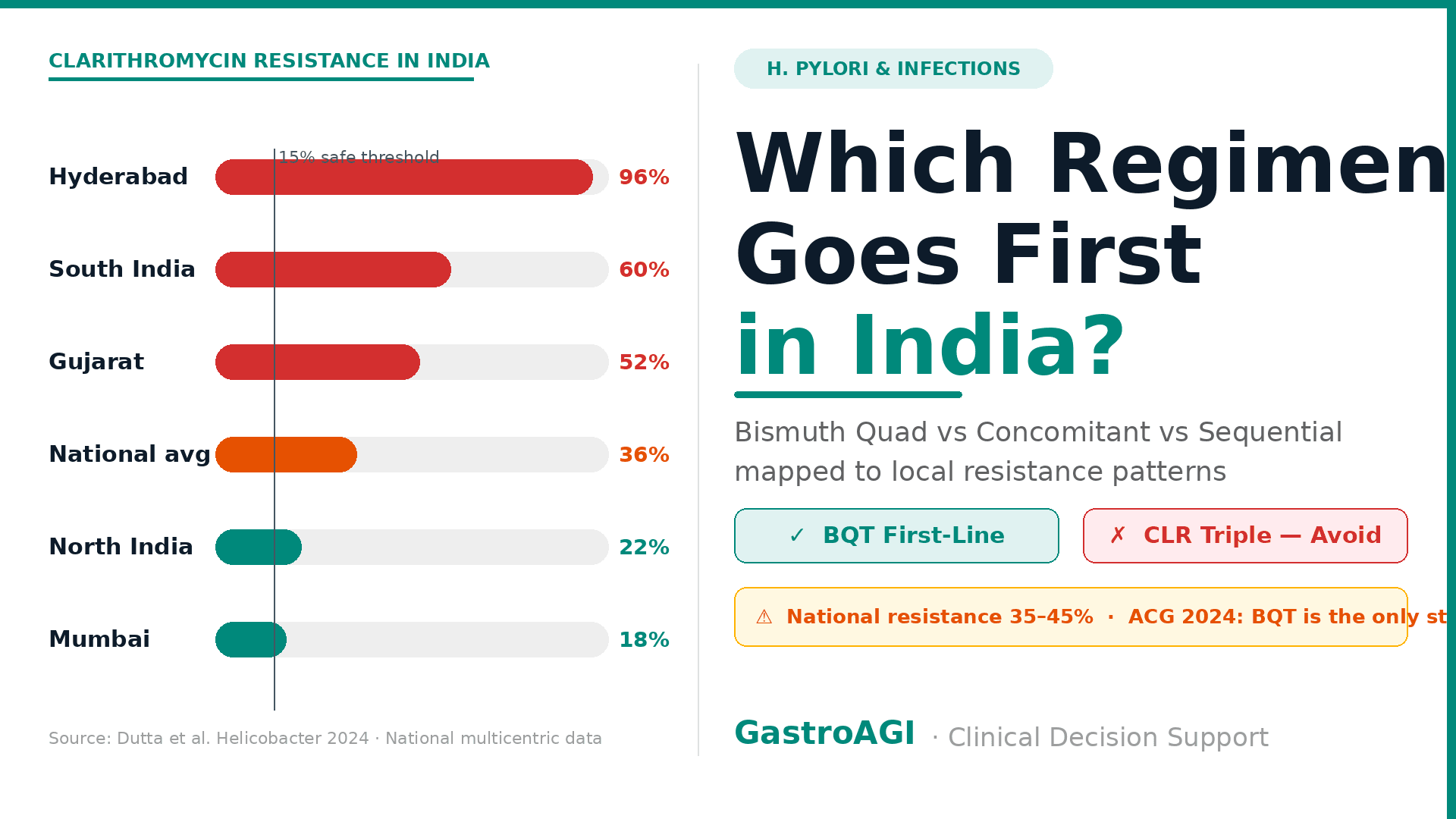
Your patient finishes a 14-day course of PPI-clarithromycin-amoxicillin. Breath test at 4 weeks: still positive. You prescribe again - bismuth quad this time - and they eradicate. That sequence was backwards. In India in 2026, empiric clarithromycin triple therapy should not be your opening move.
The core problem governing H. pylori treatment guidelines in 2026 in India is not a lack of options - it is a mismatch between the regimen prescribed and the antibiotic resistance landscape the organism actually lives in. Clarithromycin triple therapy has underpinned first-line eradication for decades, yet the data are unambiguous: national resistance to clarithromycin in India now sits at 35.64% overall, with the picture substantially worse in South India, Gujarat, and Kashmir. A ten-year trend analysis across South Asian countries confirms clarithromycin resistance has climbed from 21% in 2003 to 30% by 2022 - and continues to rise. Prescribing clarithromycin empirically when local resistance exceeds 15–20% is what drives the treatment failures filling your endoscopy list.
Yet no pan-India susceptibility atlas exists. Most Indian gastroenterologists are making regimen decisions blind to local culture data, relying on clinical intuition or outdated textbook algorithms. The decision framework below cuts through that ambiguity.
Why Clarithromycin Resistance Should End Triple Therapy as Your Default
Globally, clarithromycin resistance in H. pylori has increased from 29.1% (2015–2019) to 36.5% (2020–2023) - and geographic heterogeneity is extreme, meaning your city may be significantly above or below the national average. In India, the picture is particularly stratified: metronidazole resistance runs as high as 77.9%, clarithromycin resistance at 44.7%, and amoxicillin at 32.8% in multicentric data from PGIMER, AIIMS, SGPGI, and referral centres in Hyderabad and Chennai, with resistance rates higher in southern India than in northern India.
The mechanistic reason this matters: clarithromycin works by inhibiting the 50S ribosomal subunit. The A2143G mutation in domain V of the 23S rRNA gene is the most clinically important mechanism conferring clarithromycin resistance in Indian strains. When this mutation is present, clarithromycin-based regimens fail regardless of adherence or acid suppression. Adding bismuth or a second antibiotic doesn't rescue a backbone that is already compromised at the molecular level.
The practical threshold, per the Maastricht VI/Florence Consensus Report, is 15%: once local clarithromycin resistance exceeds 15%, empiric clarithromycin-containing triple therapy can no longer be justified as first-line. India as a whole crossed this threshold years ago. The argument for triple therapy being offered first-line in any Indian centre - without culture-guided susceptibility - no longer holds.
Clinical Scenario: When the Textbook Algorithm Costs You Two Attempts
A 38-year-old woman from Hyderabad presents with a 6-month history of epigastric pain, confirmed duodenal ulcer on OGD, and a positive rapid urease test. She has no prior antibiotic exposure for H. pylori. Her treating physician prescribes standard PPI-clarithromycin-amoxicillin for 10 days. Post-treatment breath test at 6 weeks: positive. She is retreated with bismuth quadruple therapy (PPI-bismuth-tetracycline-metronidazole) for 14 days and successfully eradicates.
Both treatment attempts were avoidable as a sequence. Clarithromycin resistance in Hyderabad runs close to 100% in some institutional data - a figure that should make any gastroenterologist in that region default directly to bismuth quadruple therapy. The first course cost the patient ten additional days of unnecessary antibiotics, a failed test, and delayed ulcer healing. In a region with known high resistance, starting with bismuth quad is not aggressive escalation - it is correct first-line prescribing.
Which Regimen Goes First: A Decision Framework Mapped to Resistance Rates
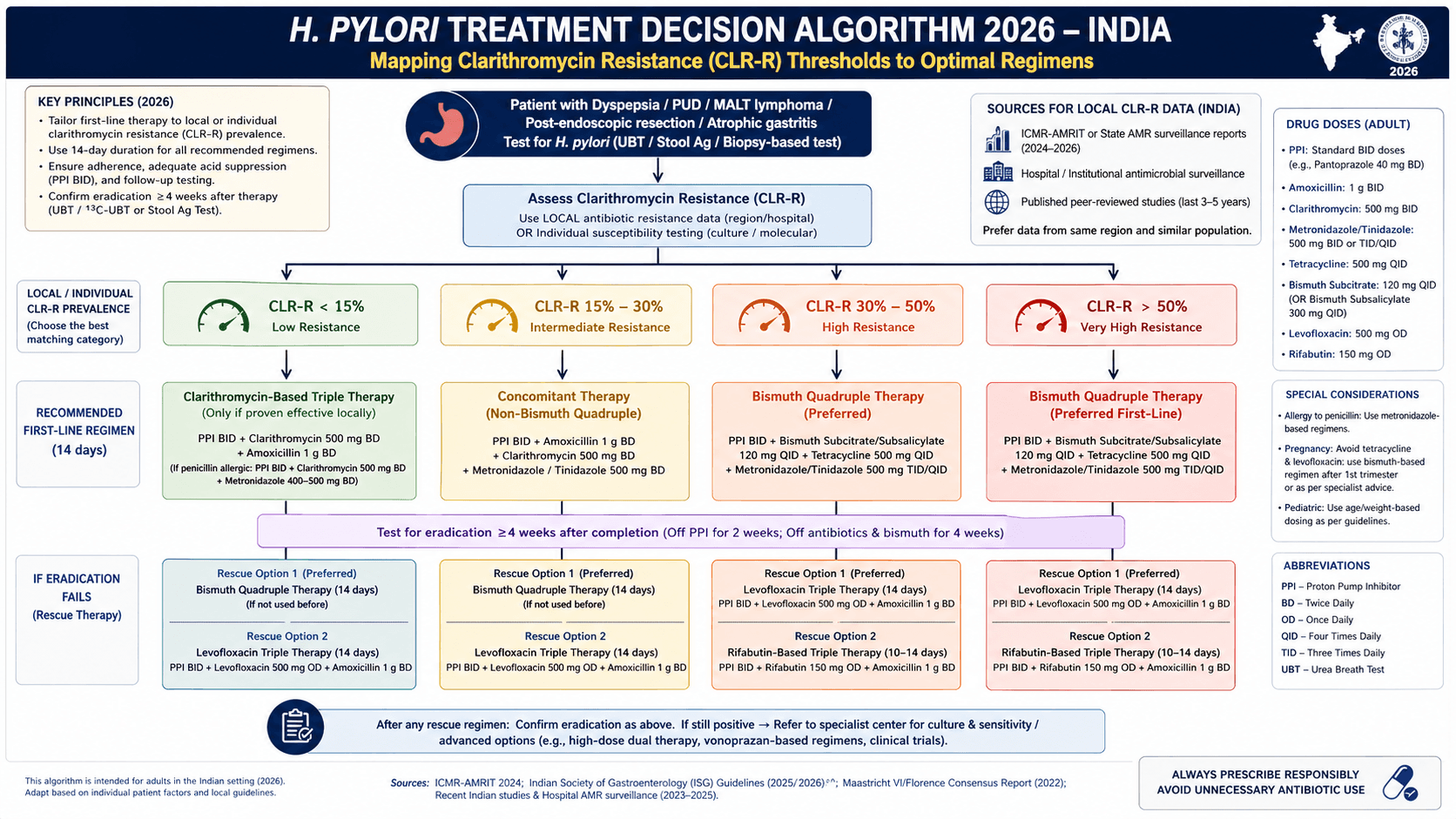
The ACG 2024 Clinical Guideline makes only one strong recommendation: optimised bismuth quadruple therapy for 14 days as first-line treatment in treatment-naïve patients when antibiotic susceptibility is unknown. This consists of a PPI at standard dose twice daily, bismuth subcitrate 120–300 mg four times daily (tetracycline 500 mg four times daily - doxycycline is not a substitute) and metronidazole 500 mg three to four times daily.
For the Indian context, map your regimen choice to the resistance environment you practice in:
When clarithromycin resistance is unknown (most Indian centres) → Bismuth Quadruple Therapy (BQT) for 14 days. BQT employing at least 1,500 mg of metronidazole for 14 days remains effective despite high metronidazole resistance in India - a critical advantage given that metronidazole resistance alone does not reliably predict BQT failure in the same way it predicts triple-therapy failure.
When clarithromycin resistance is locally documented below 15% (rare in India; some northern centres) → Concomitant therapy (PPI-amoxicillin-clarithromycin-metronidazole, PAMC) for 14 days is an acceptable alternative. Its efficacy drops steeply once dual clarithromycin-metronidazole resistance is present.
Sequential therapy (PPI-amoxicillin ×5 days, then PPI-clarithromycin-metronidazole ×5 days) was an earlier workaround that has consistently failed to outperform BQT in high-resistance settings. It should not be prescribed as first-line in 2026.
After first-line failure → do not repeat the same regimen. If BQT was first-line, levofloxacin-based triple therapy is a reasonable second-line option where levofloxacin resistance remains low - but levofloxacin resistance now runs at 32.8% nationally, making culture-guided therapy the gold standard before any fluoroquinolone-based rescue.
A Frequently Overlooked Point: Metronidazole Resistance Does Not Doom Bismuth Quad
The single most common reason Indian gastroenterologists hesitate before prescribing BQT is the assumption that India's catastrophically high metronidazole resistance (77–78% in most series) will render bismuth quad ineffective. This reasoning is incorrect, and it matters enormously for practice. Bismuth quad's efficacy against metronidazole-resistant strains is preserved when the metronidazole dose is adequate (≥1,500 mg/day in divided doses) and the duration is 14 days. The pharmacokinetic explanation: high intraluminal bismuth concentrations and tetracycline's independent bactericidal activity compensate for metronidazole resistance in a way that no other combination achieves. The regimen you should worry about in a high-metronidazole-resistance setting is concomitant therapy - not bismuth quad. Swapping these two in your clinical reasoning is where eradication rates fall off a cliff.
Bottom Line for Clinical Practice
Stop prescribing PPI-clarithromycin-amoxicillin triple therapy as empiric first-line in India. National clarithromycin resistance is 35–45%, and local data in South India, Gujarat, and Kashmir is worse. Eradication rates with triple therapy in these zones are below 70% - unacceptable for a treatable infection with a gastric cancer association.
Default to optimised bismuth quadruple therapy for 14 days (PPI + bismuth subcitrate + tetracycline + metronidazole ≥1,500 mg/day) in all treatment-naïve patients where susceptibility is unknown. This is the ACG 2024 strong recommendation and directly applicable to the Indian resistance landscape.
Do not substitute doxycycline for tetracycline. This is a well-documented prescribing error in India - doxycycline does not achieve equivalent intragastric concentrations and will reduce BQT efficacy.
Sequential therapy is no longer a recommended first-line option in any setting where dual clarithromycin-metronidazole resistance is likely. Retire it from your practice.
Test of cure is mandatory - urea breath test or stool antigen, at least 4 weeks post-treatment and 2 weeks off PPI. A negative endoscopy-only follow-up does not confirm eradication. This step is frequently skipped in Indian practice and perpetuates undetected treatment failure, ongoing transmission, and ulcer recurrence.
For second-line and rescue therapy, consider culture-guided susceptibility testing if available in your centre, particularly before prescribing any levofloxacin-based regimen. Empiric fluoroquinolone rescue in a setting with 32% levofloxacin resistance is the same logical error as empiric clarithromycin first-line.
When you are standing in the endoscopy suite with a positive rapid urease test and need to make a prescribing decision in 90 seconds, GastroAGI can walk through the resistance context for your region, confirm the optimised BQT dosing, and flag the duration and test-of-cure timing - evidence-anchored, adapted to the Indian landscape.

We are pioneers in clinical intelligence, dedicated to helping gastroenterologists harness the power of artificial intelligence to drive precision, efficiency, and patient growth.