
NG Tubes in Small Bowel Obstruction: When to Place, When to Pull, and What Not to Miss
When to place an NG tube for decompression, why routine post-op use is falling out of favor, and how to avoid the metabolic fallout of prolonged suction.


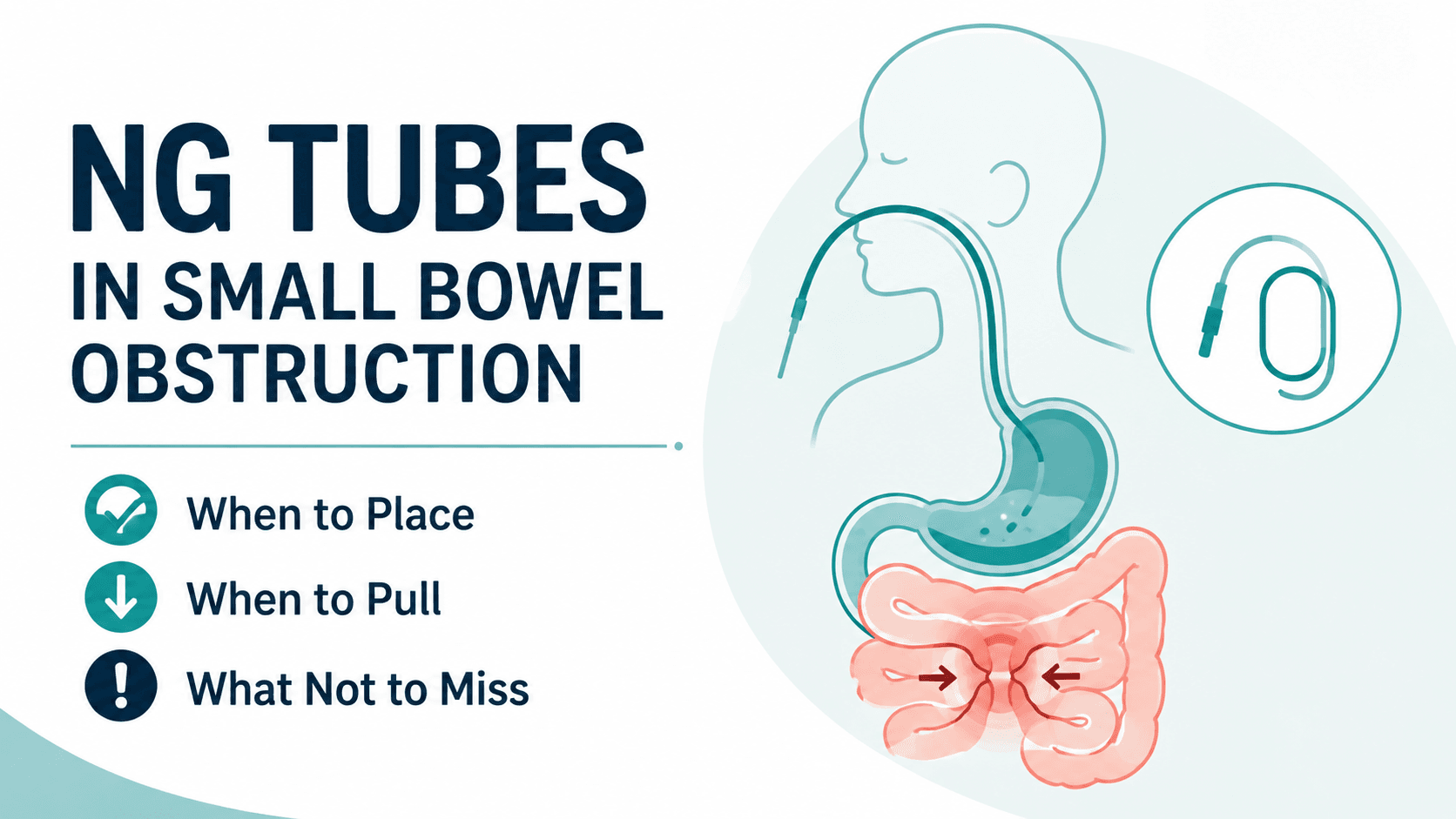
A 68-year-old man with a history of two prior laparotomies presents with three days of obstipation, bilious vomiting, and a distended, tympanic abdomen. CT confirms a transition point consistent with adhesive small bowel obstruction. The admitting team reflexively orders an NG tube "for decompression" - the same order they'd write for any post-op patient with a slow return of bowel function. One of these patients needs that tube. The other doesn't, and knowing which is which changes the entire trajectory of the admission.
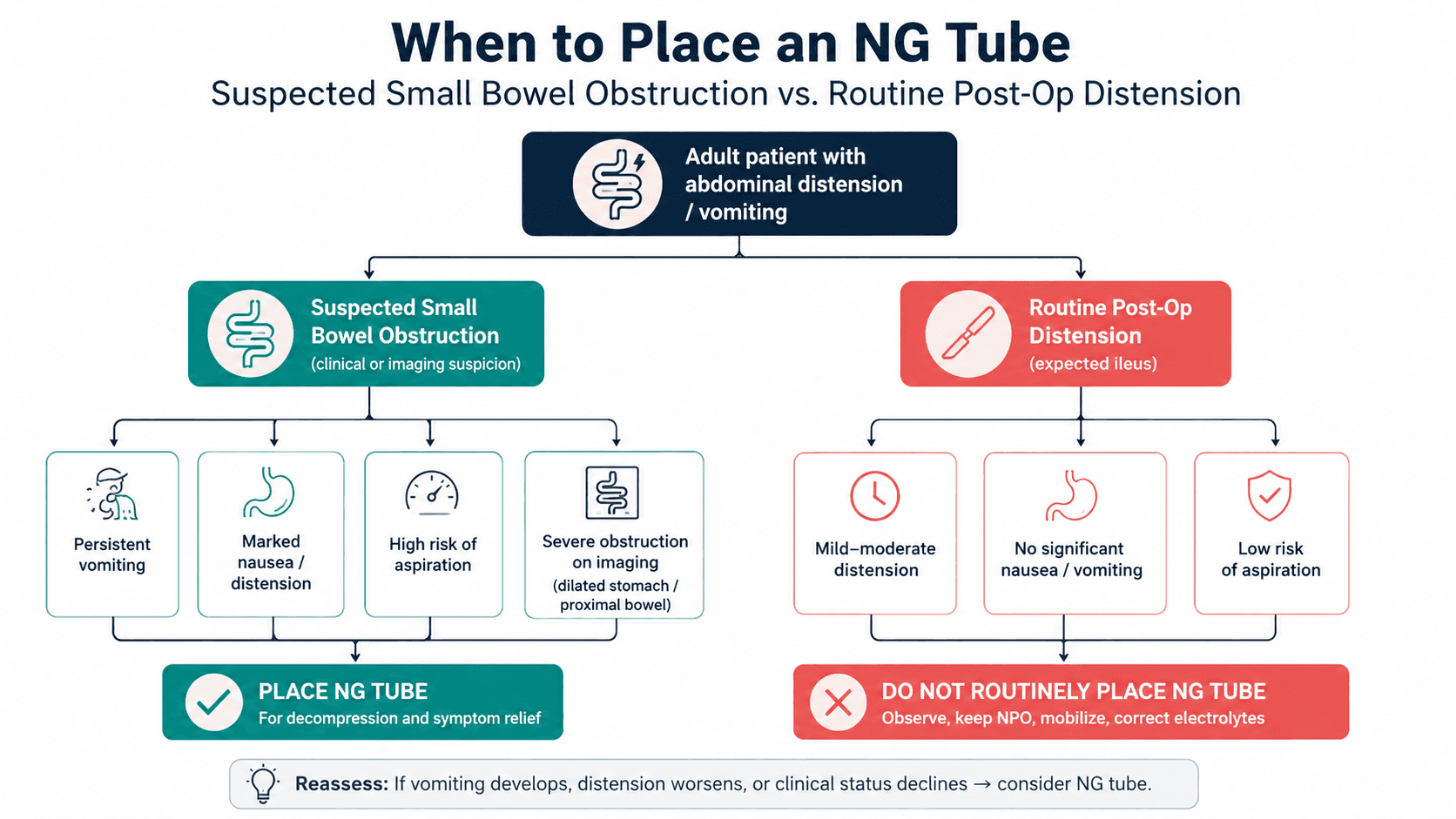
The reflex to place an NG tube on anyone with vomiting, distension, or a sluggish gut is deeply ingrained, and for decades it was standard practice after almost any abdominal surgery. That reflex has not aged well. In genuine mechanical obstruction - adhesive small bowel obstruction, severe distension with a competent pylorus, ongoing emesis with aspiration risk - an NG tube is the correct first move, decompressing the stomach and proximal bowel while the obstruction is worked up or allowed to resolve conservatively. But routine, prophylactic use after elective GI surgery is a different question entirely, and the evidence answering it has been consistent for over a decade: the tube adds a complication burden without changing outcomes. The clinical skill isn't knowing that NG tubes exist - it's knowing which patient in front of you actually needs one.
When Decompression Is the Right Call
Mechanical small bowel obstruction remains the clearest indication. When bowel proximal to a transition point is dilated and the patient is vomiting, an NG tube on low intermittent suction relieves the pressure driving nausea, reduces aspiration risk, and buys time for conservative management - IV fluids, bowel rest, correction of electrolytes - to work before anyone commits to surgery. Ileus with significant distension behaves the same way clinically, even though the underlying mechanism is motility failure rather than a fixed lesion; the stomach and bowel still need decompressing if they're acting as a reservoir the patient can't empty on their own.
Severe, persistent vomiting is the other clear indication, independent of the underlying diagnosis. A patient who cannot protect against ongoing emesis - reduced consciousness, recent sedation, a difficult airway, or emesis refractory to antiemetics - has a real aspiration risk that decompression mitigates directly. This is where the tube earns its place: not as a default order, but as a targeted response to a specific mechanical or safety problem. If none of these apply - if the patient has mild distension, is tolerating sips, and has no red flags - placing a tube adds discomfort and risk without a corresponding benefit.
Case in point
A 55-year-old woman is postoperative day one from an open sigmoid colectomy for diverticular disease. She has mild nausea, a soft but distended abdomen, and has passed flatus once. The covering resident, following old habit, orders NG tube placement "to be safe." The attending declines, noting she has no bilious vomiting, no signs of ileus beyond expected post-op distension, and is tolerating clear sips.
She is advanced to a regular diet on postoperative day two per the unit's ERAS pathway, ambulates twice that day, and is discharged on day three without ever needing decompression. Had the tube been placed, she would likely have tolerated oral intake later, spent an extra day or two in the hospital, and carried a measurable risk of pharyngolaryngitis or aspiration from the tube itself - for no gain.
_ZBb8q3F.png&w=1920&q=70)
Why Routine Post-Op Use Has Fallen Out of Favor
The 2018 ERAS® Society guidelines for elective colorectal surgery state plainly that NG tubes should not be used routinely after surgery, and if one is placed intraoperatively, it should come out before the patient wakes up. This isn't a soft recommendation. The 2023 ASCRS/SAGES enhanced recovery guidelines grade avoidance of routine NG tube and intra-abdominal drain use as a strong recommendation based on moderate-quality evidence - as firm a stance as these bodies take on most perioperative questions.
The data behind it is consistent across multiple randomized trials in elective colorectal surgery: routine NG decompression does not reduce nausea, vomiting, time to return of bowel function, or length of stay. What it does reliably do is delay tolerance of oral intake by roughly two days and raise the risk of pharyngolaryngitis and other tube-related complications. In other words, the intervention people reach for to speed up recovery measurably slows it down. The shift in practice isn't about abandoning decompression as a tool - it's about reserving it for patients who actually have an obstructive or emetic problem to solve, rather than using it as a prophylactic ritual applied to everyone leaving the OR.
A Frequently Overlooked Point
The complication that gets missed isn't the tube placement itself - it's what happens after several days of unmonitored suction. A tube left running on low intermittent suction pulls chloride- and potassium-rich gastric secretions out of the body continuously, and if nobody is tracking output against replacement fluids, patients drift into volume depletion, hypokalemia, and a contraction-driven metabolic alkalosis that can be surprisingly severe before it shows up as a clinical problem. This is the tube that was correctly indicated on day one and never reassessed on day four. Daily reassessment of output, electrolytes, and continued need is not a formality - it's the difference between a well-managed decompression and a self-inflicted electrolyte crisis.
Bottom Line for Clinical Practice
Reserve NG decompression for genuine indications: mechanical small bowel obstruction, severe distension, ongoing emesis, or documented aspiration risk - not as a routine post-op order.
Follow ERAS guidance and skip prophylactic NG tubes after elective GI surgery; if one is placed intraoperatively, remove it before the patient emerges from anesthesia.
Confirm correct tube placement before any feeding or medication administration - never assume position from insertion length alone.
Reassess the need for continued suction daily; don't let an appropriately placed tube run unmonitored.
Track output on prolonged suction and replace losses proactively - watch specifically for hypokalemia and metabolic alkalosis before they become symptomatic.
Next time you're triaging a distended, vomiting patient and weighing whether decompression is warranted, walk GastroAGI through the presentation - it will return a reasoned, guideline-anchored answer in seconds.

We are pioneers in clinical intelligence, dedicated to helping gastroenterologists harness the power of artificial intelligence to drive precision, efficiency, and patient growth.