
Biomarker-Driven First-Line Therapy in Advanced Gastroesophageal Adenocarcinoma
Biomarker testing now drives first-line therapy in advanced gastroesophageal adenocarcinoma - here's the HER2, PD-L1, MSI, and CLDN18.2 decision pathway.


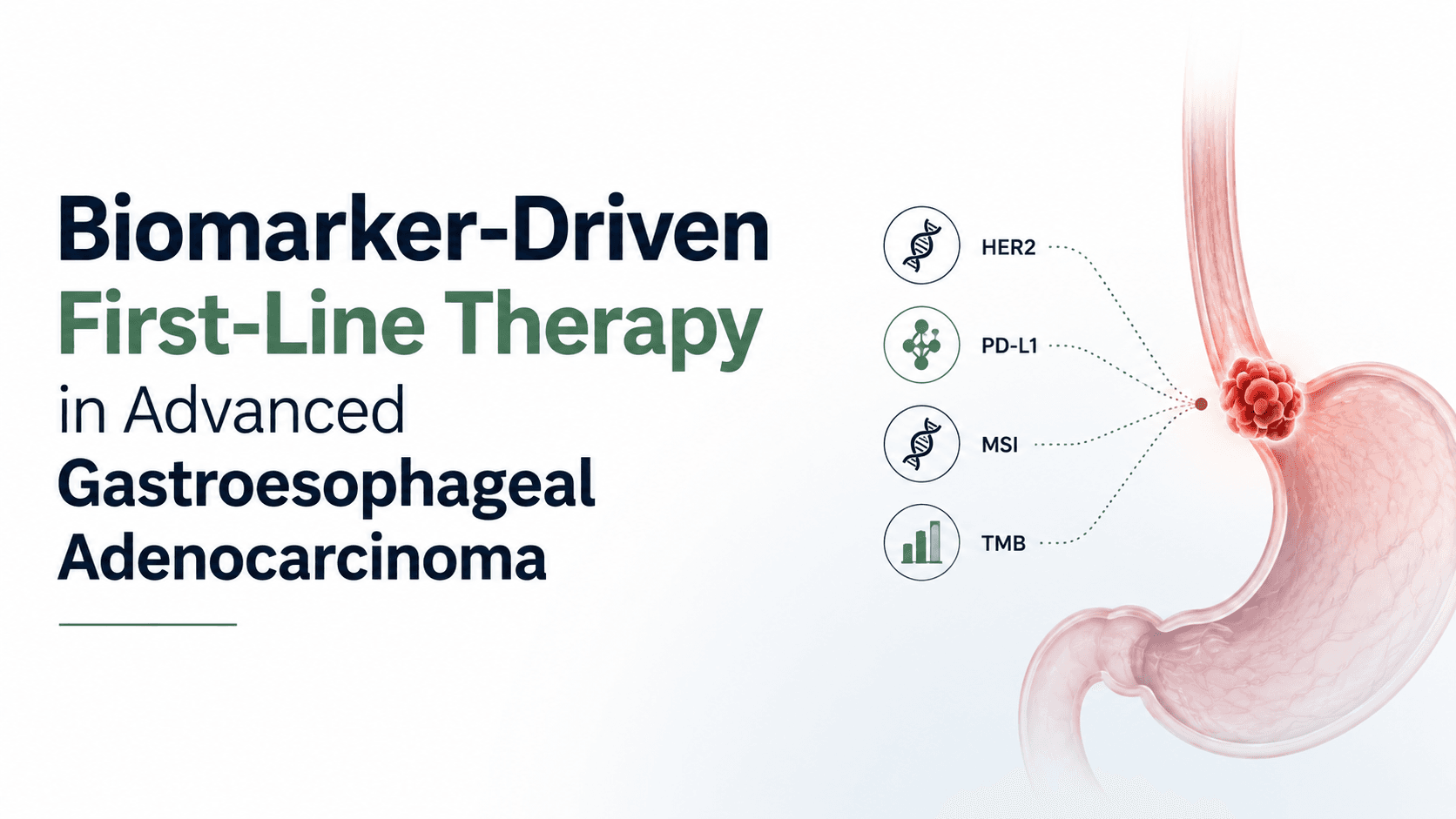
A 61-year-old man presents with a new diagnosis of metastatic gastroesophageal junction adenocarcinoma. Ten years ago, his oncologist would have started platinum-based chemotherapy and moved on. Today, that same decision hinges on four separate biomarker results - and getting the sequence wrong means missing a survival benefit that's now considered standard of care.
Advanced gastroesophageal adenocarcinoma has quietly become one of the most biomarker-dependent disease states in solid tumor oncology. Where histology once dictated treatment, a structured molecular workup now does. The shift has happened fast enough that many general gastroenterologists - who are often the ones ordering the initial biopsy and fielding the first patient questions - haven't fully absorbed the new sequence. Per NCCN Clinical Practice Guidelines, HER2, programmed death ligand 1 (PD-L1), and claudin 18 isoform 2 (CLDN18.2) testing are recommended at the time of diagnosis if advanced or metastatic disease is documented or suspected, alongside universal MMR/MSI testing. Missing any one of these tests at diagnosis doesn't just delay treatment - it can mean a patient never receives a therapy that would have meaningfully extended survival.
The Biomarker Testing Sequence That Now Drives Treatment
The modern workup follows a specific order, and the order matters clinically, not just administratively. Universal testing for microsatellite instability status by PCR/NGS or mismatch repair status by IHC is recommended in all newly diagnosed patients, since MSI-high/dMMR tumors - a small but critical subset - respond dramatically to immunotherapy alone and can sometimes be managed without chemotherapy entirely. This gets checked first because it changes the entire treatment conversation.
Next comes HER2. HER2 expression is seen in approximately 15% of gastric cancers and up to 30% of gastroesophageal junction adenocarcinomas, and HER2 abnormalities may include overexpression, amplification, or mutation, with all forms capable of influencing treatment decisions. PD-L1 and CLDN18.2 are tested in parallel - not sequentially - because both inform therapy regardless of HER2 status. CLDN18.2 positivity is generally defined by moderate-to-strong membranous staining in at least 75% of tumor cells, and unlike some other molecular features in gastroesophageal cancer, its expression appears relatively consistent across geographic regions. The practical takeaway: order all four tests reflexively at diagnosis rather than waiting to see if the first result changes management. Sequential testing costs time patients with rapidly progressive disease often don't have.
HER2-Positive Disease: Why PD-L1 Status Changes the Regimen
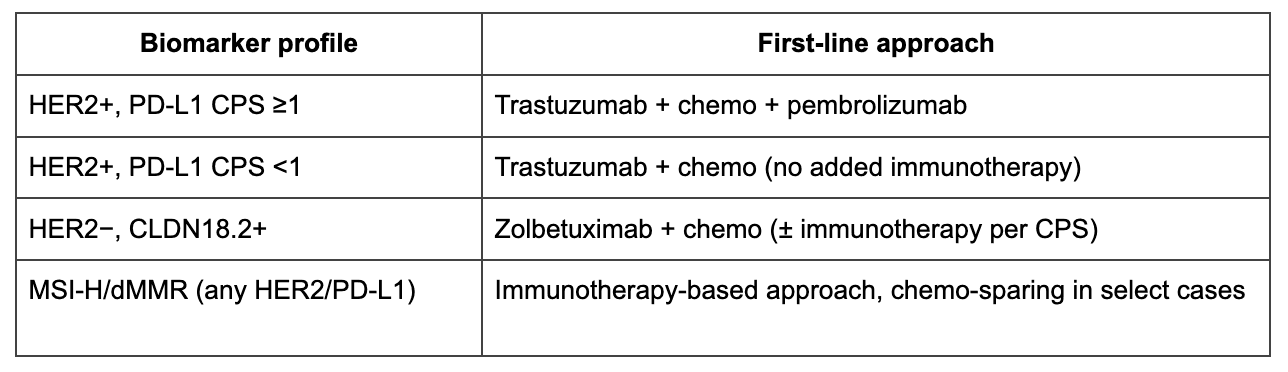
HER2-positive disease is where PD-L1 co-testing has the sharpest clinical consequence. The KEYNOTE-811 trial established that pembrolizumab in combination with trastuzumab and fluoropyrimidine- and platinum-containing chemotherapy is approved for first-line treatment of HER2-positive locally advanced unresectable or metastatic gastric or GEJ adenocarcinoma whose tumors express PD-L1 with a CPS of 1 or greater. That CPS cutoff isn't a minor eligibility detail - it's the line that separates two different standards of care.
The data backing this split is specific rather than marginal. Patients with PD-L1 CPS ≥1 had a hazard ratio of 0.79 for the addition of pembrolizumab, while the smaller group with CPS <1 did not show benefit from adding immunotherapy. As one KEYNOTE-811 investigator put it, in HER2-positive disease with CPS ≥1, adding pembrolizumab to trastuzumab and chemotherapy is now strongly favored, while CPS <1 patients remain on trastuzumab plus chemotherapy without the immunotherapy addition - a distinction with real implications for both drug toxicity burden and cost.
_mP1CBIp.png&w=1920&q=70)
Case in Point
A 58-year-old woman presents with dysphagia and a 12-pound weight loss over three months. Upper endoscopy reveals a circumferential GEJ mass; biopsy confirms adenocarcinoma, and CT shows liver metastases. Biomarker panel returns HER2 IHC 3+ (confirmed HER2-positive), PD-L1 CPS of 8, MMR-proficient, and CLDN18.2 not clinically actionable given HER2 status.
Because her tumor is both HER2-positive and PD-L1 CPS ≥1, she meets criteria for the triplet regimen - trastuzumab plus chemotherapy plus pembrolizumab - rather than trastuzumab and chemotherapy alone. Had her CPS returned below 1, the same HER2-positive result would have led to a different first-line regimen, with immunotherapy withheld. The biopsy and the biomarker panel, not the endoscopic appearance of the tumor, are what determined her treatment.
HER2-Negative Disease: PD-L1 and CLDN18.2 Take the Lead
When HER2 is negative - the majority of cases - PD-L1 and CLDN18.2 become the operative biomarkers. Higher PD-L1 CPS thresholds correlate with greater immunotherapy benefit in this population; as one recent analysis noted, benefit from checkpoint inhibition in HER2-negative disease increases across CPS strata, with the strongest effect seen at CPS ≥10, reinforcing that CPS is not simply a binary positive/negative cutoff but a gradient that should shape how strongly immunotherapy is weighted in the regimen.
CLDN18.2-positive, HER2-negative disease has its own targeted option. The GLOW trial established zolbetuximab, a CLDN18.2-directed monoclonal antibody, plus capecitabine and oxaliplatin as a first-line option for CLDN18.2-positive, HER2-negative, locally advanced unresectable or metastatic gastric or GEJ adenocarcinoma - filling a gap in a population that previously had no targeted first-line therapy beyond chemotherapy and, where eligible, immunotherapy.
A Frequently Overlooked Point
The mistake I see most often isn't choosing the wrong regimen - it's treating biomarker testing as sequential rather than parallel, or worse, treating HER2 status as sufficient on its own. A HER2-positive result doesn't complete the workup; it opens a second question about PD-L1 that changes the regimen entirely. Community pathology reports don't always flag CLDN18.2 or MSI status clearly, and it falls on the ordering clinician to confirm all four markers were actually run before treatment starts, not just the one that happened to come back first. A tumor board that reflexively assumes "HER2-positive means trastuzumab and we're done" is a year and a half behind current evidence.
Bottom Line for Clinical Practice
Order HER2, PD-L1, MMR/MSI, and CLDN18.2 testing simultaneously at diagnosis of advanced or metastatic disease - not sequentially.
In HER2-positive disease, check PD-L1 CPS before finalizing the regimen: CPS ≥1 supports adding pembrolizumab to trastuzumab and chemotherapy; CPS <1 does not.
In HER2-negative disease, CLDN18.2 positivity opens the door to zolbetuximab-based first-line therapy.
Confirm MSI-H/dMMR status is resulted before treatment starts - this subgroup's management diverges most sharply from standard chemo-immunotherapy.
Histology alone no longer determines first-line therapy; molecular profiling does.
Closing
Cases like this - where four biomarker results determine which of several distinct first-line regimens a patient receives - are exactly the kind of layered decision GastroAGI is built to help you work through in real time. For a broader look at how AI-assisted clinical reasoning is being applied across GI oncology, see our post on AI for gastroenterology. Walk your next biomarker panel through GastroAGI for a guideline-anchored read on the regimen it points to.

We are pioneers in clinical intelligence, dedicated to helping gastroenterologists harness the power of artificial intelligence to drive precision, efficiency, and patient growth.