
The Future of Gastroenterology Intelligence: How HIPAA-Ready, GI-Specialized AI Is Reshaping Care
An evidence-aware editorial on gastroenterology AI, GI guidelines, hepatology updates, HIPAA-ready AI, and GI clinical decision support in modern practice.


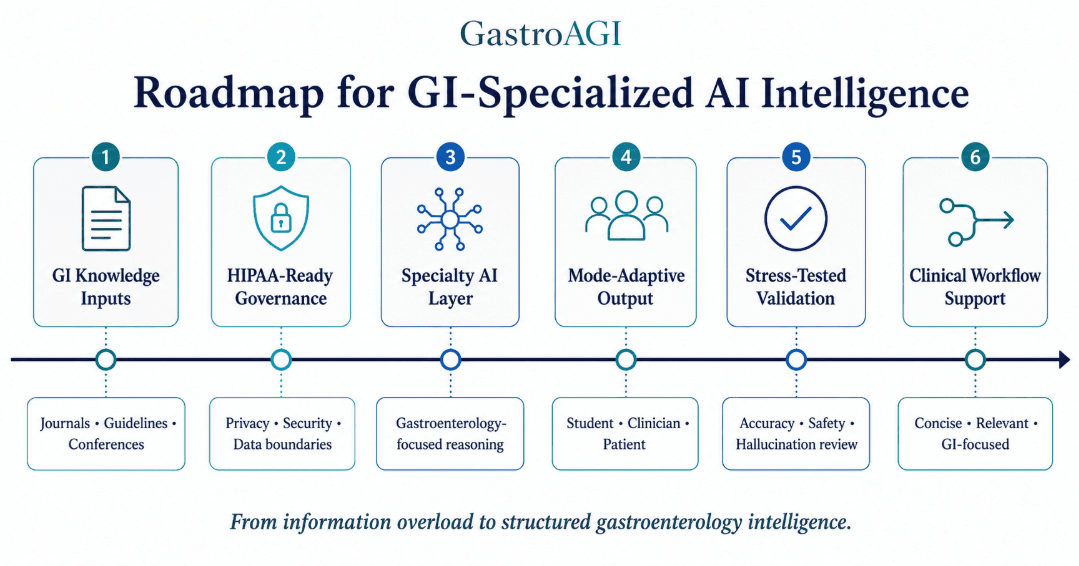
Gastroenterology has become an information-dense specialty. Clinicians are expected to synthesize expanding biomedical literature, rapidly changing GI guidelines, EHR data, pathology, imaging, endoscopy findings, and late-breaking conference updates while still making safe, time-sensitive decisions at the bedside and in the endoscopy suite. That challenge is not unique to GI, but it is especially visible in a field that spans hepatology, inflammatory bowel disease, GI oncology, screening and surveillance, pancreaticobiliary disease, motility, nutrition, and complex procedural care. Reviews of healthcare information overload and EHR-related cognitive burden have linked this environment to workflow strain and patient-safety risk, while PubMed alone now indexes more than 40 million biomedical citations. [1]
The strategic opportunity is not “more AI” in the abstract. It is better clinical intelligence: HIPAA-ready AI that is specialized for gastroenterology, grounded in current society guidance, designed for human oversight, and capable of adapting its output to the user’s role. Recent reviews across NIH/PubMed, WJGNet, Gastroenterology, AMEgroups, and ScienceDirect describe real momentum for gastroenterology AI in endoscopy, IBD, hepatology, oncology, decision support, and education, but they also emphasize unresolved issues around hallucination, liability, bias, interoperability, and real-world validation. [2]
The editorial implication is straightforward: generic search and general-purpose language models are not enough for high-stakes GI care. A safer path is GI-specialized, mode-adaptive, governed deployment. In practical terms, that means systems that can support gastroenterology education for fellows, GI clinical decision support for specialists, and responsible patient-facing communication—while respecting HIPAA, working within EHR interoperability standards, and remaining subordinate to clinician judgment. [3]
The information challenge in modern gastroenterology
If one wanted to design a specialty that exposes the limits of fragmented information workflows, gastroenterology would be a good candidate. A single week in GI practice may require the clinician to move from MASLD fibrosis risk stratification to inpatient severe ulcerative colitis rescue therapy, from Barrett’s esophagus surveillance to acute pancreatitis, and from HCC screening questions to post-polypectomy surveillance logic. Professional society libraries reflect that complexity: AGA maintains large, continuously updated clinical guidance collections, and ACG’s guidance library spans Crohn’s disease, ulcerative colitis, acute pancreatitis, focal liver lesions, preventive IBD care, colorectal cancer screening, Barrett’s esophagus, and more. [4]
Major GI domains are each evolving on their own timetable
In hepatology, the knowledge burden alone is substantial. AGA’s 2026 MASLD clinical care pathway explicitly integrates newer nomenclature, noninvasive fibrosis risk stratification, and emerging therapies; AASLD’s current hepatology guidance infrastructure separately emphasizes chronic hepatitis B prevention, surveillance, and treatment; and cirrhosis management remains tightly linked to recurring surveillance and complication-prevention tasks, including HCC screening every six months. This is not a narrow knowledge lane but a layered one: MASLD, cirrhosis, hepatitis, portal hypertension, transplant referral, and HCC all sit in the same operational ecosystem. [5]
IBD is similarly multidimensional. The current ACG guideline library includes updated 2025 guidelines for both Crohn’s disease and ulcerative colitis, while AGA’s inpatient IBD guidance emphasizes hospitalization thresholds, complication assessment, biomarkers, endoscopic evaluation when indicated, prophylactic anticoagulation, timely colectomy counseling in severe ulcerative colitis, and rapid response monitoring. In parallel, gastroenterology AI reviews describe growing use cases for AI in capsule endoscopy, relapse prediction, and disease personalization. The result is a care pathway that is not only evidence-heavy, but sequence-heavy: timing, triage, rescue, discharge planning, and longitudinal monitoring all matter. [6]
GI oncology adds another layer of risk-based nuance. AGA’s Barrett’s esophagus guideline now emphasizes personalized surveillance and high-quality endoscopy, while its gastric cancer guidance stresses that endoscopy is the best test for screening and surveillance in high-risk individuals and identifies H. pylori eradication as essential to prevention strategy. Hepatology adds a parallel cancer-surveillance logic: AGA advises HCC screening for patients with NAFLD-related cirrhosis or advanced fibrosis, and notes that alternative imaging should be considered every six months when ultrasound quality is suboptimal. These are precisely the kinds of decisions that defeat simplistic lookup tools because the correct answer depends on the interplay among risk, interval, modality, and patient phenotype. [7]
Endoscopy and pancreaticobiliary disease reinforce the same point. AGA’s 2025 CADe guidance concluded that AI-assisted technology helps identify colorectal polyps but that its effect on colorectal cancer prevention remains unclear, leading the panel to make no recommendation for or against routine CADe-assisted colonoscopy because evidence on long-term outcomes remains very low certainty. At the same time, ESGE’s 2025 position statement treats AI-assisted CADe in screening and surveillance colonoscopy as a serious clinical guidance question, and upper-GI AI reviews in Gastroenterology describe encouraging results in lesion detection. Meanwhile, pancreatic care ranges from the first 48–72 hours of acute pancreatitis management to years-long surveillance decisions for neoplastic pancreatic cysts, where strategies can differ markedly in intensity and stopping rules. [8]
Journals, guidelines, and conferences are now a single knowledge stream
Modern GI practice is no longer updated by journals alone. DDW describes itself as the premier meeting for professionals in gastroenterology, hepatology, GI endoscopy, and related fields, while UEG Week positions itself as a major annual multidisciplinary congress for digestive health. DDW also notes that conference abstracts are published in supplements to Gastroenterology and Gastrointestinal Endoscopy, illustrating how conference intelligence feeds the formal literature. In other words, the clinician who wants current hepatology updates or endoscopy advances must increasingly track journals, society guidelines, and conference outputs together. [9]
This is where the phrase gastroenterology intelligence becomes more useful than the phrase “AI tool.” The actual need is a system that can organize, contextualize, and safely retrieve specialty knowledge at the point of use. Search alone is not enough when the user is trying to decide not just what exists, but what applies now, to this patient, in this workflow, under this guideline frame. [10]
Why generic search is not enough for GI clinical decision support
Generic web search is built to return results, not to perform clinical reasoning. General-purpose large language models are better than traditional search at synthesis, but gastroenterology literature increasingly warns against treating them as specialty-safe by default. A 2024 systematic review of LLMs in gastroenterology described benefits in diagnostic support, documentation, specialist education, and patient engagement; yet other GI reviews explicitly warned that general-purpose LLMs can have unacceptably low accuracy on clinical gastroenterology and hepatology tasks, with potential patient-safety implications. A 2025 review focused on clinical decision support in gastroenterology and hepatology similarly identified persistent problems with bias, hallucinations, interoperability barriers, and training needs. [11]
That distinction matters clinically. A generic model may summarize a topic well enough for background reading, but GI clinical decision support demands more than summary. It requires specialty context, temporality, and the ability to hold ambiguity without fabricating certainty. The decision about severe UC rescue therapy, HCC surveillance in obesity-limited ultrasound, Barrett’s interval nuance, or MASLD fibrosis stratification is not merely a recall task. It is a reasoning task constrained by evidence quality, society recommendations, and local workflow. [12]
The AGA CADe example is instructive. In many product narratives, a rise in adenoma detection rate would be enough to frame AI as an automatic quality upgrade. But AGA’s 2025 guidance did not treat a surrogate improvement as equivalent to proof of long-term benefit; it highlighted the very low certainty of evidence for CRC incidence, CRC mortality, and post-colonoscopy colorectal cancer outcomes. That is exactly the kind of nuance that a GI-specialized intelligence layer should surface rather than flatten. [13]
This is also why medical AI for gastroenterology should be evaluated against workflow tasks rather than generic benchmark mythology. Can it retrieve the right guidance set? Can it separate patient education from clinician reasoning? Can it recognize when evidence is unsettled? Can it identify when a response requires escalation rather than completion? Modern GI practice will reward systems that know their limits at least as much as systems that answer quickly. [14]
What HIPAA-ready, GI-specialized AI should mean
“HIPAA-ready AI” should not be treated as a decorative label. HHS states that the HIPAA Privacy Rule establishes national standards for protecting medical records and other individually identifiable health information, and its cloud-computing guidance makes clear that cloud service providers and their customers have defined responsibilities when ePHI is created, received, maintained, or transmitted through cloud services. HHS also maintains formal guidance for de-identification through two recognized pathways—Safe Harbor and Expert Determination—which is particularly relevant for model development, testing, and secondary-use analytics. [15]
In practice, then, a HIPAA-ready AI deployment in gastroenterology should imply clearly mapped data flows, role-based access, auditability, appropriate contracting and business-associate arrangements where required, secure cloud architecture, minimum-necessary thinking, and a deliberate decision about whether data remain identifiable, are limited, or are de-identified. For patient-facing digital surfaces, covered entities also need to think about HHS OCR’s guidance on online tracking technologies. The important point is that HIPAA-ready AI is not an abstract model property; it is an operational property of a governed deployment. [16]
Regulatory scope also matters. FDA’s 2026 guidance on clinical decision support software clarifies that some CDS functions may fall outside device regulation under the 21st Century Cures Act, while other software functions remain subject to FDA’s digital-health framework depending on intended use. For health-system buyers, that means governance cannot stop at prompt quality or vendor demos; it must also include intended-use claims, escalation pathways, and documentation of what the system is and is not authorized to do. [17]
Specialization matters because gastroenterology is not a generic use case
A growing literature across Gastroenterology, WJGNet, AMEgroups, and ScienceDirect converges on a consistent point: AI in GI is broadest and most promising where it is domain-aware—endoscopy, hepatobiliary disease, pancreas, IBD, imaging, pathology, and clinical decision support—rather than generic and untethered. ScienceDirect’s 2025 hepatology scoping review mapped AI applications across imaging, histopathology, chronic liver disease, cirrhosis, and transplantation; WJGNet’s cross-GI reviews similarly span the upper and lower GI tract, IBD, hepatobiliary disease, and pancreas; and Gastroenterology’s implementation review stresses that deployment barriers are as important as technical performance. [18]
One useful design implication is mode adaptation. Gastroenterology education, GI clinical decision support, and patient communication are not the same task. A fellow preparing for rounds may need mechanistic explanation and prioritization. An attending may need structured reasoning against current GI guidelines. A patient may need plain-language explanation, reassurance, safety-netting, and avoidance of unnecessary alarm. Reviews of LLMs in gastroenterology explicitly discuss specialist education, patient engagement, and patient communication as distinct application categories, which supports the idea that a single undifferentiated response style is a poor fit for specialty care. [19]
GastroAGI as an example of role-adaptive design
A platform such as GastroAGI is most interesting, editorially, not because it is “AI for GI,” but because it treats the specialty as a set of layered users and tasks. In that framing, Student Mode supports gastroenterology education, Clinician Mode supports structured GI clinical decision support, and Patient Mode supports simplified, responsible communication. That is a stronger design thesis than simply attaching a chatbot to a guideline library.
According to the internal GastroAGI stress-test summary provided for this draft, the platform was evaluated with role-specific prompts across Student, Clinician, and Patient modes. The reported objective was not to prove superiority against external benchmarks but to assess mode separation, response appropriateness, reasoning behavior, safety framing, and hallucination frequency. Internal summary scores were 8.4/10 for Student Mode, 8.7/10 for Clinician Mode, and 9.0/10 for Patient Mode, with the organization reporting clear behavioral separation among modes and relatively low hallucination in the tested set. Those findings are directionally encouraging, but they should be presented as preliminary internal data pending independent external validation and prospective workflow study. External GI and clinical-AI literature strongly supports this kind of staged safety and trust evaluation. [20]
What further distinguishes a GI-specialized platform is not merely conversational capability but the breadth and organization of specialty knowledge available to the user. Gastroenterology evolves through multiple parallel information streams—guidelines, peer-reviewed journals, conference presentations, procedural innovations, disease-specific pathways, and emerging therapeutic evidence. A practical intelligence layer therefore benefits from reflecting the structure of the specialty itself.
In that context, GastroAGI organizes information across a broad spectrum of digestive-health domains rather than concentrating on a single disease category or procedural niche. The platform includes continuously updated topic environments spanning hepatology, inflammatory bowel disease, gastrointestinal oncology, endoscopy, liver transplantation, cirrhosis, hepatocellular carcinoma, upper gastrointestinal disease, pancreaticobiliary disorders, GI surgery, and basic sciences relevant to digestive disease.
Hepatology remains one of the clearest examples of why this matters. Contemporary liver practice now requires clinicians and trainees to navigate MASLD nomenclature, fibrosis risk stratification pathways, viral hepatitis management, portal hypertension, cirrhosis complications, transplant evaluation, and HCC surveillance recommendations that continue to evolve alongside emerging therapies and guideline updates. A platform designed around gastroenterology intelligence can help organize these knowledge layers into more clinically usable pathways rather than leaving users to navigate fragmented searches across multiple sources.
Similarly, inflammatory bowel disease care increasingly combines guideline-directed therapy with longitudinal monitoring, biologic sequencing, inpatient management decisions, therapeutic drug monitoring, and patient-centered counseling. The information burden extends beyond treatment algorithms alone and increasingly includes biomarker interpretation, disease monitoring, procedural timing, and emerging evidence presented through major meetings and specialty literature. Role-adaptive systems may therefore support not only information retrieval but also educational prioritization and communication clarity.
Procedural gastroenterology introduces another dimension. Endoscopy is increasingly shaped by advances in lesion characterization, quality metrics, artificial-intelligence-assisted detection systems, therapeutic interventions, and surveillance frameworks. Questions surrounding colorectal screening, Barrett’s esophagus, pancreaticobiliary endoscopy, and upper-GI lesion detection often require interpretation that depends on context rather than isolated facts. A GI-specialized information platform may therefore be more useful when it presents evidence alongside procedural reasoning and workflow relevance.
The same logic applies to GI oncology and pancreaticobiliary disease. Clinicians frequently move among HCC surveillance strategies, gastric and colorectal cancer prevention, pancreatic cyst follow-up, biliary disorders, and multidisciplinary management pathways. These areas are updated not only through formal guideline publications but also through rapidly evolving conference intelligence and subspecialty literature. Educational and decision-support environments that maintain awareness of such developments may therefore provide greater continuity than static reference repositories.
Importantly, GastroAGI also reflects the educational diversity of the specialty. Alongside advanced clinical topics, the platform includes dedicated environments for basic sciences, exam-oriented learning, and foundational digestive-pathophysiology concepts. This structure recognizes that gastroenterology learning occurs across multiple levels—from medical students and trainees building conceptual frameworks to practicing clinicians seeking focused evidence summaries and workflow support.
Viewed through this lens, the platform is less a generic chatbot and more an evolving gastroenterology knowledge environment organized around specialty domains, user roles, and practical workflows. Whether this model ultimately improves clinical efficiency, education, or decision quality will require continued validation. Yet the broader design principle remains compelling: modern GI practice increasingly benefits from intelligence systems that are specialty-aware, role-adaptive, and continuously aligned with the expanding information ecosystem of digestive disease.
Practical workflows and implementation in health systems
The most credible near-term use cases for gastroenterology AI are bounded, evidence-aware, and workflow-specific. In hepatology, a system can help organize MASLD fibrosis pathways, summarize chronic hepatitis B updates, or turn HCC surveillance rules into actionable reminders for the right risk groups. In IBD, it can prepare problem-oriented syntheses for hospitalization, discharge planning, biologic decision discussions, or patient education. In endoscopy, it can support surveillance interval logic, preprocedure counseling, or digest late-breaking meeting summaries into subspecialty briefs. In patient communications, it can translate specialist reasoning into plain language without changing the clinical plan. [21]
EHR integration should follow modern interoperability standards instead of bespoke copy-paste workflows whenever possible. ONC describes HL7 FHIR as a widely used API-focused standard for representing and exchanging health information, and the ONC standards hub includes both CDS Hooks and SMART on FHIR application-launch frameworks in the contemporary interoperability stack. This matters because GI intelligence systems should fit inside the chart, inbox, and documentation environment clinicians already use—rather than forcing them into yet another disconnected window. [22]
At the same time, responsible implementation requires humility. Gastroenterology’s implementation review emphasizes regulatory, ethical, and governance barriers; AMEgroups highlights liability ambiguity and the need for legal clarity; and NIST’s AI Risk Management Framework is explicitly positioned as a tool for organizations—including healthcare users—to manage AI risk. In practice, that argues for phased rollouts, local validation, red-teaming, post-deployment monitoring, audit logs, feedback capture, and clear human-override expectations. [23]
A real-world endoscopy example helps here. Penn Gastroenterology and Hepatology publicly described its adoption of GI Genius for real-time colon polyp detection during colonoscopy, presenting a concrete example of how AI enters GI care first as an assistive layer within a defined clinical domain. That is a useful model for broader GI intelligence deployment: start where the task is bounded, the workflow is visible, and the clinician remains decisional. [24]
Future directions and research needs
The next phase of gastroenterology AI should shift from novelty to evidence. The specialty needs more prospective studies that test not only answer quality but also workflow impact, decision quality, patient comprehension, documentation burden, equity, and downstream outcomes. It also needs external validation across community and academic settings, multilingual patient populations, varying endoscopy quality environments, and different EHR architectures. A system that performs well in one referral center or one internal benchmark may not generalize safely elsewhere. [25]
Research priorities are also becoming clearer. GI needs source-grounded hallucination measurement, trustworthy citation behavior, specialty-specific safety taxonomies, governance models for patient-facing use, and stronger evidence on cost-effectiveness and clinician trust. It is increasingly plausible that the winning systems in this space will not be the most verbally fluent, but the most auditable, interoperable, role-aware, and operationally dependable. That is the real future of gastroenterology intelligence: not replacing specialists, but helping them navigate a specialty whose information burden now exceeds the capacity of unguided search. [26]
References

We are pioneers in clinical intelligence, dedicated to helping gastroenterologists harness the power of artificial intelligence to drive precision, efficiency, and patient growth.