
Intrapancreatic Fat Deposition and Mortality: Is the Fatty Pancreas Becoming a Risk Marker?
A new UK Biobank study links intrapancreatic fat deposition with all-cause and vascular mortality, but clinical use remains early.


Introduction
The “fatty pancreas” has traditionally received far less clinical attention than fatty liver. In routine practice, pancreatic fat is often noticed incidentally on cross-sectional imaging, mentioned briefly, and rarely acted upon. That may be changing.
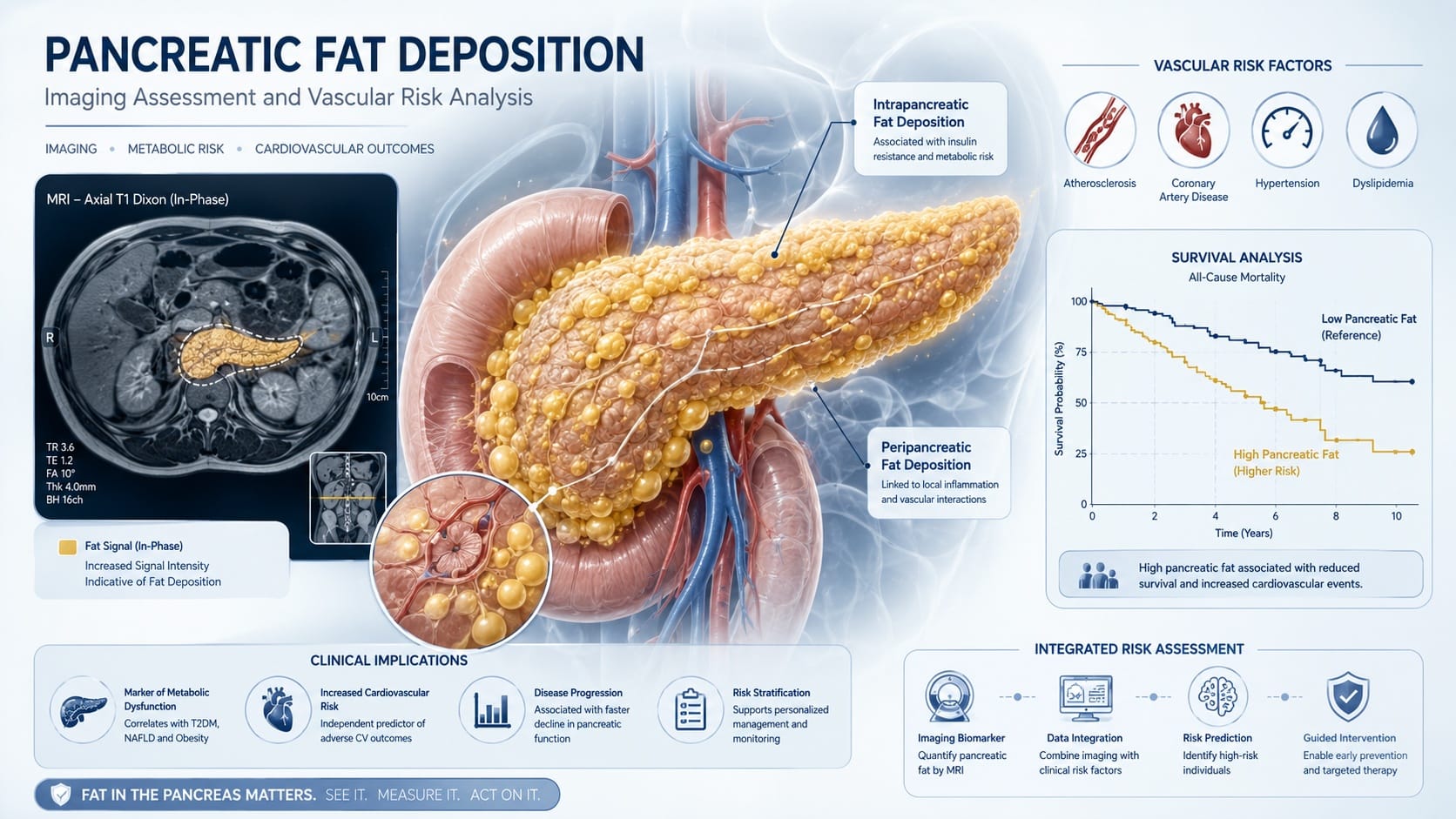
A new prospective UK Biobank study published in The American Journal of Gastroenterology examined whether intrapancreatic fat deposition, or IPFD, is associated with mortality. The study, titled “Association of Intrapancreatic Fat Deposition with Mortality: A Prospective Cohort Study with Genetic Risk Profiling,” used MRI-based pancreatic fat quantification, survival analysis, genome-wide association analysis, and polygenic risk scoring.
The headline finding is clinically intriguing: excessive baseline IPFD was associated with a higher risk of all-cause mortality and mortality from vascular diseases. The authors also reported consistent genetic-risk findings using an IPFD-linked polygenic risk score.
This does not mean that pancreatic fat measurement should become a routine screening test tomorrow. But it does suggest that pancreatic fat may be more than an incidental imaging descriptor.
Why this update matters
Pancreatic fat sits at the intersection of pancreatology, metabolic disease, diabetes risk, vascular risk, imaging biomarkers, and preventive gastroenterology. For years, clinicians have understood ectopic fat mainly through the lens of metabolic dysfunction-associated steatotic liver disease. The pancreas, however, is also metabolically active and closely linked to both endocrine and exocrine disease.
The same research group previously reported, using UK Biobank data, that elevated IPFD was associated with higher risks of acute pancreatitis, pancreatic cancer, and diabetes mellitus. In that earlier prospective cohort, IPFD was quantified using MRI and a deep learning-based framework, and fatty change of the pancreas was reported in 17.86% of 42,599 participants.
That prior study made a pancreatology-focused argument: pancreatic fat may matter for pancreatic outcomes. The newer mortality study expands the question: could pancreatic fat also carry broader prognostic information about survival, particularly vascular mortality?
For gastroenterologists, the relevance is not that we now have a new treatment target. Rather, the update encourages us to think more carefully about incidental pancreatic fat, metabolic risk clustering, and the possibility that pancreatic steatosis may reflect systemic cardiometabolic vulnerability.
What the study did
The investigators analyzed participants from the UK Biobank and divided them into two cohorts based on whether MRI-quantified IPFD was available. They used Kaplan-Meier survival analysis and multivariable Cox proportional hazards modeling to examine mortality outcomes. They also performed a genome-wide association study for IPFD and used Mendelian randomization methods. An IPFD-linked polygenic risk score was then applied in an MRI-naïve cohort.
The study included 55,058 participants in the MRI-based analysis. During a median follow-up of 4.9 years, 695 participants died, representing 1.26% of the analyzed cohort. Excessive baseline IPFD was significantly associated with increased all-cause mortality, with a reported hazard ratio of 1.081, and with mortality from vascular diseases, with a reported hazard ratio of 1.247.
The genetic component is important. The authors identified 38 significant IPFD-associated single nucleotide polymorphisms. A polygenic risk score derived from these variants showed significant associations with all-cause mortality and vascular mortality. In a larger MRI-naïve cohort of 354,761 participants, the authors reported consistent results when the polygenic score was used as a genetic proxy for IPFD.
In plain clinical language, the study asks two related questions. First, do people with more pancreatic fat on MRI have higher mortality risk? Second, does genetic predisposition to higher pancreatic fat point in the same direction?
What the study found
The main finding was that excessive IPFD was associated with future mortality, especially vascular mortality. The reported effect size for all-cause mortality was modest, while the association with vascular disease mortality appeared stronger.
This distinction matters. A modest association with all-cause mortality should not be overinterpreted as a direct causal pathway. All-cause mortality is influenced by many factors, including age, cardiometabolic health, smoking, alcohol use, socioeconomic context, malignancy, and comorbidity burden.
The vascular mortality signal is more biologically plausible in the context of ectopic fat and metabolic risk. Pancreatic fat may coexist with visceral adiposity, dyslipidemia, insulin resistance, hypertension, hepatic steatosis, and systemic inflammatory changes. The study’s genetic-risk approach strengthens the signal, but it does not convert IPFD into a ready-to-use clinical decision tool.
The best interpretation is cautious: IPFD may be a measurable imaging biomarker that captures a component of metabolic and vascular risk not fully represented by traditional risk factors.
Clinical interpretation
For the practicing gastroenterologist, the key question is not “Should we treat pancreatic fat?” The better question is: What should we do when pancreatic fat is identified?
At present, there is no guideline recommending routine MRI quantification of pancreatic fat for mortality prediction. There is also no validated intervention that specifically targets pancreatic fat independent of broader metabolic risk management.
However, the finding may still be clinically useful. When pancreatic fat is reported on imaging, it should not be dismissed automatically. It may be a prompt to look for cardiometabolic risk: diabetes or prediabetes, obesity, dyslipidemia, hypertension, alcohol exposure, metabolic syndrome, hepatic steatosis, and history of pancreatitis.
This is similar to how incidental hepatic steatosis has evolved. A finding that was once treated as benign background noise is increasingly understood as a signal for metabolic disease, fibrosis risk, and cardiovascular outcomes. Pancreatic fat is not at that level of clinical maturity, but it may be moving in that direction.
The study also fits with a growing body of data suggesting that the pancreas may be affected by ectopic fat in clinically meaningful ways. The earlier UK Biobank analysis found that elevated IPFD was associated with incident acute pancreatitis, pancreatic cancer, and diabetes mellitus, even after adjustment for multiple cardiometabolic variables.
Together, these studies support the idea that pancreatic fat deserves more research attention, particularly in metabolic GI clinics, pancreatitis cohorts, diabetes-risk populations, and imaging biomarker studies.
Practical implications for gastroenterologists
The immediate implication is awareness, not protocol change.
If a radiology report mentions fatty pancreas or pancreatic steatosis, gastroenterologists can use it as a cue to assess the broader metabolic context. That may include checking glycemic status, lipid profile, body weight trajectory, alcohol history, liver steatosis, and cardiovascular risk factors.
For patients with pancreatitis risk, pancreatic fat may eventually become part of a more refined risk model. The prior UK Biobank study linked fatty change of the pancreas with higher risks of acute pancreatitis and pancreatic cancer, although these associations still require validation before routine clinical use.
For researchers, this study is more provocative. It suggests the need for standardized definitions of pancreatic steatosis, reproducible imaging thresholds, ethnic and geographic validation, longitudinal follow-up, and mechanistic studies. We also need to know whether reducing ectopic fat through weight loss, metabolic therapy, alcohol reduction, or diabetes prevention changes pancreatic fat and whether that change modifies outcomes.
For radiologists and endosonographers, the study raises an important reporting question. Should pancreatic fat be described more consistently? At present, many reports mention pancreatic atrophy, fatty replacement, or lipomatosis without standardized quantification. MRI-based research tools may not be directly transferable to routine CT, MRI, or EUS workflows.
Limitations and caution
This study should not be presented as proof that pancreatic fat causes death. It is an observational prospective cohort study with genetic-risk profiling. Even with multivariable modeling and genetic analyses, residual confounding and selection effects remain possible.
UK Biobank participants are not a perfect representation of the general population. The median follow-up of 4.9 years is useful but not long enough to fully capture lifetime pancreatic, metabolic, cancer, and vascular outcomes. The all-cause mortality association was statistically significant but modest, which means clinical interpretation should remain measured.
Another limitation is clinical actionability. We do not yet have accepted IPFD thresholds for routine care, nor do we know whether reporting pancreatic fat improves outcomes. There is also no pancreas-specific therapy analogous to a guideline-based drug intervention.
The genetic-risk findings are interesting, but polygenic risk scores are not ready for day-to-day gastroenterology use in this context. They are valuable for research, risk stratification, and biological inference, but not yet for deciding who should undergo surveillance or intervention.
GastroAGI takeaway
Intrapancreatic fat deposition is emerging as more than a radiologic curiosity. This new UK Biobank study suggests that excessive IPFD is associated with higher future mortality, particularly vascular mortality, and that genetic predisposition to higher IPFD may show a similar direction of risk.
For now, the clinical message is cautious but important: fatty pancreas is not yet a stand-alone diagnosis that changes management, but it may be a marker of broader metabolic and vascular risk.
Gastroenterologists should not overdiagnose or alarm patients based on incidental pancreatic fat. But we should also avoid ignoring it completely. The sensible approach is to interpret pancreatic fat in context: metabolic health, diabetes risk, liver fat, cardiovascular risk, alcohol exposure, and pancreatitis history.
The fatty pancreas may be entering the same conversation that fatty liver entered years ago. The evidence is earlier, the pathways are less defined, and the clinical tools are not mature. But the signal is becoming harder to dismiss.


We are pioneers in clinical intelligence, dedicated to helping gastroenterologists harness the power of artificial intelligence to drive precision, efficiency, and patient growth.