
Positive FIT Follow-Up: Why Completing Colonoscopy May Matter More Than Timing Alone
An experienced gastroenterologist examines evidence on positive FIT follow-up, colonoscopy completion, timing, faecal haemoglobin, and colorectal cancer screening quality.


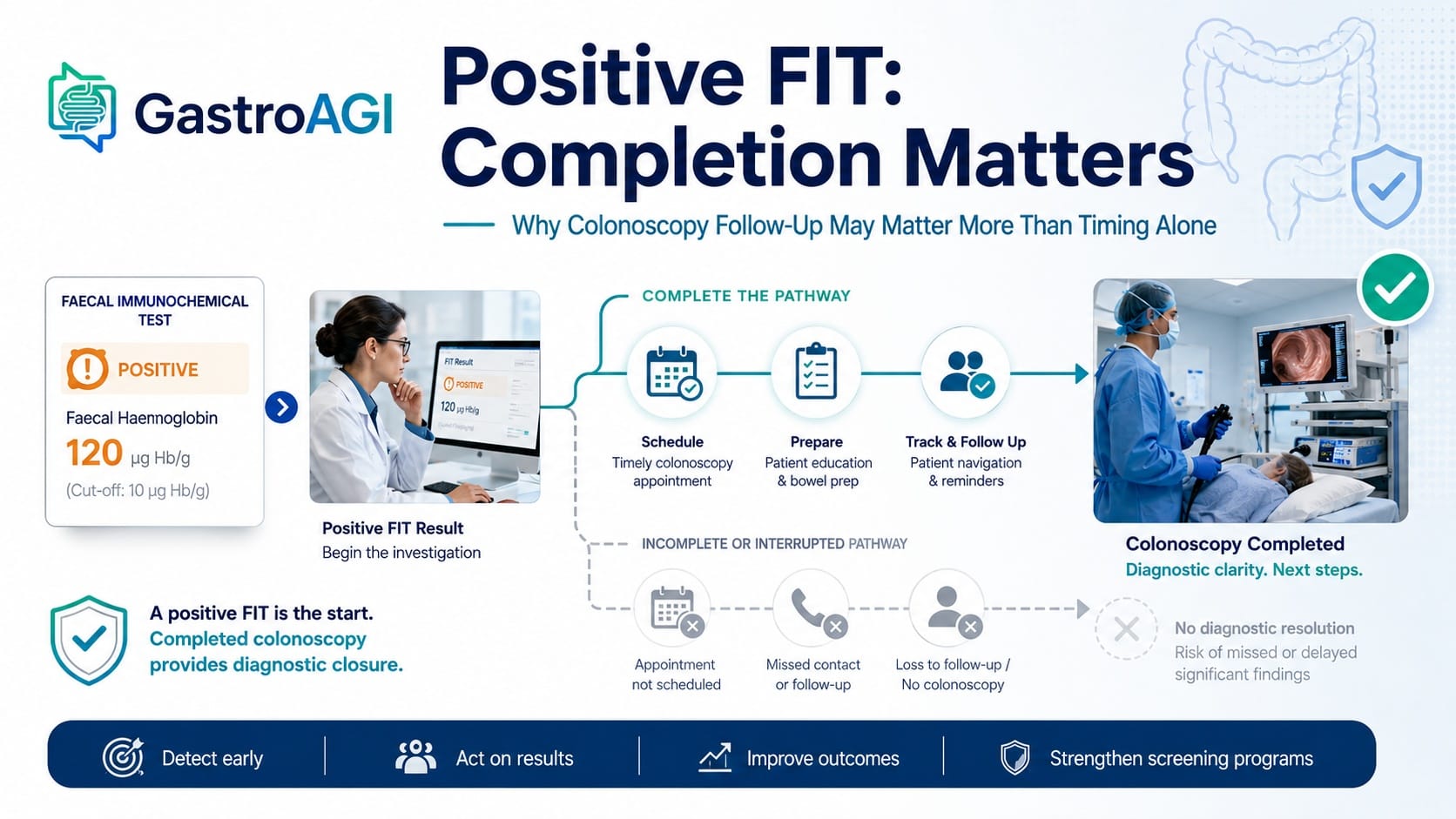
We count how many patients were invited for screening, how many returned a faecal immunochemical test, how many tests were positive, and how quickly colonoscopy appointments were offered.
The more uncomfortable question is whether the patient actually reached the end of the pathway.
A positive faecal immunochemical test, or positive FIT, is not a diagnosis. It does not confirm colorectal cancer, and it does not exclude it. It is a clinically important signal indicating that further evaluation—usually colonoscopy—is required.
Yet discussions about positive FIT follow-up often become dominated by one question:
How quickly should colonoscopy be performed?
One month? Three months? Six months?
Timing undoubtedly matters. However, the July 2026 Gut article, “Colonoscopy compliance matters more than time to colonoscopy after a positive FIT result,” asks clinicians and screening programmes to consider an even more fundamental issue:
What is the value of rapid colonoscopy targets if a meaningful proportion of patients never undergo colonoscopy at all?
The article was published online on July 24, 2026, by Adrien Grancher, Bernard Denis, and Lydia Guittet in Gut. Its DOI is 10.1136/gutjnl-2026-339212, and its PMID is 42498623.
It should be read as a clinically important interpretive article rather than a new randomized trial. Its argument builds on an earlier French nationwide retrospective cohort study examining the relationship between time to colonoscopy after positive FIT and the detection of colorectal cancer, advanced-stage colorectal cancer, and advanced adenoma.
The central message is not that timing is irrelevant.
It is that colonoscopy completion is indispensable.
A delayed colonoscopy remains an unfinished task. A colonoscopy that never happens is a failed diagnostic pathway.
A positive FIT is a question, not an answer
Patients sometimes understandably interpret a positive FIT as meaning that cancer has already been found.
Others move in the opposite direction. Because they feel well, they assume the result cannot be particularly important.
Neither interpretation is accurate.
FIT detects faecal haemoglobin. It identifies people who need further investigation, but it cannot determine the underlying cause by itself. Colonoscopy is the step that allows clinicians to investigate for colorectal cancer and advanced precursor lesions.
A positive FIT without subsequent diagnostic evaluation is therefore not completed screening.
It is an unresolved clinical question.
Consider an illustrative scenario.
A 62-year-old patient receives a positive FIT result through an organised screening programme. The result is communicated, a referral is generated, and an appointment is offered. The patient postpones because of work commitments. The second appointment is missed because the bowel preparation instructions seemed confusing. A third letter is sent, but no direct contact occurs.
From an administrative perspective, several actions have taken place.
From a clinical perspective, almost nothing has been resolved.
The test was completed. The pathway was not.
This distinction lies at the heart of the July 2026 Gut article.
Timing and compliance measure different failures
Time to colonoscopy describes the interval between a positive FIT and colonoscopy among patients who undergo the procedure.
Colonoscopy compliance describes whether the colonoscopy happens at all.
These measures are related, but they are not interchangeable.
A screening programme may report an impressive median waiting time while still losing a substantial number of FIT-positive patients before diagnostic completion. Conversely, another programme may have longer waiting intervals but successfully bring a larger proportion of patients to colonoscopy.
The first programme looks efficient on a timing dashboard.
The second may achieve more diagnostic closure.
Medicine occasionally produces situations in which the prettier spreadsheet is not the safer service.
The July 2026 article notes a colonoscopy compliance rate of 80% among individuals with a positive FIT in the context under discussion. That means a meaningful proportion of patients did not complete the expected diagnostic step.
Every one of those patients remained at unresolved risk.
This is why a positive FIT should not disappear into a referral queue after the result has been communicated. The clinically meaningful endpoint is not that a colonoscopy was recommended or booked.
It is that the diagnostic evaluation was completed—or that a documented, clinically appropriate alternative decision was made.
What the French nationwide cohort investigated
The interpretive article builds on a French nationwide retrospective cohort study titled:
“Does a long time to colonoscopy after a positive faecal immunochemical test result have a deleterious impact on colorectal cancer outcomes? A nationwide cohort study.”
The cohort included individuals with a positive FIT between 2016 and 2019 who subsequently underwent colonoscopy within 24 months.
The exposure of interest was the interval from positive FIT to colonoscopy.
The evaluated outcomes were:
Colorectal cancer
Advanced-stage colorectal cancer
Advanced adenoma
The study also examined individual and socio-geographic characteristics.
The population was substantial. A total of 374,113 FIT-positive individuals underwent post-FIT colonoscopy, corresponding to an 86.6% compliance rate in the underlying cohort report.
Among those individuals, investigators diagnosed:
21,616 colorectal cancers
122,359 advanced adenomas
The scale of the study gives it important descriptive value within an organised national screening setting.
However, the study was retrospective. It did not randomly assign patients to early or delayed colonoscopy. It also focused on individuals who ultimately underwent colonoscopy within 24 months.
Those details are essential when interpreting the results.
What the study found about colonoscopy timing
Compared with colonoscopy performed within the 2–3 month interval, the study found no increased observed risk of colorectal cancer, advanced-stage colorectal cancer, or advanced adenoma among those undergoing colonoscopy after three months and up to 24 months.
At 12 months, the adjusted odds ratios were:
0.93 for colorectal cancer
1.04 for advanced-stage colorectal cancer
0.88 for advanced adenoma
At first glance, this may appear to suggest that timing does not matter.
That would be an overinterpretation.
The more accurate conclusion is narrower:
Among FIT-positive individuals who eventually underwent colonoscopy within 24 months, longer intervals were not associated with a higher observed likelihood of colorectal cancer, advanced-stage colorectal cancer, or advanced adenoma compared with the 2–3 month interval.
The study found no association within that population and setting.
It did not prove that delaying colonoscopy is harmless for every patient.
Those are not equivalent statements.
Observational studies can describe patterns and associations. They cannot fully remove the possibility of confounding, selection bias, or systematic differences between patients scoped earlier and those scoped later.
For example, clinicians may have prioritised patients with symptoms, higher faecal haemoglobin levels, significant anaemia, concerning medical history, or other risk features. Patients undergoing later colonoscopy may therefore differ from those undergoing earlier procedures in ways not fully reflected by the available data.
The absence of a detected association should not be turned into permission for indefinite delay.
Completion may matter more than shaving weeks from the waiting time
The practical insight from the article is not that screening programmes should become relaxed about waiting periods.
It is that programmes should distinguish between two different problems:
A patient undergoes colonoscopy later than the preferred interval.
A patient never undergoes colonoscopy.
Both deserve attention, but the second represents complete loss of diagnostic follow-up.
Imagine two screening services.
In Service A, most patients receive a colonoscopy within six weeks, but one in five FIT-positive individuals never completes the procedure.
In Service B, the average waiting time is somewhat longer, but almost every FIT-positive patient reaches diagnostic colonoscopy.
This simplified scenario does not establish which service is better overall. Other factors—including cancer stage, procedure quality, patient risk, and capacity—would also matter.
But it illustrates the article’s central argument: an excellent waiting-time target cannot compensate for patients disappearing from the pathway.
Reducing an already scheduled patient’s wait by two weeks may be valuable.
Finding the patient who was never successfully scheduled may be more valuable still.
Faecal haemoglobin may help identify who needs greater urgency
One of the most clinically useful findings from the underlying study concerns faecal haemoglobin concentration, often written as f-Hb.
Patients with f-Hb concentrations of at least 200 µg/g were:
Eight times more likely to have colorectal cancer
Eleven times more likely to have advanced-stage colorectal cancer
Twice as likely to have an advanced adenoma
These comparisons were made against the 30–40 µg/g category.
This finding reinforces a point that experienced clinicians already recognise conceptually: not every positive test carries identical risk.
“Positive” is a threshold category. The quantitative result may contain additional clinical information.
A patient with a markedly elevated f-Hb concentration may require greater urgency than someone with a lower-positive result, particularly when colonoscopy capacity is limited.
This does not mean that lower-positive patients can safely be ignored. Every positive FIT still requires appropriate diagnostic follow-up.
Instead, quantitative f-Hb may help screening programmes decide who should move closer to the front of the queue without allowing those further back to fall out of the queue altogether.
The authors’ conclusion reflects this balance: colonoscopy completion may deserve priority over rigid interval adherence, while higher faecal haemoglobin concentrations support earlier colonoscopy.
The mature interpretation is therefore:
Completion is fundamental, but urgency should still respond to risk.
A booked colonoscopy is not a completed colonoscopy
Healthcare systems often treat scheduling as evidence of progress.
Clinically, however, an appointment date is only a promise.
It does not diagnose colorectal cancer, remove an advanced adenoma, or explain a positive FIT result.
Patients may fail to complete colonoscopy for many reasons:
Fear of the procedure
Anxiety about a possible cancer diagnosis
Difficulty understanding bowel preparation
Transport limitations
Work or caregiving responsibilities
Financial concerns
Medical comorbidity
Poor communication
Referral delays
Fragmented responsibility between services
Previous unpleasant procedural experiences
Some patients do not actively refuse colonoscopy. They simply become lost between a positive test, a referral, an appointment letter, and a complex healthcare system.
This is why active tracking matters.
A screening programme should ideally know whether each FIT-positive patient:
Completed colonoscopy
Declined after informed discussion
Was medically unsuitable
Chose an alternative pathway
Remains awaiting the procedure
Was lost to follow-up
The phrase “colonoscopy advised” is not diagnostic closure.
Nor, unfortunately, is “patient did not attend” a complete clinical strategy.
What clinicians can do differently
The article’s message has practical implications for gastroenterologists, primary care clinicians, endoscopy services, and screening-programme leaders.
Track patients until the pathway is resolved
A positive FIT should trigger follow-up that continues until colonoscopy is completed or another documented clinical decision is reached.
Responsibility should not become ambiguous after referral.
When everyone assumes someone else is following the patient, the patient may discover that nobody is.
Identify barriers before the appointment
Patients may miss colonoscopy because they do not understand why it is required, fear the preparation, cannot arrange transport, or believe absence of symptoms means absence of risk.
A short, clear conversation can reveal barriers that an automated letter will not.
For example:
“You have a positive screening test. This does not mean you have cancer, but it does mean we need colonoscopy to understand why the test was positive.”
That explanation is simple, accurate, and often more useful than several paragraphs of institutional language.
Use risk information intelligently
Quantitative f-Hb may help prioritise patients when demand exceeds immediate colonoscopy capacity.
Higher-risk patients may need faster access, but the system must still protect lower-priority patients from non-completion.
Risk stratification should organise follow-up, not justify abandonment.
Measure completion as a quality outcome
Time-to-colonoscopy remains important, but screening programmes should also report:
Colonoscopy completion rate
Reasons for non-completion
Time from positive FIT to diagnostic resolution
Missed appointment recovery
Variation across geographic or socioeconomic groups
Completion according to f-Hb category
Cancer and advanced adenoma detection
A service cannot improve a failure it does not measure.
Why this matters when colonoscopy capacity is limited
Many screening systems operate under capacity pressure.
There may be more positive FIT results than immediately available colonoscopy slots. Endoscopy lists may already contain symptomatic referrals, surveillance procedures, therapeutic cases, urgent bleeding, and patients requiring complex support.
The response to limited capacity cannot be to pretend every patient can be scoped instantly.
Nor should the response be to accept prolonged waits without scrutiny.
The article supports a more intelligent use of resources.
Programmes should aim to:
Complete colonoscopy for all eligible FIT-positive patients
Prioritise those at higher risk
Prevent missed appointments from becoming permanent loss to follow-up
Simplify referral and scheduling
Improve bowel-preparation support
Communicate the significance of positive FIT clearly
Monitor both waiting time and completion
There is little value in creating an exceptionally fast pathway for patients who are already engaged while failing to recover those who have quietly fallen out of the system.
Efficiency is not only about moving quickly.
It is also about making sure the right patients arrive.
What this evidence should not be used to claim
The study should not be presented as evidence that colonoscopy can safely be postponed for up to 24 months in every FIT-positive individual.
It should not be used to reassure patients that delay carries no risk.
It should not be interpreted as a recommendation to weaken existing national or local screening guidance.
It should not be described as proving that early and late colonoscopy are clinically equivalent.
The underlying evidence was observational, not randomized. The study population consisted of patients who ultimately underwent colonoscopy within 24 months. Differences between earlier and later groups may have influenced the observed findings.
The article’s title is deliberately provocative, but its message is not an invitation to complacency.
It is a reminder to focus on the entire pathway.
“Compliance matters more” does not mean “time does not matter.”
It means that discussing optimal timing becomes rather theoretical when the colonoscopy never occurs.
Strengths of the evidence
The underlying cohort has several important strengths.
First, it was large, including more than 374,000 FIT-positive individuals who underwent colonoscopy.
Second, it was embedded within a national screening context, giving it relevance for programme-level planning.
Third, it examined meaningful clinical outcomes rather than waiting times alone:
Colorectal cancer
Advanced-stage colorectal cancer
Advanced adenoma
Fourth, it incorporated quantitative faecal haemoglobin, providing clinically useful information for risk stratification.
Finally, the July 2026 Gut article draws attention to a quality measure that can be overshadowed by timing targets: whether diagnostic colonoscopy was completed.
Important limitations
The most important limitation is the retrospective observational design.
Time to colonoscopy was not assigned randomly. Earlier and later groups may have differed in symptoms, clinical urgency, f-Hb concentration, geography, healthcare access, comorbidity, or other factors.
The cohort also included individuals who completed colonoscopy within 24 months. Patients who never underwent colonoscopy are central to the compliance question, but their colonoscopy-detected outcomes cannot be evaluated in the same manner.
The findings arose from a particular French national screening setting. Other countries may use different FIT thresholds, referral systems, colonoscopy capacity, navigation processes, and reporting standards.
The July 2026 article is also not a guideline. It can inform clinical thinking and quality improvement, but it should not replace national screening recommendations or local policy.
What future research should examine
Future research should move beyond describing non-completion and test interventions designed to prevent it.
Relevant strategies may include:
Patient-navigation programmes
Direct colonoscopy scheduling
Reminder systems
Primary care follow-up
Simplified referral pathways
Bowel-preparation education
Transport support
Multilingual communication
Outreach after missed appointments
Risk-based triage using quantitative f-Hb
Research should also examine whether prioritisation based on faecal haemoglobin improves outcomes without creating inequity.
A risk-based system may be clinically sensible, but it must not create a lower-priority group that becomes an invisible group.
Future studies should report both time to colonoscopy and colonoscopy completion. One without the other provides an incomplete picture.
Timing tells us how quickly the system moved.
Completion tells us whether the system arrived.
Clinical Takeaway
The July 2026 Gut article “Colonoscopy compliance matters more than time to colonoscopy after a positive FIT result” highlights a fundamental principle of colorectal cancer screening:
A positive FIT only creates benefit when the diagnostic pathway is completed.
The underlying French nationwide retrospective cohort included 374,113 FIT-positive individuals who underwent colonoscopy within 24 months. Longer intervals beyond three months were not associated with a higher observed risk of colorectal cancer, advanced-stage colorectal cancer, or advanced adenoma compared with colonoscopy at 2–3 months.
However, this finding does not prove that delay is harmless, nor does it support postponing colonoscopy intentionally.
Higher faecal haemoglobin concentrations identified patients with substantially greater likelihood of colorectal cancer, advanced-stage disease, and advanced adenoma, supporting risk-based prioritisation when resources are constrained.
The most balanced clinical interpretation is straightforward:
Positive FIT follow-up should be timely, but above all, it must be completed.
For screening programmes, the meaningful endpoint is not a test result, a referral letter, or an appointment date.
It is diagnostic resolution.
Five Key Clinical Takeaways
The July 2026 Gut article argues that completing colonoscopy after positive FIT may be more important than focusing exclusively on rigid timing targets.
The underlying French nationwide retrospective cohort included 374,113 FIT-positive individuals who underwent colonoscopy within 24 months.
Longer intervals up to 24 months were not associated with a higher observed risk of colorectal cancer, advanced-stage colorectal cancer, or advanced adenoma compared with the 2–3 month interval.
An f-Hb concentration of at least 200 µg/g was associated with substantially higher likelihood of colorectal cancer, advanced-stage colorectal cancer, and advanced adenoma compared with the 30–40 µg/g category.
The evidence supports stronger tracking, navigation, risk-based prioritisation, and colonoscopy-completion systems—not deliberate delay or departure from established screening guidance.
Source Reference
Grancher A, Denis B, Guittet L. Colonoscopy compliance matters more than time to colonoscopy after a positive FIT result. Gut. Published online July 24, 2026. DOI: 10.1136/gutjnl-2026-339212. PMID: 42498623.
Related underlying cohort:
Grancher A, Denis B, Plaine J, Vidal-Sengchanh S, Quertier M-C, Quintin C, Guittet L. Does a long time to colonoscopy after a positive faecal immunochemical test result have a deleterious impact on colorectal cancer outcomes? A nationwide cohort study. Gut.
References

We are pioneers in clinical intelligence, dedicated to helping gastroenterologists harness the power of artificial intelligence to drive precision, efficiency, and patient growth.