
REFINED-ASUC Criteria: A Modern Approach to Diagnosing Acute Severe Ulcerative Colitis
An experienced gastroenterologist explains the 2026 REFINED-ASUC criteria for diagnosing acute severe ulcerative colitis in patients receiving corticosteroids or advanced therapies.


Patients rarely read the textbook before arriving in hospital.
A patient with ulcerative colitis may present with frequent bloody stools, tachycardia, anaemia, low albumin, nocturnal bowel movements, and a rising inflammatory burden—but may already have been taking oral corticosteroids for several days. Another may be receiving an advanced therapy that partially suppresses fever or C-reactive protein without adequately controlling the colitis.
Neither patient necessarily presents in the classical manner described by criteria developed more than 70 years ago.
This is the problem addressed by the article:
“New Diagnostic Criteria for Acute Severe Ulcerative Colitis in the Modern Treatment Era: A Modified Delphi Consensus by REFINED-ASUC.”
Published online in Clinical Gastroenterology and Hepatology on July 22, 2026, the paper reports the work of the Refined Evaluation Framework and INvEstigations for Diagnostics in ASUC, known more conveniently as the REFINED-ASUC Working Group. Its DOI is 10.1016/j.cgh.2026.07.011.
The study does not compare drugs, rescue therapies, or surgical strategies. It is not a randomized trial, a prospective patient cohort, or a treatment guideline.
It is a modified Delphi consensus designed to answer a deceptively difficult question:
How should acute severe ulcerative colitis be diagnosed when modern therapy has already altered the patient’s presentation?
That question matters because diagnosing acute severe ulcerative colitis, or ASUC, is not simply an exercise in classification. The diagnosis may trigger hospital admission, infection testing, endoscopic assessment, radiologic evaluation, close physiological monitoring, intravenous treatment, early rescue-therapy planning, and surgical consultation.
In severe colitis, diagnostic delay is rarely improved by optimism.
Why the traditional ASUC definition now feels incomplete
The diagnosis of ASUC has traditionally relied on the 1955 Truelove and Witts criteria.
These criteria have endured because they are clinically practical and historically important. They helped generations of clinicians recognize a dangerous form of ulcerative colitis that required urgent inpatient management.
However, the therapeutic world in which those criteria were developed was very different from modern inflammatory bowel disease practice.
Today, a patient may arrive in hospital while already receiving:
Oral corticosteroids
Biologic therapy
Small-molecule treatment
Combination treatment
Previous rescue therapy
Treat-to-target monitoring
Treatment may alter the clinical phenotype.
Corticosteroids may reduce fever or suppress the C-reactive protein response. Advanced therapies may partially improve bowel frequency without adequately controlling bleeding. A patient may appear less systemically inflamed on paper while still having dangerous mucosal disease.
This creates a clinical dilemma.
Should a patient be considered less severely ill because one laboratory marker has been partially suppressed by treatment?
Or should the threshold for concern change because the patient is already receiving therapy that ought to have improved the disease?
REFINED-ASUC addresses this mismatch by incorporating treatment exposure directly into diagnostic reasoning.
That is perhaps its most important conceptual contribution.
Treatment history is no longer background information. It becomes part of the diagnostic framework.
A familiar scenario in modern IBD practice
Consider a patient with established ulcerative colitis who has been taking high-dose oral corticosteroids for several days.
The patient reports six or seven bowel movements daily, visible blood in roughly one-third of them, nocturnal symptoms, progressive fatigue, and reduced oral intake. The CRP is elevated, but not dramatically so.
Under a rigid interpretation of older criteria, the patient may appear not to satisfy every expected marker of systemic severity.
Yet something is clearly wrong.
The patient is already receiving treatment that should have reduced inflammation. The persistence of bleeding, frequent bowel movements, nocturnal symptoms, and systemic decline may therefore be more concerning—not less.
This is where experienced clinical judgment often begins to whisper before the criteria begin to shout.
REFINED-ASUC attempts to turn some of that modern clinical reasoning into a more structured diagnostic framework.
How the REFINED-ASUC consensus was developed
The study used a four-round Delphi process followed by a consensus meeting.
The participating experts were gastroenterologists from:
Europe
North America
The Asia-Pacific region
Together, they formed the REFINED-ASUC Working Group.
Consensus was defined as:
At least 70% agreement or disagreement for Likert-scale questions
At least 70% homogeneity for single-choice or multiple-choice responses
This methodology is appropriate when clinical practice has evolved more quickly than the available validation evidence.
A Delphi process allows experts to review statements repeatedly, reconsider their positions, and move toward a defined level of agreement. It is particularly useful when developing diagnostic definitions, research frameworks, or consensus terminology.
However, its limitations must be understood.
The participants were expert gastroenterologists—not hospitalized patients.
There was no patient-level intervention.
There was no treatment comparator.
The outcomes were consensus statements and proposed diagnostic criteria, not colectomy rates, mortality, steroid response, or long-term remission.
A Delphi consensus tells us what knowledgeable experts agreed should be considered.
It does not prove that the resulting criteria predict clinical outcomes.
Expert agreement is valuable. Nature, unfortunately, is not obliged to agree with the experts until the criteria are tested prospectively.
The proposed REFINED-ASUC diagnostic framework
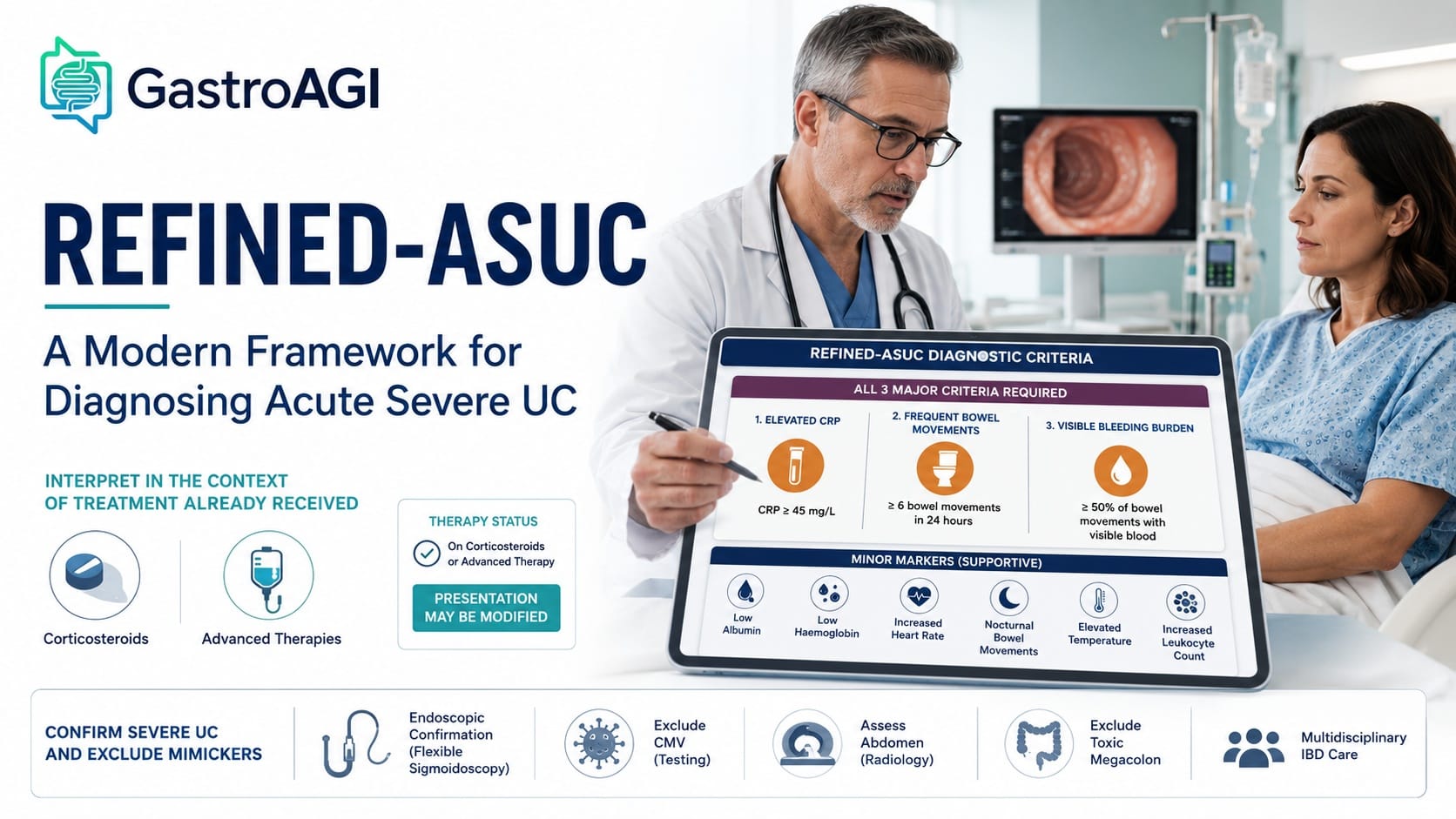
For patients already receiving advanced therapy or corticosteroids, the REFINED-ASUC group reached consensus on a structure involving:
Three major criteria plus at least two minor criteria.
The three major criteria
The proposed major criteria are:
C-reactive protein at least two times the upper limit of normal
At least six bowel movements per 24 hours
Visible blood in at least 50% of bowel movements over 24 hours
These criteria combine inflammatory burden, stool frequency, and bleeding severity.
This matters because no single component adequately captures the clinical syndrome.
Frequent bowel movements alone may occur for several reasons. CRP may be affected by treatment or individual biological variation. Bleeding alone does not define the full systemic severity of the illness.
Together, however, they describe a patient with active, clinically significant colitis despite ongoing therapy.
The minor criteria
The proposed minor criteria are:
Low albumin
Increased heart rate
Nocturnal bowel movements
Low haemoglobin
Increased body temperature
Elevated leukocyte count
These minor criteria broaden the framework beyond stool counting.
They capture nutritional deterioration, inflammatory stress, blood loss, systemic response, and disruption of normal daily physiology.
Anyone who has looked after patients with severe ulcerative colitis knows that nocturnal bowel movements carry a particular significance.
A bowel that repeatedly wakes the patient during the night is not respecting office hours, and severe inflammation rarely does.
Why the major-plus-minor structure is clinically meaningful
The proposed framework recognizes that ASUC is not simply “diarrhoea with a high CRP.”
It is a severe inflammatory syndrome with multiple dimensions:
Stool frequency
Visible bleeding
Systemic inflammation
Anaemia
Nutritional compromise
Tachycardia
Fever
Leukocytosis
Nocturnal disease activity
A major-plus-minor structure may help clinicians identify patients who are seriously unwell even when no single variable appears dramatic in isolation.
For example, imagine a patient receiving advanced therapy who has:
Six bowel movements daily
Visible blood in more than half
CRP more than twice the upper limit of normal
Low albumin
Tachycardia
Nocturnal bowel movements
The overall pattern is far more informative than any one value.
Clinical severity often lives in the combination.
The laboratory system may display each abnormality in a separate row. The clinician’s task is to recognize that the abnormalities belong to the same patient.
Why visible bleeding remains central
One of the three major criteria is visible blood in at least 50% of bowel movements during 24 hours.
This is clinically understandable.
Visible bleeding supports the presence of ongoing active mucosal inflammation and helps distinguish severe colitis from other causes of frequent bowel movements, including functional symptoms, medication effects, or non-inflammatory diarrhoea.
In a severe ulcerative colitis flare, bleeding is not merely an inconvenient symptom.
It represents continuing mucosal injury.
However, the threshold must be interpreted carefully.
The source supports this percentage as a consensus-derived diagnostic component. It does not prove that 49% represents low risk while 50% represents high risk. Biology is rarely impressed by a one-percentage-point administrative boundary.
Nor does the consensus establish that the visible bleeding threshold independently predicts colectomy, treatment failure, or mortality.
It is a proposed diagnostic marker requiring prospective validation.
The threshold should support judgment, not replace it.
High-dose corticosteroids require different thinking
One of the most intellectually interesting aspects of REFINED-ASUC is its separate consideration of patients already receiving high-dose corticosteroids.
For this subgroup, the panel supported lower thresholds:
CRP at least one times the upper limit of normal
Visible blood in at least 33% of bowel movements over 24 hours
Why lower the thresholds?
Because high-dose corticosteroids may partly suppress the inflammatory expression of disease.
A patient already receiving substantial corticosteroid treatment may not demonstrate the same degree of CRP elevation or bleeding burden as an untreated patient, even when the underlying disease remains severe.
Waiting for more dramatic abnormalities may therefore delay recognition.
Consider a patient who has already received several days of high-dose corticosteroids but continues to experience frequent stools, one-third visibly bloody, nocturnal symptoms, anaemia, and tachycardia.
The persistence of this disease activity despite therapy should increase concern.
The patient has not merely arrived with severe symptoms. The patient has failed to improve adequately despite treatment intended to suppress them.
REFINED-ASUC therefore makes an important diagnostic adjustment:
The meaning of a clinical finding depends partly on what treatment preceded it.
This is sensible medicine.
A temperature of 37.8°C means one thing in an untreated patient and may mean something different in a patient receiving medication that suppresses inflammation. The same principle applies to CRP and bleeding burden.
What about patients who have not received treatment?
The panel agreed that similar diagnostic principles might apply to untreated patients.
However, formal consensus was not achieved for that group.
This is an important boundary.
It would be tempting to describe REFINED-ASUC as a universal replacement for existing ASUC criteria.
The source does not support that claim.
The strongest consensus applies to patients already receiving advanced therapy or corticosteroids, including a separate approach for patients on high-dose corticosteroids.
For untreated patients, the experts saw potential relevance but did not reach the required consensus threshold.
Clinicians should therefore present REFINED-ASUC as a modern diagnostic proposal with particular relevance to treated patients—not as a fully established definition for every acute severe ulcerative colitis presentation.
Endoscopy still matters
The REFINED-ASUC panel agreed that endoscopy should confirm the diagnosis and help exclude cytomegalovirus infection.
This is an important reminder that clinical and laboratory criteria do not replace direct assessment of the disease process.
Severe colitis may coexist with or be complicated by infection. CMV infection can alter management and may be particularly relevant in patients exposed to immunosuppressive therapy.
The criteria may help identify suspected ASUC.
Endoscopy helps evaluate the mucosa and assess for competing or contributing pathology.
For fellows, the teaching point is straightforward:
Do not allow a scoring system to become a substitute for looking at the disease when it is clinically appropriate to do so.
A checklist can organize thought. It cannot perform the endoscopy.
Radiology and the exclusion of toxic megacolon
The panel also agreed that radiologic investigations should support exclusion of toxic megacolon.
This is essential because severe colitis is not only an inflammatory problem. It can become a structural and systemic emergency.
A patient with abdominal distension, systemic toxicity, tenderness, or concerning clinical deterioration requires assessment beyond stool frequency and CRP.
No proposed diagnostic framework should create false reassurance when a major complication is developing.
REFINED-ASUC therefore remains part of a broader safety pathway that includes:
Clinical assessment
Laboratory evaluation
Endoscopic confirmation
CMV exclusion
Radiologic assessment
Monitoring for complications
The diagnosis of ASUC is a synthesis, not a single laboratory result.
How clinicians may use REFINED-ASUC in practice
The most reasonable clinical use of REFINED-ASUC is as a structured framework for evaluating contemporary patients whose presentation may have been modified by treatment.
When assessing possible ASUC, clinicians may now pay closer attention to documenting:
Current and recent corticosteroid exposure
Advanced therapy exposure
Bowel movement frequency over 24 hours
Proportion of bowel movements containing visible blood
Nocturnal bowel movements
CRP relative to the laboratory upper limit of normal
Albumin
Haemoglobin
Heart rate
Body temperature
Leukocyte count
This may improve communication between emergency clinicians, gastroenterologists, IBD nurses, surgeons, and trainees.
“Severe flare” can mean different things to different people.
A structured record of bowel frequency, bleeding percentage, treatment exposure, and systemic markers provides a more precise clinical language.
It may also help identify patients whose disease is more concerning than the CRP alone suggests.
A practical admission scenario
Imagine two patients presenting with ulcerative colitis symptoms.
Patient A
Seven bowel movements daily
Visible blood in most stools
CRP more than twice the upper limit of normal
Low albumin
Tachycardia
Nocturnal symptoms
Currently receiving advanced therapy
Patient B
Six bowel movements daily
Visible blood in one-third
CRP just above the upper limit of normal
Anaemia
Nocturnal symptoms
Already taking high-dose corticosteroids
The first patient fits the proposed major-plus-minor framework relatively clearly.
The second may appear less inflammatory if the CRP is considered without context. However, the lower thresholds proposed for high-dose corticosteroid exposure may appropriately raise concern.
This is precisely the type of patient for whom the REFINED-ASUC framework may be useful.
It encourages clinicians to ask not only:
“How abnormal are the findings?”
but also:
“How abnormal are these findings given the treatment the patient is already receiving?”
That is a more sophisticated clinical question.
What REFINED-ASUC does not tell us
The source does not prove that applying the proposed criteria will:
Reduce colectomy
Improve survival
Shorten hospital stay
Predict corticosteroid failure
Identify the ideal rescue therapy
Prevent complications
Improve long-term remission
Reduce readmissions
The consensus has not yet been prospectively validated against these outcomes.
It is also not a treatment guideline.
The study does not compare:
Intravenous corticosteroids
Infliximab
Ciclosporin
JAK inhibitors
Other rescue strategies
Surgical timing
Colectomy approaches
Its focus is diagnosis.
Clinicians should also avoid using the criteria to dismiss serious disease when a patient narrowly fails to meet a numerical threshold.
A patient does not become safe because one bowel movement contained insufficient blood to satisfy a percentage calculation.
Clinical criteria guide recognition. They do not relieve the clinician of responsibility for the patient in front of them.
Strengths of the REFINED-ASUC consensus
The greatest strength of the consensus is that it directly addresses modern treatment reality.
Many patients presenting with severe ulcerative colitis are no longer treatment-naïve. They may already be receiving therapies that alter symptoms and inflammatory markers.
REFINED-ASUC recognizes this explicitly.
A second strength is the international composition of the expert group, with gastroenterologists from Europe, North America, and the Asia-Pacific region.
A third strength is the structured four-round Delphi process and the use of predefined consensus thresholds.
A fourth strength is the breadth of the proposed framework. It does not rely on stool frequency alone but includes bleeding, inflammatory markers, nutritional status, haematologic changes, vital signs, nocturnal symptoms, endoscopy, infection assessment, and radiology.
The framework therefore reflects how experienced clinicians actually assess severe colitis: by integrating multiple signals.
Important limitations
The principal limitation is the evidence type.
A modified Delphi process provides expert consensus, not diagnostic validation.
The proposed criteria have not yet demonstrated:
Sensitivity
Specificity
Predictive value
Reproducibility
Prognostic accuracy
Impact on clinical outcomes
The thresholds also require testing across different laboratories, healthcare systems, patient populations, treatment backgrounds, and disease severities.
Using CRP relative to the upper limit of normal may improve portability between laboratories, but that does not guarantee equal performance in all settings.
The absence of formal consensus for untreated patients is another important limitation. It prevents the framework from being presented as universal.
Finally, some clinical variables—such as the exact proportion of bowel movements containing visible blood—may be difficult to measure reliably in routine care. Patients do not always arrive with a perfectly completed 24-hour spreadsheet, and few would consider that a reasonable expectation during an acute severe flare.
Implementation will therefore require practical documentation systems.
What future research needs to establish
The next step is prospective validation.
Future studies should test whether the REFINED-ASUC criteria identify patients who experience:
Failure of corticosteroid therapy
Need for rescue treatment
Colectomy
Readmission
Complications
Prolonged hospitalization
Diagnostic reclassification after infection testing
Researchers should also examine how the criteria perform across different advanced therapies and corticosteroid doses.
Patients receiving treatment should not automatically be considered one homogeneous group. Different therapies may alter clinical and laboratory expression in different ways.
Implementation studies will also be necessary.
Can clinicians reliably record the proportion of bloody bowel movements?
Can nocturnal symptoms be documented consistently?
Can electronic admission templates improve data capture?
Can the criteria be applied similarly by IBD specialists, general gastroenterologists, emergency physicians, and trainees?
A diagnostic framework is only useful when clinicians can apply it accurately at the bedside.
Clinical Takeaway
The REFINED-ASUC criteria address a genuine problem in modern inflammatory bowel disease care: diagnosing acute severe ulcerative colitis in patients whose clinical presentation may already have been modified by corticosteroids or advanced therapy.
For treated patients, the consensus proposes a framework based on three major criteria plus at least two minor criteria.
The major criteria are:
CRP at least twice the upper limit of normal
At least six bowel movements per 24 hours
Visible blood in at least 50% of bowel movements
The minor criteria include:
Low albumin
Increased heart rate
Nocturnal bowel movements
Low haemoglobin
Increased temperature
Elevated leukocyte count
For patients receiving high-dose corticosteroids, lower thresholds were proposed for CRP and visible bleeding.
The framework also reinforces the role of endoscopy in confirming disease and excluding CMV infection, together with radiologic assessment for toxic megacolon.
The most balanced interpretation is that REFINED-ASUC provides a thoughtful, contemporary diagnostic proposal—not a validated outcome-prediction tool and not a treatment guideline.
For clinicians, its greatest value may be intellectual as much as numerical:
Disease severity should be interpreted in the context of the treatment the patient has already received.
After 25 years in gastroenterology, that principle feels less like a new rule and more like good clinical sense finally being given a formal structure.
Five Key Clinical Takeaways
REFINED-ASUC is a modified Delphi consensus, not a randomized trial, patient cohort, or treatment guideline.
It addresses a modern diagnostic gap by incorporating corticosteroid and advanced therapy exposure into ASUC assessment.
For treated patients, the proposed framework uses three major criteria plus at least two minor criteria.
Patients receiving high-dose corticosteroids are considered separately, with lower proposed CRP and visible bleeding thresholds.
Prospective validation is required before REFINED-ASUC can be considered an established predictor of treatment failure, colectomy, or other clinical outcomes.

Source Reference
Raine T, Peyrin-Biroulet L, Begun J, Biedermann L, Blumenstein I, Cheifetz AS, Colombel JF, Dulai PS, Gecse KB, Jairath V, Nakase H, Panaccione R, Reinisch W, Verstockt B, Higgins PDR. New Diagnostic Criteria for Acute Severe Ulcerative Colitis in the Modern Treatment Era: A Modified Delphi Consensus by REFINED-ASUC. Clinical Gastroenterology and Hepatology. Published online July 22, 2026. DOI: 10.1016/j.cgh.2026.07.011.
References

We are pioneers in clinical intelligence, dedicated to helping gastroenterologists harness the power of artificial intelligence to drive precision, efficiency, and patient growth.