
New Diagnostic Criteria for Acute Severe Ulcerative Colitis: REFINED-ASUC Consensus for the Modern Treatment Era
REFINED-ASUC proposes updated diagnostic criteria for acute severe ulcerative colitis in patients already receiving steroids or advanced therapy.


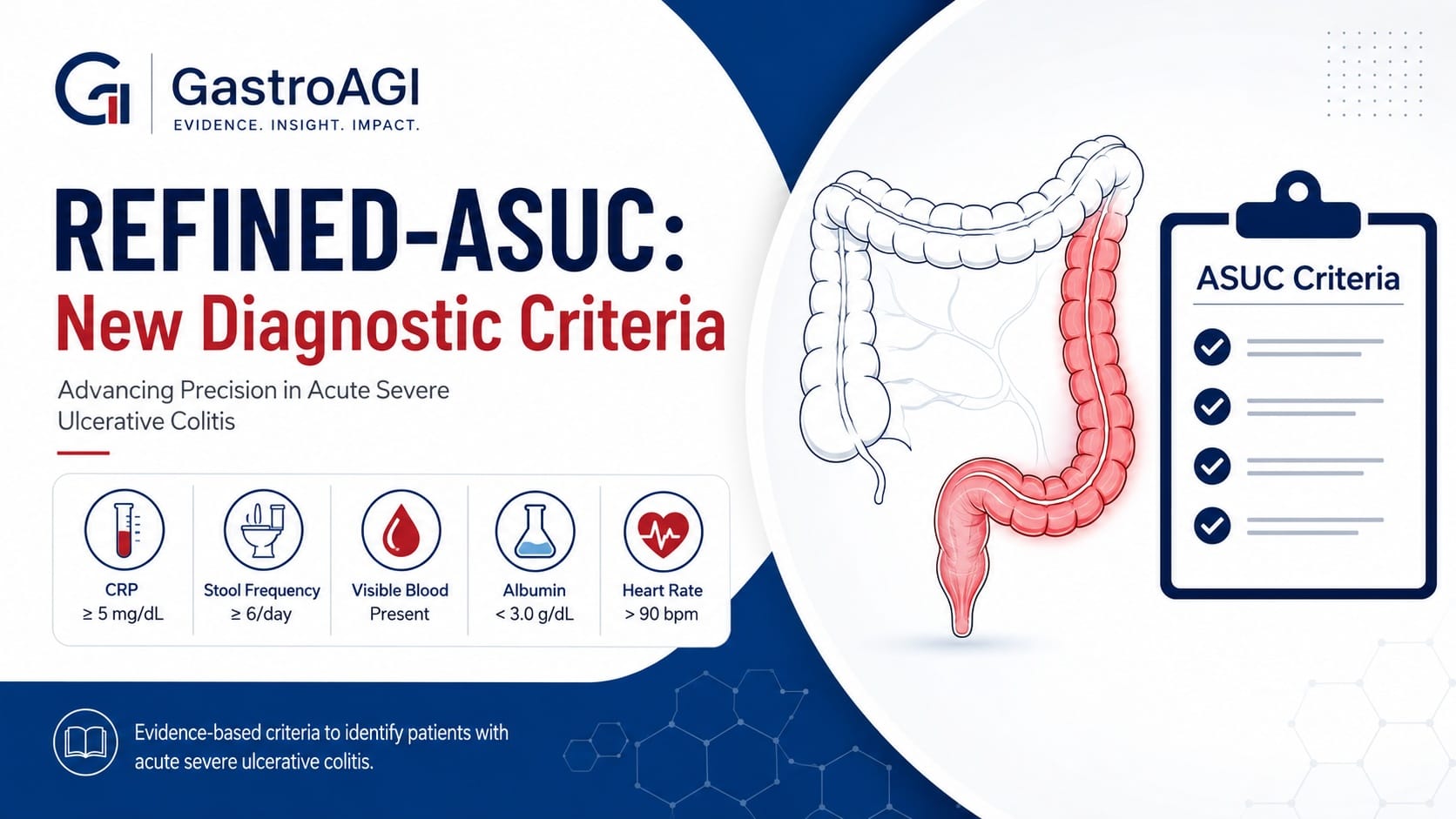
Acute severe ulcerative colitis remains one of the highest-stakes scenarios in inflammatory bowel disease care. The first clinical question is deceptively simple: does this patient meet criteria for ASUC? The answer can determine admission urgency, inpatient monitoring intensity, timing of intravenous corticosteroids, need for rescue therapy discussions, endoscopic evaluation, infection assessment, radiology, and early surgical involvement.
For decades, that decision has usually been anchored to the 1955 Truelove and Witts criteria. The problem is not that those criteria are irrelevant; it is that the therapeutic landscape around ulcerative colitis has changed dramatically. Many patients now present after outpatient exposure to corticosteroids, biologics, or small-molecule advanced therapies. A modern patient may arrive already partially treated, with attenuated fever, altered inflammatory markers, or a symptom pattern that does not map neatly onto older definitions.
The new article “New Diagnostic Criteria for Acute Severe Ulcerative Colitis in the Modern Treatment Era: A Modified Delphi Consensus by REFINED-ASUC” directly addresses this gap. Published online in Clinical Gastroenterology and Hepatology on July 22, 2026, the paper reports a four-round modified Delphi process and consensus meeting involving European, North American, and Asia-Pacific gastroenterologists. The working group was named REFINED-ASUC, standing for Refined Evaluation Framework and Investigations for Diagnostics in ASUC.
Why older ASUC definitions need refinement
The article begins from a clinically familiar premise: ASUC is a potentially life-threatening manifestation of ulcerative colitis, and its diagnosis has typically relied on the Truelove and Witts criteria. However, those historic criteria do not incorporate prior or current treatment with corticosteroids or modern advanced therapies.
That omission matters because outpatient treatment can modify the phenotype seen at presentation. A patient already receiving corticosteroids may have a different inflammatory signal than an untreated patient. A patient receiving advanced therapy may still have clinically severe disease, but the pattern of symptoms and laboratory abnormalities may not behave exactly as expected from older cohorts.
The REFINED-ASUC consensus therefore does not simply ask whether older criteria are “right” or “wrong.” It asks whether clinicians need a more contemporary diagnostic framework that acknowledges the treatment context in which ASUC now presents.
What the REFINED-ASUC group investigated
This was not a randomized trial, cohort study, or validation study. It was a modified Delphi consensus designed to gather expert opinion on potential criteria and diagnostic approaches for ASUC in contemporary practice, including patients already receiving outpatient corticosteroids or advanced therapy.
The Delphi panel included gastroenterologists from Europe, North America, and the Asia-Pacific region. The process involved four Delphi rounds and a consensus meeting. Consensus was defined as at least 70% agreement or disagreement for Likert-scale statements, or at least 70% homogeneity for single-choice or multiple-choice responses.
This design is important for interpretation. Delphi methodology is useful when clinical practice faces a definitional gap and randomized evidence is unavailable or impractical. It can produce structured expert agreement, but it does not prove that the proposed criteria predict outcomes better than existing criteria. REFINED-ASUC should therefore be understood as a consensus framework requiring prospective validation, not as a completed diagnostic performance study.
The proposed structure: major and minor criteria
The most clinically actionable output is the proposed diagnostic structure for patients already treated with advanced therapy or corticosteroids.
The panel reached consensus that ASUC diagnosis in this group could be based around three major criteria plus at least two minor criteria. The major criteria were: C-reactive protein at least two times the upper limit of normal, six or more bowel movements per 24 hours, and visible blood in at least 50% of bowel movements over 24 hours. The minor criteria included low albumin, increased heart rate, nocturnal bowel movements, low hemoglobin, increased body temperature, or elevated leukocyte count.
This approach is clinically intuitive. It retains the central role of stool frequency and bleeding, but it also incorporates systemic inflammation, nutritional or inflammatory burden through albumin, anemia, nocturnal symptoms, heart rate, temperature, and leukocyte count. Instead of relying on a single historical threshold, it creates a composite diagnostic picture.
For gastroenterologists, the key practical message is that ASUC assessment may need to become more explicitly multidimensional, especially in patients whose outpatient therapy has already modified their presentation.
High-dose corticosteroids: a distinct subgroup
One of the most important details in the abstract is that patients already receiving high-dose corticosteroids were considered a subgroup requiring different thresholds.
For these patients, consensus thresholds included CRP at least one times the upper limit of normal and visible blood in at least 33% of bowel movements over 24 hours, rather than the higher inflammatory and bleeding thresholds used in the broader treated group.
This is a clinically meaningful distinction. It reflects the possibility that high-dose steroids may suppress or alter some markers of disease severity without eliminating risk. A patient on high-dose corticosteroids may still have severe colitis even if CRP or bleeding proportion does not meet stricter thresholds.
However, this should be framed carefully. The consensus suggests different diagnostic thresholds for this subgroup, but the source does not establish that these thresholds have been prospectively validated against outcomes such as colectomy, rescue therapy failure, complications, or mortality. The appropriate conclusion is that high-dose steroid exposure should influence diagnostic interpretation—not that the proposed cutoffs are already proven superior in all settings.
Untreated patients: similar principles, less consensus
The abstract reports that similar principles were agreed for untreated patients, but without achieving consensus.
That caveat is important. It means the strongest consensus output applies to patients already receiving outpatient corticosteroids or advanced therapy. For untreated patients, the direction of thinking may be similar, but the Delphi process did not reach the same level of formal agreement.
Clinicians should therefore avoid overextending the framework. REFINED-ASUC is most clearly positioned as a modern diagnostic approach for already-treated patients, where the traditional criteria may be least well adapted.
Endoscopy and radiology remain part of the diagnostic pathway
The REFINED-ASUC panel also agreed that endoscopy should be used to confirm ASUC diagnosis and to exclude cytomegalovirus infection. The panel further agreed that radiologic investigations should support exclusion of toxic megacolon.
This point deserves emphasis because diagnostic criteria should not be interpreted as replacing clinical investigation. In ASUC, symptom and laboratory criteria are part of the evaluation, but they do not remove the need to assess for alternative or complicating diagnoses. Cytomegalovirus infection can influence management, and toxic megacolon is a critical complication that must not be missed.
The source does not specify a detailed endoscopic protocol, imaging modality, or timing sequence in the abstract. Therefore, any practical implementation should remain aligned with local ASUC pathways and existing institutional practice until the full consensus document is integrated into guidelines or validated pathways.
How this may affect clinical thinking
The immediate impact of REFINED-ASUC is conceptual and operational. It encourages clinicians to ask, at the point of assessment: what treatment has the patient already received, and how might that change the diagnostic threshold for severe disease?
This is particularly relevant in contemporary IBD care, where patients may present to hospital after outpatient corticosteroids, biologics, Janus kinase inhibitors, sphingosine-1-phosphate receptor modulators, or other advanced therapies. The abstract specifically refers to outpatient treatment with corticosteroids and advanced therapy, rather than naming each therapeutic class.
The proposed criteria may also help standardize communication across emergency departments, inpatient teams, IBD specialists, and surgeons. A structured major/minor framework could make it easier to document why a patient is being treated as ASUC despite prior therapy or partially modified inflammatory markers.
For clinical research, the implications may be even greater. Trial eligibility, cohort definitions, and comparisons across studies depend on consistent disease definitions. If validated, a modern treatment-aware ASUC definition could improve study design and make research populations more representative of current practice.
What clinicians should not conclude
The most important restraint is that this is consensus, not outcome validation. The authors themselves conclude that the criteria include additional clinical and laboratory parameters for validation in prospective studies.
Therefore, clinicians should not conclude that the REFINED-ASUC criteria have already been proven to outperform Truelove and Witts criteria in predicting colectomy, steroid failure, rescue therapy requirement, mortality, or length of stay. The abstract does not provide sensitivity, specificity, predictive values, calibration, or comparative prognostic performance.
Clinicians also should not treat the criteria as a substitute for clinical judgment. A patient with suspected severe colitis, systemic toxicity, rapid deterioration, profound anemia, hypoalbuminemia, infection concern, or radiologic complication may require urgent management even when a formal threshold is uncertain. Conversely, criteria-based labeling should be integrated with endoscopic, infectious, radiologic, and multidisciplinary assessment.
Finally, this consensus does not by itself define treatment sequencing. It addresses diagnosis and diagnostic approach, not comparative treatment recommendations for intravenous corticosteroids, rescue therapy, surgery, or advanced therapy selection.
Strengths of the consensus
The main strength is that the REFINED-ASUC process addresses a real and increasingly common clinical problem: ASUC definitions developed before modern therapy may not fit patients already treated before hospital presentation.
The panel was geographically broad, including European, North American, and Asia-Pacific gastroenterologists, which supports relevance beyond a single national practice environment. The four-round Delphi process and predefined consensus threshold add methodological structure.
Another strength is the explicit incorporation of both clinical and laboratory parameters. The proposed framework recognizes that ASUC is not defined by stool frequency alone. Bleeding burden, inflammatory markers, albumin, hemoglobin, fever, leukocytosis, heart rate, and nocturnal bowel movements may all contribute to the severity signal.
The inclusion of endoscopy, cytomegalovirus exclusion, and radiologic assessment for toxic megacolon also keeps the framework grounded in the realities of inpatient severe colitis evaluation.
Limitations and uncertainty
The limitations are equally central to interpretation. Delphi consensus depends on expert agreement. It can identify what experienced clinicians believe is reasonable, but it cannot determine diagnostic accuracy without subsequent empirical testing.
The abstract does not report patient-level validation, outcome prediction, comparison against established criteria, or performance across different healthcare systems. It also does not establish how the proposed thresholds perform in special populations, such as older patients, pregnant patients, patients with comorbid infection, or patients receiving specific classes of advanced therapy.
Another uncertainty is implementation. A major/minor criteria framework may be easy to describe, but it requires reliable 24-hour stool counts, accurate recording of visible blood proportion, laboratory standardization around upper limits of normal, and timely availability of endoscopy and radiology. These may vary across inpatient settings.
Most importantly, prospective validation is needed before the criteria can be considered practice-changing. The authors explicitly state that the additional clinical and laboratory parameters require validation in prospective studies.
Where REFINED-ASUC may fit next
The most logical next step is prospective evaluation in hospitalized ulcerative colitis cohorts. Future studies should test whether the proposed criteria identify patients at risk for clinically meaningful outcomes, including steroid nonresponse, need for rescue therapy, colectomy, toxic megacolon, intensive care, readmission, and mortality.
It would also be useful to compare REFINED-ASUC criteria directly with traditional Truelove and Witts criteria, particularly in patients already receiving corticosteroids or advanced therapy. Subgroup analyses by treatment exposure, corticosteroid dose, disease extent, biomarker profile, and endoscopic severity would clarify where the new criteria add the most value.
For now, REFINED-ASUC is best viewed as a structured consensus proposal that reflects how modern IBD experts are thinking about ASUC diagnosis in treated patients. It is not yet a fully validated replacement for existing definitions.
Clinical Takeaway
REFINED-ASUC proposes a modern, treatment-aware diagnostic framework for acute severe ulcerative colitis. The consensus recognizes that patients already receiving corticosteroids or advanced therapy may not fit older ASUC definitions developed in a different therapeutic era. The proposed approach combines major criteria—CRP, bowel movement frequency, and visible blood—with minor clinical and laboratory features, while emphasizing endoscopic confirmation, cytomegalovirus exclusion, and radiologic assessment for toxic megacolon.
For clinicians, the message is practical but cautious: treatment history should influence how ASUC is diagnosed, especially in patients already exposed to outpatient therapy. The criteria are clinically relevant and likely to shape future research, but they require prospective validation before being treated as definitive or practice-changing guidance.
Five key clinical takeaways
REFINED-ASUC is a modified Delphi consensus, not a randomized trial or validated diagnostic performance study.
The article was published online in Clinical Gastroenterology and Hepatology on July 22, 2026, with Tim Raine and colleagues as authors.
The consensus focuses on modern ASUC diagnosis, especially in patients already receiving outpatient corticosteroids or advanced therapy.
Proposed criteria include three major features plus at least two minor features in treated patients, with different thresholds suggested for those on high-dose corticosteroids.
The criteria are not yet practice-changing on their own; the authors state that prospective validation is needed.

Source reference and link
Raine T, Peyrin-Biroulet L, Begun J, Biedermann L, Blumenstein I, Cheifetz AS, Colombel JF, Dulai PS, Gecse KB, Jairath V, Nakase H, Panaccione R, Reinisch W, Verstockt B, Higgins PDR. “New Diagnostic Criteria for Acute Severe Ulcerative Colitis in the Modern Treatment Era: A Modified Delphi Consensus by REFINED-ASUC.” Clinical Gastroenterology and Hepatology. Published online July 22, 2026. DOI: 10.1016/j.cgh.2026.07.011.

We are pioneers in clinical intelligence, dedicated to helping gastroenterologists harness the power of artificial intelligence to drive precision, efficiency, and patient growth.