
Risk-Based Gastric Cancer Surveillance: What the AGA Clinical Practice Update Means in Everyday Gastroenterology
The AGA Clinical Practice Update outlines a risk-based approach to gastric cancer screening and surveillance through high-quality endoscopy, systematic biopsies, H pylori eradication, mucosal staging, and individualized decision-making.


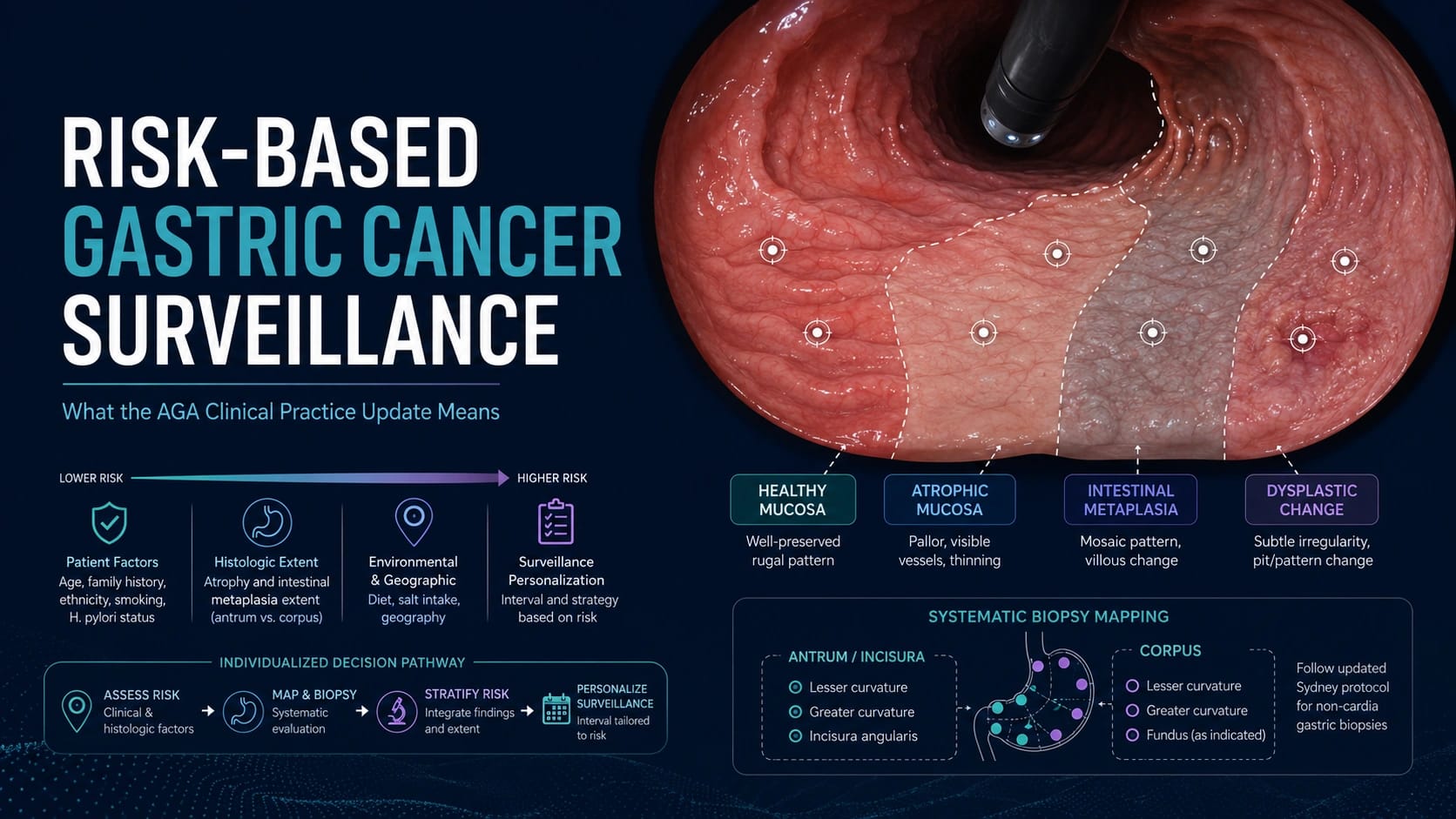
When a Small Biopsy Finding Creates a Large Clinical Question
Few pathology reports generate quite as much uncertainty as an incidental diagnosis of gastric atrophy, intestinal metaplasia, or dysplasia.
The patient may feel entirely well. The endoscopy may have been performed for an unrelated indication. Yet the biopsy report suddenly introduces the possibility of future gastric cancer risk—and with it, a series of questions that are not always easy to answer.
Does this patient need another endoscopy?
How extensively should the stomach be biopsied?
Does every patient with gastric intestinal metaplasia require surveillance?
And perhaps most importantly, are we dealing with a meaningful premalignant condition or simply a histologic finding whose clinical significance has not yet been adequately defined?
These questions are particularly relevant in the United States, where population-wide gastric cancer screening is not routine, but risk is far from evenly distributed.
The American Gastroenterological Association Clinical Practice Update by Shah, Wang, Wallace, and Hwang attempts to bring greater structure to this area. Published in Gastroenterology in February 2025, following online publication on December 23, 2024, the document provides best practice advice on screening and surveillance for individuals at increased risk of gastric cancer in the United States.
It is important to be precise about what kind of document this is.
This is a Clinical Practice Update Expert Review. It is not a randomized controlled trial, a cohort study, or a formally graded clinical guideline. The advice statements were developed through review of the published literature and expert opinion. A formal systematic review was not performed, and the recommendations do not carry graded ratings of evidence quality or strength.
That distinction is not academic housekeeping. It determines how the document should be used.
The CPU is best understood as a practical clinical framework for a difficult and inconsistently managed problem—not as a universal mandate for gastric cancer screening.
The Cancer Pathway the Update Is Trying to Interrupt
The primary focus is intestinal-type noncardia gastric adenocarcinoma, referred to throughout the update as gastric cancer.
This cancer pathway is closely associated with chronic Helicobacter pylori infection and the progressive development of premalignant gastric mucosal changes, including atrophic gastritis, gastric intestinal metaplasia, dysplasia, and eventually carcinoma.
Autoimmune gastritis may also arise within the broader clinical landscape of premalignant gastric disease. However, the CPU does not attempt to provide detailed guidance on every related condition. Comprehensive management of autoimmune gastritis, gastric intestinal metaplasia, endoscopic submucosal dissection, and post-resection care is directed to other AGA publications.
The underlying clinical problem is familiar: premalignant gastric conditions are usually silent.
Early gastric cancer is also frequently asymptomatic. Waiting for pain, weight loss, anaemia, or obstructive symptoms is therefore not an effective prevention strategy. By the time the stomach complains loudly, it may already have been quiet for far too long.
In current US practice, endoscopy with histologic confirmation remains the method by which gastric premalignant conditions and early gastric cancer can be diagnosed accurately.
The practical question is therefore not whether every person should undergo screening.
It is whether a particular patient carries enough baseline risk to justify a carefully performed endoscopic assessment.
Who Should Enter the Screening Conversation?
The CPU identifies several groups in the United States who should be considered for gastric cancer screening:
First-generation immigrants from regions with a high incidence of gastric cancer
Possibly other non-White racial and ethnic groups
Individuals with a first-degree family history of gastric cancer
Patients with selected hereditary gastrointestinal polyposis or hereditary cancer syndromes
These categories identify people who may deserve consideration for screening. They do not create a single surveillance pathway for everyone within them.
A first-generation immigrant from a high-incidence region, a patient with a strong family history, and a person with a hereditary cancer syndrome may all enter the discussion through different doors. What happens after that depends heavily on the findings at the index endoscopy.
Risk is subsequently refined through endoscopic and histologic staging.
Important features include:
The presence and severity of atrophic gastritis
The presence and anatomical distribution of gastric intestinal metaplasia
Active or previous H pylori infection
Histologic subtype of intestinal metaplasia, when applicable
The presence of dysplasia
Additional familial, demographic, or hereditary risk factors
This is one of the most useful aspects of the CPU.
Demographic or familial risk may determine who enters the screening pathway. The quality of the endoscopic and pathological assessment then determines whether that patient should remain in a surveillance programme.
The Index Endoscopy Must Do More Than Reach the Duodenum
The CPU identifies endoscopy as the best screening and surveillance test for individuals at increased risk of gastric cancer.
That conclusion is not based merely on the ability to look inside the stomach. A properly performed examination allows the endoscopist to identify subtle mucosal abnormalities, target suspicious lesions, obtain systematic biopsies, and establish the distribution and severity of premalignant disease.
In this context, endoscopy is not simply a diagnostic procedure. It is the platform on which subsequent risk stratification is built.
The CPU therefore places considerable emphasis on examination quality, including:
High-definition white-light endoscopy
Image-enhanced endoscopy
Adequate mucosal cleansing
Appropriate gastric insufflation
Careful inspection
Photodocumentation
Systematic biopsy protocols when indicated
This has an immediate practical implication.
A report stating that the “stomach appeared normal” is not necessarily equivalent to a high-quality negative gastric cancer screening examination. The value of the conclusion depends on how thoroughly the stomach was cleaned, distended, inspected, documented, and sampled.
The same applies to pathology. A few randomly obtained fragments placed into a single jar may confirm that intestinal metaplasia exists, but they may not establish where it exists or how extensive it is.
And without anatomical extent, meaningful risk stratification becomes difficult.
Gastric Biopsies Need Geography
For suspected gastric atrophy, with or without intestinal metaplasia, the CPU advises systematic biopsy sampling using a protocol such as the updated Sydney System.
At least five biopsies should be obtained. Samples from the antrum and incisura should be placed together in one labelled container, while samples from the gastric corpus should be placed in a separate container. Any visually suspicious lesion should be described and biopsied separately.
This may sound like a small technical detail. It is not.
Separate anatomical labelling allows the pathologist to determine whether disease is limited or extensive. That distinction can materially influence surveillance decisions.
Focal changes confined to one region do not necessarily carry the same implications as multifocal or extensive atrophy or intestinal metaplasia involving both the distal and proximal stomach.
In other words, gastric biopsies need a map—not merely a jar.
The CPU also encourages collaboration between endoscopists and local gastrointestinal pathologists. When atrophic gastritis or intestinal metaplasia is identified, pathology reports should consistently document clinically useful risk-stratification features.
At minimum, these include:
Presence or absence of H pylori
Severity of gastric atrophy and/or intestinal metaplasia
Histologic subtype of intestinal metaplasia, when applicable
This is a valuable quality-improvement opportunity for many centres.
Surveillance decisions can only be as reliable as the endoscopic sampling and pathology reporting on which they are based. When either is incomplete, the apparent precision of the follow-up plan may be misleading.
H pylori Eradication Is Foundational—but Not the Whole Strategy
The CPU positions H pylori eradication as an essential component of both primary and secondary gastric cancer prevention.
Opportunistic testing for H pylori should be considered in individuals judged to be at increased risk of gastric cancer. The document also supports considering testing of adult household members when an individual is found to be infected, reflecting a family-based approach to detection.
For clinicians, the key word is foundational.
Eradication of active H pylori is central to prevention, but it should not be mistaken for a substitute for endoscopic assessment in patients who already have significant premalignant mucosal abnormalities or suspected neoplasia.
The CPU specifically notes that eradication should not delay necessary endoscopic intervention.
This distinction matters in practice. Treating H pylori addresses an important carcinogenic driver. It does not automatically remove the need to stage the mucosa, evaluate dysplasia, or investigate a suspicious lesion.
Once advanced atrophy, extensive intestinal metaplasia, or dysplasia is present, the clinical conversation has moved beyond infection treatment alone.
What Happens After a Negative Index Examination?
The CPU offers a pragmatic approach when an increased-risk patient undergoes screening endoscopy and no atrophy, intestinal metaplasia, or neoplasia is identified.
Further screening should not be automatic. It should be considered in the context of the individual’s underlying risk factors and preferences.
Continued screening may be reasonable in those with a family history of gastric cancer or several concurrent risk factors. However, the optimal interval after a negative index examination remains uncertain.
This is an area where the document is appropriately cautious.
A high-quality negative examination may be reassuring, but it does not necessarily eliminate future risk in someone with strong familial, hereditary, or demographic predisposition. At the same time, the CPU does not provide evidence for repeating endoscopy at a fixed interval in every such patient.
Shared decision-making is therefore unavoidable.
The clinician must weigh the quality of the original examination, the patient’s baseline risk, comorbidities, preferences, and the uncertainty surrounding potential benefit.
Which Premalignant Findings May Justify Surveillance?
For patients with confirmed gastric atrophy, with or without intestinal metaplasia, the CPU recommends further risk stratification rather than treating all findings as equivalent.
Patients with severe atrophic gastritis and those with multifocal or incomplete gastric intestinal metaplasia are considered more likely to benefit from surveillance, particularly when additional risk factors such as a family history of gastric cancer are present.
This is where careful wording matters.
The CPU uses these findings as risk markers supporting consideration of surveillance. It does not demonstrate through randomized evidence that a particular surveillance interval reduces gastric cancer mortality in every subgroup.
Clinicians should therefore resist two extremes.
The first is dismissing all gastric intestinal metaplasia as an incidental biopsy finding of little consequence.
The second is placing every patient with intestinal metaplasia into indefinite endoscopic surveillance without considering extent, subtype, examination quality, competing risks, or patient preferences.
The more defensible position lies between those approaches: stage carefully, identify the higher-risk phenotype, and individualize the surveillance decision.
Dysplasia Is Not a Routine Follow-Up Finding
The CPU treats gastric dysplasia as a distinctly higher-risk clinical problem.
Both indefinite and low-grade dysplasia may be difficult to identify reliably at endoscopy and may also be challenging to diagnose consistently on histopathology. For that reason, all gastric dysplasia should be confirmed by an experienced gastrointestinal pathologist.
Patients with either visible or nonvisible dysplasia should be referred to an endoscopist or centre with expertise in the diagnosis and management of gastric neoplasia.
This is an important escalation point.
Dysplasia should not simply trigger another routine endoscopy placed somewhere on a general waiting list. It requires confirmation, careful reassessment, appropriate image-enhanced examination, and access to clinicians familiar with subtle gastric neoplasia.
For suspected high-grade dysplasia or early gastric cancer, the CPU advises endoscopic submucosal dissection with the goal of en bloc, R0 resection. This permits accurate pathological staging and, where appropriate, treatment with curative intent.
Patients who undergo successful resection of gastric dysplasia or cancer require continued endoscopic surveillance. The CPU also acknowledges that further evidence is needed to determine the most appropriate surveillance strategies, particularly within US populations.
Surveillance Has Little Value When Treatment Is No Longer Possible
One of the most clinically mature recommendations in the CPU concerns when surveillance should stop.
Screening and surveillance should be offered only to patients who are sufficiently fit to undergo endoscopic or potentially surgical treatment if clinically important neoplasia is found.
When a patient is no longer a candidate for meaningful intervention, surveillance should be discontinued.
This avoids a common problem in preventive medicine: continuing a test long after its result can no longer improve the patient’s care.
The purpose of surveillance is not simply to detect disease earlier. It is to detect disease at a point when the patient can benefit from treatment.
The CPU does not impose a strict age threshold or a single comorbidity cutoff. Instead, clinicians are asked to consider life expectancy, frailty, procedural risk, fitness for treatment, competing health priorities, and patient preference.
A surveillance programme should have a plausible clinical destination. Otherwise, it risks becoming an annual ritual rather than a meaningful intervention.
What This Update Changes in Practice
The CPU supports a more structured approach to gastric cancer prevention in higher-risk US populations.
Its practical pillars are:
Identifying individuals with increased baseline risk
Performing a genuinely high-quality index endoscopy
Mapping premalignant gastric changes through systematic biopsies
Ensuring pathology reports contain clinically useful staging information
Detecting and eradicating H pylori
Escalating dysplasia to experienced pathology and endoscopy teams
Individualizing surveillance according to mucosal findings and patient-level risk
Stopping surveillance when treatment would no longer be appropriate
Perhaps the most important shift is conceptual.
The CPU does not treat gastric cancer surveillance as a simple yes-or-no decision based on the presence of intestinal metaplasia. It treats surveillance as the final step in a sequence that begins with patient selection and depends on the quality of everything that follows.
Poor patient selection, hurried endoscopy, unmapped biopsies, and vague pathology cannot be rescued by choosing a precise surveillance interval at the end.
What Clinicians Should Not Read Into the CPU
The document does not recommend universal gastric cancer screening for the US population.
It does not establish definitive surveillance intervals for every combination of risk factors.
It does not provide randomized evidence that surveillance reduces mortality across all patient groups.
It also does not eliminate the need for clinical judgement.
Because this is an expert review based on literature synthesis and expert opinion rather than a formally graded systematic guideline, its principal strength is practical coherence. It gathers the available evidence into a clinically usable pathway for an area where practice has often been variable.
Its limitations are equally important.
Key unanswered questions include:
The optimal interval after a negative index endoscopy
The most appropriate surveillance timing for different risk profiles
How best to implement risk-based screening across diverse US healthcare systems
Whether these strategies reduce gastric cancer incidence
Whether they lead to earlier-stage diagnosis
Whether they ultimately reduce mortality
These are not minor gaps. They are the questions future prospective studies will need to address.
Clinical Takeaway
The AGA Clinical Practice Update reframes gastric cancer prevention as a targeted, quality-dependent, risk-based process.
Patients should enter the pathway because they have meaningful baseline risk—not simply because an upper endoscopy happens to be available. Once they enter, the value of the strategy depends on a careful examination, systematic and anatomically labelled biopsies, clear pathology reporting, appropriate management of H pylori, and thoughtful interpretation of premalignant findings.
Not every patient with gastric intestinal metaplasia requires the same surveillance plan.
The more useful question is whether the index examination has adequately defined the patient’s risk.
This CPU provides clinicians with a sensible framework for answering that question. However, it remains expert-review guidance rather than definitive outcome-proven evidence. It should improve clinical consistency and encourage stronger collaboration between endoscopists and pathologists, while leaving room for shared decision-making wherever the evidence remains uncertain.
Five Key Clinical Takeaways
This is an expert review, not a randomized trial or formally graded guideline. Its advice should guide clinical reasoning without being interpreted as definitive comparative-effectiveness evidence.
Screening is intended for selected higher-risk individuals. It is not a recommendation for universal gastric cancer screening in the general US population.
The quality of the index endoscopy matters. Careful inspection, image enhancement, cleansing, photodocumentation, and systematic biopsies are essential for meaningful risk stratification.
Surveillance should be based on the complete risk profile. Severity and extent of atrophy or intestinal metaplasia, histologic subtype, dysplasia, H pylori status, family history, and other risk factors should be considered together.
Surveillance should stop when treatment is no longer realistic. Detection has value only when the patient is fit enough to benefit from endoscopic or surgical intervention.

Source Reference
Shah SC, Wang AY, Wallace MB, Hwang JH. AGA Clinical Practice Update on Screening and Surveillance in Individuals at Increased Risk for Gastric Cancer in the United States: Expert Review. Gastroenterology. 2025;168(2):405–416.e1. Published online December 23, 2024. DOI: 10.1053/j.gastro.2024.11.001.
References

We are pioneers in clinical intelligence, dedicated to helping gastroenterologists harness the power of artificial intelligence to drive precision, efficiency, and patient growth.