
Rome V in 2026: What Changed in the Diagnosis and Management of Disorders of Gut–Brain Interaction
Rome V replaces functional GI disorders with DGBI - here's what changed in diagnostic criteria, classification, and clinical management in 2026.


A 34-year-old woman presents to your clinic with recurring epigastric fullness after meals, loose stools three to four times a week, and intermittent cramping that partially resolves with defecation. She meets Rome IV criteria for both functional dyspepsia - postprandial distress subtype - and IBS with predominant diarrhea. Prior workup is unremarkable. She's been dismissed twice with "irritable bowel" and sent home without a clear plan. Rome V, published in May 2026, gives you the language, the framework, and the therapeutic roadmap to do better.
The release of Rome V represents the most substantive revision to the disorders of gut–brain interaction (DGBI) classification since Rome III introduced postprandial distress syndrome and epigastric pain syndrome as distinct entities. The update spans a decade of evidence - from the microbiome-gut-brain axis to pharmacogenomics to cross-cultural epidemiology - and restructures both nomenclature and diagnostic thresholds to close the gap between what the research criteria define and what clinicians actually encounter. For gastroenterologists managing patients daily, this is not an academic update. It changes how you diagnose, how you explain, and increasingly, how you treat.
From "Functional" to DGBI: Why the Terminology Shift in Rome V Is Clinically Important
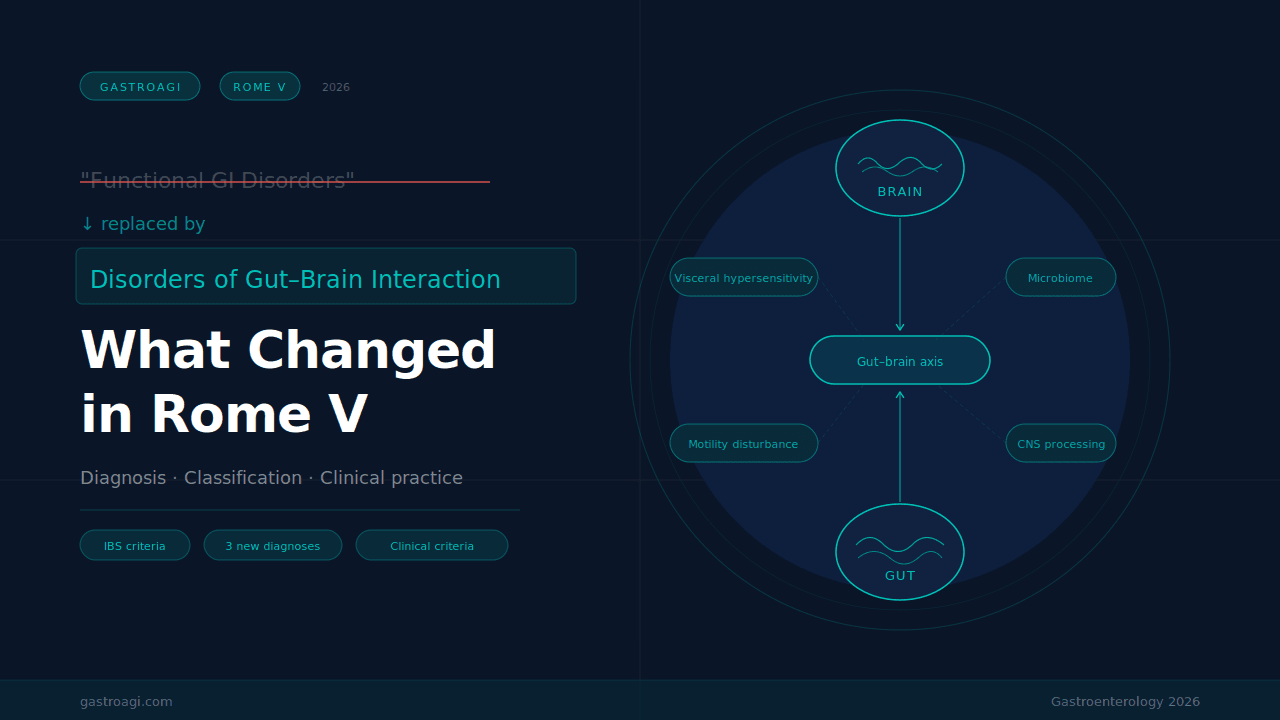
Rome IV (2016) introduced "disorders of gut–brain interaction" as an alternative to "functional gastrointestinal disorders." Rome V buries the old term entirely. Per Drossman et al (Gastroenterology 2026;170:1083–1098), the word "functional" is no longer used in Rome V diagnoses where alternatives exist - because it carries the implicit suggestion that the disorder is psychosomatic, nonorganic, or somehow less legitimate.
This is not semantic housekeeping. The stigma embedded in "functional" has been quantified: it reduces patient engagement, increases health care avoidance, and undermines therapeutic alliance. When you tell a patient she has a "functional" disorder, she hears "nothing is wrong." DGBI, by contrast, carries a definition that clinicians can explain plainly and patients can accept: gastrointestinal symptoms arising from any combination of motility disturbance, visceral hypersensitivity, altered mucosal and immune function, altered gut microbiota, and altered central nervous system processing.
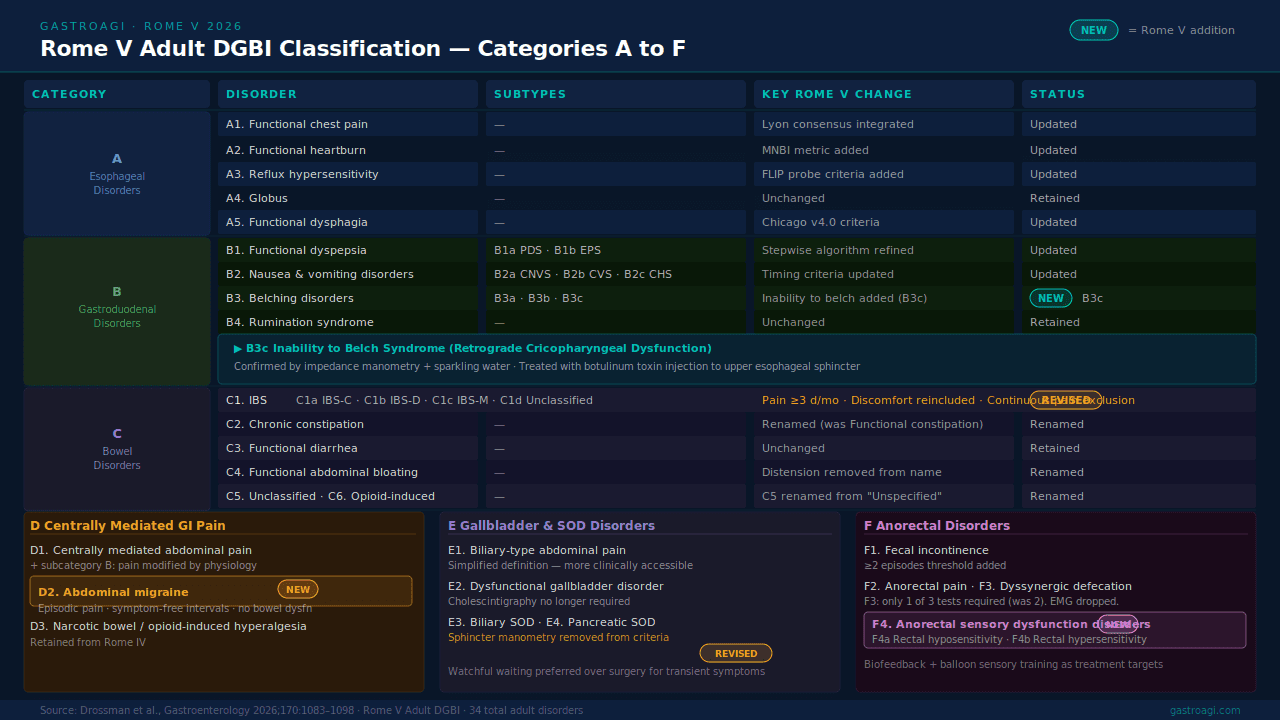
That definition matters in the room. It also matters in the criteria. Rome V now includes 34 adult and 22 pediatric DGBI categories - a reorganized, expanded taxonomy that adds new diagnoses based on evidence accumulated since 2016. The pediatric classification has been restructured entirely, moving from an age-based model (neonate/toddler vs. child/adolescent) to an anatomic one (upper vs. lower DGBI), consistent with adult categorization. For clinicians managing adolescent gastroenterology, this alignment reduces diagnostic confusion across the age transition.
What's New: Key Diagnostic Changes in Rome V That Affect Clinical Practice
IBS: Frequency Threshold Adjusted, "Discomfort" Returns
The Rome V IBS criteria recalibrate two parameters that have drawn sustained criticism since Rome IV. First, abdominal discomfort has been reincluded alongside pain as a qualifying symptom - removed in Rome IV, it is back because evidence showed patients in several countries present with discomfort as the dominant experience without frank pain, and excluding them systematically underrepresented the true clinical burden.
Second, and more practically significant: the frequency threshold has been reduced. Rome IV required pain at least one day per week in the last three months. Rome V changes this to at least three days per month in the last three months. This shift arose from a global epidemiology study of over 50,000 individuals showing the stricter threshold dropped IBS prevalence from approximately 10% to 4% - not because fewer people were ill, but because the bar was artificially high, screening out patients with clinically significant but intermittent symptoms. The new threshold aligns better with what is actually seen in practice.
An additional Rome V IBS criterion specifies that abdominal pain and discomfort should not be continuous - a deliberate differentiator from centrally mediated abdominal pain syndrome (CAPS), where continuity of pain is a defining feature.
Three Newly Added Adult Diagnoses
Rome V introduces three new adult categories with meaningful implications for practice:
Inability to Belch Syndrome (B3c) - also referred to as retrograde cricopharyngeal dysfunction - is recognized as a distinct DGBI rather than a symptom complaint. Esophageal impedance manometry with sparkling water provocation confirms the diagnosis, and botulinum toxin injection to the upper esophageal sphincter has demonstrated efficacy. Many of these patients have been cycled through ENT and gastroenterology for years without a clear label.
Abdominal Migraine (D2) has been formalized as an adult diagnosis under centrally mediated GI pain disorders. Previously a pediatric-only category, it is increasingly documented in adults and is characterized by episodic abdominal pain with symptom-free intervals and no bowel dysfunction - distinguishing it from IBS.
Anorectal Sensory Dysfunction Disorders (F4) include rectal hyposensitivity (F4a) and rectal hypersensitivity (F4b). This addition acknowledges that abnormalities in rectal sensation - whether producing decreased urge and straining, or increased urgency with frequent toileting - are diagnosable entities with biofeedback and balloon sensory training as evidence-based interventions.
Clinical Scenario: Applying the Multidimensional Clinical Profile
A 47-year-old teacher presents with a 3-year history of abdominal cramping and bloating that has progressively interfered with her ability to work full days. Her symptoms meet Rome V IBS-diarrhea criteria. She also reports early satiety and postprandial nausea, partially meeting criteria for functional dyspepsia - postprandial distress subtype. She has a documented history of childhood adversity and scores in the moderate range on PHQ-9. Two previous gastroenterologists ordered colonoscopy, upper endoscopy, and serologies - all normal. She arrives skeptical.
A Rome IV approach would identify two overlapping diagnoses and leave the treatment fragmented. The Rome V Multidimensional Clinical Profile (MDCP) approach, by contrast, moves beyond the categorical diagnosis to characterize the full dimensionality of her illness: symptom severity, bowel physiology, psychosocial comorbidity (moderate depression, history of early adversity), quality of life impact (inability to sustain full-time work), and patient illness experience (skepticism, catastrophizing, prior dismissal). Using this framework, her treatment plan includes a low-FODMAP dietary trial, a serotonin-noradrenaline reuptake inhibitor as a neuromodulator (targeting both visceral hypersensitivity and mood), and referral to a gut-directed psychologist for cognitive behavioral therapy. This is not polypharmacy - it is a biopsychosocial treatment calibrated to her clinical profile.
The Rome V Clinical Criteria: Why Frequency and Duration Thresholds Have a Different Role in Practice
One of the more practically significant revisions in Rome V is the formalization of Rome Clinical Criteria - a parallel set of diagnostic thresholds designed explicitly for clinical use, as opposed to research and clinical trial settings.
Standard Rome V criteria require symptoms to be present for at least 6 months, with specific frequency thresholds. These thresholds were developed for trial enrollment - they define a sufficiently symptomatic cohort and reduce diagnostic noise in research populations. But in clinical practice, they create a problem. A large global study found that 25% of individuals have GI symptoms that don't meet full Rome criteria but still experience significant quality-of-life impairment, higher rates of anxiety and depression, and increased health care utilization. These patients exist in a diagnostic gap.
Rome V closes this gap formally. The Rome Clinical Criteria retain the qualitative symptom requirements - the nature and character of symptoms must still match the DGBI diagnosis - but allow the frequency threshold to be reduced and dispense with the 6-month duration requirement, replacing it with a suggested 8-week minimum (with exceptions for episodic disorders such as cyclic vomiting syndrome and proctalgia fugax). The key operational criterion is bothersomeness: symptoms must be sufficiently bothersome to interfere with daily activities or prompt health-seeking. This restores clinical judgment to the diagnostic encounter and allows clinicians to treat the patient in front of them, not the protocol patient.
For practicing gastroenterologists, this means: if a patient's symptom pattern qualitatively fits IBS or functional dyspepsia, has been present for 8 weeks or more, and is meaningfully affecting function or quality of life - the Rome V Clinical Criteria support a positive diagnosis and a treatment plan, even if frequency thresholds aren't strictly met.
A Frequently Overlooked Point: Overlapping DGBI Require a Unified Treatment Strategy, Not a Sequential One
Multiple overlapping DGBI are the norm in clinical practice, not the exception. A cross-sectional study of 5,931 adults found that over one-third of patients who met criteria for one DGBI also met criteria for one or more additional diagnoses involving different GI regions - and that a higher number of co-occurring diagnoses correlated directly with worse quality of life, more abdominal surgeries, and more medical treatments. The instinct to treat each diagnosis separately - IBS with one agent, functional dyspepsia with another - misses the point. Rome V frames overlapping DGBI as an expression of broader dysregulation along the brain–gut axis, not as independent conditions. The treatment target in these cases is the underlying biopsychosocial matrix: neuromodulators that address visceral hypersensitivity globally, gut-directed behavioral therapies that modify central pain processing, and dietary strategies addressing luminal triggers. Start there.
Bottom Line for Clinical Practice
Retire "functional GI disorder." Rome V explicitly removes this term. Explain to patients that DGBI reflects dysregulation across motility, visceral sensitivity, mucosal immune function, microbiota, and CNS processing - it is real, it is diagnosable, and it is treatable.
Apply the Rome V Clinical Criteria in practice. The 6-month duration and strict frequency thresholds belong in clinical trials. In clinic, if the qualitative symptom pattern fits and the patient is bothered enough to seek care, make the diagnosis and begin treatment.
Use the revised IBS threshold. Rome V requires abdominal pain or discomfort at least 3 days per month (not 1 day per week). If your patient has been falling just short of Rome IV criteria, reassess - they may now meet criteria.
Screen systematically for overlapping DGBI. Upper and lower DGBI co-occur in over one-third of patients. A positive IBS diagnosis should prompt structured enquiry about postprandial symptoms, nausea, and esophageal symptoms before treatment is finalized.
Deploy the Multidimensional Clinical Profile. The MDCP captures severity, psychosocial context, quality of life impact, and patient experience - not just the categorical diagnosis. Treatment targeted to this full profile consistently outperforms diagnosis-only approaches.
Rome V is a decade's worth of evidence compressed into actionable criteria. The classification is cleaner, the diagnostic thresholds are more clinically calibrated, and the biopsychosocial framework is now operationalized in a way that supports real treatment decisions. Next time a complex DGBI case lands in your clinic, walk GastroAGI through the clinical profile - symptom pattern, psychosocial history, severity, and prior treatments - and get a guideline-anchored, Rome V-informed differential and management plan in seconds.

We are pioneers in clinical intelligence, dedicated to helping gastroenterologists harness the power of artificial intelligence to drive precision, efficiency, and patient growth.