
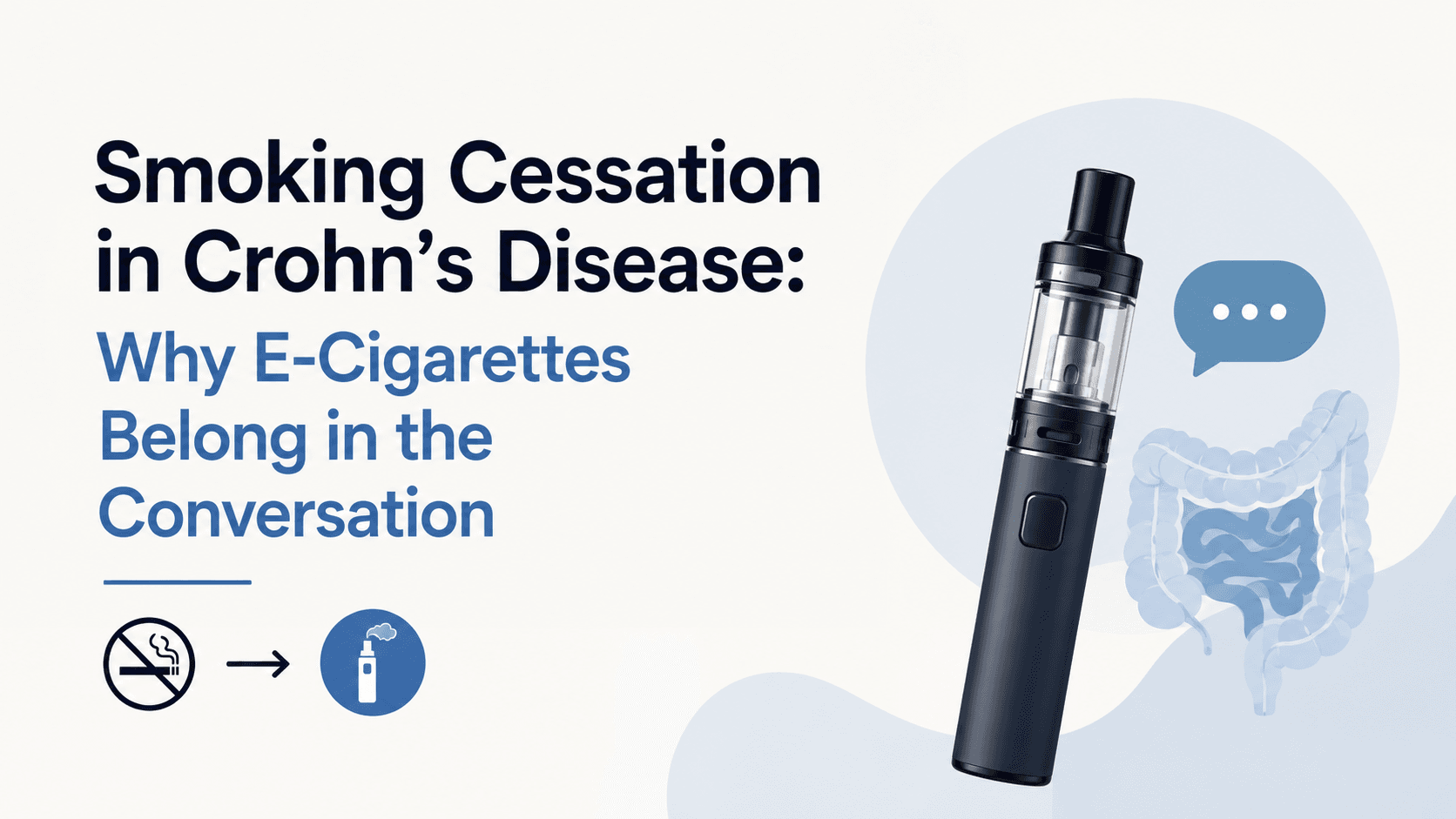
Smoking Cessation in Crohn's Disease: Why E-Cigarettes Belong in the Conversation
New JAMA guidance backs e-cigarettes for smoking cessation. Here's how to use it with Crohn's disease patients, where quitting cuts relapse risk by two-thirds.


A 28-year-old woman with ileal Crohn's disease, two prior resections, and a pack-a-day habit tells you she's tried patches twice and lasted eleven days both times. She's not opposed to quitting. She's opposed to failing again. The conversation that follows determines whether she becomes one of the roughly 1 in 8 smokers with Crohn's disease who actually quit - or one of the majority who don't.
Smoking is the single most consistently reproduced modifiable risk factor for a worse disease course in Crohn's disease, and gastroenterologists have known this for decades. What's changed is the toolkit. A 2026 JAMA Special Communication from the Treatment Research Network of the Society for Research on Nicotine and Tobacco now recommends that clinicians integrate nicotine e-cigarettes into shared decision-making conversations about smoking cessation in Crohn's disease, alongside FDA-approved pharmacotherapy - not instead of it. For a GI-specific population where relapse risk, not just cardiovascular or oncologic risk, hangs on quitting, this changes what "standard counseling" should look like at the point of care.
The Clinical Problem: Counseling That Doesn't Match the Stakes
Gastroenterologists already tell Crohn's disease patients to quit smoking. What most don't do is engage with why quit attempts fail, or offer a method beyond a pamphlet and a referral. The result is a gap between what we know about smoking cessation in Crohn's disease and what we actually do at the bedside. Nicotine replacement therapy has modest real-world quit rates, varenicline carries tolerability concerns some patients won't accept, and many patients arrive having already failed both. Meanwhile, nicotine e-cigarettes are misunderstood by clinicians almost as often as by patients - a persistent overestimation of relative harm that the JAMA authors argue is now out of step with the evidence. For a GI clinic seeing a patient with active or recent flares, this isn't an abstract public health issue. It's a modifiable variable sitting in the room.
First Major Section: What Quitting Actually Buys a Crohn's Disease Patient
The magnitude of benefit is the part worth stating plainly, because it's larger than most non-GI clinicians assume. In Cosnes and colleagues' intervention study, Crohn's disease patients who quit smoking for more than a year had a flare-up risk roughly two-thirds lower than those who continued, and their disease course converged with that of patients who had never smoked at all. Later work in the biologic era reproduced the same directional effect: continuing smokers had higher rates of corticosteroid use and intestinal resection, while quitters tracked with nonsmokers. This is not a modest risk reduction of the kind gastroenterologists are used to discounting. It rivals, and in some cohorts exceeds, the benefit of adding a biologic.
The mechanism is still incompletely defined - proposed pathways include effects on mucosal microvascular perfusion, mucus composition, and innate immune signaling - but the clinical signal has been consistent since the 1990s. What has lagged is translating that signal into a structured cessation strategy embedded in routine Crohn's disease management, rather than a single line in the after-visit summary.
Case in Point
A 34-year-old man with stricturing ileocolonic Crohn's disease, on adalimumab, presents with his third flare in 18 months despite objective biologic drug levels in range and no evidence of antibody formation. He smokes 10–15 cigarettes daily, has tried nicotine gum twice, and describes the cravings as "worse than the disease some days." Rather than escalating therapy again, his gastroenterologist reframes the visit around smoking as an independent driver of his relapse pattern, separate from drug failure.
The clinician walks through the relative-risk data directly - including that a nicotine e-cigarette is a reasonable option to raise alongside patch and gum, given his prior failures with both. The patient opts to try a nicotine e-cigarette under a structured taper plan with follow-up at four weeks. At three months, he's cigarette-free, still using the e-cigarette at a reduced nicotine concentration, and his biologic has been left unchanged rather than escalated to a second agent.
Second Major Section: Building E-Cigarettes Into the Conversation Without Overselling Them
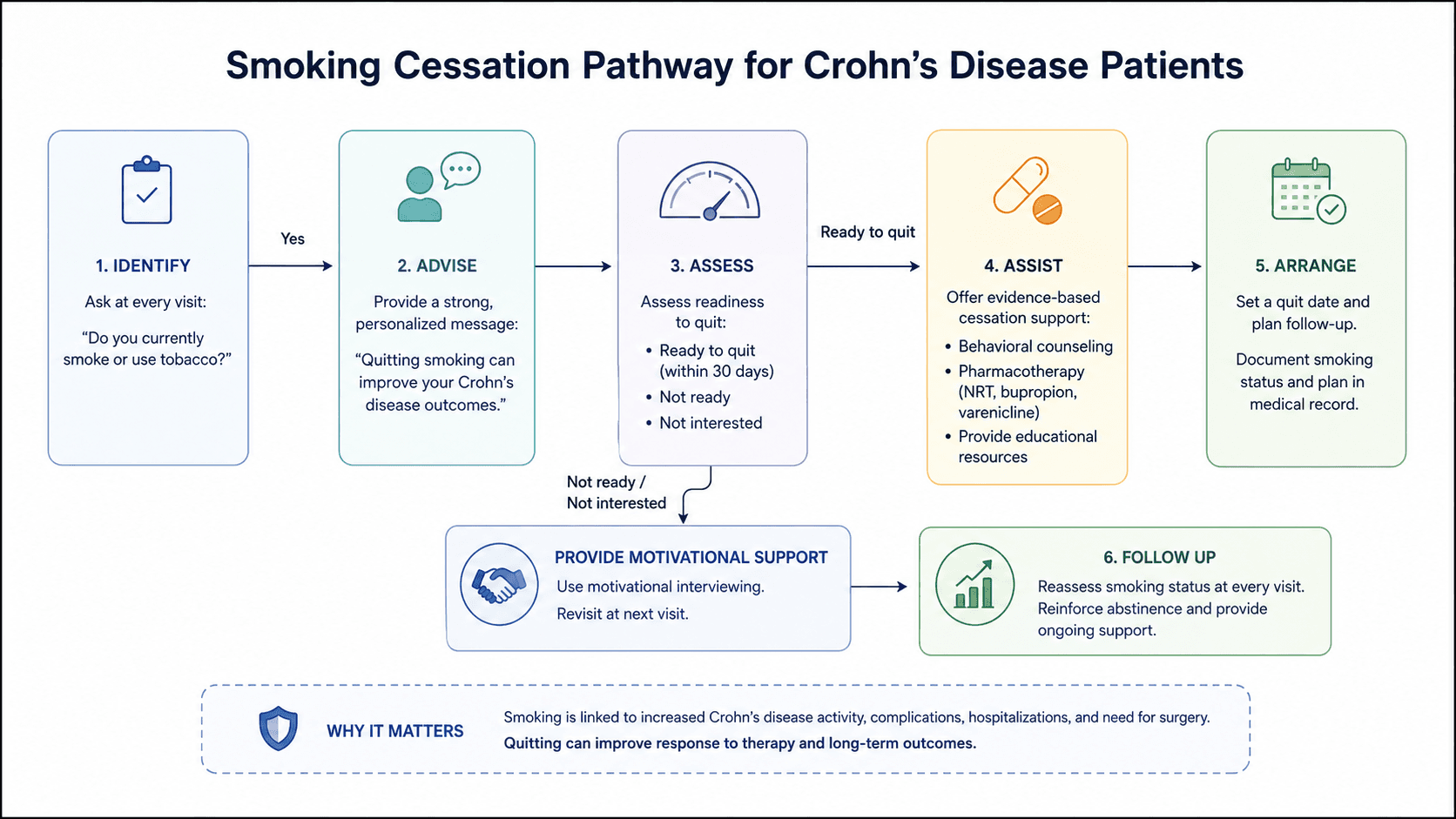
The JAMA Special Communication's central recommendation is narrower than "recommend e-cigarettes" - it's to integrate them into a shared decision-making conversation that also covers NRT, varenicline, and bupropion, so the patient chooses with accurate information about relative risk rather than by default. For Crohn's disease patients specifically, that conversation should include three things most cessation scripts skip: the magnitude of GI-specific benefit from quitting, the fact that e-cigarettes deliver nicotine (still not risk-free, still relevant to a mucosal disease) without combustion products, and a plan for tapering off the e-cigarette itself rather than treating it as a permanent substitute.
Two practical paths tend to work in a GI clinic that doesn't run its own tobacco program: refer to a structured cessation service and remain in the loop on whether e-cigarettes were part of that conversation, or manage the discussion directly and document a specific plan - product type, nicotine concentration, and a re-evaluation date - rather than a general instruction to quit. Patients who've already failed NRT twice are disproportionately the ones who benefit from having a different option named explicitly, rather than being sent back to the same failed method a third time.
A Frequently Overlooked Point
The instinct many gastroenterologists have is to treat smoking cessation as someone else's job - primary care's, pulmonology's, a quitline's - because IBD management already consumes the visit. But the relapse-risk data means that in a Crohn's disease patient who smokes, cessation counseling isn't adjacent to disease management; it functions as disease management, with an effect size comparable to therapy escalation. Deferring it to a specialty better equipped to run structured tobacco programs is reasonable. Deferring it indefinitely, or treating it as a single throwaway line at the end of a visit focused on drug levels and imaging, means missing the highest-yield intervention available for a meaningful subset of patients.
Bottom Line for Clinical Practice
Quote the Cosnes-era finding directly to patients: sustained smoking cessation cuts Crohn's disease flare risk by roughly two-thirds and brings the disease course in line with never-smokers.
Before escalating biologic therapy for recurrent flares in a smoker, confirm whether a genuine cessation attempt, with a specific method and follow-up plan, has actually occurred.
Offer nicotine e-cigarettes as one option within a shared decision-making conversation for patients who have already failed NRT or varenicline - not as a first-line default.
Document product type, nicotine strength, and a taper timeline when e-cigarettes are chosen, and set a re-evaluation date rather than leaving the plan open-ended.
Recognize that counseling quality, not counseling existence, predicts quit rates; a generic instruction to stop smoking performs far worse than a structured plan with a named method.
Working through a Crohn's disease patient's relapse pattern and wondering how much of it is smoking-driven versus treatment failure? Walk GastroAGI through the case details - it will return a reasoned, guideline-anchored response in seconds.


We are pioneers in clinical intelligence, dedicated to helping gastroenterologists harness the power of artificial intelligence to drive precision, efficiency, and patient growth.