
Should SNRIs Be Considered the Most Effective Neuromodulators for IBS? A Cautious Reading of the Evidence
A Gut correspondence asks whether SNRIs should be viewed as the most effective IBS neuromodulators after a recent network meta-analysis.


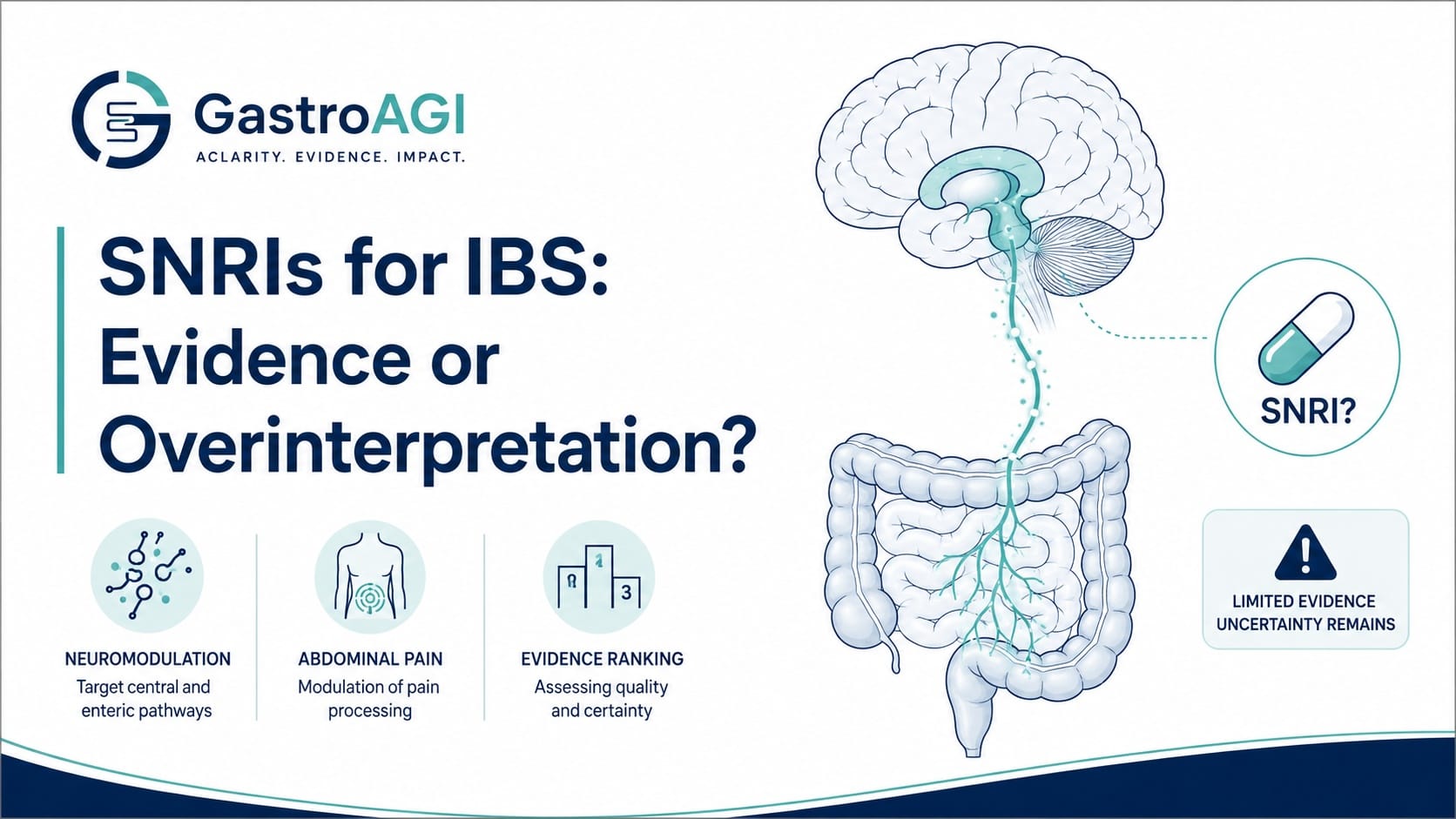
In irritable bowel syndrome, clinicians often face a difficult therapeutic question: when symptoms are driven not only by bowel habit but also by pain, visceral hypersensitivity, hypervigilance, and impaired gut–brain regulation, which treatment should be prioritised? Dietary therapy, gut-directed psychological therapy, antispasmodics, laxatives, antidiarrhoeals, secretagogues, antibiotics, and neuromodulators may all have a role depending on phenotype and patient priorities. But the choice of neuromodulator remains particularly nuanced.
A recent Gut correspondence brings this debate into focus with the deliberately provocative title: “Should serotonin-noradrenaline reuptake inhibitors be considered the most effective neuromodulators for irritable bowel syndrome?” The article appeared as an online-first letter/correspondence in Gut on the journal’s early online platform under the identifier gutjnl-2026-340002, with the page dated 21 July 2026.
The correspondence discusses whether serotonin–noradrenaline reuptake inhibitors, or SNRIs, should be considered preferred neuromodulators for IBS based on current evidence. A public author post describes it as correspondence in Gut discussing whether SNRIs should be considered the preferred IBS neuromodulators, with Christian von Mühlenbrock acknowledging Tim Vanuytsel and Jan Tack for mentorship and collaboration.
This is not a new randomized trial. It is not a guideline. It is a scholarly response to emerging comparative evidence, especially a recent systematic review and network meta-analysis in Gut evaluating gut–brain neuromodulators and brain–gut behavioural therapies for IBS. That distinction is central: the article should prompt thoughtful interpretation, not immediate rewriting of treatment algorithms.
The clinical dilemma: IBS pain is not only a bowel problem
IBS is increasingly framed as a disorder of gut–brain interaction. This matters because many patients experience symptoms that are not adequately explained by stool frequency or consistency alone. Abdominal pain, bloating, symptom-related anxiety, central amplification, and altered pain modulation may dominate the clinical picture.
Neuromodulators are used in this context not simply as “antidepressants,” but as agents that may influence pain processing, visceral sensitivity, sleep, mood comorbidity, and central modulation of gut symptoms. For gastroenterologists, the terminology matters. Calling these drugs neuromodulators helps separate their GI use from psychiatric labeling and allows more accurate patient counselling.
Historically, tricyclic antidepressants have been the most familiar neuromodulator class in IBS practice, particularly when abdominal pain and diarrhoea-predominant symptoms are prominent. Selective serotonin reuptake inhibitors have also been used, often where constipation, anxiety, or mood symptoms coexist. SNRIs sit between these categories conceptually, targeting both serotonin and noradrenaline pathways, with established roles in some chronic pain states outside gastroenterology. The Gut correspondence asks whether the current IBS evidence is strong enough to move SNRIs closer to the front of the neuromodulator discussion.
The evidence that triggered the question
The correspondence appears to engage with a recent Gut systematic review and network meta-analysis titled “Efficacy of gut-brain neuromodulators and brain-gut behaviour therapies for irritable bowel syndrome: systematic review and network meta-analysis.” That study was published online in Gut in June 2026, with DOI 10.1136/gutjnl-2026-339311. PubMed indexing confirms the title, journal, DOI, online-ahead-of-print status, and authors including Mais Khasawneh, Elyse R. Thakur, Vivek C. Goodoory, Paul Moayyedi, Christopher J. Black, and Alexander C. Ford.
The network meta-analysis compared the relative efficacy of gut–brain neuromodulators and brain–gut behavioural therapies in adults with IBS. It searched the medical literature up to 8 February 2026 for randomized controlled trials. The main analysis used dichotomous endpoints of improvement in either global IBS symptoms or abdominal pain, pooling data using a random-effects model and ranking treatments by P-score.
The analysis included 68 eligible RCTs with 6694 participants. Compared with waiting-list control, SNRIs ranked first in six trials involving 387 patients, with a reported relative risk for global IBS symptoms or abdominal pain not improving of 0.49 and a 95% confidence interval of 0.32 to 0.75. The reported P-score was 0.95, interpreted as a high probability of ranking as the most efficacious treatment in that network.
Tricyclic antidepressants ranked second in 15 trials involving 1519 patients, with a relative risk of 0.60 and 95% confidence interval of 0.43 to 0.85. Dynamic psychotherapy or emotional processing ranked third, while cognitive behavioural therapy, disease self-management approaches, selective serotonin reuptake inhibitors, and gut-directed hypnotherapy were also reported to be superior to waiting-list control.
At first glance, these results make SNRIs look very attractive. But the same abstract also contains the caution that should shape the entire interpretation: no SNRI trials were at low risk of bias, there was possible publication bias in some analyses, and overall certainty of evidence was low or very low for most comparisons.
Why “ranked first” does not automatically mean “best first-line choice”
Network meta-analysis is useful because it can compare multiple interventions, even when head-to-head trials are limited. However, rankings can be misunderstood. A high P-score does not guarantee that an intervention should become the preferred clinical option. Ranking depends on the available trials, comparator structure, sample size, endpoint definitions, trial quality, and assumptions of comparability across the network.
In the Gut network meta-analysis, SNRIs ranked first, but the SNRI evidence came from only six trials and 387 patients. That is a relatively small evidence base compared with many interventions commonly used in IBS. The finding is clinically interesting, but it is not the same as a large, low-bias, pragmatic trial showing superiority of SNRIs over TCAs, CBT, gut-directed hypnotherapy, or standard IBS pharmacotherapy.
The comparator also matters. The reported effect was against waiting-list control, not necessarily against an active neuromodulator, structured behavioural therapy, or phenotype-directed medical therapy. Waiting-list controls can exaggerate relative benefit when compared with active placebo or credible therapeutic comparators, particularly in disorders where expectation, therapeutic alliance, and behavioural engagement may influence outcomes.
Therefore, the most defensible conclusion is not “SNRIs are the most effective IBS treatment.” It is more precise to say that, in a recent network meta-analysis, SNRIs ranked highly for improvement in global IBS symptoms or abdominal pain, but certainty was limited by trial quality, sample size, and the structure of the evidence.
What the correspondence contributes
Because the Gut item is a correspondence rather than an original trial, its value lies in interpretation. The title itself frames the central clinical question: should SNRIs be considered the most effective neuromodulators for IBS?
That question is important because clinicians may be tempted to translate a ranking result into a prescribing hierarchy. The correspondence appears to challenge or refine that interpretation, asking whether the available evidence justifies calling SNRIs the preferred neuromodulator class.
For a GastroAGI audience, this is exactly where the teaching value lies. The correspondence is not practice-changing guidance. It is a prompt to examine how we interpret network meta-analyses in disorders of gut–brain interaction. It reminds clinicians that relative rankings must be weighed against evidence certainty, trial bias, generalisability, tolerability, patient phenotype, comorbidity, and shared decision-making.
Practical interpretation for gastroenterologists
In clinical practice, neuromodulator selection for IBS is rarely based on a single efficacy estimate. A patient with IBS-D, poor sleep, and pain-predominant symptoms may be approached differently from a patient with IBS-C, prominent anxiety, and medication sensitivity. Another patient may prefer gut-directed hypnotherapy or CBT over pharmacological therapy. A patient already taking an antidepressant for psychiatric indications may require coordination with primary care or psychiatry before any switch or add-on therapy is considered.
The Gut network meta-analysis supports the broader concept that several gut–brain interventions can improve IBS symptoms. Its conclusion states that several neuromodulators, especially TCAs, and several brain–gut behavioural therapies, including dynamic psychotherapy or emotional processing, CBT, disease self-management, and gut-directed hypnotherapy, are efficacious for IBS, while also emphasizing low or very low certainty for most comparisons.
That broad message may be more clinically useful than the single ranking of SNRIs. IBS management should not become a race to identify one “winner.” Instead, the evidence supports a menu of gut–brain treatments that may be selected according to symptom pattern, patient preference, access, adverse-effect profile, comorbidity, and clinician experience.
What clinicians should not infer
Clinicians should not infer that SNRIs are now established as first-line neuromodulators for all patients with IBS. The correspondence is a letter, and the underlying network meta-analysis reported limitations in certainty and risk of bias.
Clinicians should also avoid interpreting association or comparative ranking as direct causation in routine practice. A network meta-analysis can suggest relative efficacy across trial networks, but it does not prove that an SNRI will outperform a TCA or behavioural therapy for an individual patient in a real-world clinic.
Nor should the finding be used to bypass safety considerations. SNRIs have known systemic adverse-effect considerations, including tolerability issues and potential drug interactions, but the accessible Gut correspondence and network meta-analysis abstract do not provide enough detail to make specific safety recommendations here. Any prescribing decision should remain individualized and aligned with local prescribing standards and the patient’s broader medical and psychiatric profile.
Why the evidence remains hypothesis-generating
The SNRI signal is interesting precisely because it is plausible and clinically relevant. IBS pain may involve altered central pain modulation, and serotonin–noradrenaline pathways are biologically relevant to pain processing. But plausibility does not substitute for high-certainty clinical evidence.
The SNRI evidence base in the network meta-analysis was smaller than the TCA evidence base, and the abstract explicitly notes that no trials in the SNRI group were at low risk of bias. That should temper enthusiasm. A highly ranked treatment based on a small number of biased or heterogeneous trials may move down the hierarchy when larger, better-designed trials are completed.
Future research should ideally include adequately powered head-to-head comparisons of SNRIs against TCAs, placebo, and credible behavioural interventions. Trials should use standardized IBS outcomes, assess abdominal pain and global symptoms separately, include IBS subtype analyses, report adverse events and discontinuation clearly, and follow patients long enough to understand durability of benefit.
A pragmatic trial design would be especially useful. Clinicians need to know not only whether SNRIs work under trial conditions, but which patients tolerate them, which phenotypes benefit most, how they compare with low-dose TCAs in real-world practice, and how they fit alongside dietetic and psychological therapy.
A balanced place for SNRIs today
The most balanced interpretation is that SNRIs deserve attention as potentially useful gut–brain neuromodulators for IBS, particularly where pain and central modulation are clinically prominent. However, the current evidence does not justify a blanket statement that they are the most effective or universally preferred neuromodulator class.
The Gut correspondence is therefore useful not because it provides a new treatment algorithm, but because it sharpens a question that many clinicians already face: how should we integrate emerging comparative evidence into individualized IBS care without over-reading low-certainty rankings?
For fellows and trainees, this is a good example of evidence literacy. “Ranked first” is not synonymous with “recommended first.” “Efficacious versus waiting-list control” is not the same as “superior to all active alternatives.” “Neuromodulator” does not mean the same thing as psychiatric treatment. And “promising” does not mean practice-changing.
Clinical Takeaway
The Gut correspondence “Should serotonin-noradrenaline reuptake inhibitors be considered the most effective neuromodulators for irritable bowel syndrome?” is best read as an interpretive caution around a provocative signal from a recent network meta-analysis. SNRIs ranked highly in that analysis, but the evidence came from a small number of trials, none at low risk of bias, and the overall certainty of evidence for most comparisons was low or very low.
For clinicians, SNRIs should be considered an important area for further study and a possible option within individualized IBS neuromodulator practice. They should not yet be presented as the established most effective neuromodulator for all IBS patients. The evidence is hypothesis-generating and clinically relevant, but not practice-changing on its own.
Five key clinical takeaways
The selected Gut article is a letter/correspondence, not a randomized trial, guideline, or original cohort study.
The correspondence asks whether SNRIs should be considered the most effective IBS neuromodulators, reflecting debate after a recent network meta-analysis.
The underlying Gut network meta-analysis included 68 RCTs and 6694 participants evaluating gut–brain neuromodulators and brain–gut behavioural therapies in adults with IBS.
SNRIs ranked first in that analysis, but the SNRI evidence came from six trials with 387 patients, and no SNRI trials were judged at low risk of bias.
The appropriate clinical message is caution: SNRIs are promising but should not yet be treated as established first-choice neuromodulators for all IBS patients.

Source reference and link
Von Mühlenbrock C, Vanuytsel T, Tack J. “Should serotonin-noradrenaline reuptake inhibitors be considered the most effective neuromodulators for irritable bowel syndrome?” Gut. Online first, 21 July 2026. Article identifier: gutjnl-2026-340002.
Context source: Khasawneh M, Thakur ER, Goodoory VC, Moayyedi P, Black CJ, Ford AC. “Efficacy of gut-brain neuromodulators and brain-gut behaviour therapies for irritable bowel syndrome: systematic review and network meta-analysis.” Gut. Online ahead of print, June 2026. DOI: 10.1136/gutjnl-2026-339311.
References

We are pioneers in clinical intelligence, dedicated to helping gastroenterologists harness the power of artificial intelligence to drive precision, efficiency, and patient growth.