
HER2-Positive Gastroesophageal Cancer in 2026: How HERIZON-GEA-01 Resets the First-Line Standard
HERIZON-GEA-01 phase 3 trial shows zanidatamab + tislelizumab + chemo achieves median OS of 26.4 months vs 19.2 with trastuzumab in HER2+ GEA


A 58-year-old male presents with progressive dysphagia, a 9 kg weight loss over three months, and a biopsy-confirmed HER2-positive gastroesophageal junction adenocarcinoma. Staging shows liver metastases. His PD-L1 combined positive score comes back at 2. Until last week, this was a trastuzumab-plus-chemotherapy case with a few nuanced arguments for adding pembrolizumab. The HERIZON-GEA-01 trial, published in the New England Journal of Medicine on May 28, 2026, changed the conversation for exactly this patient.
HER2-positive disease accounts for approximately 20% of gastroesophageal adenocarcinoma (GEA) cases, and it has carried a disproportionately poor prognosis despite the availability of targeted therapy. Trastuzumab became the first-line backbone after the ToGA trial in 2010 - a result built on a modest overall survival benefit of roughly 2.7 months. For 16 years, that modest gain was the ceiling. The clinical question driving HERIZON-GEA-01 was straightforward: can a dual HER2-targeting bispecific antibody built to hit two non-overlapping epitopes simultaneously outperform a single-domain binder that has been the standard since gastroesophageal oncology was a subspecialty niche? And does adding a PD-1 checkpoint inhibitor extend that benefit further - including in patients whose tumours don't express PD-L1? Much like resmetirom becoming the first approved drug for NASH with fibrosis rewrote the MASLD treatment algorithm, the answer to both questions here reshapes the first-line standard for HER2-positive GEA. Based on zanidatamab HER2-positive gastroesophageal cancer first-line treatment data from 914 patients across three continents, the answer to both is yes.
What Zanidatamab Is and Why It Was Expected to Outperform Trastuzumab
Zanidatamab is a bispecific IgG1-like antibody that binds two distinct, non-overlapping HER2 epitopes - domain 2 (the trastuzumab binding site) and domain 4 (the pertuzumab binding site) - on the same molecule. That simultaneous dual epitope occupancy drives receptor crosslinking and internalisation, antibody-dependent cellular cytotoxicity (ADCC), and complement-dependent cytotoxicity through mechanisms that a monospecific antibody cannot replicate at the same receptor density. In HER2-overexpressing tumours, where receptor copy number is already high, this translates to a more efficient and sustained suppression of HER2 signalling than trastuzumab alone.
The phase Ib/II data that preceded HERIZON-GEA-01 were compelling enough to justify a phase 3. In patients with previously untreated, unresectable HER2-positive gastric and gastroesophageal junction cancer treated with zanidatamab plus tislelizumab plus CAPOX chemotherapy, the confirmed objective response rate was 75.8%, median duration of response was 23.3 months, and median overall survival reached 32.4 months - figures that had not been seen in this disease setting.
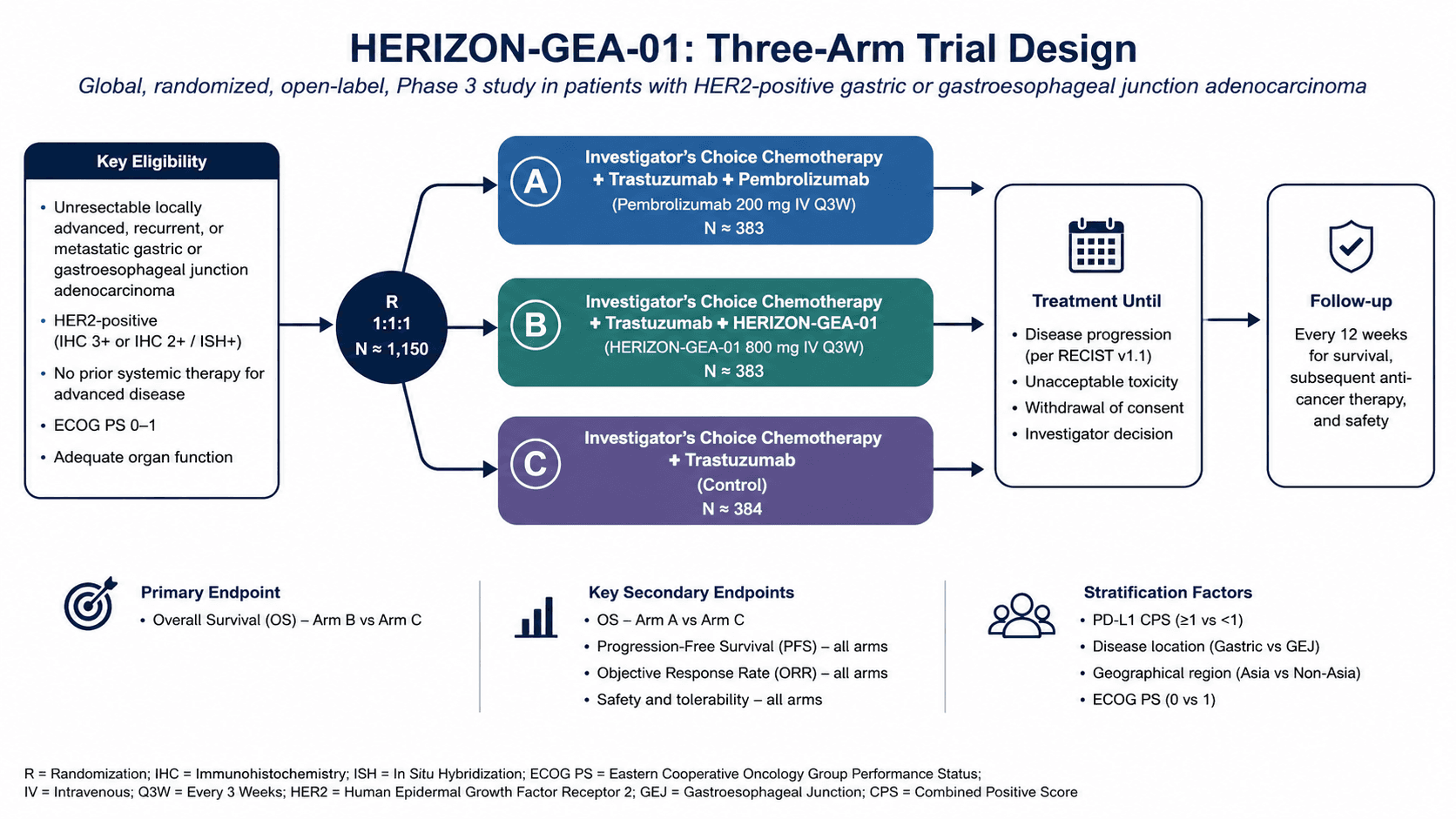
HERIZON-GEA-01 enrolled 914 patients with centrally confirmed HER2-positive advanced GEA and no prior systemic therapy, randomising them 1:1:1 to three arms: zanidatamab plus chemotherapy (n=304), zanidatamab plus tislelizumab plus chemotherapy (n=302), or trastuzumab plus chemotherapy as the control (n=308). Chemotherapy was physician's choice of capecitabine plus oxaliplatin (CAPOX) or 5-fluorouracil plus cisplatin. The two primary endpoints were progression-free survival and overall survival. Central HER2 confirmation was mandatory - a methodological rigour that matters when interpreting the magnitude of the treatment effect.
Clinical Scenario
Case in Point
A 61-year-old man with ECOG performance status 1 presents with a 4-month history of dysphagia and a 10 kg weight loss. Upper endoscopy and biopsy confirm gastroesophageal junction adenocarcinoma; central HER2 testing returns IHC 3+. CT staging identifies two hepatic lesions and para-aortic lymphadenopathy. PD-L1 combined positive score on the biopsy specimen is less than 1. He has no prior systemic therapy and no significant cardiopulmonary comorbidities. Pre-HERIZON-GEA-01 practice left this patient in an uncomfortable grey zone: trastuzumab plus chemotherapy was standard, KEYNOTE-811 offered the option of adding pembrolizumab, but the PD-L1 negativity created a legitimate clinical question about the magnitude of checkpoint inhibitor benefit in this specific patient.
Post-HERIZON-GEA-01, the decision is more straightforward. The trial demonstrated that the OS benefit of zanidatamab plus tislelizumab plus chemotherapy was consistent across PD-L1 subgroups - an effect that does not map onto pembrolizumab's PD-L1-dependent behaviour in this disease. This patient, previously in a treatment grey zone because of his PD-L1 score, now has a clearly supported regimen with the longest median OS reported in first-line HER2-positive GEA. The conversation with him shifted from "the data on checkpoint inhibitors in PD-L1-negative disease are limited" to "the triple combination showed benefit irrespective of PD-L1 status in a 914-patient phase 3 trial."
Reading the Efficacy and Safety Numbers - What Actually Matters Clinically
The headline numbers from HERIZON-GEA-01 are clear, but the detail that clinicians should carry into practice is the duration of response gap, not just the survival curves. Confirmed objective response rates across the three arms were similar - 69.6% with zanidatamab plus chemotherapy, 70.7% with the triple combination, and 65.7% with trastuzumab plus chemotherapy. Responses are not the differentiator. What separates these regimens is how long those responses last.
Median duration of response was 14.3 months in the zanidatamab plus chemotherapy doublet, 20.7 months in the triple combination arm, and 8.3 months in the trastuzumab control arm. The gap between 20.7 and 8.3 months represents more than a statistical improvement - it reflects a fundamentally different disease trajectory for a patient sitting across the clinic table asking how long a response might hold.
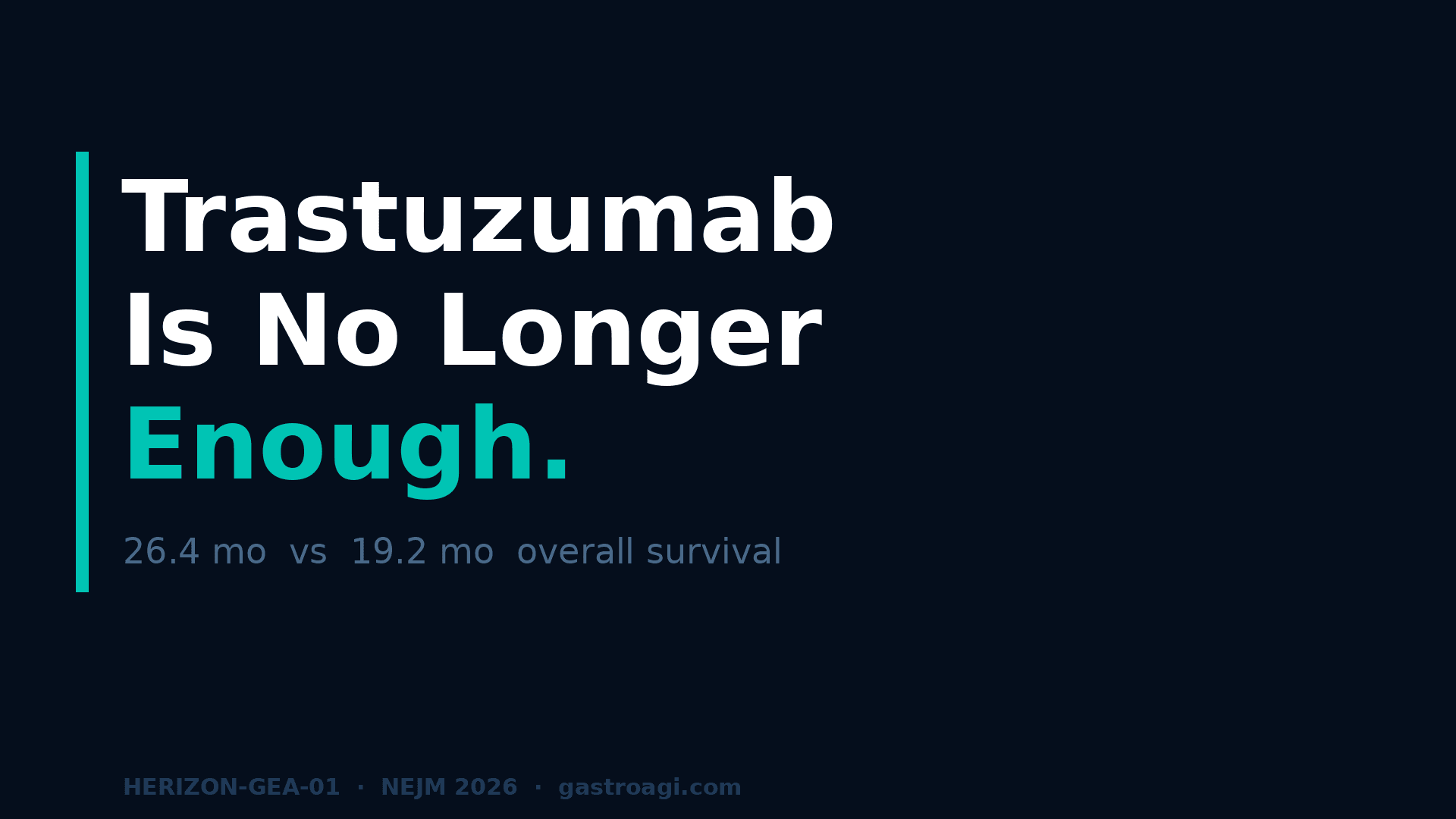
Overall survival with zanidatamab plus tislelizumab plus chemotherapy reached a median of 26.4 months compared to 19.2 months with trastuzumab plus chemotherapy (hazard ratio for death 0.72; 95% CI 0.57–0.90; P=0.004). For the first time in this disease, more than half of patients in a phase 3 trial were alive at two years. That 2-year OS rate is the benchmark this disease setting has not previously cleared.
On safety, diarrhea was the dominant treatment-related adverse event - reported in 100% of patients in the phase Ib/II zanidatamab-tislelizumab combination data and confirmed as the leading toxicity in the phase 3 context. This is not an unexpected signal for a dual-HER2 targeting antibody, and it is manageable with early anti-diarrheal prophylaxis. The overall safety profile was characterised as manageable by the trial investigators, with no new safety signals beyond the established class effects of the component agents. For patients with prior gastrointestinal motility concerns or inflammatory bowel disease, a proactive bowel management protocol from cycle 1 is warranted.
The zanidatamab-plus-chemotherapy doublet, without tislelizumab, also outperformed trastuzumab on duration of response (14.3 vs 8.3 months), establishing it as a viable option where checkpoint inhibitors are genuinely contraindicated - autoimmune disease on active immunosuppression, prior severe immune-related adverse events, or organ transplant recipients.
A Frequently Overlooked Point - PD-L1 Score Should Not Exclude Patients from the Triple Regimen
The finding that tislelizumab's contribution to overall survival held across PD-L1-negative tumours will be the most commonly misapplied aspect of these data in routine practice. The reflex to reserve checkpoint inhibitors for high-CPS patients is reasonable when the drug in question is pembrolizumab layered onto trastuzumab - that is the biology KEYNOTE-811 studied. It does not transfer cleanly here. Zanidatamab's dual HER2 epitope targeting appears to reshape the tumour microenvironment in ways that make PD-1 blockade effective independent of baseline PD-L1 expression, likely through enhanced ADCC-mediated immune cell recruitment. Until the PD-L1 subgroup analyses presented at ASCO 2026 are fully published, the default position should be to offer the triple combination to all eligible patients with advanced HER2-positive GEA - not to apply a PD-L1 threshold borrowed from a different drug, in a different mechanism context, against a less potent HER2-targeted backbone.
When you are managing a HER2-positive GEA case and need to think through regimen selection, PD-L1 status, performance status constraints, or toxicity management - walk GastroAGI through the clinical details. It will return a reasoned, guideline-anchored response in seconds, grounded in the data that just changed this disease. For how the same approach applies to another GI cancer where NEJM trial data is reshaping management, see daraxonrasib in RAS-mutated pancreatic cancer.
References

We are pioneers in clinical intelligence, dedicated to helping gastroenterologists harness the power of artificial intelligence to drive precision, efficiency, and patient growth.