
Portal Vein Thrombosis and Procedural Bleeding in Liver Disease: What AASLD Guidance Means for Hepatology Practice
AASLD guidance clarifies vascular liver disorders, PVT, hepatic vein thrombosis, and procedural bleeding risk in liver disease.


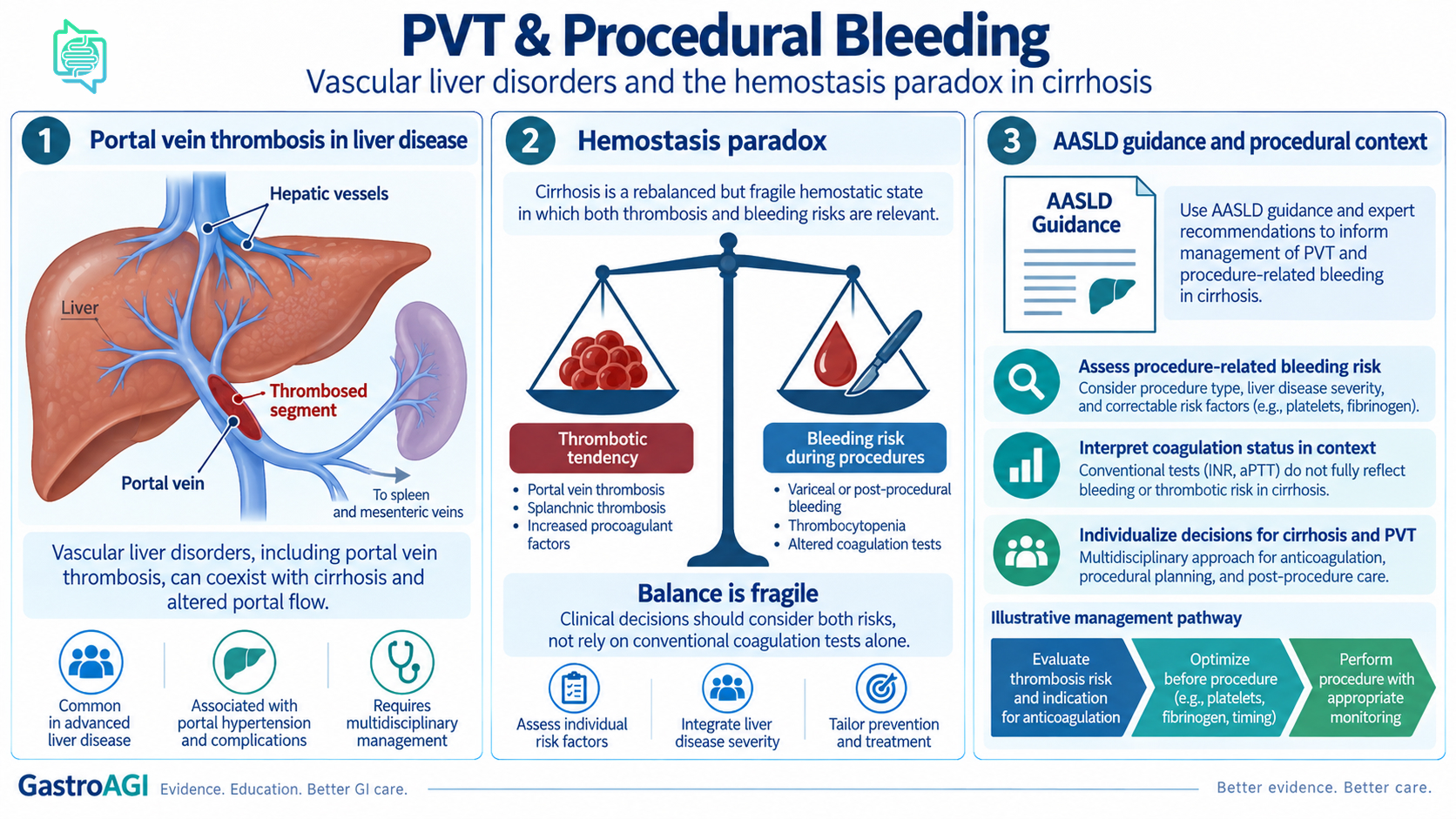
In patients with liver disease, why do clinicians so often face the same paradox: a patient appears “coagulopathic” on routine laboratory testing, yet may still develop portal vein thrombosis, hepatic vein thrombosis, or other clinically significant vascular events?
This is not a theoretical contradiction. It is a daily hepatology problem. The patient with cirrhosis and an elevated INR may need an invasive procedure. The transplant candidate may have newly detected portal vein thrombosis. The patient with chronic liver disease may be labeled as bleeding-prone, while also being at risk for thrombosis in the splanchnic circulation. The clinical challenge is not simply to decide whether the patient is “bleeding” or “clotting.” It is to understand that liver disease can disturb hemostasis in ways that make both procedural bleeding and vascular thrombosis clinically relevant.
The AASLD Liver Fellow Network revisited this problem in its September 8, 2026 educational guideline-summary post, “Vascular Liver Disorders, Portal Vein Thrombosis and Procedural Bleeding In Patients with Liver Disease.” The post links to the AASLD Practice Guidance with DOI 10.1002/hep.31646 and is part of the Liver Fellow Network’s Guidelines series, which AASLD describes as a series designed to summarize AASLD guidance into practical takeaways.
The underlying document is the AASLD Practice Guidance titled “Vascular Liver Disorders, Portal Vein Thrombosis, and Procedural Bleeding in Patients With Liver Disease: 2020 Practice Guidance by the American Association for the Study of Liver Diseases.” It was published in Hepatology in 2021, volume 73, issue 1, pages 366–413.
A guidance document, not a new clinical trial
The first point for clinicians is evidentiary: this is not a randomized trial, cohort study, meta-analysis, or new drug evaluation. It is AASLD Practice Guidance.
The underlying paper explicitly states that it provides a data-supported approach to the management of vascular liver disorders, portal vein thrombosis, hepatic vein thrombosis, and procedural bleeding in patients with liver disease. It also clarifies that it differs from AASLD Guidelines, which are typically supported by systematic literature reviews, formal grading of evidence quality and recommendation strength, and, when appropriate, meta-analysis using GRADE methodology. In contrast, this Practice Guidance was developed by expert consensus after formal review and analysis of the literature, with oversight by the AASLD Practice Guidelines Committee.
This distinction matters. A Practice Guidance can be clinically influential and highly useful, but it should not be misrepresented as new primary evidence. It organizes existing data and expert interpretation into a practical framework. For GastroAGI readers, this means the document should inform structured clinical thinking, while individual patient decisions still require case-specific judgment.
Why vascular liver disorders require a broader frame
Earlier approaches to vascular liver disorders often centered on large-vessel thrombosis, particularly thrombosis of the portal vein and hepatic vein. The AASLD practice guidance explains that newer understanding of hemostasis and bleeding in cirrhosis has expanded the clinical field. The document therefore covers both thrombosis—especially in the splanchnic vasculature—and bleeding related to hemostatic disturbance in chronic liver disease.
That expanded scope is clinically important. A hepatology consultation for portal vein thrombosis cannot be separated from the patient’s bleeding risk, transplant candidacy, portal hypertension, liver function, and procedural needs. Similarly, pre-procedural bleeding assessment in cirrhosis cannot be reduced to a single coagulation test without considering the biology of chronic liver disease and the nature of the procedure.
The guidance therefore speaks to an area where hepatology, hematology, interventional radiology, transplant surgery, and endoscopy frequently intersect.
Portal vein thrombosis: beyond presence or absence
The AASLD guidance highlights the need for standard nomenclature for portal vein thrombosis, including characterization of location, time course, and progression.
This is more than semantic precision. Portal vein thrombosis is clinically heterogeneous. A small, recent, non-occlusive thrombus has different implications from chronic complete obstruction, cavernous transformation, or thrombosis extending into the superior mesenteric vein. The guidance’s focus on classification reflects a practical reality: treatment decisions depend on anatomy, chronicity, progression, symptoms, and clinical context.
For clinicians, the key message is that “PVT” should not be treated as a single uniform diagnosis. Reports should clarify where the thrombus is, whether it is recent or chronic, whether it is progressing, and whether it may affect complications of portal hypertension or liver transplantation planning. The guidance notes that treatment decisions should be based on expected benefit and minimizing the risk of clot extension that could worsen portal hypertension or hinder liver transplantation.
That statement is important because it avoids two common extremes: automatically anticoagulating every patient with PVT, or withholding anticoagulation solely because the patient has cirrhosis and abnormal coagulation tests.
Procedural bleeding: why routine tests may be insufficient
One of the major additions emphasized by the AASLD guidance is an evidence-based justification for bleeding risk assessment in patients with cirrhosis before invasive procedures, including current concepts in preprocedural testing and laboratory analysis and their role in predicting bleeding complications.
For gastroenterologists, this is a familiar but difficult area. Patients with cirrhosis often undergo endoscopy, paracentesis, liver biopsy, interventional radiology procedures, surgery, or transplant-related interventions. Traditional coagulation tests are frequently abnormal, but their relationship to procedural bleeding risk in cirrhosis is complex. The guidance does not support a simplistic interpretation of abnormal laboratory values as equivalent to predictable bleeding risk.
The available source summary does not provide the full procedure-by-procedure recommendations, so this blog should not invent thresholds for platelet correction, fibrinogen replacement, plasma administration, or procedure cancellation. What can be stated from the source is that the guidance addresses preprocedural bleeding risk assessment and the role of laboratory analysis in predicting bleeding complications.
The practical implication is that clinicians should approach procedural risk through a structured assessment rather than reflexive correction of laboratory abnormalities. The exact approach, however, must come from the full guidance and local procedural protocols.
Cirrhosis and the “rebalanced” hemostasis problem
The AASLD practice guidance includes an overview of current understanding of bleeding and thrombosis in cirrhosis.
This is foundational. Chronic liver disease alters multiple procoagulant, anticoagulant, fibrinolytic, endothelial, and platelet-related pathways. The result is not simply anticoagulation. Instead, the hemostatic system may be unstable, with vulnerability to bleeding in some settings and thrombosis in others.
The guidance’s combined attention to procedural bleeding and splanchnic thrombosis reflects this duality. Clinicians should be cautious about using a single laboratory abnormality or a single diagnostic label to make broad assumptions about risk. A cirrhotic patient may have an elevated INR and still develop portal vein thrombosis. Another patient may have portal hypertension and require an invasive procedure where bleeding risk depends on the procedure, the patient’s clinical status, and the nature of the hemostatic disturbance.
The source supports this conceptual framing, but it does not provide in the accessible summary a complete mechanistic review. Therefore, mechanistic discussion should remain limited and clinically oriented.
Hepatic vein thrombosis and other vascular liver disorders
The underlying AASLD Practice Guidance covers hepatic vein thrombosis as well as portal vein thrombosis. The summary of new features also notes updated diagnostic, treatment, and management recommendations for sinusoidal obstruction syndrome, hereditary hemorrhagic telangiectasia, and hepatic vein thrombosis.
This broader scope is useful because vascular liver disorders are not restricted to PVT. Hepatic venous outflow obstruction, sinusoidal injury syndromes, and vascular malformations can all produce liver-related morbidity and require different diagnostic and therapeutic pathways.
For trainees, the educational value is clear: vascular liver disease should not be collapsed into one entity. The differential diagnosis depends on vascular territory, underlying liver disease, associated systemic conditions, and clinical presentation. For practicing hepatologists, the guidance provides a consolidated reference across uncommon but consequential disorders.
The AASLD practice guideline page also notes that prior guidelines focused on thrombosis of large vessels such as the portal vein and hepatic vein, whereas the updated guidance expands to hemostasis, procedural bleeding, and splanchnic thrombosis.
Noncirrhotic portal hypertension and portosinusoidal vascular disorders
The AASLD guidance includes classification and management recommendations for idiopathic noncirrhotic portal hypertension and portosinusoidal vascular disorders.
This is clinically relevant because not all portal hypertension is cirrhosis. Patients may present with portal hypertensive complications despite preserved synthetic function or without classic cirrhotic morphology. Recognizing noncirrhotic portal hypertension matters because diagnostic evaluation, prognosis, associated conditions, and management priorities may differ.
The accessible source summary does not provide the classification criteria or management algorithms, so specific diagnostic thresholds should not be reproduced here. The appropriate interpretation is that the AASLD guidance recognizes these disorders as part of the vascular liver disease spectrum and includes recommendations for their classification and management.
For clinicians, the message is to avoid anchoring prematurely on cirrhosis when portal hypertension is present. Vascular liver disorders can mimic or coexist with other liver diseases, and careful evaluation is required.
Pediatric considerations and vascular complications
The guidance also includes management issues specific to children and guidance on early intervention in extrahepatic portal vein obstruction in children.
This is important because vascular liver disease spans adult and pediatric hepatology. Pediatric extrahepatic portal vein obstruction can have long-term consequences for portal hypertension, variceal bleeding, growth, and surgical planning. While most GastroAGI readers may focus on adult practice, the presence of pediatric guidance highlights the need for age-specific decision-making.
The available source summary does not provide pediatric intervention details. Therefore, this blog should not make pediatric management recommendations beyond acknowledging that the AASLD document includes this domain.
What clinicians should conclude
Clinicians can reasonably conclude that the AASLD Practice Guidance provides a structured, data-supported, expert-consensus approach to vascular liver disorders, PVT, hepatic vein thrombosis, and procedural bleeding in patients with liver disease.
They can also conclude that modern management requires attention to both thrombosis and bleeding, particularly in cirrhosis and chronic liver disease. The guidance emphasizes updated understanding of bleeding and thrombosis in cirrhosis, preprocedural bleeding risk assessment, thrombophilia evaluation, PVT classification, procedural and medical therapy for PVT, and vascular disorders including hepatic vein thrombosis, sinusoidal obstruction syndrome, hereditary hemorrhagic telangiectasia, and portosinusoidal vascular disorders.
Clinicians should not conclude that the September 8, 2026 Liver Fellow Network post is itself a new guideline or a new evidence review. The AASLD page identifies it as an educational summary post, and the linked full guidance is the 2020 AASLD Practice Guidance published in Hepatology.
Clinicians also should not infer specific anticoagulation regimens, procedural correction thresholds, surveillance intervals, or transplant algorithms from the brief AASLD Liver Fellow Network page alone. Those details require review of the full Practice Guidance and application to the individual patient.
Why this remains clinically useful in 2026
Although the underlying Practice Guidance was published in Hepatology in 2021, the AASLD Liver Fellow Network’s 2026 summary is clinically useful because these questions remain common and high stakes. PVT in cirrhosis, anticoagulation decisions, procedural bleeding risk, and vascular liver disorders continue to generate uncertainty in inpatient hepatology, transplant evaluation, endoscopy, and interventional radiology.
The guidance is particularly valuable for fellows because it forces a shift away from reflexive thinking. Elevated INR does not automatically define bleeding risk. Portal vein thrombosis does not automatically mean the same thing in every patient. Anticoagulation decisions must account for expected benefit, clot extension risk, portal hypertension, and transplant implications. Procedural bleeding assessment requires more than a glance at routine coagulation results.
For researchers, the document also points toward areas where stronger evidence is still needed: better procedural bleeding prediction tools, more robust comparative data on anticoagulation strategies in cirrhosis, clearer risk stratification for PVT progression, and implementation pathways that integrate hepatology, hematology, endoscopy, radiology, and transplant teams.
Clinical Takeaway
The September 8, 2026 AASLD Liver Fellow Network post revisits a key hepatology practice document: the AASLD Practice Guidance on vascular liver disorders, portal vein thrombosis, hepatic vein thrombosis, and procedural bleeding in patients with liver disease. The underlying guidance is not a new trial and not a GRADE-based guideline; it is an expert-consensus, data-supported Practice Guidance developed after literature review and AASLD oversight.
Its central clinical value is conceptual and practical: patients with liver disease cannot be categorized simply as “auto-anticoagulated” or uniformly bleeding-prone. Cirrhosis and chronic liver disease create complex hemostatic disturbances in which both procedural bleeding and splanchnic thrombosis matter. For clinicians, the guidance supports structured assessment of PVT, careful evaluation of procedural bleeding risk, attention to vascular liver disorders beyond PVT, and individualized decision-making based on anatomy, progression, liver disease severity, and transplant relevance.
For GastroAGI readers, the safest conclusion is that this AASLD guidance remains highly practice-informing, especially for hepatology trainees and clinicians managing cirrhosis, portal hypertension, transplant candidates, and invasive procedures. It should inform clinical reasoning, but patient-level decisions should be based on the full guidance, multidisciplinary input, and local expertise.
Five key clinical takeaways
The September 8, 2026 AASLD Liver Fellow Network item is an educational guideline-summary post, not a new trial or new full guideline.
The underlying source is the AASLD Practice Guidance published in Hepatology as “Vascular Liver Disorders, Portal Vein Thrombosis, and Procedural Bleeding in Patients With Liver Disease.”
The guidance provides a data-supported, expert-consensus approach to vascular liver disorders, PVT, hepatic vein thrombosis, and procedural bleeding in liver disease.
A major clinical message is that liver disease involves complex hemostatic disturbance; clinicians must consider both thrombosis and bleeding risk, especially around procedures and splanchnic thrombosis.
The content is practice-informing, especially for hepatology and transplant decision-making, but specific anticoagulation or procedural correction decisions require the full guidance and patient-specific judgment.
Source reference and link:
Northup PG, Garcia-Pagan JC, Garcia-Tsao G, Intagliata NM, Superina RA, Roberts LN, Lisman T, Valla DC. Vascular Liver Disorders, Portal Vein Thrombosis, and Procedural Bleeding in Patients With Liver Disease: 2020 Practice Guidance by the American Association for the Study of Liver Diseases. Hepatology. 2021;73(1):366–413. DOI: 10.1002/hep.31646.
References

We are pioneers in clinical intelligence, dedicated to helping gastroenterologists harness the power of artificial intelligence to drive precision, efficiency, and patient growth.