
AI-Assisted Colonoscopy in 2026: What the JAMA Autonomous-AI Debate Means for Endoscopists
A 2026 Lancet study shows routine AI exposure lowers unassisted polyp detection rates. Here's what the JAMA autonomous-AI debate means for GI practice


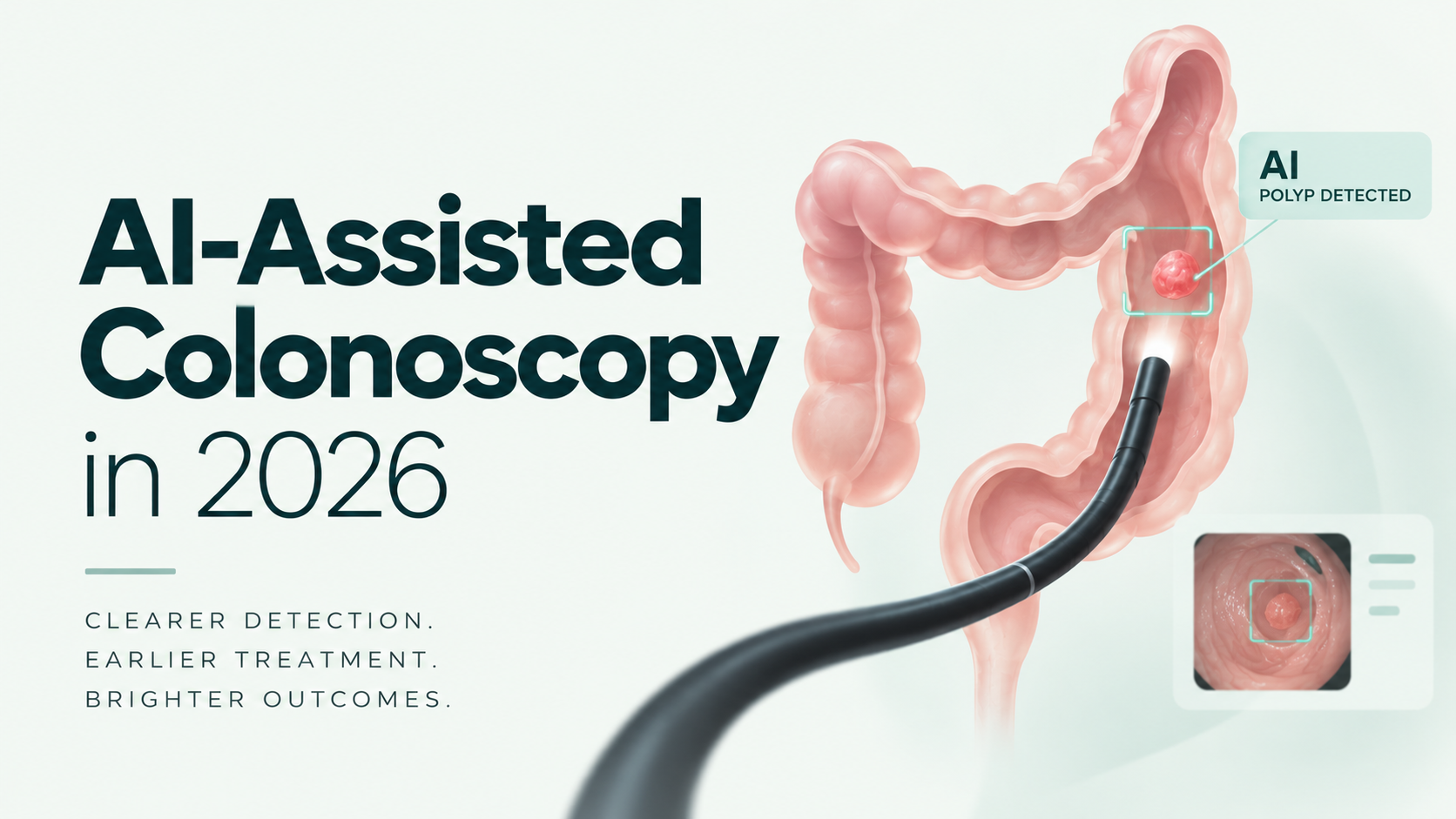
Halfway through a Tuesday screening list, the endoscopy unit's computer-aided detection system goes down. The attending finishes the remaining four colonoscopies unassisted, the way he did for the fifteen years before the box started flashing around polyps for him. Afterward, he can't shake the feeling that he moved through the mucosa a little faster than usual, waiting for a highlight that never came. A 2025 Lancet Gastroenterology & Hepatology analysis suggests he's not imagining it - and a companion 2026 JAMA Perspective argues that the standard fix, more human oversight, may be exactly backward.
The prevailing model for AI in medicine is "augmented intelligence": AI proposes, the physician disposes, and keeping a human in the loop is treated as an unambiguous safety net. That model assumes human review only ever adds a check against AI error. But AI deskilling in colonoscopy is a different failure mode entirely - it isn't about AI making a bad call that a physician should catch, it's about physicians quietly losing the unassisted skill they'd otherwise rely on to catch anything at all. The evidence for this effect in endoscopy specifically, combined with a broader argument now circulating in JAMA about when human oversight helps versus hurts, has real implications for how GI practices should be deploying computer-aided polyp detection.
The ACCEPT Trial: First Real-World Evidence of AI-Induced Deskilling in Colonoscopy
Across four endoscopy centers in Poland participating in the ACCEPT trial, researchers compared unassisted colonoscopy performance in the three months before AI polyp detection was introduced at the end of 2021 against the three months after. The retrospective analysis included 1,443 diagnostic colonoscopies - 795 pre-AI and 648 post-AI - performed by the same pool of experienced endoscopists. The adenoma detection rate in standard, non-AI-assisted procedures fell from 28.4% before AI exposure to 22.4% after, an absolute drop of 6.0 percentage points (95% CI −10.5 to −1.6; P = .0089). On multivariable regression, AI exposure independently predicted lower unassisted ADR (OR 0.69; 95% CI 0.53–0.89), alongside sex and age.
What makes this data hard to dismiss is what it ruled out. Every participant was an experienced endoscopist, which removes inadequate training as an explanation. The comparison held the same physicians against themselves before and after AI rollout, which removes case-mix as a confounder. AI exposure was the only modifiable variable that changed between the two periods, and it was associated with a measurable decline in the same clinicians' unaided detection rate. This is the first documented evidence of a negative behavioral effect from AI adoption on a core procedural skill in gastroenterology.
Case in point
A second-year GI fellow trains almost entirely on lists where computer-aided polyp detection is running. She has excellent numbers - her supervised ADR consistently beats department benchmarks. Midway through her final year, her program institutes quarterly "unassisted blocks" after reviewing the ACCEPT data, and her attending notices her scan speed through the right colon increases and her per-quadrant dwell time decreases compared to her AI-assisted lists.
Her program director doesn't treat this as a competency failure - it's an expected consequence of training in an AI-saturated environment that most fellows now enter. Instead, unassisted blocks become a standing part of her curriculum, not a one-time correction, with her unassisted ADR tracked separately from her AI-assisted ADR going forward. The goal isn't proving she doesn't need the tool. It's making sure the skill underneath the tool doesn't quietly erode while she's using it.
_8CBVXCO.png&w=1920&q=70)
Autonomous AI vs. Human-in-the-Loop: What the 2026 JAMA Perspective Argues
Ezekiel Emanuel and coauthors published a Perspective in JAMA in August 2026 that directly challenges the augmented-intelligence consensus held by bodies like the AMA and ACP. Their argument, drawn from meta-analytic evidence across medicine and other fields, is that when AI-alone performance already exceeds human-alone performance on a task, adding human oversight tends to degrade rather than improve the result. Two mechanisms drive this: algorithm aversion, where clinicians override a correct AI recommendation because it conflicts with their own judgment, and deskilling - the exact pattern documented in the ACCEPT colonoscopy data.
The authors map five cognitive clinical domains where AI systems are matching or exceeding physician performance: information gathering, differential diagnosis, diagnostic workup selection, treatment protocol selection, and chronic disease dose titration. They frame fully autonomous AI as a near-term operational possibility in select workflows within the next several years, not a distant hypothetical, while acknowledging real constraints: much of the supporting evidence is simulation-heavy rather than drawn from live deployment, AI failure modes under adversarial conditions remain unpredictable, liability and reimbursement frameworks aren't built for autonomous care, and procedures requiring physical dexterity - colonoscopy included - aren't candidates for full autonomy regardless of cognitive performance. Human-in-the-loop AI medicine, in their framing, needs to be justified task by task rather than assumed as a universal default.
A frequently overlooked point
Most GI societies already advise against routine, unselected use of AI-assisted polyp detection, and the reasoning usually cited is that the adenoma detection rate gains haven't yet translated into a measurable reduction in colorectal cancer incidence or mortality. The ACCEPT deskilling data adds a second, independent reason to be deliberate rather than reflexive about CADe adoption: even if a unit decides the detection benefit is worth it, that decision should come with a plan to preserve unassisted skill, not an assumption that skill preservation happens automatically because a human is still holding the scope.
Bottom line for clinical practice
Treat AI polyp detection as a tool with a documented deskilling cost, not a free upgrade to ADR - build periodic unassisted procedure blocks into practice, not just training programs.
Track unassisted ADR separately from AI-assisted ADR for endoscopists who use CADe routinely, so a decline doesn't go unnoticed until the system fails.
Don't assume human oversight is always the safer default - when AI-alone performance on a task is genuinely superior, algorithm aversion can make outcomes worse, not better.
Fully autonomous AI in cognitive domains (differential diagnosis, workup selection) is advancing faster than in procedural domains - colonoscopy's physical component keeps the physician central for now.
Reflexive CADe adoption without an ADR-to-outcome benefit or a skill-maintenance plan isn't evidence-based practice - it's rollout without a control.
The debate over autonomous AI versus human-in-the-loop care is really a debate about where AI should reason for you and where it should help you reason. Walk a differential or a workup decision through GastroAGI and it stays in the second category - surfacing the guideline-anchored logic rather than just the answer, so the clinical judgment underneath stays yours to exercise.

We are pioneers in clinical intelligence, dedicated to helping gastroenterologists harness the power of artificial intelligence to drive precision, efficiency, and patient growth.