
Vedolizumab Trough Concentrations in IBD: What a New Meta-analysis Means for Clinical and Endoscopic Remission
A 2026 CGH meta-analysis links higher vedolizumab trough levels with remission in IBD, strongest for endoscopic remission in UC.


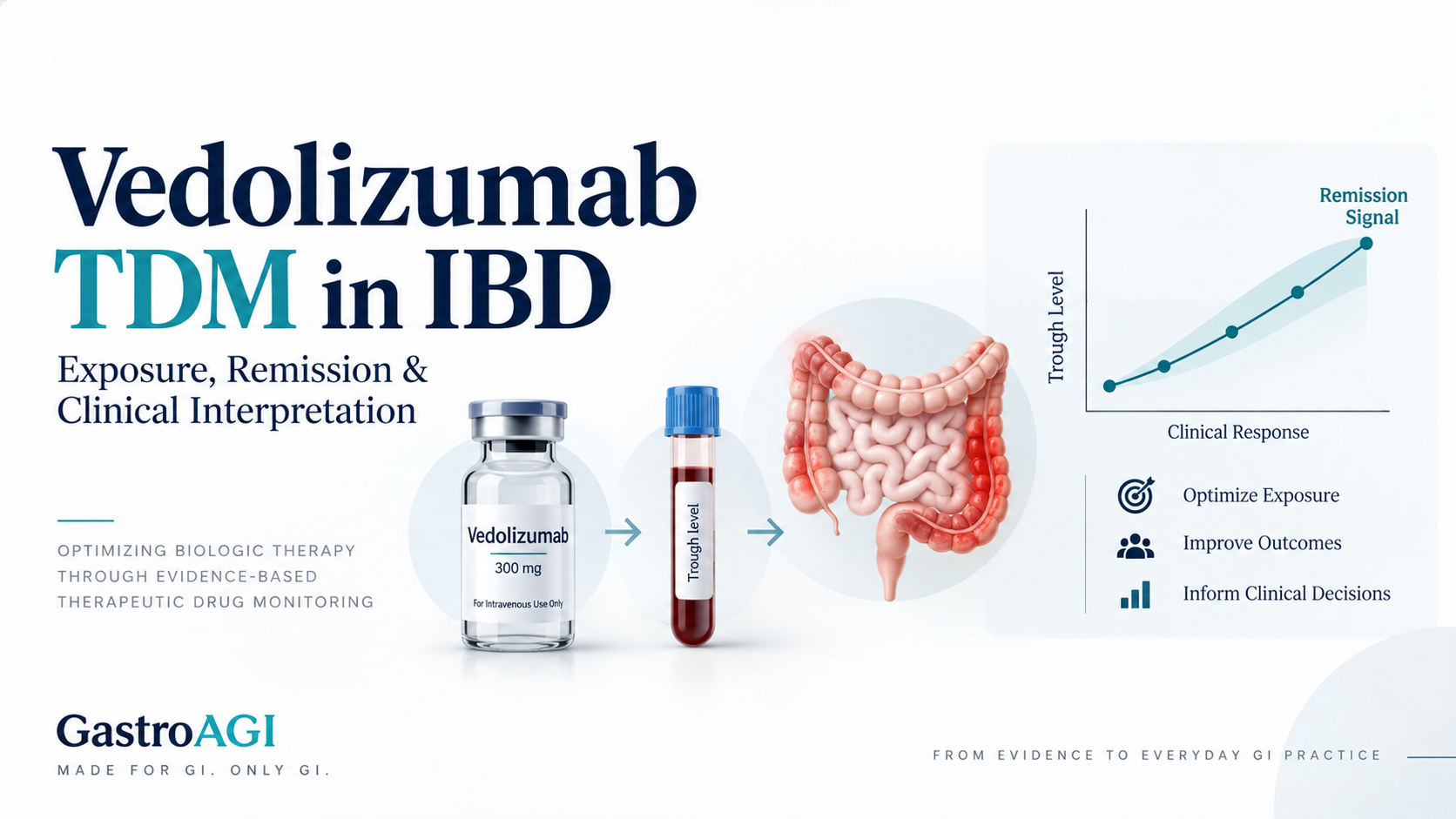
Can Vedolizumab Drug Levels Help Clinicians Read the Signal Behind Remission?
For gastroenterologists managing inflammatory bowel disease, vedolizumab presents a familiar therapeutic dilemma. The drug is widely used in Crohn’s disease and ulcerative colitis, yet the role of therapeutic drug monitoring remains less settled than it is for anti-TNF therapy. When a patient has an incomplete response, a secondary loss of response, or persistent endoscopic activity despite apparently adequate dosing, clinicians often ask a practical question: is this patient underexposed to vedolizumab, or is the inflammatory pathway simply not sufficiently responsive to the drug?
A new systematic review and meta-analysis by Soliman and colleagues, published online ahead of print in Clinical Gastroenterology and Hepatology on September 18, 2026, addresses that question by synthesising evidence on vedolizumab trough concentrations and clinical and endoscopic remission in Crohn’s disease and ulcerative colitis. The article is titled “Vedolizumab trough concentrations and clinical and endoscopic outcomes in inflammatory bowel disease: a systematic review and meta-analysis.” PubMed lists the article as a review and provides the DOI 10.1016/j.cgh.2026.09.009.
The central message is clinically useful but deliberately cautious: higher vedolizumab trough concentrations were associated with remission, with the most robust signal seen for endoscopic remission in ulcerative colitis. However, the authors explicitly note that much of the evidence is cross-sectional and may reflect reverse causation rather than a true dose-response relationship. They conclude that prospective interventional trials are needed before proactive vedolizumab therapeutic drug monitoring can be recommended.
The unresolved problem: exposure, response, or both?
Therapeutic drug monitoring is appealing because it offers a seemingly objective way to interpret treatment failure. If drug concentrations are low, dose optimisation may be reasonable. If concentrations are adequate and inflammation persists, mechanistic failure becomes more likely. This logic is well established in parts of anti-TNF management, but non-anti-TNF biologics have been more difficult to fit into the same framework.
Vedolizumab is a gut-selective anti-integrin therapy used in both Crohn’s disease and ulcerative colitis. In practice, trough concentrations are sometimes measured during induction or maintenance, particularly in patients with partial response, loss of response, or ongoing inflammatory activity. Yet the evidence base has been limited by small studies, variable timing of blood sampling, heterogeneous remission definitions, and different clinical or endoscopic endpoints. The authors of the 2026 meta-analysis identify this uncertainty directly: the role of therapeutic drug monitoring in optimising vedolizumab therapy for Crohn’s disease and ulcerative colitis “remains unclear,” and prior evidence has been constrained by small sample size and heterogeneous endpoints.
That uncertainty matters because clinicians are increasingly expected to treat beyond symptoms. Clinical remission alone may not align with mucosal healing or endoscopic remission, and a patient may feel better while inflammation persists. Conversely, symptoms may be driven by non-inflammatory mechanisms despite biochemical or endoscopic control. A drug concentration can therefore be tempting as a decision tool, but only if the concentration is meaningfully linked to the outcome being targeted.
What Soliman and colleagues investigated
This was a systematic review and meta-analysis designed to evaluate the association between vedolizumab trough concentrations and remission outcomes in inflammatory bowel disease. The investigators followed PRISMA 2020 guidance and searched the literature from inception through April 2026. Eligible studies reported vedolizumab trough concentrations stratified by remission status in Crohn’s disease or ulcerative colitis. The outcomes were clinical remission and endoscopic remission.
The statistical approach is important for interpretation. The authors estimated pooled mean differences using random-effects models with restricted maximum likelihood estimation and quantified heterogeneity using the I² statistic. In practical terms, the meta-analysis did not simply report whether patients in remission had “higher levels” in a general sense; it attempted to quantify how much higher trough concentrations were among remitters compared with non-remitters, while recognising that included studies were not identical.
The population included both major IBD phenotypes. Twenty-three studies, comprising 6,753 patients, met inclusion criteria, and 18 studies contributed to the quantitative synthesis. This is a larger evidence base than earlier summaries, which is one reason the paper is clinically relevant. However, larger pooled numbers do not automatically eliminate bias, especially when source studies differ in design, disease phenotype, timing, endpoint definitions, and reasons for measuring drug levels.
Ulcerative colitis: the clearest endoscopic signal
The strongest and cleanest association reported in the abstract was in ulcerative colitis for endoscopic remission. Higher vedolizumab trough concentrations were strongly associated with endoscopic remission in UC, with a pooled mean difference of 4.86 μg/mL, 95% confidence interval 2.75–6.98, p < 0.0001, and I² = 0.0%.
For clinicians, this is the most compelling part of the analysis. The absence of observed heterogeneity for this endpoint suggests that the association between higher trough concentration and endoscopic remission in UC was relatively consistent across the included studies contributing to that estimate. It does not prove that raising a patient’s vedolizumab level will produce endoscopic remission, but it does support the idea that drug exposure is clinically relevant in UC, particularly when the target is endoscopic healing rather than symptom improvement alone.
This distinction matters. In ulcerative colitis, endoscopic disease activity is directly observable and often tracks with treatment targets used in modern care. A trough concentration associated with endoscopic remission may therefore be more clinically meaningful than one associated only with symptom-based remission. The meta-analysis suggests that in UC, vedolizumab trough concentrations may be a useful part of the interpretive framework when endoscopic activity persists. However, the paper does not establish a prospective treatment algorithm, and it should not be read as a mandate for routine proactive monitoring in all UC patients receiving vedolizumab.
Clinical remission: useful association, but more heterogeneity
The analysis also found associations between higher vedolizumab trough concentrations and clinical remission in both ulcerative colitis and Crohn’s disease. In UC, the mean difference was 3.18 μg/mL with p = 0.025. In Crohn’s disease, the mean difference was 3.08 μg/mL with p < 0.0001. However, the authors note that these clinical-remission estimates were statistically heterogeneous.
This heterogeneity is clinically important. “Clinical remission” can mean different things across studies, depending on the index used, symptom thresholds, patient-reported outcomes, timing of assessment, steroid use, biomarker status, and whether objective inflammation was present. In Crohn’s disease especially, symptoms can reflect stricturing disease, functional overlap, bile acid diarrhea, small intestinal bacterial overgrowth, post-surgical anatomy, or other non-inflammatory contributors. A trough concentration may correlate with clinical status in some cohorts but be less informative in others.
For practice, the clinical-remission signal should be interpreted as supportive rather than definitive. It suggests that lower exposure may be one piece of the explanation in patients who have not achieved clinical remission. But it does not allow a clinician to conclude, from symptoms alone, that a low trough level is the cause of persistent disease activity. Objective assessment remains essential.
Crohn’s disease endoscopic remission: a more cautious message
One of the most clinically sobering findings is that no association was observed for endoscopic remission in Crohn’s disease. The reported mean difference was 1.40 μg/mL, with p = 0.453.
This does not mean vedolizumab exposure is irrelevant in Crohn’s disease. The same abstract reports an association between higher concentrations and clinical remission in Crohn’s disease. But for the harder target of endoscopic remission, the pooled analysis did not show a statistically significant association. That distinction should temper how clinicians discuss vedolizumab trough testing in Crohn’s disease.
Several explanations are possible, but they remain interpretive rather than proven by the abstract alone. Crohn’s disease is anatomically and biologically heterogeneous, with variable small-bowel involvement, transmural inflammation, stricturing or penetrating complications, and different endoscopic scoring contexts. Endoscopic remission may also be assessed at different sites, times, and thresholds. The meta-analysis finding should therefore be understood as a limitation of the current evidence, not as proof that dose optimisation cannot help selected Crohn’s disease patients.
Proposed maintenance ranges: helpful, but not a treatment rule
The authors report that pooled remission-associated concentrations were presented descriptively and supported maintenance targets of at least 13–15 μg/mL in ulcerative colitis and at least 10–12 μg/mL in Crohn’s disease.
These figures are likely to attract attention because clinicians often want actionable thresholds. However, the word “descriptively” is doing important work. These are not prospectively validated treatment targets in the same sense as a guideline-mandated threshold. They describe concentrations associated with remission across available studies. They may help frame interpretation of a maintenance trough result, particularly when integrated with symptoms, biomarkers, endoscopy, treatment timing, and adherence. But they should not be converted into a universal rule that every patient below the threshold requires escalation or that every patient above it has mechanistic failure.
A practical way to use these numbers is as context. If a UC patient has persistent endoscopic inflammation and a low maintenance vedolizumab trough concentration, the meta-analysis supports considering underexposure as a plausible contributor. If a Crohn’s disease patient has active endoscopic disease despite a concentration in the proposed range, the evidence is less supportive of assuming that further exposure increase will reliably produce endoscopic remission. In both scenarios, the result should prompt clinical reasoning, not replace it.
Association is not causation: the central limitation
The most important sentence in the abstract may be the authors’ caution that these associations are largely cross-sectional and may reflect reverse causation rather than a dose-response relationship.
This is the key distinction for GastroAGI readers. A cross-sectional association can show that patients in remission tend to have higher drug concentrations. It cannot reliably prove that higher concentrations caused remission. Active inflammation may itself influence pharmacokinetics through protein loss, inflammatory burden, altered clearance, or other mechanisms. In that scenario, low drug concentration may partly be a marker of uncontrolled disease rather than the primary reason for it.
The reverse-causation problem is not a minor technicality. It directly affects clinical decision-making. If low trough concentration causes non-remission, dose escalation should improve outcomes. If low trough concentration is mainly a consequence of severe inflammation or altered clearance, escalation may still help some patients, but the expected benefit is less certain and may depend on timing, phenotype, inflammatory burden, and whether the disease remains vedolizumab-responsive.
The authors therefore conclude that prospective interventional trials are required before proactive therapeutic drug monitoring can be recommended. That conclusion should be preserved in any clinical interpretation of the study.
What clinicians should conclude now
This meta-analysis strengthens the evidence that vedolizumab exposure is linked to remission outcomes in IBD, especially endoscopic remission in ulcerative colitis. It gives clinicians a more robust synthesis than isolated cohort studies and provides approximate maintenance concentration ranges associated with remission. It also reinforces that drug concentration data are most useful when interpreted alongside objective disease activity.
Clinicians should conclude that vedolizumab trough concentrations can be clinically informative. In a patient with ongoing inflammation, a low trough concentration may support considering underexposure as part of the differential explanation. In UC, the association with endoscopic remission appears particularly consistent in the pooled analysis. In CD, the evidence is more mixed, especially for endoscopic remission.
Clinicians should not conclude that proactive vedolizumab monitoring is now established standard practice for all patients. Nor should they assume that increasing the dose to achieve a target trough concentration will necessarily cause remission. The evidence summarised by Soliman and colleagues is association-based, and the authors explicitly call for prospective interventional trials before recommending proactive TDM.

The research agenda: from biomarker to strategy
The next step is not simply more observational correlation. The field needs prospective studies testing whether trough-guided vedolizumab optimisation improves clinically meaningful outcomes compared with standard care. Such trials would ideally stratify by disease type, induction versus maintenance phase, inflammatory burden, baseline pharmacokinetic risk, prior biologic exposure, and objective outcomes such as endoscopic remission.
The most important unanswered question is not whether patients in remission often have higher vedolizumab concentrations. This meta-analysis supports that association. The more practice-changing question is whether measuring and acting on vedolizumab trough concentrations improves outcomes, reduces unnecessary treatment cycling, prevents complications, or offers value compared with symptom-, biomarker-, and endoscopy-guided care.
Until those data are available, vedolizumab TDM is best viewed as a potentially useful interpretive tool rather than a stand-alone decision pathway.
Clinical Takeaway
Soliman and colleagues provide a timely synthesis of vedolizumab trough concentration data in IBD. The evidence supports an association between higher vedolizumab trough concentrations and remission, most convincingly for endoscopic remission in ulcerative colitis. The reported descriptive maintenance ranges—at least 13–15 μg/mL in UC and at least 10–12 μg/mL in CD—may help clinicians contextualise results, but they should not be treated as prospectively validated universal targets.
For practice, the message is measured: vedolizumab trough concentrations may help explain incomplete response or persistent inflammation, especially when interpreted with endoscopy, biomarkers, symptoms, timing, and adherence. But association does not prove causation. The current evidence does not establish that proactive vedolizumab TDM improves outcomes, and prospective interventional trials remain necessary before routine proactive monitoring can be recommended.
Five key clinical takeaways
The 2026 CGH systematic review/meta-analysis included 23 studies and 6,753 patients; 18 studies contributed to quantitative synthesis.
Higher vedolizumab trough concentrations were most robustly associated with endoscopic remission in ulcerative colitis, with no observed heterogeneity for that endpoint.
Higher trough concentrations were also associated with clinical remission in UC and Crohn’s disease, but these clinical-remission estimates were statistically heterogeneous.
No significant association was observed between vedolizumab trough concentration and endoscopic remission in Crohn’s disease in the pooled analysis.
The authors caution that largely cross-sectional associations may reflect reverse causation; prospective interventional trials are needed before proactive vedolizumab TDM can be recommended.
Source
Soliman MA, Saraga A, Gade A, Habibi Moini S, Mecsas-Faxon B, Rabinowitz LG, Midura I, Knezevic Ivanovski T, Roblin X, Peyrin-Biroulet L, Cheifetz AS, Papamichael K. Vedolizumab trough concentrations and clinical and endoscopic outcomes in inflammatory bowel disease: a systematic review and meta-analysis. Clinical Gastroenterology and Hepatology. Published online September 18, 2026. DOI: 10.1016/j.cgh.2026.09.009. PMID: 42759685.
References

We are pioneers in clinical intelligence, dedicated to helping gastroenterologists harness the power of artificial intelligence to drive precision, efficiency, and patient growth.