
Eosinophilic Esophagitis in 2026: Why Histologic Remission Doesn't Guarantee Symptom Relief
New 2026 data: histologic remission in eosinophilic esophagitis doesn't reliably predict symptom relief. See how dupilumab and budesonide rank for dysphagia


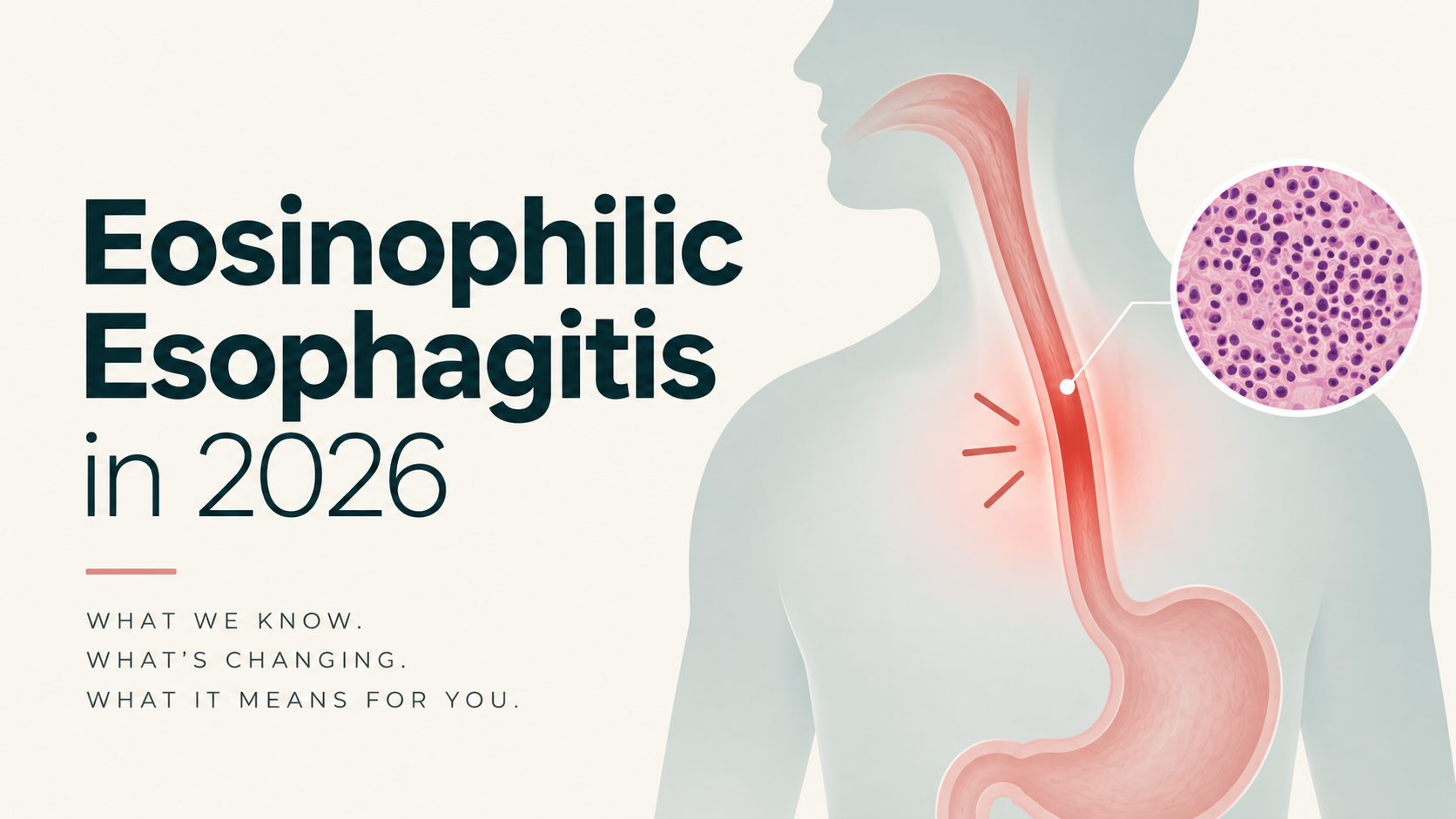
A 34-year-old man with eosinophilic esophagitis returns for his six-month follow-up on dupilumab. His peak eosinophil count has fallen from 60 to 2 per high-power field - a clean histologic remission by any definition in use today. He still cuts his steak into matchsticks and chews each bite twenty times, and he food-impacted twice last month. His biopsy report reads like a success story. His symptom diary doesn't agree. A 2026 network meta-analysis of EoE therapies confirms this isn't an outlier - it's a pattern built into how the field currently measures treatment response.
EoE trials have long anchored their primary endpoint to histologic remission - typically defined as ≤6 or ≤15 eosinophils per high-power field - because it's objective, biopsy-confirmed, and reproducible across sites. Symptom scores are messier. They're self-reported, and they're distorted by compensatory eating behavior: patients with longstanding EoE learn to chew excessively, avoid certain textures, and drink liquids with meals long before they ever describe dysphagia to a physician. The result is a therapeutic landscape where a drug can look excellent on a pathology report and still leave a patient reaching for water mid-meal. The 2026 network meta-analysis in Clinical Gastroenterology and Hepatology, led by Hayek and colleagues, pooled 13 randomized controlled trials of biologics and swallowed topical corticosteroids across the outcomes that actually matter to patients - dysphagia, endoscopic appearance, and histology - rather than treating eosinophil count as a proxy for all three.
Ranking EoE Therapies by Dysphagia Outcome, Not Just Eosinophil Count
The network meta-analysis found that dupilumab 300 mg ranked highest for dysphagia improvement at both 12 and 24 weeks, making it the strongest early performer on the outcome patients actually notice. Budesonide oral suspension (BOS) 2 mg also produced meaningful dysphagia improvement at 12 weeks, and by 48 weeks, budesonide orodispersible tablets (BOT) showed the strongest symptomatic efficacy in the network. That time-dependent shift matters clinically: a drug's rank on dysphagia isn't fixed, it depends on how far out you're measuring.
Histologically, the picture was almost uniform - nearly every active therapy in the analysis achieved histologic remission over placebo, with etrasimod the single notable exception that failed to separate meaningfully on eosinophil count. In other words, achieving histologic remission is not what differentiates these drugs anymore; nearly all of them clear that bar. What differentiates them is how quickly and how durably they resolve dysphagia - and the analysis found that histologic improvement did not consistently translate into that symptomatic benefit. A patient's biopsy and a patient's swallow are, increasingly, two separate data points that need to be tracked separately rather than assumed to move together.
Case in point
A 27-year-old woman with EoE and a five-year history of food avoidance starts BOS 2 mg twice daily after failing PPI therapy. At her 12-week follow-up, her eosinophil count has dropped from 45 to 8/hpf - not quite histologic remission by the strictest ≤6 threshold, but her Dysphagia Symptom Questionnaire score has fallen from 28 to 6, and she reports eating pizza crust for the first time in years.
Her gastroenterologist resists the urge to escalate therapy based on the incomplete histologic response alone. Instead, the visit is built around her symptom trajectory: she's asked directly about food texture modifications, meal duration, and any residual avoidance behaviors, not just whether dysphagia "improved." The eosinophil count gets rechecked at 24 weeks rather than triggering an immediate switch, because the NMA data suggest that in the BOS cohort, further histologic gains often continue on the same regimen without a change in drug class.
Building a Treatment Algorithm Around Symptoms, Not Just Histology
The practical implication of this network meta-analysis is that repeat endoscopy with biopsy can no longer serve as a stand-in for asking a patient how they're eating. If histologic improvement doesn't consistently predict symptomatic benefit, then a normalizing eosinophil count at week 12 tells you about inflammation, not about function. Structured symptom instruments - the Dysphagia Symptom Questionnaire or the EoE Symptom Activity Index - need to be administered at every follow-up alongside biopsy, not reserved for patients who spontaneously report ongoing trouble swallowing.
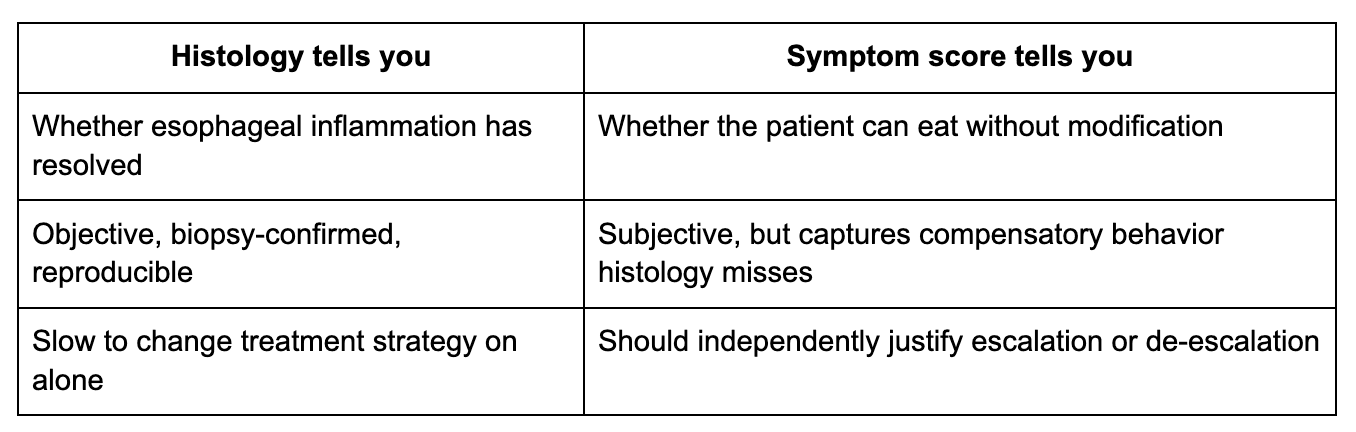
It's also worth being honest about the limits of this evidence base. Long-term comparative and safety data across these drug classes remain limited, and there are still few direct biologic-versus-steroid head-to-head trials. The rankings this analysis produces are the best available synthesis, not a settled hierarchy - treatment selection should still weigh symptoms, endoscopic findings, histology, safety profile, and patient preference together rather than optimizing for any single axis.
A frequently overlooked point
Clinicians tend to treat a rising or falling eosinophil count as the headline finding at every EoE follow-up, in part because it's the number that's easiest to trend on a flowsheet. But a patient who has spent years adapting their eating habits around dysphagia will often underreport symptoms on a generic questionnaire simply because they've stopped attempting the foods that used to trigger them. The eosinophil count moves independently of that adaptation. Asking specifically about food texture, meal duration, and avoidance - not just "any trouble swallowing?" - surfaces a truer picture of response than the biopsy alone ever will.
Bottom line for clinical practice
Don't equate a normalizing eosinophil count with functional recovery - pair every biopsy with a structured dysphagia assessment (DSQ or EEsAI).
For early symptom control, dupilumab 300 mg showed the strongest dysphagia response at 12 and 24 weeks in this network meta-analysis.
For durability approaching one year, budesonide orodispersible tablets showed the strongest symptomatic efficacy at 48 weeks.
Etrasimod was the outlier that failed to achieve meaningful histologic remission - don't assume every EoE drug clears eosinophils equally.
Treat this therapeutic hierarchy as provisional; direct biologic-versus-steroid trials and long-term safety data are still sparse.
Next time a follow-up biopsy doesn't match what your patient is telling you about their meals, walk the case through GastroAGI - it will reason through the histologic and symptomatic data side by side and return a guideline-anchored take in seconds.

We are pioneers in clinical intelligence, dedicated to helping gastroenterologists harness the power of artificial intelligence to drive precision, efficiency, and patient growth.