
Can Looking Toward the Screen Edge Improve Adenoma Detection? Lessons From the EYE-SIGHT Randomized Trial
A multicenter RCT found real-time peripheral gaze feedback improved adenoma and polyp detection during colonoscopy without longer observation time.


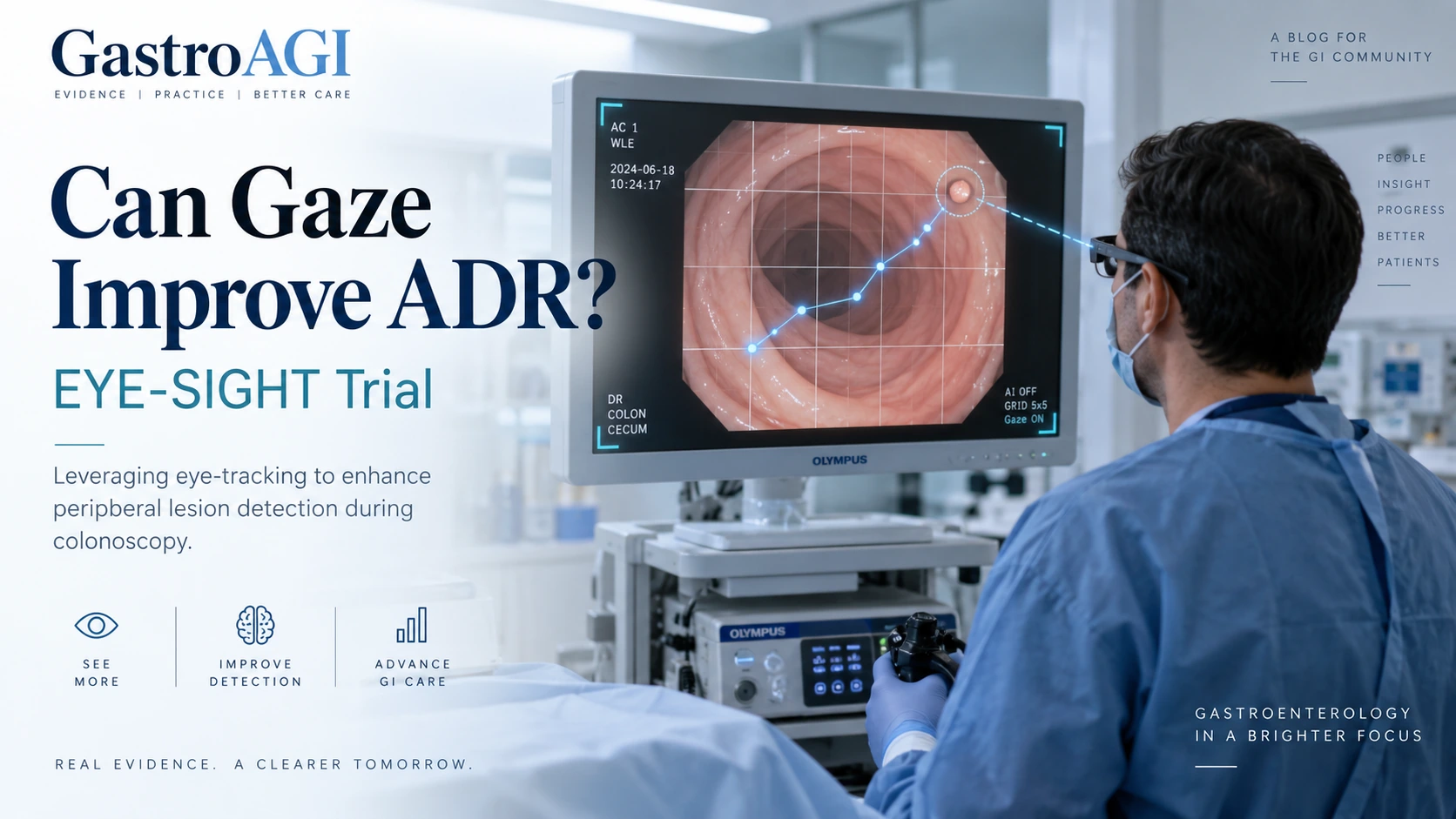
When Adenomas Are Missed, Is the Problem Only Technology—or Also Where We Look?
Colonoscopy quality has traditionally been discussed through familiar metrics: bowel preparation, withdrawal time, cecal intubation, adenoma detection rate, inspection technique, imaging quality, and endoscopist experience. Yet every colonoscopy is also a visual task. The endoscopist must continuously scan a moving, changing field while the lumen opens, folds appear and disappear, fluid obscures the mucosa, and subtle lesions compete for attention.
This raises a deceptively simple question: during colonoscopy, does where the endoscopist looks on the monitor influence adenoma detection?
The EYE-SIGHT trial, published in Clinical Gastroenterology and Hepatology, brings this question into the realm of randomized evidence. The study evaluated whether real-time eye-tracking feedback, designed to prompt endoscopists to direct their gaze toward peripheral areas of the endoscopy screen, could improve colorectal adenoma detection. The trial found that the intervention increased adenomas per colonoscopy, adenoma detection rate, polyp detection rate, and peripheral gaze rate, without significantly increasing observation time.
For gastroenterologists and endoscopists, the study is clinically interesting because it does not test a new scope, cap, imaging platform, artificial intelligence detection algorithm, or resection device. Instead, it targets the human visual strategy at the center of colonoscopy performance.
A Colonoscopy Quality Question Hidden in Plain Sight
Colorectal cancer prevention depends on detecting and completely removing adenomas. The EYE-SIGHT investigators begin from this established premise and highlight a less settled issue: the optimal visual strategy for endoscopists remains undefined. Their hypothesis was that guiding gaze toward the periphery of the endoscopy screen could enhance adenoma detection.
This is a practical question. During withdrawal, many lesions may be subtle, flat, partially hidden behind folds, or located at the edge of the visual field. An endoscopist’s attention may naturally concentrate toward the center of the monitor, especially when navigating the lumen or following the direction of scope movement. If peripheral regions receive less visual attention, lesions near the screen edge may be missed even when they are technically visible.
The EYE-SIGHT trial therefore reframes adenoma detection as not only a matter of mucosal exposure, but also a matter of visual attention. That distinction is important. A well-prepared colon and adequate withdrawal time do not guarantee that the visual field has been optimally searched.
What the Trial Tested
The EYE-SIGHT trial was a single-blinded, multicenter randomized controlled trial conducted at four institutions in Japan between September 2024 and July 2025. The participating institutions included International University of Health and Welfare Ichikawa Hospital, Tokyo Metropolitan Geriatrics Hospital, Omori Red Cross Hospital, and Showa Medical University Hospital.
Individuals aged 40 to 90 years were randomized to an intervention group or a control group. In the intervention group, real-time eye-tracking feedback prompted endoscopists to maintain gaze on peripheral areas of the screen. These peripheral areas were defined as the 16 outer segments of a 5 × 5 screen grid. Feedback was delivered through alerts. In the control group, no feedback was provided.
The primary endpoint was adenomas per colonoscopy. Secondary endpoints included adenoma detection rate, polyp detection rate, peripheral gaze rate, and observation time.
This endpoint selection is clinically meaningful. Adenomas per colonoscopy captures not just whether at least one adenoma is detected, but also the burden of adenomas found during an examination. Adenoma detection rate remains a widely recognized colonoscopy quality metric, while polyp detection rate and peripheral gaze rate help clarify whether the intervention changed detection behavior and visual behavior. Observation time is also important because any quality intervention that substantially prolongs procedures may face implementation barriers.
The Intervention: Feedback on Visual Attention, Not Image Interpretation
The intervention used real-time eye-tracking feedback. The system prompted endoscopists to direct their gaze toward the screen periphery, as defined by the 5 × 5 grid. The 16 outer segments represented the peripheral regions.
This is conceptually different from computer-aided detection. AI-based systems typically analyze the endoscopic image and highlight suspected lesions. The EYE-SIGHT intervention did not primarily function as a lesion-recognition tool. Instead, it acted on the endoscopist’s viewing pattern, encouraging more attention to regions of the screen that might otherwise be under-scanned.
That distinction matters for interpretation. The trial does not prove that the eye-tracking system detected adenomas. It suggests that modifying the endoscopist’s gaze behavior was associated with improved adenoma and polyp detection. The mechanism is therefore human-performance oriented: the intervention appears to have changed how the endoscopic field was visually searched.
What the Study Found
The trial enrolled 400 patients. Of these, 198 were in the intervention group and 199 were in the control group. Mean age was similar between groups, 68.9 years in the intervention group and 68.6 years in the control group, and baseline characteristics were reported as balanced.
The intervention group achieved a significantly higher number of adenomas per colonoscopy than the control group: 1.34 versus 0.95, with a P value of .046. Adenoma detection rate was also higher in the intervention group: 53.3% versus 39.2%, P = .007. Polyp detection rate increased as well: 66.5% versus 47.2%, P < .001.
The visual-behavior endpoint moved in the expected direction. Peripheral gaze rate was higher in the intervention group than in the control group: 33.7% versus 25.9%, P < .001. Observation time did not differ significantly between groups: 8.4 versus 8.0 minutes, P = .094.
The authors concluded that increased peripheral gaze through real-time guidance significantly improved adenoma and polyp detection without extending procedure time. They described this as a low-burden and potentially scalable approach to improving colonoscopy.
Why the Findings Are Clinically Interesting
The clinical relevance of EYE-SIGHT lies in its focus on endoscopist attention. Many colonoscopy quality interventions attempt to improve what the endoscopist can see. This trial asks whether quality can also be improved by changing how the endoscopist looks.
The reported improvement in adenoma detection rate is notable because ADR is a core quality metric in colonoscopy. The increase in adenomas per colonoscopy also suggests that the intervention may have improved lesion detection beyond simply converting some negative examinations into positive ones. However, the study should be interpreted as evidence of improved detection during the trial conditions, not as direct evidence of reduced interval colorectal cancer or improved long-term patient outcomes. Those outcomes were not reported in the abstracted trial summary.
The lack of significant prolongation in observation time is also relevant. A common barrier to colonoscopy quality interventions is workflow burden. In this trial, the intervention improved detection metrics without a statistically significant increase in observation time. That makes the concept attractive from an implementation perspective, although real-world adoption would still depend on equipment availability, training, user acceptance, alert design, cost, and integration into endoscopy units.
A Human-Factors Lens on Colonoscopy
One of the most useful aspects of this trial is that it brings human factors into the quality conversation. Colonoscopy is often framed as a technical procedure, but it is also a cognitive and perceptual task. The endoscopist must navigate, clean, insufflate, recognize anatomy, detect subtle lesions, assess morphology, decide whether to resect, and maintain awareness of patient safety.
Visual attention is not unlimited. In any complex visual environment, some regions are inspected more thoroughly than others. If endoscopists tend to concentrate on the central screen area, peripheral lesions may receive less attention. The EYE-SIGHT intervention attempted to correct that by nudging gaze outward.
The trial therefore supports a broader idea: colonoscopy quality improvement may benefit from measuring and training perceptual behavior, not just procedural endpoints. Peripheral gaze rate is not currently a routine quality metric, and this trial does not establish it as one. But it suggests that gaze behavior is measurable, modifiable, and clinically relevant enough to merit further investigation.
What Clinicians Should Not Over-Interpret
The EYE-SIGHT trial was randomized and multicenter, which strengthens the evidence. Still, several boundaries should be kept clear.
First, the trial shows improved adenoma and polyp detection under study conditions. It does not establish that eye-tracking feedback should become standard of care in all colonoscopy units. Implementation requires broader validation, operational feasibility, cost-effectiveness assessment, and evaluation across different practice settings.
Second, the trial does not prove that peripheral gaze is the only or dominant mechanism of improved adenoma detection. The intervention increased peripheral gaze rate, and detection improved, but multiple factors may influence how feedback changes endoscopist behavior. Alerts may increase overall vigilance, alter scanning rhythm, or modify withdrawal attention in ways not fully captured by peripheral gaze rate alone.
Third, the findings should not be generalized beyond the studied population and setting without caution. The study was conducted in four Japanese institutions, with patients aged 40 to 90 years. Whether similar effects would be observed across different countries, screening programs, endoscopist experience levels, equipment platforms, sedation practices, bowel preparation quality profiles, and lesion prevalence settings requires further evidence.
Fourth, the trial should not be interpreted as replacing established colonoscopy quality principles. Adequate bowel preparation, careful mucosal inspection, complete examination, appropriate withdrawal technique, and complete resection remain central. Eye-tracking feedback, if validated further, would be an adjunct to quality practice rather than a substitute for it.
Strengths That Make the Trial Worth Attention
The study has several strengths relevant to clinical readers. It was randomized, multicenter, and designed around a clearly defined behavioral intervention. The intervention was objectively linked to an eye-tracking system rather than relying only on general instruction to “look carefully.” The trial also measured both detection outcomes and a behavioral process outcome: peripheral gaze rate.
The primary endpoint, adenomas per colonoscopy, is clinically meaningful because it reflects the number of adenomas detected per examination. The secondary endpoints provide a coherent pattern: adenoma detection rate and polyp detection rate improved, peripheral gaze rate increased, and observation time was not significantly prolonged.
That internal consistency makes the findings persuasive as a proof of concept. The trial suggests that visual guidance can change gaze behavior and that this change may improve detection performance.
Limitations and Evidence Gaps
The main limitations for current clinical interpretation relate to generalizability, implementation, and downstream outcomes.
The trial was conducted in four institutions in Japan. This supports multicenter validity within that setting, but it does not answer whether the same intervention would perform similarly in community endoscopy centers, high-volume screening programs, trainee-led colonoscopy, or health systems with different workflow constraints.
The study also reports detection outcomes rather than long-term clinical outcomes. Improved adenoma detection is important, but the trial does not directly show a reduction in interval colorectal cancer, colorectal cancer mortality, post-colonoscopy colorectal cancer, or surveillance burden. Those outcomes would require much larger and longer studies.
The technology itself is another consideration. Real-time eye-tracking feedback requires hardware, software, calibration, and integration into the endoscopy environment. Alerts must be useful without becoming distracting. The trial reports improved detection without significant observation-time prolongation, but broader implementation would need to assess user experience, false or excessive alerts, learning effects, maintenance, cost, and compatibility with existing endoscopy systems.
Finally, the durability of the effect remains an open question. If endoscopists train with peripheral gaze feedback, does performance remain improved when the system is removed? Does feedback mainly help endoscopists with lower baseline peripheral gaze rates? The CGH page notes a subgroup observation that among endoscopists with baseline peripheral gaze rate below 26%, the intervention significantly increased peripheral gaze rate. This is hypothesis-generating and suggests that baseline gaze behavior may influence benefit, but it should not be overextended into a clinical selection rule without further evidence.

How This Could Influence Future Endoscopy Practice
The EYE-SIGHT trial may influence practice less by immediately changing equipment standards and more by expanding how endoscopy quality is conceptualized. Colonoscopy performance may depend on three interacting domains: mucosal exposure, image quality, and visual attention. Much of modern innovation has targeted the first two. This trial targets the third.
Future research could compare eye-tracking feedback with other quality interventions, assess additive effects with computer-aided detection, evaluate training applications, and determine whether gaze metrics can identify endoscopists who would benefit most from feedback. Studies could also explore whether peripheral gaze training has durable effects or requires continuous real-time prompting.
For fellows and trainees, the trial raises an educational point: “look carefully” may be too vague. Structured visual scanning strategies could become part of colonoscopy training if further evidence supports them. For experienced endoscopists, the trial suggests that even subtle, unconscious viewing habits may affect lesion detection.
Clinical Takeaway
The EYE-SIGHT trial provides randomized evidence that real-time feedback directing endoscopists’ gaze toward the periphery of the colonoscopy screen can improve adenoma and polyp detection metrics without significantly extending observation time. The intervention increased adenomas per colonoscopy, adenoma detection rate, polyp detection rate, and peripheral gaze rate in a multicenter Japanese trial.
The findings are clinically relevant because they identify visual attention as a modifiable factor in colonoscopy quality. However, this should be viewed as evidence supporting a promising quality-improvement strategy, not as established guidance requiring routine eye-tracking in all colonoscopy units. Further studies are needed to confirm generalizability, assess cost and workflow implications, define training value, evaluate durability, and determine whether improved detection translates into better long-term patient outcomes.
Five key clinical takeaways
The EYE-SIGHT trial was a single-blinded, multicenter randomized controlled trial conducted at four Japanese institutions between September 2024 and July 2025.
The intervention used real-time eye-tracking feedback to prompt endoscopists to look toward peripheral areas of the endoscopy screen, defined as the 16 outer segments of a 5 × 5 grid.
The primary endpoint, adenomas per colonoscopy, was higher with peripheral gaze feedback than control: 1.34 versus 0.95; P = .046.
Adenoma detection rate and polyp detection rate were also higher in the intervention group, while observation time was not significantly different.
The trial supports visual attention as a modifiable colonoscopy-quality factor, but it does not yet establish routine eye-tracking feedback as standard clinical guidance.
Source
Ishibashi F, Ono S, Okusa K, Arimoto J, Katagiri A, Fukagawa K, Ito S, Mochida K, Tonishi T, Ozaki E, Chiba H, Suzuki S. Gaze Shift to Screen Edge Boosts Colorectal Adenoma Detection: Multicenter Randomized Controlled Trial (EYE-SIGHT Trial). Clinical Gastroenterology and Hepatology. 2026;24(9):2595–2603. Published online January 27, 2026. DOI: 10.1016/j.cgh.2026.01.012. PMID: 41610931.
Source link: PubMed / Clinical Gastroenterology and Hepatology.
References

We are pioneers in clinical intelligence, dedicated to helping gastroenterologists harness the power of artificial intelligence to drive precision, efficiency, and patient growth.