
Alcohol, Cardiometabolic Risk, and Cirrhosis: What Danish 10-Year Risk Data Mean for Preventive Hepatology
Danish cohort data show alcohol remains the dominant modifiable cirrhosis risk factor, with metabolic risks adding most at lower intake.


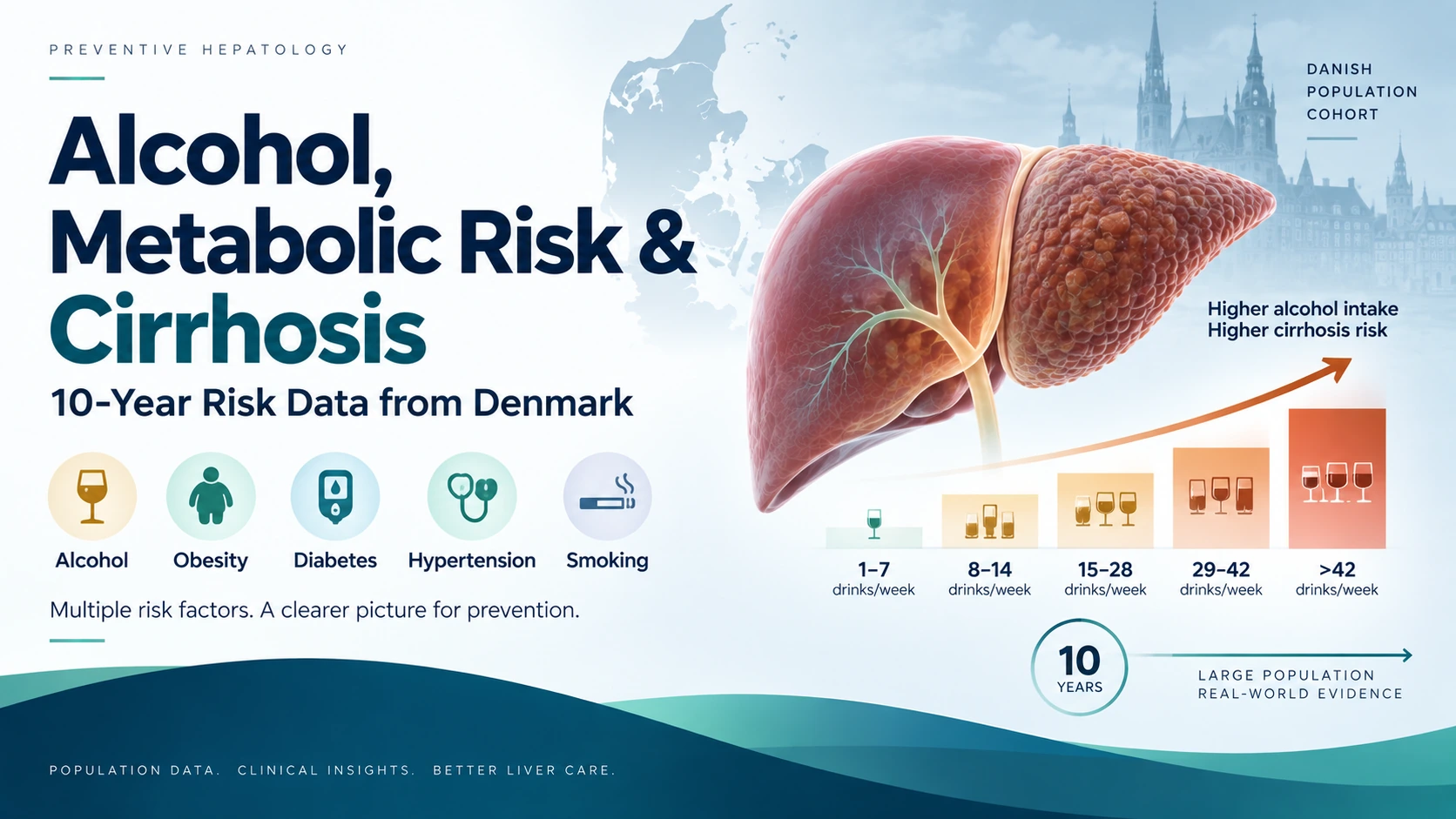
A patient drinks regularly, has obesity, hypertension, diabetes, and smokes.
Which risk deserves the most attention if the clinical goal is preventing cirrhosis?
The answer is tempting to make complicated. Modern liver practice increasingly recognises that alcohol exposure and metabolic dysfunction frequently coexist, and the newer steatotic liver disease framework has made that overlap more explicit.
But prevention still requires prioritisation.
A large Danish population-based cohort published in the Journal of Hepatology provides useful numbers for that conversation. Across more than 350,000 adults, alcohol exposure showed the steepest association with future cirrhosis, while obesity, diabetes, hypertension, and smoking also contributed substantially.
The lesson is not that metabolic health can be ignored.
It is that when alcohol intake becomes substantial, alcohol may dominate the liver-specific risk conversation more than clinicians sometimes acknowledge.
The MetALD era has made the overlap visible
For years, liver disease was often discussed in separate silos.
Metabolic disease went in one box.
Alcohol went in another.
Real patients were rarely so cooperative.
Someone with central obesity, type 2 diabetes, hypertension, and dyslipidemia may also drink enough alcohol for that exposure to materially change liver risk. Conversely, someone presenting with hazardous alcohol use may carry substantial metabolic and cardiovascular risk that remains clinically important even if alcohol is the most obvious driver of liver injury.
The concept of MetALD formalises part of this overlap. In the source study, MetALD is described as steatotic liver disease occurring in people with at least one cardiovascular risk factor and weekly alcohol intake of 140–350 g ethanol in women or 210–420 g in men.
That classification is useful.
But from a prevention perspective, classification alone does not answer the more practical question:
Which exposure is contributing most to future cirrhosis risk?
This Danish cohort helps quantify that.
More than 350,000 participants, followed through national registries
The investigators used data from the Danish National Health Surveys conducted in 2010, 2013, and 2017, linking survey information to national registries through December 31, 2022.
The analysis included 354,624 participants without previously diagnosed cirrhosis.
Participants were at least 16 years old, and survey response rates ranged from 54.0% to 59.5%.
At baseline, the median age was 55 years.
The prevalence of major exposures gives a useful sense of the population:
12% reported at least 15 drinks per week
17% had BMI ≥30 kg/m²
5% had diabetes
28% had hypertension
18% had dyslipidemia
21% smoked
Across approximately 3.3 million person-years of follow-up, 1,211 participants developed cirrhosis.
The investigators then estimated 10-year absolute cirrhosis risk, relative risks, population attributable fractions, and potential additive interactions between alcohol and cardiometabolic risk factors.
This is an excellent design for asking population-level risk questions.
It is not a randomized prevention trial.
That difference matters throughout the interpretation.
Alcohol produced the clearest dose-risk gradient
The alcohol data are probably the most clinically useful part of the paper because they translate a vague message—“more alcohol means more liver risk”—into an understandable 10-year gradient.
Using 1–7 drinks per week as the reference group, 10-year absolute cirrhosis risk was:
0.14% with 1–7 drinks/week
0.29% with 8–14 drinks/week
0.68% with 15–28 drinks/week
2.0% with 29–42 drinks/week
4.6% with more than 42 drinks/week
One drink was defined as 12 g of ethanol.
The adjusted hazard ratios followed the same steep pattern:
2.29 for 8–14 drinks/week
4.80 for 15–28 drinks/week
11.93 for 29–42 drinks/week
22.80 for more than 42 drinks/week
again relative to those consuming 1–7 drinks per week.
These numbers deserve a moment.
The absolute risk at lower intake remained numerically modest in this general-population cohort.
But the trajectory is not subtle.
As weekly alcohol intake rose, cirrhosis risk increased progressively and then steeply.
That is far more useful in clinic than saying simply that alcohol is “a risk factor.”
The abstainer finding is a reminder of how observational alcohol data can mislead
The study also observed increased relative cirrhosis risk among abstainers compared with participants drinking 1–7 drinks per week.
That result should not be turned into the familiar—and misleading—argument that a little alcohol must therefore be protective.
The abstainer category in observational studies is messy.
It may include former drinkers.
Some may have stopped because of illness.
Others may differ systematically in health status, socioeconomic characteristics, previous alcohol exposure, medication use, or other unmeasured factors.
The study itself should therefore not be read as evidence that clinicians ought to recommend alcohol consumption.
The robust signal is in the other direction:
higher alcohol exposure was strongly associated with higher cirrhosis risk.
Metabolic risk still mattered—just not as much as alcohol at the population level
Obesity, diabetes, hypertension, and smoking were each associated with roughly a two- to threefold higher cirrhosis risk.
So the data do not support treating cardiometabolic health as a secondary concern.
Where alcohol distinguished itself was in the estimated population attributable fraction, which attempts to quantify how much of the observed population burden might theoretically be attributed to an exposure if the association were causal and other assumptions held.
The reported population attributable fractions were:
59.9% for alcohol consumption above the minimum-risk reference range
29.3% for hypertension
21.2% for smoking
13.8% for BMI ≥30 kg/m²
9.0% for diabetes
Dyslipidemia did not have a statistically significant overall population attributable fraction.
For preventive hepatology, that hierarchy is informative.
It suggests that alcohol contributed the largest estimated modifiable share of cirrhosis burden in this cohort.
That does not mean every patient with hypertension or obesity should hear only about alcohol.
It means that in a patient drinking heavily, spending the entire visit discussing weight while barely addressing alcohol would probably miss the dominant liver-specific risk signal.
Less alcohol-metabolic “synergy” than we might expect
One of the more interesting findings is what happened when alcohol exposure and cardiometabolic risk were considered together.
Obesity, diabetes, and hypertension increased cirrhosis risk among participants consuming 1–28 drinks per week, but the study found no clear added risk from these factors above 28 drinks per week.
The authors characterised the overall synergy between alcohol and cardiometabolic risk as limited.
This needs careful wording.
It would be wrong to conclude that obesity or diabetes suddenly becomes biologically irrelevant once a patient drinks heavily.
A more plausible interpretation is statistical and clinical:
once alcohol exposure is sufficiently high, its contribution to cirrhosis risk may become so dominant that the additional effect of some metabolic variables is harder to distinguish in this dataset.
In practical terms, prevention may need to be prioritised differently at different levels of alcohol exposure.
At lower or moderate intake, metabolic factors may meaningfully shift risk.
At very high intake, alcohol reduction may become the highest-yield liver-specific target.
That is a much more defensible message than saying “metabolic risk does not matter in heavy drinkers.”
Smoking deserves more attention in liver clinics
Smoking behaved somewhat differently from obesity, diabetes, and hypertension.
It was associated with increased cirrhosis risk across alcohol-consumption categories, with signals suggesting supra-additive interaction.
That is clinically useful.
Smoking is often discussed primarily through cardiovascular disease, lung disease, and malignancy.
It may receive less attention in a hepatology consultation unless transplantation, cancer, or perioperative risk makes it immediately relevant.
These data are a reminder that smoking belongs in liver-risk counselling too.
For the patient sitting in front of us with alcohol exposure, metabolic dysfunction, and tobacco use, smoking cessation should not be outsourced entirely to another specialty.
The clinic conversation may need a hierarchy—not a silo
The false binary between “metabolic” and “alcohol-related” liver disease is increasingly difficult to defend.
The patient does not care which academic box their liver disease fits into.
They need to know which modifiable exposures are most likely to matter.
This study supports a simple clinical approach:
assess everything, but prioritise intelligently.
In a patient with modest alcohol exposure and marked obesity, diabetes, or hypertension, metabolic optimisation may have a large role in reducing future liver risk.
In a patient drinking 35 or 45 drinks per week, the liver conversation should not bury alcohol reduction beneath a long list of secondary interventions.
And in either situation, smoking still matters.
This is not a new treatment algorithm.
It is better risk communication.
Absolute risk may be more persuasive than another warning about “liver damage”
One strength of the Danish study is that it reports both absolute and relative risks.
Relative risks are excellent for epidemiology.
They are often poor for patient conversations.
Telling a patient that their hazard ratio is 11.93 is unlikely to change much.
Showing how 10-year cirrhosis risk rises across increasing drinking categories may be easier to understand.
That does not mean those percentages should be transferred mechanically to every patient.
The cohort was Danish, and individual risk varies with sex, genetics, baseline liver disease, viral hepatitis status, drinking pattern, medications, comorbidity, and other factors.
But absolute-risk framing can make counselling more concrete.
The message changes from:
“Alcohol is bad for your liver.”
to:
“As weekly exposure rises, the observed 10-year cirrhosis risk rises sharply.”
That is a more specific clinical conversation.
Dyslipidemia is the finding most likely to be overinterpreted
Dyslipidemia was not associated with overall cirrhosis risk in the cohort, although an association was seen among those drinking 8–14 drinks per week.
This does not mean dyslipidemia is beneficial.
It does not mean lipid management is unnecessary.
And it certainly does not mean that a normal or abnormal lipid panel can be used as a shortcut for liver risk.
Dyslipidemia is a heterogeneous clinical category, and this analysis does not address every lipid phenotype, statin exposure, cardiometabolic pathway, or cardiovascular consequence.
For patients with metabolic disease, lipid management remains important even if dyslipidemia was not independently associated with cirrhosis overall in this particular dataset.
No alcohol category here should be mistaken for a “safe” prescription
The study uses 1–7 drinks per week as the reference category.
That is an analytic choice.
It is not a clinical recommendation.
The data cannot establish a universally safe amount of alcohol because alcohol-related harm is influenced by many variables not captured by a single weekly drink count.
Self-reported alcohol exposure also introduces uncertainty.
People may underreport.
Consumption may change over time.
Weekly totals do not fully describe binge episodes, lifetime exposure, periods of abstinence, or alcohol use disorder severity.
So while the risk gradient is useful, the reference category should never be turned into:
“Up to seven drinks is safe.”
The paper does not show that.
Population attributable fractions are not promises of prevention
The 59.9% population attributable fraction for alcohol is striking.
But attributable fractions are easy to miscommunicate.
They estimate the proportion of cases that might theoretically be attributable to an exposure under assumptions that include a causal relationship.
They do not mean that eliminating higher alcohol intake tomorrow would automatically prevent exactly 59.9% of all cirrhosis cases.
Real populations are more complicated.
Risk factors overlap.
Behaviours change.
Confounding remains.
And intervention effects may not perfectly mirror observational associations.
The figure is most useful for understanding relative public-health importance, not for predicting the exact benefit of an intervention in an individual patient.
Why the study is strong
This is a large population-based cohort with 354,624 participants and more than 3.3 million person-years of follow-up.
National registry linkage makes it possible to study a relatively uncommon outcome such as cirrhosis at scale.
The analysis also reports both absolute and relative risk, evaluates multiple cardiometabolic factors, examines additive interaction, and provides population attributable fractions.
That combination makes the study particularly useful for prevention and public-health thinking.
It also addresses a very contemporary clinical problem:
alcohol and metabolic dysfunction frequently coexist, and clinicians increasingly need to manage them together rather than as competing diagnoses.
Where caution is still needed
The fundamental limitation is that this remains observational evidence.
Participants were not randomized to drink alcohol, develop obesity, smoke, or have hypertension.
Alcohol intake was self-reported at baseline, which creates potential underreporting and misclassification.
Exposure may also have changed substantially during follow-up.
The outcome was hospital-diagnosed cirrhosis, meaning compensated or undiagnosed cases outside the registry definition may have been missed.
And because the cohort was Danish, exact risk percentages may not transfer cleanly to populations with different drinking cultures, obesity prevalence, viral hepatitis burden, ethnicity, healthcare access, or competing mortality patterns.
These limitations do not erase the risk gradient.
They simply define how confidently the numbers should be applied to an individual.
What preventive hepatology should study next
The most important unanswered question is not whether alcohol, obesity, diabetes, hypertension, and smoking are associated with cirrhosis.
We know they are.
The next question is how much cirrhosis risk actually falls when those exposures are modified.
Future studies need repeated measurements rather than a single baseline snapshot.
Alcohol intake changes.
Weight changes.
Diabetes control changes.
Smoking stops—or restarts.
Hypertension treatment improves.
Risk is dynamic.
Intervention studies could then determine whether reducing alcohol intake, losing weight, improving glycaemic control, treating hypertension, or stopping smoking produces measurable reductions in cirrhosis incidence.
Risk-prediction tools should probably also stop treating alcohol and cardiometabolic variables as separate silos.
The patient rarely does.

Clinical Takeaway
This large Danish population-based cohort provides a useful hierarchy for preventive hepatology.
Alcohol consumption showed the strongest modifiable association with future cirrhosis and a steep dose-risk gradient across weekly intake categories.
Obesity, diabetes, hypertension, and smoking also increased risk, particularly at lower alcohol exposure, while smoking remained relevant across drinking categories. Dyslipidemia was not associated with cirrhosis risk overall.
For clinicians, the practical message is to address alcohol, metabolic health, and smoking together—but not necessarily with equal emphasis in every patient.
When alcohol exposure is high, alcohol reduction may be the most important liver-specific prevention target.
When intake is lower, cardiometabolic factors may contribute more visibly to risk and deserve active management.
The study should not be used to define a universally safe drinking threshold, dismiss metabolic risk at high alcohol exposure, or claim that modifying any one factor will reduce cirrhosis by the exact magnitude suggested by observational associations.
What it does provide is something preventive hepatology badly needs: a clearer sense of which modifiable risks may deserve priority when several are present at once.
Source: Alcohol, Cardiometabolic Risk Factors, and Cirrhosis: Ten-Year Risk Estimates from a Population-based Danish Cohort. Journal of Hepatology. Published online August 24, 2026. DOI: 10.1016/j.jhep.2026.08.017.
References

We are pioneers in clinical intelligence, dedicated to helping gastroenterologists harness the power of artificial intelligence to drive precision, efficiency, and patient growth.