
Baveno VIII and the New Direction of Portal Hypertension Care: From CSPH Detection to Decompensation Prevention
Baveno VIII updates portal hypertension and ACLD guidance, emphasizing non-invasive risk stratification, prevention, recompensation, and vascular disease.


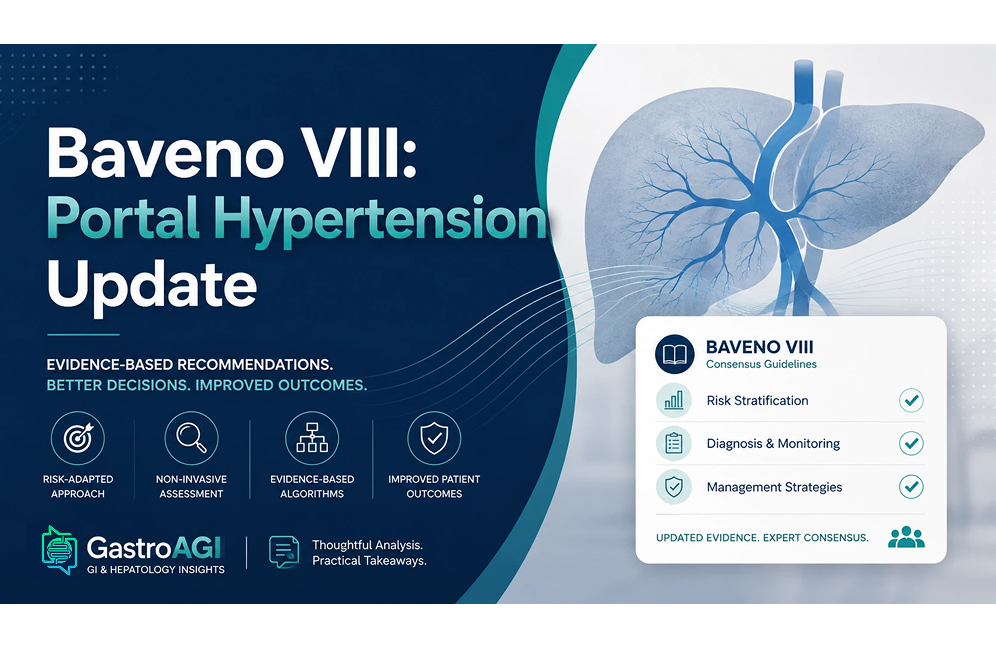
For hepatologists and gastroenterologists, one of the most consequential questions in advanced chronic liver disease is no longer simply whether portal hypertension is present. The harder question is: which patient is most likely to decompensate, and when should preventive care begin?
The Baveno VIII Consensus Conference places that question at the centre of modern portal hypertension care. Published as “Baveno VIII – Advancing Consensus in Portal Hypertension” in the Journal of Hepatology, the document updates guidance for patients with advanced chronic liver disease, portal hypertension, and vascular liver diseases. The consensus conference was held in March 2026 in Baveno, Italy, and the article was published online in August 2026, with PubMed listing the DOI as 10.1016/j.jhep.2026.07.030.
This is not a randomized trial, a meta-analysis, or a single guideline based on one disease entity. It is a structured expert consensus process, developed by the Baveno Cooperation in collaboration with the Vascular Liver Disease Interest Group, or VALDIG. The faculty reviewed evidence accrued since Baveno VII and voted on statements and recommendations across nine panels. Strong consensus was defined as agreement by more than 80% of the expert faculty. In total, 272 statements and recommendations reached strong consensus, and the document also proposes 153 research priorities.
For clinicians, the practical importance of Baveno VIII lies less in any single statement than in the direction of travel: portal hypertension management continues to move toward earlier risk stratification, greater use of non-invasive tests, prevention of first and further decompensation, and more structured thinking about recompensation and vascular liver disease.
Why portal hypertension guidance keeps evolving
Portal hypertension remains a defining driver of morbidity in advanced chronic liver disease. Variceal bleeding, ascites, hepatic encephalopathy, and other complications often determine prognosis, hospitalisation risk, and transplant evaluation. The Baveno series has shaped this field for more than three decades, beginning with earlier consensus meetings focused heavily on variceal bleeding and progressively expanding toward a stage-based, prevention-oriented framework.
Baveno VIII continues that evolution. The EASL summary explicitly notes that the field has shifted from the “mere treatment” of complications such as variceal bleeding toward prevention of decompensation. That shift is clinically important because patients with compensated advanced chronic liver disease may appear stable while carrying very different risks of progression. A framework that identifies higher-risk patients earlier can influence surveillance, pharmacological prevention, endoscopy decisions, monitoring frequency, and referral pathways.
However, Baveno VIII should not be read as a claim that every compensated patient requires escalation. A central promise of non-invasive risk stratification is precision in both directions: identifying patients who need earlier preventive intervention while avoiding unnecessary procedures or over-treatment in lower-risk groups.
What Baveno VIII investigated and how it was developed
The source article describes Baveno VIII as a consensus conference based on a structured process across nine panels addressing advanced chronic liver disease, vascular liver diseases, and complications related to portal hypertension. The panels covered non-invasive test-based risk stratification in compensated advanced chronic liver disease; modifiers of steatotic liver disease; prevention of first decompensation; prevention of further decompensation; portal hypertension-related gastrointestinal bleeding; management of further decompensation; cirrhosis recompensation; vascular liver diseases such as Budd–Chiari syndrome and portosinusoidal vascular disorder/non-cirrhotic portal fibrosis; and portal vein thrombosis in patients with and without underlying liver disease.
The article reports that each panel included two chairs and four to eight panelists, with proposed statements iteratively reviewed by the full Baveno faculty. The full faculty included 84 participants: chairs, panelists, and invited lecturers. Statements reaching at least 80% agreement were approved, and the recommendations were graded by level of evidence, strength of recommendation, and whether they were new, modified, or unchanged compared with Baveno VII.
This methodology matters because Baveno VIII is not merely an opinion piece. It is an evidence-informed consensus process. At the same time, consensus is not the same as direct comparative evidence. Some recommendations will necessarily rest on stronger data than others. Clinicians should therefore interpret Baveno VIII as a carefully structured synthesis of current expert agreement, not as proof that every recommendation has equivalent evidentiary certainty.
Non-invasive tests move further into the centre of care
One of the clearest signals from Baveno VIII is the continued centrality of non-invasive testing. The EASL summary states that updated guidance covers blood- and imaging-based tests, which continue to play a major role in identifying patients with compensated advanced chronic liver disease and clinically significant portal hypertension, with several diagnostic thresholds refined in light of new evidence.
This is highly relevant to everyday hepatology practice. In many settings, invasive haemodynamic testing is unavailable, impractical, or reserved for selected indications. Non-invasive tests offer a scalable way to stratify risk, guide surveillance intensity, and identify patients who may benefit from preventive strategies. The Baveno VIII abstract confirms that the key role of clinically significant portal hypertension and the expanding use of non-invasive tests were reaffirmed, while cutoffs were revised.
The important caveat is that the source summary does not provide all revised thresholds in the accessible EASL news text. Therefore, clinicians should consult the full Journal of Hepatology article before applying numerical cutoffs in local protocols. It would be inappropriate to infer specific threshold values from the news release alone.
The broader clinical message is still clear: non-invasive assessment is no longer peripheral. It is becoming a practical foundation for identifying compensated patients at meaningful risk and monitoring them over time.
From diagnosing CSPH to predicting first decompensation
Perhaps the most conceptually important update is the stated shift from estimating the probability of clinically significant portal hypertension alone toward directly identifying patients most likely to develop their first major complication. The EASL summary describes this as a move toward serial non-invasive monitoring so that screening and pharmacological preventive therapies can be initiated earlier and more effectively.
This distinction matters. CSPH is a critical disease stage, but the patient-centred event is often decompensation: ascites, bleeding, encephalopathy, or other complications that change prognosis and care trajectory. Baveno VIII appears to strengthen the idea that clinicians should not stop at classifying haemodynamic risk; they should use available tools to anticipate clinical transition.
For practice, this may encourage more deliberate longitudinal assessment. A single test result may be less informative than a trajectory interpreted alongside disease aetiology, treatment response, metabolic modifiers, and clinical status. Still, clinicians should be careful not to overstate prediction. Risk stratification estimates probability; it does not determine individual destiny. Baveno VIII supports earlier and more precise care, but it does not eliminate uncertainty.
Prevention becomes the organising principle
Baveno VIII’s emphasis on prevention is clinically intuitive but operationally challenging. The guidance addresses prevention of first decompensation and prevention of further decompensation in separate domains. This separation reflects two different clinical states. A patient with compensated advanced chronic liver disease and high risk of first decompensation is not the same as a patient who has already developed ascites or variceal bleeding.
The EASL summary notes that the recommendations are intended to clarify when preventive treatments should be started, adjusted, or stopped. That phrasing is important. Modern management is not simply about adding interventions. It requires reassessment, discontinuation when appropriate, and avoidance of unnecessary procedures in patients at lower risk.
For gastroenterologists and hepatologists, this reinforces a prevention-focused clinic workflow: identify advanced disease, estimate portal hypertension and decompensation risk, apply evidence-based preventive therapies where appropriate, monitor trajectory, and revisit decisions as the underlying liver disease evolves. The source does not justify broad claims that Baveno VIII will reduce mortality in all settings. Rather, it provides a consensus framework intended to support earlier and more precise intervention.
Portal hypertensive bleeding, ascites, TIPS, and nutrition: refinement rather than reinvention
The EASL summary identifies updated management of variceal bleeding, ascites, and other complications as another highlight. It specifically mentions refined recommendations covering resuscitation, blood transfusion thresholds, antibiotic use, endoscopic and pharmacological treatment, and criteria for transjugular intrahepatic portosystemic shunt placement in severe or recurrent complications. It also notes inclusion of nutritional assessment and management in patients with advanced chronic liver disease.
These domains are familiar, but their inclusion underscores a practical point: Baveno VIII is not only about compensated disease or non-invasive testing. It also addresses bedside decisions in decompensated patients. Variceal bleeding and ascites remain settings where small differences in timing, triage, resuscitation, endoscopic therapy, pharmacotherapy, antibiotics, and TIPS selection can meaningfully affect outcomes.
Again, the news source does not provide the detailed algorithms. Clinicians should avoid substituting a summary for the full consensus document. The GastroAGI interpretation is that Baveno VIII likely functions as both a conceptual update and a practical reference, but implementation should depend on the full article, local resources, endoscopy availability, interventional radiology expertise, and multidisciplinary hepatology pathways.
Recompensation: a useful but demanding concept
Baveno VIII also refines guidance on “recompensation,” described by EASL as criteria by which patients with decompensated cirrhosis who receive etiologic treatment of their underlying liver disease may be considered to have returned to a compensated stage with a considerably improved prognosis.
This is an important clinical concept. With effective antiviral therapy, alcohol abstinence, metabolic risk modification, and other aetiology-directed interventions, some patients improve after decompensation. Recognising recompensation may affect prognosis discussions, surveillance thinking, transplant timing, and intensity of follow-up.
But recompensation should not be treated casually. It is not the same as cure, and the source does not suggest that all prior risks disappear. A patient who improves after etiologic therapy may still require careful monitoring. Baveno VIII’s contribution is to refine criteria and language, helping clinicians discuss improvement in a more disciplined way rather than relying on vague impressions of “better liver function.”
The practical value is standardisation. If trials and clinics use clearer recompensation criteria, future evidence can become more comparable. That, in turn, may clarify which patients can safely de-escalate some interventions and which remain at substantial risk despite clinical improvement.
Vascular liver disease enters the broader portal hypertension conversation
Another notable feature is expanded coverage of vascular liver diseases. Led by VALDIG, Baveno VIII provides guidance on Budd–Chiari syndrome, portosinusoidal vascular disorder, also called non-cirrhotic portal fibrosis in some regions, and portal vein thrombosis. The EASL summary specifically mentions anticoagulation, pregnancy, and endovascular interventions.
This expansion is clinically welcome because vascular liver diseases often sit at the intersection of hepatology, haematology, radiology, obstetric medicine, and transplant care. These conditions can be diagnostically complex and may not fit neatly into cirrhosis-based algorithms. Bringing them into the Baveno VIII framework may encourage more consistent terminology, multidisciplinary decision-making, and research priorities.
The inclusion of portal vein thrombosis both in patients without underlying liver disease and in patients with advanced chronic liver disease is especially relevant. These are not equivalent populations. Risks and benefits of anticoagulation, bleeding risk assessment, portal hypertension severity, and procedural options can differ substantially. Baveno VIII’s structured approach may help clinicians avoid oversimplified decision-making.
Pediatric portal hypertension: first inclusion, cautious implementation
For the first time, pediatric hepatologists were included in some panels, and Baveno VIII includes statements related to pediatric liver disease and portal hypertension. This is a meaningful development. Pediatric portal hypertension has distinct aetiologies, physiology, procedural considerations, and long-term developmental implications.
However, first inclusion should not be mistaken for complete resolution of pediatric evidence gaps. The EASL summary itself highlights urgently needed pediatric liver disease research as part of the forward agenda. For clinicians, the value is recognition and formalisation; the limitation is that pediatric recommendations will likely require ongoing validation, adaptation, and specialist interpretation.
In practice, pediatric portal hypertension care should remain highly specialised and multidisciplinary. Baveno VIII provides a consensus foundation, not a replacement for pediatric hepatology expertise.
What clinicians should and should not conclude
Clinicians should conclude that Baveno VIII represents a major consensus update in portal hypertension, advanced chronic liver disease, and vascular liver disease. It reinforces non-invasive risk stratification, prevention of decompensation, refined management of portal hypertension-related complications, formal criteria for recompensation, expanded vascular liver disease guidance, and first pediatric statements. These conclusions are directly supported by the source article and EASL summary.
Clinicians should not conclude that every statement has equal evidentiary strength, that non-invasive tests are interchangeable across all populations, or that a news summary is sufficient to implement revised numerical thresholds. They should also avoid interpreting consensus guidance as causal evidence. Baveno VIII synthesises evidence and expert agreement; it does not itself test an intervention against a control group.
The most appropriate clinical response is careful adoption: read the full document, compare changes against existing local pathways, identify areas where practice is already aligned, and prioritise updates that affect patient selection, surveillance, prevention, acute bleeding management, TIPS referral, vascular liver disease pathways, and research protocols.
The research agenda may be as important as the recommendations
Baveno VIII proposes 153 priority research topics. That number is not incidental. It signals that even in a mature field, many clinically important questions remain unresolved.
The EASL summary highlights future directions including validation of artificial intelligence-based diagnostic tools, optimal anticoagulation strategies in vascular liver disease, and pediatric liver disease research. These are areas where practice is evolving but evidence remains incomplete. For researchers and fellows, Baveno VIII can therefore serve not only as clinical guidance but also as a map of unanswered questions.
For GastroAGI readers, this is the deeper message: the next phase of portal hypertension care will likely depend on better prediction models, serial non-invasive monitoring strategies, more precise preventive therapy selection, and stronger evidence in populations historically underrepresented in trials.
Clinical Takeaway
Baveno VIII is best understood as a prevention-oriented, risk-stratified update to portal hypertension and advanced chronic liver disease care. It confirms the expanding role of non-invasive tests, refines the focus from CSPH detection toward prediction of decompensation, updates management across key complications, formalises recompensation criteria, broadens vascular liver disease guidance, and introduces pediatric portal hypertension statements.
Its recommendations are clinically important but should be implemented with appropriate caution. This is a structured expert consensus, not a single interventional trial. The update should inform practice pathways, multidisciplinary discussion, and research design, while clinicians continue to distinguish risk prediction from certainty, association from causation, and consensus-based recommendations from definitive trial evidence.
For hepatologists, gastroenterologists, fellows, and researchers, Baveno VIII provides both a current clinical framework and a roadmap for the next generation of portal hypertension research.
Source reference: Baveno Cooperation and VALDIG. “Baveno VIII – Advancing Consensus in Portal Hypertension.” Journal of Hepatology. Published online August 2026. DOI: 10.1016/j.jhep.2026.07.030. EASL news release published August 25, 2026.
Five key clinical takeaways
Baveno VIII is a consensus guidance update, not an RCT or meta-analysis; its recommendations reflect structured evidence review and expert voting.
Non-invasive risk stratification is central, especially for compensated advanced chronic liver disease and clinically significant portal hypertension.
The clinical focus is shifting toward prediction and prevention of decompensation, rather than only identifying CSPH.
The guidance expands beyond variceal bleeding, covering ascites, further decompensation, TIPS criteria, nutrition, recompensation, vascular liver diseases, and pediatric portal hypertension.
Implementation requires reading the full consensus document, especially before applying revised thresholds or changing local protocols.
Source reference and link
Baveno Cooperation / VALDIG. “Baveno VIII – Advancing Consensus in Portal Hypertension.” Journal of Hepatology. Published online August 2026. DOI: 10.1016/j.jhep.2026.07.030. EASL news release: “Baveno VIII Consensus Conference provides updated guidance on advanced chronic liver disease, portal hypertension and vascular liver disease.”
References

We are pioneers in clinical intelligence, dedicated to helping gastroenterologists harness the power of artificial intelligence to drive precision, efficiency, and patient growth.