
Chronic Liver Disease and Earlier Cholangiocarcinoma Diagnosis: What the GLOBAL-BTC Registry Suggests
GLOBAL-BTC registry data link chronic liver disease with earlier cholangiocarcinoma diagnosis, more surgery, and better survival.


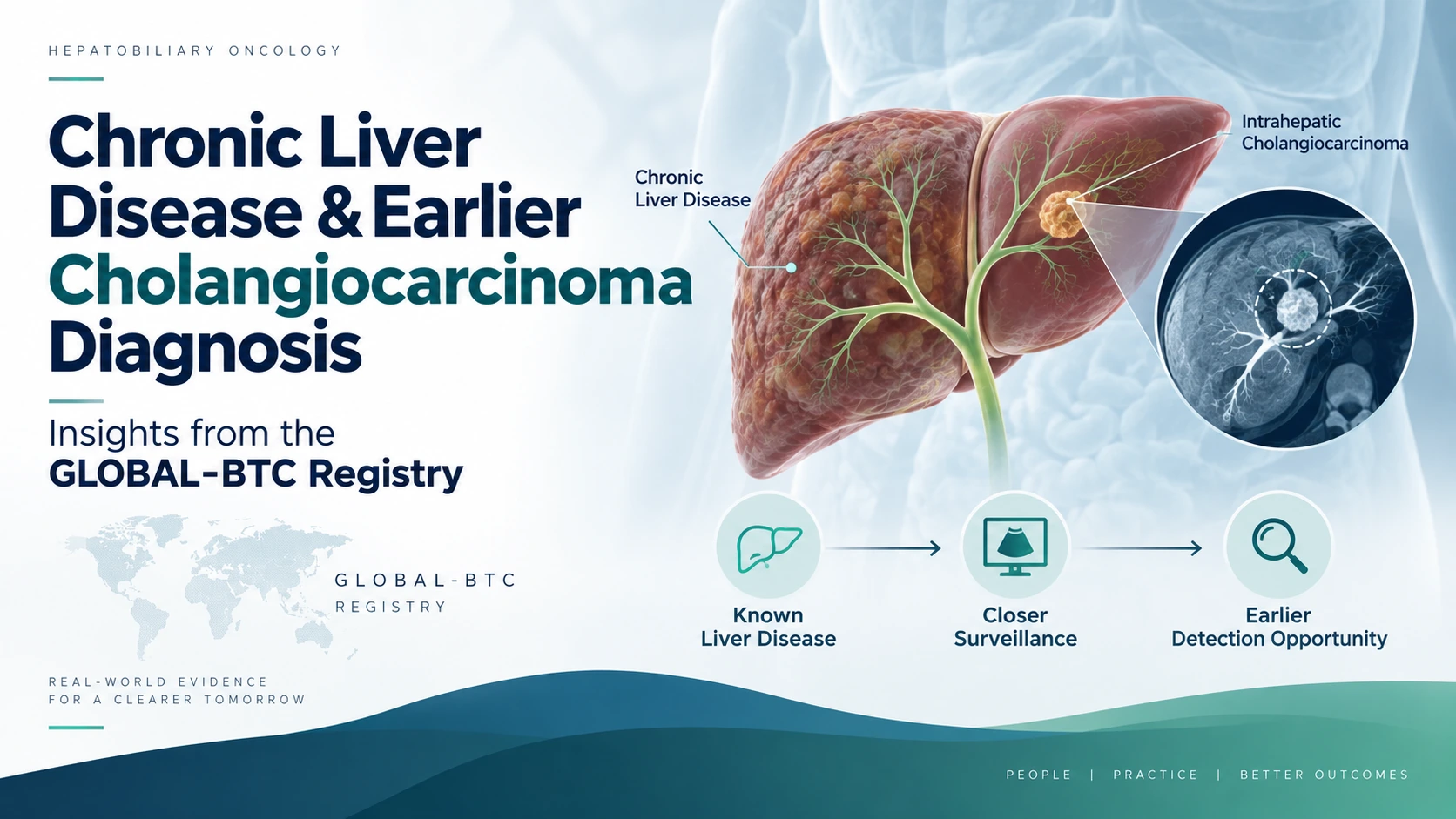
Chronic liver disease increases the risk of hepatobiliary malignancy. That part is familiar.
What is less obvious is what happens after cholangiocarcinoma develops.
A patient with cirrhosis, primary sclerosing cholangitis, viral hepatitis, or another chronic liver disorder may already be undergoing laboratory testing, cross-sectional imaging, specialist review, or structured surveillance. In theory, that creates an opportunity to detect a biliary tract cancer earlier than in someone with no known liver disease and no reason to be imaged.
The international GLOBAL-BTC registry asks whether that opportunity is visible in real-world outcomes.
The answer appears to be yes.
Patients with pre-existing chronic liver disease were diagnosed with cholangiocarcinoma at earlier stages, underwent curative-intent surgery more often, and had better survival than patients without documented chronic liver disease.
The tempting headline would be that chronic liver disease somehow confers a survival advantage in cholangiocarcinoma.
That would almost certainly be the wrong lesson.
The more clinically useful interpretation is that being known to hepatology may change when the cancer is found.
And in cholangiocarcinoma, timing matters.
A surveillance paradox in hepatobiliary oncology
Cholangiocarcinoma remains an aggressive malignancy in which stage at diagnosis strongly determines what can realistically be offered.
Localized disease may still leave a route toward curative-intent surgery.
Metastatic disease usually closes that door.
That makes the GLOBAL-BTC observation particularly interesting. Chronic liver disease is itself a risk state, yet patients carrying that risk may also have something that many patients without recognized liver disease do not have: repeated contact with the healthcare system.
Imaging gets ordered.
Liver biochemistry gets checked.
Subtle radiological changes may be noticed earlier.
Symptoms may be interpreted in a hepatobiliary context sooner.
The study does not directly prove that any one of these mechanisms explains the findings. But it provides a plausible framework for understanding why patients with chronic liver disease might present with less advanced cholangiocarcinoma despite being biologically predisposed to developing it.
That distinction matters because the message is not that chronic liver disease is protective.
It is not.
The more interesting possibility is that surveillance exposure modifies the stage at which risk becomes visible.
What GLOBAL-BTC actually compared
The analysis included 3,743 patients with cholangiocarcinoma diagnosed between 2010 and 2024 across international centers.
Of these:
993 had chronic liver disease
2,750 did not
Chronic liver disease was defined broadly and included primary sclerosing cholangitis, cirrhosis, viral hepatitis, and other chronic liver disorders.
The investigators compared demographics, clinical characteristics, biochemical features, stage at presentation, treatment, and survival between patients with and without pre-existing liver disease.
They also performed propensity score-matched analyses to examine whether the difference in stage at diagnosis persisted after balancing selected baseline factors.
That last point strengthens the analysis, but it does not make it a randomized experiment.
This remains a retrospective registry study.
The “exposure” was simply the presence of chronic liver disease before the cancer diagnosis.
There was no randomized surveillance strategy, no standardized imaging interval, and no assigned screening intervention.
So the study can show us a pattern.
It cannot prove what caused that pattern.
The chronic liver disease group looked different before treatment even began
The two groups differed in several important ways.
Patients with chronic liver disease were:
more often male: 67% versus 53%
slightly younger: median age 63 versus 66 years
more likely to have intrahepatic tumors: 64% versus 42%
more likely to have ECOG performance status 0: 53% versus 35%
and had lower CA19-9 levels: 56 versus 135 U/mL.
But the most important difference was stage.
Patients with chronic liver disease presented with localized disease in 57% of cases compared with 43% among patients without chronic liver disease.
Metastatic disease was less common: 23% versus 31%.
That is the clinical center of the paper.
Once stage shifts, much else shifts with it.
A patient diagnosed before metastatic spread is more likely to remain eligible for surgery. A patient diagnosed after dissemination has entered a very different treatment pathway.
So when survival subsequently differs between the groups, stage is not a peripheral finding.
It is probably central to the story.
Earlier-stage diagnosis persisted after propensity matching
A reasonable criticism is that the chronic liver disease cohort simply looked healthier, younger, or otherwise more favorable at baseline.
The investigators addressed this partly through propensity score matching.
After matching selected baseline characteristics, the association between pre-existing chronic liver disease and earlier-stage diagnosis persisted.
That makes the finding harder to dismiss as a simple demographic artifact.
But propensity matching has limits.
It can balance what has been measured.
It cannot balance what was never captured.
And in a question like this, several potentially important variables are exactly the kind that registries struggle to measure consistently:
how often patients underwent imaging,
whether they were enrolled in structured surveillance programs,
how easily they accessed hepatology or tertiary care,
how quickly abnormal imaging was escalated,
regional differences in referral pathways,
socioeconomic factors,
or whether the threshold for investigating cholestatic symptoms differed in patients already known to have liver disease.
In other words, propensity matching strengthens confidence in the association.
It does not tell us that chronic liver disease itself produced earlier cancer biology.
More early-stage disease meant more curative-intent surgery
The treatment data fit the stage findings closely.
Curative-intent tumor surgery was performed in 60% of patients with chronic liver disease compared with 48% of those without.
That is clinically coherent.
If patients are diagnosed earlier, more remain operable.
And once more patients undergo potentially curative treatment, survival differences become easier to understand.
Median overall survival was:
12.2 months in patients with chronic liver disease
11.1 months in patients without
with a hazard ratio of 0.88 (95% CI 0.80–0.98).
Five-year survival also favored the chronic liver disease group, with an odds ratio of 1.70 (95% CI 1.37–2.11).
The survival difference is statistically meaningful, but the absolute median survival difference is not enormous.
That is useful perspective.
The more important signal may be the entire pathway:
closer clinical contact → earlier-stage diagnosis → greater surgical eligibility → improved survival distribution.
The study cannot prove that sequence mechanistically, but it fits the observed data better than the idea that chronic liver disease somehow makes cholangiocarcinoma biologically more favorable.
Intrahepatic cholangiocarcinoma showed the strongest signal
The survival difference was particularly notable among patients with intrahepatic cholangiocarcinoma.
Median overall survival was:
14.2 months with chronic liver disease
11.1 months without chronic liver disease
with a hazard ratio of 0.77 (95% CI 0.68–0.87).
Five-year survival also favored the chronic liver disease group, with an odds ratio of 2.19 (95% CI 1.60–3.01).
That subgroup deserves attention because intrahepatic tumors may be particularly likely to be found incidentally or semi-incidentally during liver imaging performed for other reasons.
A surveillance scan ordered for cirrhosis or another chronic liver condition may identify a lesion before symptoms develop.
Again, that is plausible.
It is not demonstrated causally by the registry.
But from a hepatology perspective, it is exactly the kind of finding that should make us think about the downstream value of structured longitudinal liver care.
Treatment sensitivity did not appear fundamentally different
One of the most useful findings in the analysis is what did not differ.
Treatment responses across modalities were reported as comparable between patients with and without chronic liver disease.
This helps narrow the interpretation.
If survival were better because tumors arising in chronic liver disease were intrinsically more treatment-sensitive, one might expect response differences.
Instead, the stronger signal sits upstream.
Patients with chronic liver disease appeared to arrive at treatment with more favorable stage distribution and greater access to surgery.
That points away from “better tumor biology” and toward “better timing of diagnosis.”
It is a subtle distinction, but an important one.
The study is really about the value of being visible to the system
For hepatologists, the most interesting implication may not be oncological at all.
It may be organizational.
Patients with established liver disease tend to be visible.
They come back.
They have tests.
They are discussed in multidisciplinary meetings.
They appear on surveillance lists.
Radiologists have prior scans for comparison.
Changes are more likely to be interpreted within the context of hepatobiliary risk.
A patient without chronic liver disease may have none of those advantages.
Their cholangiocarcinoma may first announce itself through jaundice, pain, weight loss, biliary obstruction, or metastatic disease.
By then, the stage has already done much of the prognostic work.
GLOBAL-BTC therefore raises a broader question: can the early-detection advantage that appears to accompany chronic liver disease follow-up be reproduced deliberately in populations where risk is high enough to justify surveillance?
That is where the study becomes potentially practice-shaping—not because it establishes a new protocol, but because it identifies a signal worth testing prospectively.
This is not a universal argument for cholangiocarcinoma screening
The chronic liver disease category in this analysis is broad.
It includes PSC, cirrhosis, viral hepatitis, and other chronic liver disorders.
Those conditions do not carry identical cholangiocarcinoma risk.
They do not have identical surveillance practices.
And they should not automatically be treated as a single screening population.
A finding generated across a heterogeneous chronic liver disease cohort cannot by itself answer:
who should undergo surveillance,
which modality should be used,
how often imaging should occur,
whether biomarkers add value,
what false-positive burden is acceptable,
or whether surveillance is cost-effective.
The registry supports the concept of structured surveillance research.
It does not establish a one-size-fits-all surveillance program.
That boundary should remain very clear.
Lead-time bias remains a real concern
Earlier diagnosis always brings the problem of lead-time bias.
If a cancer is found six months earlier but the patient's date of death is unchanged, measured survival from the time of diagnosis appears six months longer even though nothing biologically improved.
That possibility cannot be fully excluded here.
The higher rate of curative-intent surgery is encouraging because it suggests earlier detection may have altered treatment opportunity rather than simply shifting the diagnostic clock.
But the registry cannot completely separate:
true survival benefit,
lead-time effects,
length-time bias,
surveillance intensity,
and differences in access to specialist care.
This is why the paper should be read as hypothesis-strengthening rather than practice-defining.
Access to hepatology may itself be part of the exposure
Another possibility is that chronic liver disease functions partly as a marker of healthcare access.
A patient already followed in hepatology may be closer to imaging, tertiary referral, surgical assessment, oncology, and multidisciplinary decision-making.
That could influence outcomes independently of surveillance.
Conversely, advanced liver dysfunction might sometimes reduce eligibility for aggressive treatment.
The net effect is therefore complex and may differ substantially by region, liver disease subtype, health system, and center expertise.
That complexity is difficult to fully capture in a registry spanning 2010 to 2024, a period during which imaging quality, systemic therapy, surgical selection, molecular profiling, and multidisciplinary hepatobiliary care all evolved.
What the study should change today
It should probably not change a surveillance protocol tomorrow morning.
But it should change how we think about the opportunity.
For hepatologists, the study reinforces vigilance for cholangiocarcinoma in high-risk liver disease populations.
For GI oncologists and hepatobiliary surgeons, it highlights how much of cancer outcome may be determined before the patient reaches oncology.
And for multidisciplinary teams, it is a reminder that early cancer detection is often not a single test.
It is a system.
Patients who remain longitudinally connected to liver care may benefit from repeated opportunities for disease to be noticed before it becomes unresectable.
That may be the most clinically useful message from GLOBAL-BTC.
What comes next
The next research step is not another registry showing the same association.
It is prospective work asking whether structured surveillance actually improves meaningful outcomes.
Future studies need to determine:
which chronic liver disease groups have sufficient risk to justify surveillance,
which combination of imaging and biomarkers performs best,
what interval offers the right balance between detection and burden,
whether surveillance meaningfully increases curative-intent treatment,
and whether earlier detection translates into lower disease-specific mortality rather than simply longer measured survival from diagnosis.
Subgroup-specific evidence will also matter.
PSC should not automatically be treated the same as cirrhosis.
Viral hepatitis should not automatically be treated the same as another chronic cholestatic disorder.
The registry gives us a broad signal.
The next generation of studies needs to tell us where that signal is clinically actionable.

Clinical Takeaway
The GLOBAL-BTC registry suggests that patients with pre-existing chronic liver disease who develop cholangiocarcinoma are diagnosed at earlier stages, undergo curative-intent surgery more often, and have better survival than patients without documented chronic liver disease. The association was especially notable in intrahepatic cholangiocarcinoma.
The most plausible interpretation is not that chronic liver disease improves tumor biology.
It is that patients already embedded in hepatology care may have more opportunities for earlier detection.
That is clinically important because stage determines treatment opportunity.
For now, the study strengthens the rationale for better-defined surveillance research in high-risk chronic liver disease populations. It does not establish a universal cholangiocarcinoma screening protocol, prove that surveillance caused the survival difference, or justify extrapolating the same strategy across all forms of chronic liver disease.
Source:
Chronic liver disease is associated with earlier-stage cholangiocarcinoma diagnosis and improved prognosis: Findings from the GLOBAL-BTC registry. Journal of Hepatology. Published online August 24, 2026. DOI: 10.1016/j.jhep.2026.08.020.
References

We are pioneers in clinical intelligence, dedicated to helping gastroenterologists harness the power of artificial intelligence to drive precision, efficiency, and patient growth.